NCERT Book Class 8 Geography Resource and Development Mineral and Power Resources

Get the free Resources and Development Chapter 3 Mineral and Power Resources PDF right now! It comes straight from the official NCERT Book for Class 8 Social Science. Updated for the 2026-27 session, you can read or download this full book easily.

NCERT Class 8 Social Science Resources and Development Chapter 3 Mineral and Power Resources

This part of NCERT Book Class 8 Geography Resource and Development Mineral and Power Resources helps you learn Class 8 Social Science step by step. Read the text to understand everything. You can also match your answers using the NCERT Solutions for Class 8 Social Science.

Resources and Development Chapter 3 Mineral and Power Resources NCERT Book Class 8 PDF (2026-27)

Kiri was visiting Sukant in his native place near Dhanbad. Kiri was amazed to see that large areas were black. “Sukant, why is this place so black and dusty?” she asked. “This is because of the coal mines nearby. Do you see the trucks? They are carrying the mineral coal”, replied Sukant.
“What are minerals?,” asked Kiri. Sukant replied, “Have you ever seen a baker baking biscuits? The flour, milk, sugar and sometimes eggs are mixed together. While eating the baked biscuits can you see these ingredients separately? Just as in the biscuits, there are a number of things that you cannot see, rocks on this earth have several materials called minerals mixed in them. These minerals are scattered throughout the earth’s rocky crust”.
A naturally occurring substance that has a definite chemical composition is a mineral. Minerals are not evenly distributed over space. They are concentrated in a particular area or rock formations. Some minerals are found in areas which are not easily accessible such as the Arctic ocean bed and Antarctica.
Minerals are formed in different types of geological environments, under varying conditions. They are created by natural processes without any human interference. They can be identified on the basis of their physical properties such as colour, density, hardness and chemical property such as solubility.


Types of Minerals
 
 
NCERT Class 8 Geography Resource and Developmernt Mineral and Power Resources
 
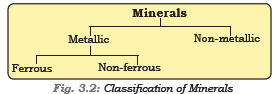
There are over three thousand different minerals. On the basis of composition, minerals are classified mainly as metallic and non-metallic minerals (Fig. 3.2).
 
 
Metallic minerals contain metal in raw form. Metals are hard substances that conduct heat and electricity and have a characteristic lustre or shine. Iron ore, bauxite, manganese ore are some examples. Metallic minerals may be fer rous or non-ferrous. Ferrous minerals like iron ore, manganese and chromites contain iron. A non-ferrous mineral does not contain iron but may contain some other metal such as gold, silver, copper or lead.
Non-metallic minerals do not contain metals. Limestone, mica and gypsum are examples of such minerals. The mineral fuels like coal and petroleum are also non-metallic minerals.


Click on the below link to download NCERT Class 8 Geography Resource and Developmernt Mineral and Power Resources

Download NCERT E-Textbook: Class 8 Social Science Resources and Development Chapter 3 Mineral and Power Resources

Download Textbook: Resources and Development Chapter 3 Mineral and Power Resources (Class 8 Social Science)

Download the certified NCERT Textbook for Class 8 Social Science Resources and Development Chapter 3 Mineral and Power Resources tailored for this academic term. Educational authorities and instructors recommend the Resources and Development Chapter 3 Mineral and Power Resources e-textbook as exam frameworks for Class 8 rely completely on its core syllabus. Grab the full chapter download in standard PDF format directly from this section.

Complete Chapter E-Books for Class 8 Social Science

Access a full archive of NCERT books in English Medium tailored for Class 8 courses. Essential for English-medium students, modules like Resources and Development Chapter 3 Mineral and Power Resources deliver in-depth concepts and thorough review questions at the section close. Simply select the provided links to secure your free Social Science textbook PDF and begin learning immediately.

Key Advantages of NCERT Digital Books

The Class 8 Social Science Resources and Development Chapter 3 Mineral and Power Resources book is designed to provide a strong conceptual understanding. Students should also access NCERT Solutions and revision notes on our platform to enhance their learning experience.

FAQs

Where can I download the latest NCERT Book Class 8 Geography Resource and Development Mineral and Power Resources in PDF for 2026-27?

You can download the latest, teacher-verified PDF for NCERT Book Class 8 Geography Resource and Development Mineral and Power Resources for free on StudiesToday.com. These digital editions are updated as per 2026-27 session and are optimized for mobile reading.

Does this Social Science book follow the latest NCERT rationalized syllabus?

Yes, our collection of Class 8 Social Science NCERT books follow the 2026 rationalization guidelines. All deleted chapters have been removed and has latest content for you to study.

Why is it better to download NCERT Book Class 8 Geography Resource and Development Mineral and Power Resources chapter-wise?

Downloading chapter-wise PDFs for Class 8 Social Science allows for faster access, saves storage space, and makes it easier to focus in 2026 on specific topics during revision.

Are these NCERT books for Class 8 Social Science sufficient for scoring 100%?

NCERT books are the main source for NCERT exams. By reading NCERT Book Class 8 Geography Resource and Development Mineral and Power Resources line-by-line and practicing its questions, students build strong understanding to get full marks in Social Science.