
NCERT Book Class 8 Geography Resource and Development Land Soil Water Natural Vegetation and Wildlife

Official NCERT Book for Class 8 Social Science: Resources and Development Chapter 02 Land Soil Water Natural Vegetation and Wildlife Resources

Explore the complete NCERT textbook for Class 8 Social Science. Tailored for the 2026-27 curriculum, this resource breaks down complex topics to help students prepare effectively for school examinations.

Chapter-wise Study Material: Resources and Development Chapter 02 Land Soil Water Natural Vegetation and Wildlife Resources

Navigate directly to the Resources and Development Chapter 02 Land Soil Water Natural Vegetation and Wildlife Resources section using the digital viewer below. Organizing your study sessions chapter-by-chapter allows for seamless offline review. Be sure to utilize the accompanying NCERT Solutions to verify your textbook answers.
In a small village in Tanzania, Africa, Mamba gets up very early in the morning to fetch water. She has to walk a long way and returns after a few hours. She then helps her mother in the house and joins her brothers in taking care of their goats. All her family owns is a piece of rocky land around their small hut. Mamba’s father can barely grow some maize and beans on it after toiling hard. This is not enough to feed their family for the whole year.
 
Peter lives in the heart of the sheep rearing region in New Zealand where his family runs a wool processing factory. Everyday when he returns from school, Peter watches his uncle taking care of their sheep. Their sheep yard is situated on a wide grassy plain with hills in the far distance. It is managed in a scientific way using the latest technology. Peter’s family also grows vegetables through organic farming.
 
Mamba and Peter stay in two different parts of the world and lead very different lives. This difference is because of the differences in the quality of land, soil, water, natural vegetation, animals and the usage of technology. The availability of such resources is the main reason places differ from each other.
 
Land
 
Land is among the most important natural resources. It covers only about thirty per cent of the total area of the earth’s surface and all parts of this small percentage are not habitable.
The uneven distribution of population in different parts of the world is mainly due to varied characteristics of land and climate. The rugged topography, steep slopes of the mountains, low-lying areas susceptible to water logging, desert areas, thick forested areas are normally sparsely populated or uninhabited. Plains and river valleys offer suitable land for agriculture. Hence, these are the densely populated areas of the world.
 
NCERT Class 8 Geography Resource and Developmernt Land Soil Water Natural Vegetation and Wildlife
 
LAND USE
 
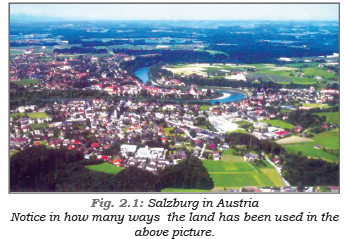
Land is used for different purposes such as agriculture, forestry, mining, building houses, roads and setting up of industries. This is commonly termed as Land  use. Can you list out the different ways in which Mamba's and Peter's family use their land?
 
The use of land is determined by physical factors such as topography, soil, climate, minerals and availability of water. Human factors such as population and technology are also important determinants of land use pattern.


Click on the below link to download NCERT Class 8 Geography Resource and Developmernt Land Soil Water Natural Vegetation and Wildlife

Official NCERT Textbook PDF: Class 8 Social Science Resources and Development Chapter 02 Land Soil Water Natural Vegetation and Wildlife Resources

Download Textbook: Resources and Development Chapter 02 Land Soil Water Natural Vegetation and Wildlife Resources (Class 8 Social Science)

Secure your copy of the NCERT Textbook for Class 8 Social Science Resources and Development Chapter 02 Land Soil Water Natural Vegetation and Wildlife Resources. Widely adopted across educational institutions, final question papers map directly to the framework outlined in this chapter.

Complete Chapter E-Books for Class 8 Social Science

Explore our exhaustive library of NCERT books in English Medium spanning all subjects in Class 8. Every chapter features comprehensive explanations followed by extensive end-of-chapter exercises.

Maximize Conceptual Clarity with NCERT E-Books

Built to foster deep conceptual mastery, this manual serves as an ideal study tool. Complement your textbook reading by exploring our professional NCERT Solutions and revision notes online.

FAQs

Where can I download the latest NCERT Book Class 8 Geography Resource and Development Land Soil Water Natural Vegetation and Wildlife in PDF for 2026-27?

You can download the latest, teacher-verified PDF for NCERT Book Class 8 Geography Resource and Development Land Soil Water Natural Vegetation and Wildlife for free on StudiesToday.com. These digital editions are updated as per 2026-27 session and are optimized for mobile reading.

Does this Social Science book follow the latest NCERT rationalized syllabus?

Yes, our collection of Class 8 Social Science NCERT books follow the 2026 rationalization guidelines. All deleted chapters have been removed and has latest content for you to study.

Why is it better to download NCERT Book Class 8 Geography Resource and Development Land Soil Water Natural Vegetation and Wildlife chapter-wise?

Downloading chapter-wise PDFs for Class 8 Social Science allows for faster access, saves storage space, and makes it easier to focus in 2026 on specific topics during revision.

Are these NCERT books for Class 8 Social Science sufficient for scoring 100%?

NCERT books are the main source for NCERT exams. By reading NCERT Book Class 8 Geography Resource and Development Land Soil Water Natural Vegetation and Wildlife line-by-line and practicing its questions, students build strong understanding to get full marks in Social Science.