

Official CBSE Study Materials for Class 10 Social Science
Access comprehensive study materials and useful resources for Minds Map using the Minds Map Class 10 Social Science Democratic Politics. Designed to align with the 2026-27 CBSE academic guidelines, these advanced resources help Class 10 Social Science students reinforce core concepts beyond standard textbooks.
Advanced Resources for Social Science
Access the complete useful resource PDF for Class 10 Social Science below. Regular practice with these targeted academic notes builds familiarity with complex topics and helps secure higher marks in final school evaluations.
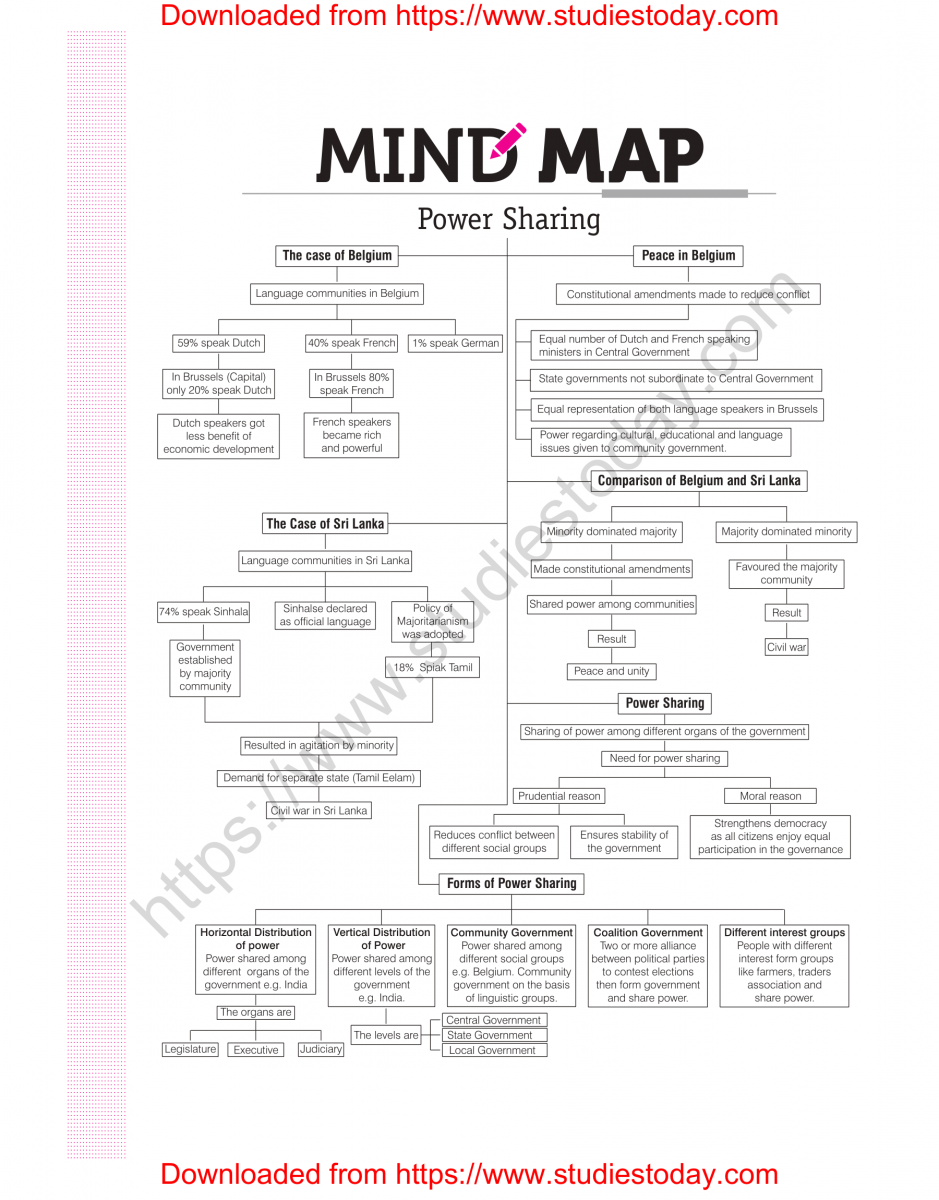
These Class 10 Social Science mind maps for Democratic Politics summarise the key ideas of the course in one place. This notes page covers power sharing with the case of Belgium and Sri Lanka, federalism and its practice in India, democracy and diversity, gender, religion and caste, political parties and party systems, the outcomes of democracy, and the challenges to democracy along with suggested political reforms.
Topics Covered
1. Power Sharing
2. Federalism
3. Democracy and Diversity
4. Gender, Religion and Caste
5. Political Parties
6. Outcomes of Democracy
7. Challenges to Democracy
POWER SHARING
The Case of Belgium
Language communities in Belgium: 59% speak Dutch, 40% speak French and 1% speak German.
In Brussels (Capital), 80% speak French and only 20% speak Dutch.
Dutch speakers got less benefit of economic development.
French speakers became rich and powerful.
Peace in Belgium
Constitutional amendments were made to reduce conflict:
Equal number of Dutch and French speaking ministers in the Central Government.
State governments are not subordinate to the Central Government.
Equal representation of both language speakers in Brussels.
Power regarding cultural, educational and language issues is given to community governments.
The Case of Sri Lanka
Language communities in Sri Lanka: 74% speak Sinhala and 18% speak Tamil.
Sinhalese was declared the official language, and a policy of majoritarianism was adopted.
The government was established by the majority community.
This resulted in agitation by the minority and a demand for a separate state (Tamil Eelam).
This led to a civil war in Sri Lanka.
Comparison of Belgium and Sri Lanka
In Belgium, the minority was dominated by the majority, but constitutional amendments were made and power was shared among communities, which resulted in peace and unity.
In Sri Lanka, the majority dominated the minority. The policy favoured the majority community, which resulted in civil war.
Power Sharing
Power sharing means sharing of power among different organs of the government.
Need for power sharing:
Prudential reason: It reduces conflict between different social groups and ensures the stability of the government.
Moral reason: It strengthens democracy, as all citizens enjoy equal participation in governance.
Forms of Power Sharing
1. Horizontal distribution of power: Power is shared among different organs of the government, such as the Legislature, Executive and Judiciary. Example: India.
2. Vertical distribution of power: Power is shared among different levels of government, which are the Central Government, State Government and Local Government. Example: India.
3. Community government: Power is shared among different social groups. Example: Belgium, where the community government is based on linguistic groups.
4. Coalition government: Two or more alliances between political parties contest elections, then form the government and share power.
5. Different interest groups: People with different interests, such as farmers, traders, associations and interest groups, form groups and share power.
FEDERALISM
Concept of Federalism
Federalism is a system of government where power is divided between the centre and the states or provinces.
Features of Federalism
1. There are two or more levels of government.
2. Each level of government has its own jurisdiction.
3. The authority of each level is guaranteed by the constitution.
4. Fundamental provisions cannot be changed by one level of government alone.
5. Courts settle disputes between different levels of government.
6. The revenue sources of each level of government are clearly stated.
Formation of Federations
Federations are formed in two ways:
Coming together federations: States come together to form a bigger unit and share equal power. Example: U.S.A.
Holding together federations: The Centre is more powerful than the states. Example: India.
Federalism in India
India has a three-tier system of government:
Central/Union Government: It represents the Union of India.
State Government: It represents all the states in India.
Local Government: Panchayats and municipalities. It represents the local form of administration in India.
Union Territories: Delhi, Chandigarh, etc.
Distribution of Legislative Powers
Union List: Includes subjects of national importance, such as defence, foreign affairs and banking.
State List: Includes subjects of state and local importance, such as police, trade, commerce and agriculture.
Concurrent List: Includes subjects of common interest, such as education, forest, marriage and trade unions.
Residuary List: Includes subjects that do not fall in any of the above categories, for example, computers.
Practice of Federalism in India
Linguistic States: States are divided on the basis of languages in India, for example, Maharashtra, Punjab and Haryana.
Language Policy: Hindi is the national language, and there are 22 other languages recognised by the Constitution. States are allowed to do all government work in their state language.
Centre-State Relations: Formation of regional parties and major alliances to form coalition governments.
Linguistic Diversity: To honour the linguistic diversity of India, the Constitution has declared 22 languages as Scheduled languages, and the remaining languages as non-scheduled languages.
Decentralisation in India
Division of powers in the vertical direction.
Power is given to state and local governments.
Local governments are given authority and importance, and they take local decisions.
Representation of women is increased in local government (one-third).
Rural local government is known as Panchayati Raj.
DEMOCRACY AND DIVERSITY
Democracy
Democracy sees people as one, without any discrimination.
Social Difference
Social difference is a difference on the basis of physical appearance, caste, religion, gender and other differences.
Outcome of Social Difference
Positive: Equality in some cases. Some countries are able to manage social differences in spite of diversity, for example, Belgium.
Social inequality: Social differences become deeper and lead to social inequality, like Blacks in the US and lower castes in India, who are generally poor.
Social division: When social differences become more prominent in society, leading to a wide gap.
Types of Social Division
Overlapping social division: When social differences become more important and other differences get added to them, thereby dividing communities, for example, Blacks in the US and Dalits in India.
Cross-cutting social division: When social differences cross-cut each other, thereby weakening the differences, for example, Catholics and Protestants in the Netherlands.
Origin of Social Differences
By birth: Physical appearance (skin colour), gender, caste and community. For example, the difference on the basis of skin colour divided the US into Blacks and whites. Afro-American athletes stood in protest at the Mexico Olympics, which symbolised Black power and led to the Civil Rights Movement in the US.
By choice: Course of study, choice to follow a religion, occupation, choice to choose a game or cultural activity, and migration. Differences by choice can create social divisions even in a homogeneous society, for example, Northern Ireland, where politics led to greater social divisions.
Politics of Social Division
In a democracy, political parties compete against each other. Competition tends to divide society further. Politics deepens social divisions. Parties compete on the basis of divisions. This leads to conflicts and violence, and even to the disintegration of society. For example, Yugoslavia disintegrated into six countries.
Outcome of the Politics of Social Division
Three determinants:
Perception about identities: When people see their identity as separate from their nation, it leads to disintegration. When people relate their identity with the national identity, social divisions do not divide the country. For example, India and Belgium.
Role of political leaders: When leaders' demands are within the Constitution, they can be accommodated. Otherwise, unconstitutional demands, disintegration or majoritarian politics take place.
Attitude of the government: If the government protects the interests of minorities, there is peace in the country. Otherwise, acts of violence, agitation and civil war take place.
GENDER, RELIGION AND CASTE
Basis of Social Differences
Gender, religion and caste are the three bases of social differences.
Gender
Gender is a biological difference between males and females. Gender division is a social division under which unequal roles are assigned.
Roles:
Males: Earning and all the work outside home. As a result, men become more powerful, enjoying greater freedom and social respect.
Females: Household work, cooking, and taking care of children. As a result, women have a minimum role in public life, are confined to home and have no freedom. This led to protest for equal rights, movements demanding equality of women, feminist movements and demands for political representation.
Women's Status in India
Status in society: Indian women have low respect in society due to a patriarchal society.
Literacy rate: The female literacy rate in India is 65.4%.
Unpaid work: Women work more than one hour more than men, but they are not paid for household work.
Wage difference: In spite of the Equal Remuneration Act, 1976, women workers get less pay than men for equal work.
Child sex ratio: Due to the preference for male children, the child sex ratio is not equal.
Violence against women: Exploitation, harassment and violence against women have increased in urban areas.
Political representation: The proportion of women in the legislature is low.
Religious Division
Division of society on the basis of religion. The relation between religion and politics converts into discrimination and oppression of minorities. It also leads to communal riots.
Communalism
Communalism is when one community tries to promote itself at the cost of the other.
Communal politics means using religion in politics to gain dominance. Forms of communalism in politics:
Religious beliefs in the superiority of one's religion.
When in majority, following majoritarianism. When in minority, forming a separate political unit.
Use of sacred symbols, religious leaders and emotional appeals in politics.
Communal violence, riots and massacres between different communities.
India as a Secular State
No official religion of the country.
People have the freedom to practise, follow and propagate their religion.
No discrimination on the basis of religion anywhere.
State intervention is permitted to ensure equality within religious communities.
Caste
Caste inequalities create social division. In India, untouchability is an extreme form of casteism. The government has prohibited untouchability. Urbanisation and occupational mobility have reduced the caste hierarchy.
Caste in Politics
Caste in politics means using caste to gain dominance.
Negative aspect: Parties choose candidates according to the caste composition of the electorate. Parties favour a particular caste to gain support.
Positive aspect: Lower caste people enjoy voting rights now. Everyone gets a fair chance to contest in the elections.
Politics in Caste
Politics in caste means the influence of politics on caste. Each caste tries to gather more subcastes to increase its number. One caste may make an alliance with other castes to gain political support. A new kind of caste group, such as the backward caste, has emerged.
POLITICAL PARTIES
Political Parties
A political party is a group of people who come together to contest elections. Political parties consist of leaders, active members and followers.
Functions of Political Parties
1. They choose candidates to contest elections.
2. They announce programmes and policies that they will do if chosen.
3. They play an important role in making laws for the country.
4. The majority party forms and runs the government.
5. As the opposition party, they check the working of the ruling party (the government).
6. They highlight various issues, thus forming public opinion.
7. They provide better access to common people, as they have a greater presence.
Political Party Systems
Types:
One-party system: Only one party controls and runs the government. Example: China.
Two-party system: Two parties contest the elections. Example: UK and US.
Multi-party system: More than two parties contest the elections. Example: India.
Coalition of parties: When no one party is in majority, it forms an alliance with other parties to form the government.
Types of Political Parties
National parties: A party that secures a minimum of 6% vote in Lok Sabha elections or wins 4 seats in the Lok Sabha, and in assembly elections in 4 states. A national party has a unique party symbol. Examples: Indian National Congress (founded in 1885), Bharatiya Janata Party (founded in 1980), Bahujan Samaj Party (founded in 1984), Communist Party of India (founded in 1925), Communist Party of India (Marxist) (founded in 1964) and Nationalist Congress Party (founded in 1999).
State parties: A party that secures a minimum of 6% vote in the Legislative Assembly and wins at least 2 seats in it.
Regional Parties and State Parties
Regional parties with national presence: Parties active in a state, having national-level political organisation. Examples: Samajwadi Party and Rashtriya Janata Dal.
Regional parties: Parties active in a certain state and confined to their state identity. Examples: Biju Janata Dal and Sikkim Democratic Front.
Challenges to Parties
Lack of democracy within the party: There are no internal elections, and power is concentrated in the hands of a few leaders only.
Topmost positions are controlled by a family. Party leaders favour family members and friends. Ordinary workers cannot rise to the top.
Using money and muscle power: Parties nominate candidates who can raise money. Parties support criminals who can use power to win elections. Genuine and honest candidates are sidelined.
Parties have similar policies and ideologies. Due to this, people do not have a meaningful choice.
Reformation of Parties
Steps taken:
Anti-defection law: No MLA or MP is allowed to change party after the elections.
File an affidavit: Mandatory for every candidate to give details about property and criminal cases.
Income tax return: Order passed by the Election Commission to file an income tax return by every party.
Have a unique party symbol.
Suggestions:
Regulating the internal affairs of the parties.
Party tickets should be given to women candidates also (one-third).
Government should provide money support for election expenses to the parties.
OUTCOMES OF DEMOCRACY
Democracy
Democracy is the power of the people to choose their government.
Democracy is better than other forms of government due to:
Promotes equality among people. Facilitates better decision-making. Provides a peaceful way to resolve conflicts. Provides for correcting mistakes. Improves the self-respect of people.
Outcomes or expectations from democracy
Political Outcome
Political expectations from a democratic government:
Accountability: Answerable for the actions taken by the government to its people.
Responsive: The government is responsible for all the decisions taken.
Transparency: Citizens are able to examine all the actions and decisions taken by the government.
Decision-making: Involves the citizens in decision-making wherever applicable.
Political outcome ensures:
Regular, free and fair elections.
Public debate on major policies.
Lawful (legitimate) government, with law equal for everyone.
Government attentive to the needs of the people.
Economic Outcome
Economic expectations from a democratic government:
Economic growth and development: Democracy is expected to bring growth and all-round economic development. However, some dictatorship countries show better economic growth.
Reduction of inequality and poverty: It ensures equality among all classes of society. However, many democratic countries have large inequalities of income.
Economic outcome ensures:
Cooperation from other countries.
Equal distribution of income and wealth.
Government keenly takes up the problem of poverty.
Social Outcome
Expectations from the democratic government on social issues:
Accommodation of social diversity: Proper handling of social differences, divisions and conflicts.
Dignity and freedom of people: Respect and freedom of every individual living in the country.
Equal treatment of women: Equal treatment of women in society and treating them with respect.
Equal status of all castes: Respect and equal position in society to the backward classes.
Social outcome ensures:
Democracy represents both majority and minority.
No rule or discrimination on the basis of religion, race or linguistic groups.
In elections, any group or person can come as majority.
CHALLENGES TO DEMOCRACY
Challenge
A challenge is a difficulty that can be overcome. Challenges in democracy are the difficulties in the path of democracy.
Three types of challenges
Foundational challenge: The challenge to form a democratic government. This is done by bringing down non-democratic rule, not taking any military help and establishing a democratic country peacefully. Example: the foundation of democracy in Nepal.
Challenge of expansion: Democracy across all regions, groups and communities. This is done by ensuring greater power to local governments, strengthening backward classes, giving equal status to women in society, and making no distinction on the basis of caste or race. Example: the expansionary challenge faced in India and the US.
Deepening of democracy: Strengthening democracy by ensuring more participation of people in democracy, reducing the control of the rich and influential, ensuring equal participation in governmental decision-making, and providing equal opportunities to poor people.
Political Reforms (suggestions to overcome challenges)
Encourage people's participation. Example: the Right to Information Act empowers the people.
Ban undesirable things and political practices, but only after careful analysis, as a ban may lead to positive or negative results.
Positive effects of a ban: Change in rules for LBW (leg before wicket) and reduced negative batting tactics.
Negative effects of a ban: People with more than two children cannot contest in Panchayat elections. This leads to denial to many poor people.
Essentials of Democracy
Points that define democracy and the conditions necessary for democracy:
1. All people have a right to vote by making their choice.
2. Only elected representatives take all major decisions.
3. Formation of government according to the constitutional laws.
4. Citizens are given political, economic and social rights.
5. Power is shared within the government and between different social groups.
6. Respect and voice of the minorities also.
7. No discrimination on the basis of caste, religion or gender.
Free study material for Social Science
CBSE Class 10 Social Science Study Material: Minds Map
Core Study Kit: Class 10 Social Science Minds Map
Explore essential learning tools for Class 10 Social Science Minds Map. This curated collection features in-depth notes and targeted practice questions built around the active 2026 curriculum to streamline your daily revision.
NCERT-Aligned Solutions for Minds Map
Built using official NCERT guidelines for Class 10 Social Science, these materials provide reliable academic support. Integrating past examination questions and step-by-step solutions helps students understand official CBSE grading criteria.
Next Steps in Your Exam Preparation
For peak performance in upcoming evaluations, integrate official Social Science sample papers directly into your study schedule. Follow up your revision by attempting online MCQ tests for Minds Map to refine calculation speed and precision.
FAQs
Our advanced study package for Minds Map includes detailed concepts, diagrams, Mind Maps, and explanation of complex topics to ensure Class 10 students learn as per syllabus for 2026 exams.
The Mind Maps provided for Minds Map act as visual anchors which will help faster recall during high-pressure exams.
Yes, teachers use our Class 10 Social Science resources for lesson planning as they are in simple language and have lot of solved examples.
Yes, You can download the complete, mobile-friendly PDF of the Social Science Minds Map advanced resources for free.
Yes, our subject matter experts have updated the Minds Map material to align with the rationalized NCERT textbooks and have removed deleted topics and added new competency-based questions.