

Access the current CBSE Class 10 English Syllabus, updated for 2026-27, covering the complete course structure, chapter weightage, and assessment guidelines. Referring to this keeps Class 10 students matched to the latest CBSE pattern and books.
Marks Distribution - Class 10 English Syllabus
Here is the official CBSE Class 10 English curriculum for 2026-27. Following the current curriculum, and knowing how marks are split across topics, makes exam prep more focused and effective.
2026-27 Curriculum - Class 10 English
Stay updated with the most recent curriculum changes for Class 10 English in the 2026-27 session.
ENGLISH LANGUAGE AND LITERATURE (Code No. 184)
CLASS – X
2023-24
SECTION - WISE WEIGHTAGE
Sections Weightage
A Reading Skills (40 periods)* 20 Marks
B Writing Skills with Grammar (40 periods)* 20 Marks
C Language through Literature (50 periods)* 40 Marks
*This is a suggestive number.
Section A
Reading Skills
I. Reading Comprehension through Unseen Passage 20 Marks
1. Discursive passage of 400-450 words. (10 marks)
2. Case-based factual passage (with visual input- statistical data, chart etc.) of 200-250 words. (10 marks)
(Total length of two passages to be 600-700 words)
Multiple Choice Questions / Objective Type Questions, and Short Answer Questions (to be answered in 30-40 words) will be asked to assess comprehension, interpretation, analysis, inference, evaluation and vocabulary.
Section B
II Grammar Writing Skills and Grammar 10 Marks
- Determiners
- Tenses
- Modals
- Subject – verb concord
- Reported speech
o Commands and requests
o Statements
o Questions
3. The courses at the secondary level seek to cement high professional grasp of grammatical items and levels of accuracy. Accurate use of spelling, punctuation and grammar in context will be assessed through Gap Filling/ Editing/Transformation exercises. Ten out of 12 questions will have to be attempted.
III Writing Skills 10 marks
4. Writing a Formal Letter based on a given situation, in 100-120 words. One out of two questions is to be answered. 5 marks
5. Writing an Analytical Paragraph in100-120 words on a g i ven Map / Chart / Graph /Cue/ s . One out of two questions is to be answered. 5 marks
Section C 40 Marks
Language through Literature
IV. Reference to the Context (5+5 = 10 Marks)
6. One extract out of two from Drama / Prose.
7. One extract out of two from poetry.
Multiple Choice Questions / Objective Type Questions Very Short Answer Questions (one word/ One sentence), Short Answer Questions (to be answered in 30-40 words) will be asked to assess inference, analysis, interpretation, evaluation and vocabulary.
V. Short & Very Long Answer Questions 30 Marks
8. Four out of Five Short Answer Type Questions to be answered in 40-50 words from the book FIRST FLIGHT to assess interpretation, analysis, inference and evaluation.
4x3=12 marks
9. Two out of Three Short Answer Type Questions to be answered in 40-50 words each from FOOTPRINTS WITHOUT FEET to assess interpretation, analysis, inference and evaluation. 2x3=6 marks
10. One out of two Long Answer Type Questions from FIRST FLIGHT to be answered in about 100-120 words each to assess creativity, imagination and extrapolation beyond the text and across the text. This can be a passage-based question taken from a situation/plot from the text. 6 marks
11. One out of two Long Answer Type Questions from FOOTPRINTS WITHOUT FEET, on theme or plot involving interpretation, extrapolation beyond the text and inference or character sketch to be answered in about 100-120 words. 6 marks
Prescribed Books: Published by NCERT, New Delhi
1. FIRST FLIGHT
A. Prose
i. A Letter to God
ii. Nelson Mandela - Long Walk to Freedom
iii. Two Stories About Flying
iv. From the Diary of Anne Frank
v. Glimpses of India
vi. Mijbil the Otter
vii. Madam Rides the Bus
viii. The Sermon at Benares
ix. The Proposal (Play)
B. Poems
1. Dust of Snow
2. Fire and Ice
3. A Tiger in the Zoo
4. How to Tell Wild Animals
5. The Ball Poem
6. Amanda!
7. The Trees
8. Fog
9. The Tale of Custard the Dragon
10. For Anne Gregory
2. FOOTPRINTS WITHOUT FEET
1. A Triumph of Surgery
2. The Thief's Story
3. The Midnight Visitor
4. A Question of Trust
5. Footprints Without Feet
6. The Making of a Scientist
7. The Necklace
8. Bholi
9. The Book that Saved the Earth
3. WORDS AND EXPRESSIONS – II (WORKBOOK FOR CLASS X) – Units 1 to 4 and Units 7 to 11
Note: Teachers are advised to:
(i) encourage interaction among peers, students and teachers through activities such as role play, discussions, group work etc.
(ii) reduce teacher-talking time and keep it to the minimum,
(iii) take up questions for discussion to encourage pupils to participate and to marshal their ideas and express and defend their views, and
(iv) follow the Speaking and Listening activities given in the NCERT books.
Besides measuring learning outcome, texts serve the dual purpose of diagnosing mistakes and areas of non-learning. To make evaluation a true index of learners’ knowledge, each language skill is to be assessed through a judicious mixture of different types of questions.
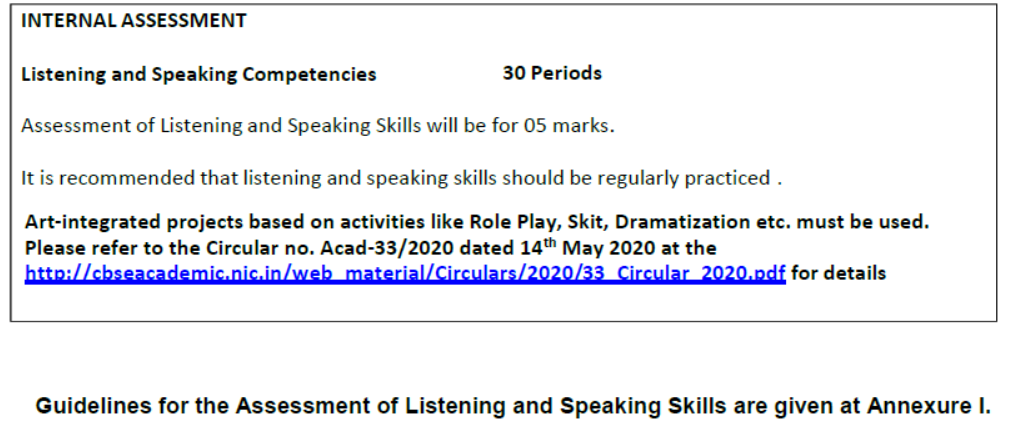
Guidelines for Assessment of Listening and Speaking Skills (ALS)
ALS is a component of the Subject Enrichment Activity under Internal Assessment. ALS must be seen as an integrated component of all four language skills rather than a compartment of two. Suggested activities, therefore, take into consideration an integration of the four language skills but during assessment, emphasis will be given to speaking and listening, since reading and writing are already being assessed in the written exam.
Assessment of Listening and Speaking Skills: (5 Marks)
i. Activities:
● Subject teachers must refer to books prescribed in the syllabus.
● In addition to the above, teachers may plan their own activities and create their own material for assessing the listening and speaking skills.
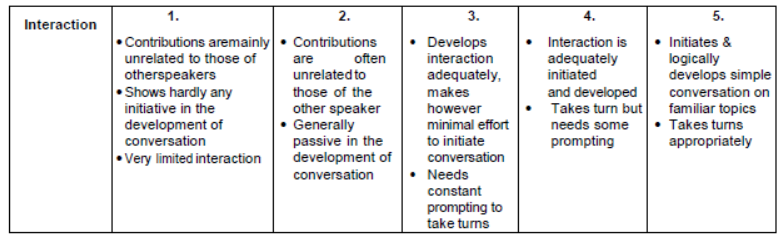
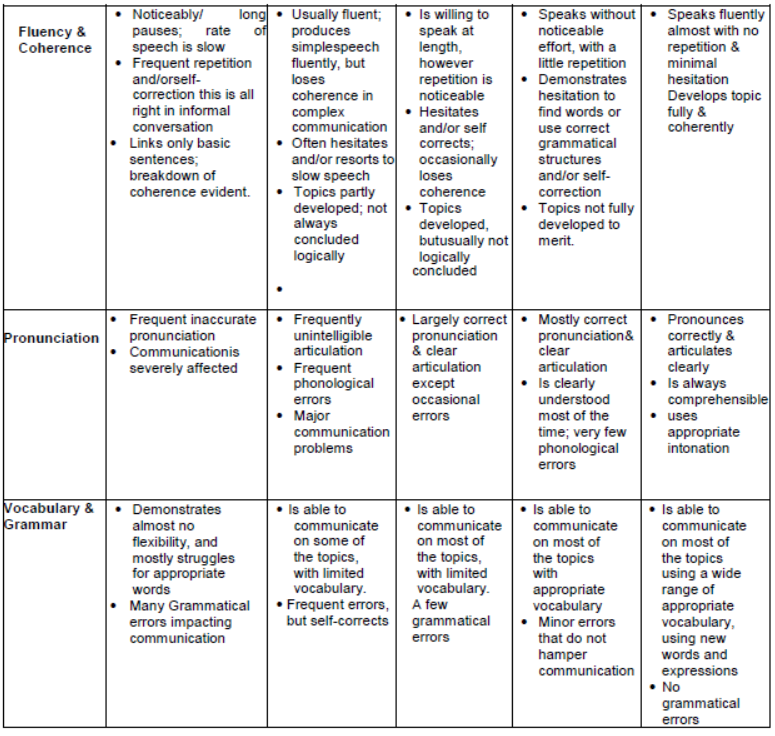
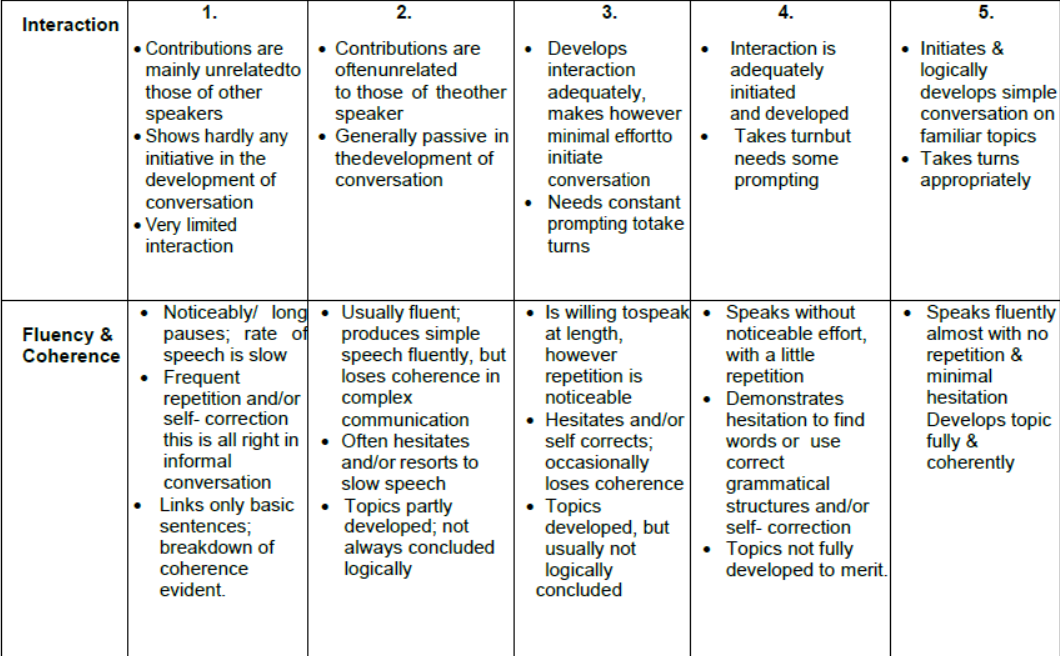
ii. Parameters for Assessment: The listening and speaking skills are to be assessed on the following parameters:
a. Interactive competence (Initiation & turn taking, relevance to the topic)
b. Fluency (cohesion, coherence and speed of delivery)
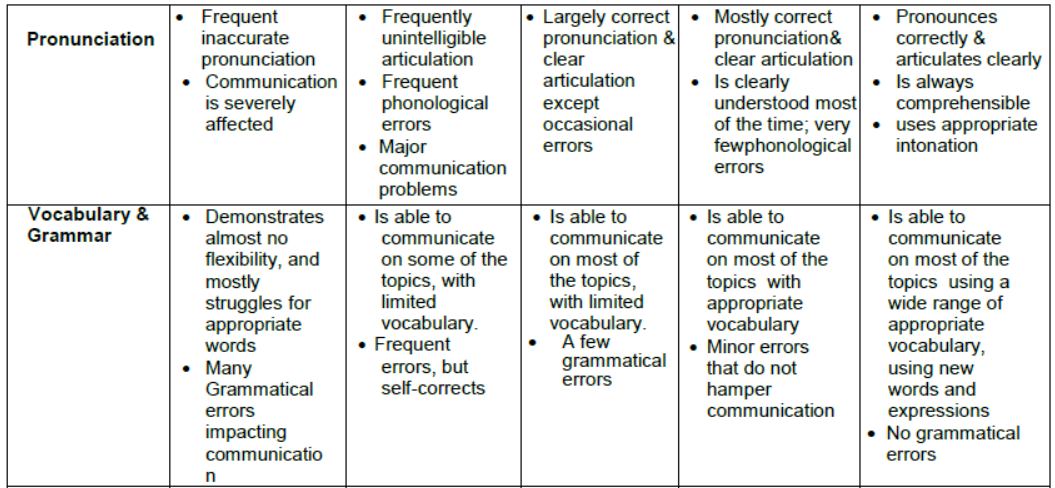
c. Pronunciation
d. Language (grammar and vocabulary)
A suggestive rubric is given below:
iii. Schedule:
- The practice of listening and speaking skills should be done throughout the academic year.
- The final assessment of the skills is to be done as per the convenience and schedule of the school.
COMMUNICATIVE ENGLISH
(Code NO. 101) CLASS – X
2023-24
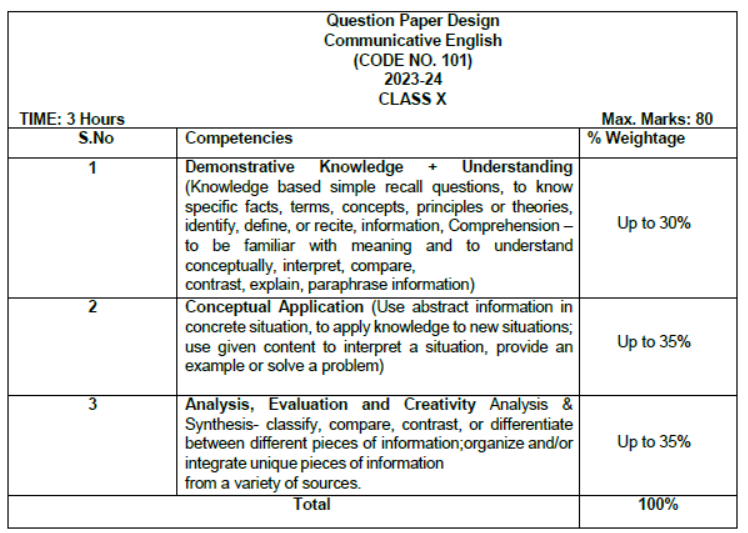
SECTION-WISE WEIGHTAGE
Section Total Weightage
A Reading Skills 22
B Writing Skills 22
C Grammar 10
D Literature Textbook 26
TOTAL 80
SECTION A: READING SKILLS (12+10=22 Marks) 50 Periods
• The section will have two unseen passages with the maximum word limit of 750 words. The passages can have continuous and non-continuous text inspired from the themes in prescribed books. Please refer to the Main Course Book (MCB) for types of non-continuous texts. (For example –Unit 1 has lists, tables, cues, message, telephone conversation etc.).
- Objective Type Questions (including Multiple Choice Questions), Very Short Answer Type Questions (one word/ one phrase / one sentence) and Short Answer Type Questions (30-40 words each) will be asked to test interpretation, analysis, inference, evaluation and vocabulary in context.
SECTION B: WRITING SKILLS 22 Marks 50 Periods
This section will have a variety of short and long writing tasks.
• Email to school authorities (Application for leave/ change of subject /change of section/ bus-timings or similar topics) in maximum 50 words 3 Marks
• Factual Description of a person/object in maximum 100 words 4 Marks
• One out of two formal letters, in maximum 120 words, thematically aligned to topics in MCB. 7 Marks
• One out of two articles based on verbal cues, in maximum 150 words, thematically aligned to MCB topics. 8 Marks
SECTION C: GRAMMAR 10 Marks 20 periods
Grammar items will be taught and assessed over a period of time.
1. Tenses
2. Modals
3. Subject – verb concord
4. Reported speech
- Commands and requests
- Statements
- Questions
5. Clauses:
- Noun clauses
- Adverb clauses
- Relative clauses
6. Determiners
The above items may be tested through test types as given below:
• Gap filling 3 marks
• Editing or Omission 4 marks
• Sentences Reordering or Sentence Transformation in context. 3 marks
SECTION D: LITERATURE TEXTBOOK 26 Marks 50 Periods
• Two out of three extracts from prose/poetry for reference to the context. Very Short Answer Questions will be asked to assess global comprehension, interpretation, inference and evaluation. 8 marks (4+4)
• Five Short Answer type Questions out of six from the Literature Reader to test local and global comprehension of theme and ideas, analysis, evaluation and appreciation (30-40 words each) 5 x2 = 10 Marks
• One out of two Long Answer type Questions to assess how the values inherent in the text have been brought out. Creativity, evaluation and extrapolation beyond the text and across the texts will be assessed. This can also be a passage-based question taken from a situation/plot from the texts. (150 words). 8 marks
Prescribed Books: Interact in English Series by CBSE (available on www.cbseacademic.nic.in)
• Main Course Book (Revised Edition)
• Literature Reader (Revised Edition)
• Workbook (Revised Edition)
NOTE: Teachers are advised to:
i) encourage classroom interaction among peers, students and teachers through activities such as role play, group work etc.,
ii) reduce teacher-talk time and keep it to the minimum,
iii) take up questions for discussion to encourage pupils to participate and to marshal their ideas and express and defend their views.
Assessment of Listening and Speaking Skills: 50 Periods Guidelines for the Assessment of Listening and Speaking Skills are given at Annexure I.
Guidelines for Assessment of Listening and Speaking Skills (ALS)
ALS is a component of the Subject Enrichment Activity under Internal Assessment. ALS must be seen as an integrated component of all four language skills. Suggested activities, therefore, take into consideration an integration of the four language skills but during assessment, emphasis will be given to speaking and listening, since reading and writing are already being assessed in the written exam.
Assessment of Listening and Speaking Skills: (5 Marks)
i. Activities:
● Subject teachers must refer to books prescribed in the syllabus.
● In addition to the above, teachers may plan their own activities and create their own material for assessing the listening and speaking skills.
ii. Parameters for Assessment: The listening and speaking skills are to be assessed on the following parameters:
a. Interactive competence (Initiation & turn taking, relevance to the topic)
b. Fluency (cohesion, coherence and speed of delivery)
c. Pronunciation
d. Language (grammar and vocabulary)
A suggestive rubric is given below:
iii. Schedule:
- The practice of listening and speaking skills should be done throughout the academic year.
- The final assessment of the skills is to be done as per the convenience and schedule of the school.
Free study material for English
FAQs
The complete and updated syllabus for Class 10 English for the 2026-27 academic session is available on StudiesToday.com with detailed chapter-wise marks issued by CBSE.
Yes, several topics have been rationalized to reduce the academic load on Class 10 students. The English syllabus highlights the deleted topics section and is as per 2026 Exam format.
For Class 10 English, the evaluation is split into an 80-mark theory paper and a 20-mark internal assessment (Project/ASL).
The Class 10 English curriculum focuses on 50% competency-based questions.
We have provided the Class 10 English curriculum in a bilingual format where applicable for 2026-27 session.
Our team has carefully updated all resources based on the latest circulars from the official CBSE website. The Class 10 English syllabus is 100% authentic and aligned with the 2026-27 academic calendar.