

Class 10 Social Science Practice Sheet: CBSE Class 10 Geography Minerals And Energy Resources Worksheet Set 04
Review targeted academic worksheets with the CBSE Class 10 Geography Minerals And Energy Resources Worksheet Set 04. Built according to official educational standards for the 2026-27 term, these downloadable Class 10 Social Science resources support effective daily practice and detailed self-evaluation for Contemporary India Chapter 05 Minerals and Energy Resources.
Download Contemporary India Chapter 05 Minerals and Energy Resources Worksheet PDF with Answers
View or download the dedicated CBSE Class 10 Geography Minerals And Energy Resources Worksheet Set 04 resource below. Engaging with these practice papers under focused study conditions ensures continuous academic progress and mastery of the 2026-27 curriculum for Contemporary India Chapter 05 Minerals and Energy Resources.
Question : In the present day energy crisis what steps will you like to take for saving energy?
Answer : (i) Energy is a basic requirement for economic development. Hence, there is an urgent need to develop a sustainable path of energy development. Promotion of energy conservation and increased use of renewable energy sources are the twin planks of sustainable energy.
(ii) We have to adopt a cautious approach for the judicious use of our limited energy resources. As concerned citizens we can do our bit by using public transport systems instead of individual vehicles.
(iii) Switching off electricity when not in use, using power-saving devices and using non-conventional sources of energy are other important steps for saving energy.
Question : How is geo-thermal energy produced? Explain.
Answer : The Earth grows progressively hotter with increasing depth. Where the geothermal gradient is high, high temperatures are found at shallow depths. Groundwater in such areas absorbs heat from the rocks and becomes hot.
It is so hot that when it rises to the earth's surface it turns into steam. This steam is used to drive turbines and generate electricity.
Question : How do minerals occur in sedimentary rocks?
Answer : (i) In sedimentary rocks a number of minerals occur in beds or layers.
(ii) They have been formed as a result of deposition, accumulation andconcentration in horizontal strata.
(iii) Coal and some forms of iron ore have been concentrated as a result of long periods under great heat and pressure.
(iv) Another group of sedentary numerals such as gypsum, potash salt and sodium salt are formed as a result of evaporation.
Question : State two main uses of copper. Also, mention three major copper-producing districts of India.
Answer : Being malleable, ductile and a good conductor, copper is mainly used in electrical cables, electronics and chemical industries. India is critically deficient in the reserve and production of copper.
Three major copper producing regions of India:
(i) Madhya Pradesh is the largest producer of copper in India. The Balaghat mines in Madhya Pradesh produces 52 per cent of India’s copper.
(ii) Rajasthan is the second largest producer of copper. The Khetri mines in Rajasthan are famous.
(iii) The Singhbhum district of Jharkhand has also large reserves of copper.
Question : (i) How are deposits of bauxite formed and aluminium obtained?
(ii) What is the utility of aluminium?
(iii) Describe the distribution of aluminium.
Answer : (i) Bauxite deposits are formed due to decomposition of wide variety of rocks rich in aluminium silicates. Ores containing aluminium are obtained from bauxite which is a clay-like substance from which alumina and later aluminium is obtained.
(ii) It is an important metal because it combines the strength of metals such as iron with good conductivity and great malleability.
(iii) Odisha is the largest bauxite producing state. 45% of country’s total production in 2000-2001 was from Orissa. Panchpatmali deposits in Koraput district are the most important bauxite deposits in the state.
Question : State uses of limestone. Also mention the states where it is produced.
Answer : Limestone is the basic raw material for the cement industry and essential for smelting iron ore in the blast furnace.
It is found in association with rocks composed of calcium carbonates or calcium and magnesium carbonates. It is found in sedimentary rocks of most geological formations.
It is produced in states like Andhra Pradesh, Madhya Pradesh, Rajasthan, Gujarat and Tamil Nadu.
Question : State any two factors affecting the economic viability of mineral reserves.
Answer : (i) The mineral content of the ore must be in sufficient concentration to make its extraction commercially viable.
(ii) The type of formation or structure in which minerals are found determines the relative ease with which mineral ores may be mined. This also determines the cost of extraction.
Question : Explain any three values attached with the use of minerals in a sustainable manner.
Answer : (i) Our industries and agriculture immensely depend on mineral deposits and the substances manufactured from them. The total volume of workable mineral deposits is an insignificant fraction i.e. one per cent of the earth’s crust. Hence, minerals should be used cautiously.
(ii) The geological processes of mineral formation are so slow that the rates of replenishment are infinitely small in comparison to the present rates of consumption.
(iii) Mineral resources are finite and non-renewable. Rich mineral deposits are our country’s extremely valuable but short-lived possessions.
Question : Why is conservation of mineral resources essential? Explain any three methods to conserve them.
Answer : The total volume of workable mineral deposits is an insignificant fraction i.e. one per cent of the earth’s crust. We are rapidly consuming mineral resources that took millions of years to be created and concentrated. The geological processes of mineral formation are so slow that the rates of replenishment are infinitely small in comparison to the present rates of consumption. Mineral resources are, therefore, finite and non-renewable. Hence their conservation is essential.
Three methods to conserve minerals:
(i) Mineral resources should be used in planned and sustainable manner.
(ii) Improved technology need to be constantly evolved to allow use of low grade ores at low costs.
(iii) Recycling of metals, using scraps metals and other substitutes are steps in conserving our mineral resources for the future.
Question : Why is Chhotanagpur plateau called a ‘store house of minerals’?
Answer : (i) Chhotanagpur plateau is called a store house of minerals as it has very high grade haematite iron ore.
(ii) The ranges of hills in Chhotanagpur have 14 deposits of super high grade haematite iron ore.
(iii) Most of the mica deposits are found on the northern edge of Chhotanagpur plateau.
(iv) Koderma–Hazaribagh belt of Jharkhand is the leading producer of Mica.
Question : Why is conservation of minerals important?
Answer : (i) Minerals are important for the development of a country. Various substances manufactured from minerals industry and agriculture depend on them.
(ii) Minerals are already in short supply and their consumption is so fast. We must keep it in mind that the total volume of workable mineral deposits is an insignificant fraction, i.e. one per cent of the earth’s crust.
(iii) Minerals require millions of years to be created and concentrated. The geological processes of mineral formation are so slow that the rates of replenishment are infinitely small in comparison to present rates of consumption.
(iv) Mineral resources are finite and non-renewable continued extraction of ores leads to increasing costs as mineral extraction comes from greater depths along with the decrease in quality. It has therefore, become essential to conserve minerals.
Question : 'Energy saved is energy produced.' Assess the statement.
Answer : Energy is required for all activities in industries, agriculture, transport and domestic use. It implies that all these activities can take initiatives to conserve energy if we discipline ourselves.
To begin with, each one of us should be always ready and be vigilant to take note of wasteful use and correct it immediately. It may be as simple as putting off an electrical appliance when not in use. We should develop a mindset to use public transport system instead of individual vehicles. Electronic devices must be switched off when not in use.
We should use more and more power saving devices and at home we should plan to install solar panels to generate some electricity.
When we do not use a particular quantity of electric power someone else use can it. In absolute sense power plants will need to produce that much less of power; which benefits the environment as that much less fossil fuel will have to be burnt.
Question : What is solar energy? What is its importance?
Answer : The energy obtained from the sun is known as the solar energy. Its importance can be understood by the following points.
(i) Solar energy does not cause environmental problems as it is pollution free.
(ii) India has enormous possibilities of tapping solar energy.
(iii) It is becoming popular in rural and remote areas of India. Thus, it will be able to minimise the dependence of rural households on firewood and dung cake.
Question : Distinguish between ferrous and non-ferrous minerals
Answer : Ferrous and non-ferrous minerals

Long Questions for Class 10 Social Science Minerals and Energy Resources
Question : Differentiate between metallic and nonmetallic minerals with examples.
Answer : Metallic Minerals:
(a) Metallic minerals are those minerals which can be processed to obtain metals.
(b) Magnetite, hematite, bauxite, are some examples.
(c) These are generally associated with igneous and metamorphic rocks.
(d) They are usually hard and have shines or luster of their own.
Non-Metallic Minerals:
(a) Non-metallic minerals are those which do not yield new products on melting.
(b) Coal, salt, clay, marble are some examples.
(c) These are generally associated with sedimentary rocks.
(d) They are not so hard and have no shine or luster of their own.
Question : Why is there a need to use non-conventional sources of energy ?
Answer : The growing demand of energy leads to an incessant dependence on fossil fuels such as coal, oil and gas. Rising prices of oil and gas, and their potential shortages have raised uncertainties about the security of energy supply in future, which in turn has serious repercussions on the growth of the national economy. Moreover, increasing use of fossil fuels also causes serious environmental problems. Hence, there is a pressing need to use renewable energy sources like solar energy, wind energy, tide energy, biomass and energy from waste material. These are called non-conventional energy resources. Their production does not emit any harmful pollutants and emissions.
Question : Why do you think that solar energy has a bright future in India ?
Answer : Solar energy is an inexhaustible form of energy produced from sunlight. There is enough scope for the development of solar energy. It has a bright future in India because :
(i) Many parts (regions) of the country receives sunlight on 300 days annually and so it becomes possible to generate 20 MW solar energy per square kilometre in such areas.
(ii) It is easy to establish solar plants in urban and rural areas.
(iii) By setting up solar plants in rural areas the dependence of people on firewood can be reduced.
(iv) It is also becoming popular as it is used for cooking, heating water, lighting, etc.
(v) It is a renewable source of energy, while other conventional sources used for generating electricity are exhaustible and nonrenewable.
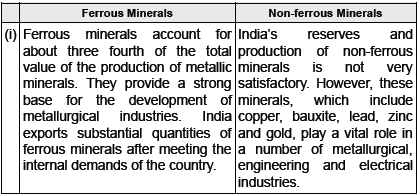
Question : Distinguish between the Ferrous and Non-ferrous minerals.
Answer :
Question : Why is the use of non-conventional sources of energy becoming essential these days?
Answer : The use of non-conventional sources of energy is becoming necessary because of the following reasons:
(i) The growing consumption of energy in the country has made us dependent on fossil fuels such as coal, oil and gas and it may lead to shortages in the supply of oil, gas and coal in future.
(ii) Rising prices of oil and gas has adversely affected the foreign exchange.
(iii) The growth of the national economy is getting slowed down.
(iv) Ever-increasing use of fossil fuels is causing serious environmental problems.
(v) Non-conventional sources of energy are renewable and also eco-friendly.
Question : What efforts are required to use mineral resources in a planned and sustainable manner? Explain in three points.
Answer : Following efforts have to be made to use minerals in a planned and sustainable manner :
(i) Recycling of metals : We should recycle the metal or metal-made products to prevent its scarcity.
For example : Used steel blade should be sent for recycling, so that the steel can be used again for other purposes.
(ii) Improved technologies need to be evolved : Traditional technologies should be replaced with new and improve technologies, so that the wastages can be minimised.
(iii) Use of substitute or alternative resource : The resources which cannot be recycled or reused should be replaced with the recyclable resources. e.g. Use of green gas instead of coal for cooking purpose.
Question : Collect information about Thermal/Hydel power plants located in your state.
Answer : Hydel power plants located in Andhra Pradesh. Hydro power is considered as one of the most economic and non-polluting sources of energy. Electricity generated from water is termed as Hydroelectricity. Hydroelectricity means electricity generated by hydropower or from the use of the gravitational force of falling or flowing water. It is one of the most common forms of power generation because this form of energy neither produces any direct waste matter nor is subjected to exhaustion. The potential for hydro-electric power stations in terms of installed capacity in India is estimated to be about 148,700 MW, out of which a capacity of 42,783 MW (28.77%) has been developed so far and 13,616 MW (9.2 %) of capacity is under construction.
Question : Why is there need to use non-conventional sources of energy ?
Answer : The growing demand of energy leads to an incessant dependence on fossil fuels, such as coal, oil and gas. Rising prices of oil and gas and their potential shortages have raised uncertainties about the security of energy supply in future, which in turn has serious repercussions on the growth of the national economy. Moreover, increasing use of fossil fuels also causes serious environmental problems. Hence, there is a pressing need to use renewable energy sources like solar energy, wind energy, tide energy, biomass and energy from waste material. These are called non-conventional energy resources. Their production does not emit any harmful pollutants and emissions.
Question : Why is there an enormous possibility of tapping solar energy in India ?
Answer : (i) India is blessed with an abundance of sunlight, water, wind and biomass.
(ii) It has the largest programmes for the development of these renewable energy resources. Besides, it is a tropical country. It has possibilities of tapping solar energy.
(iii) Photovoltaic technology converts sunlight directly into electricity. Solar energy is fast becoming popular in rural and remote areas.
(iv) The largest solar plant of India is located at Madhapur near Bhuj, where solar energy is used to sterilise milk cans.
(v) It is totally harmless and does not pollute the environment. In other words, we can say that it is eco-friendly.
Question : Explain how minerals are unevenly distributed in India ?
Answer : India is fortunate to have fairly rich and varied mineral resources. However, these are unevenly distributed.
(i) Peninsular rocks contain most of the reserves of coal, metallic minerals, mica and many other non-metallic minerals.
(ii) Sedimentary rocks on the western and eastern flanks of the peninsula, in Gujarat and Assam have most of the petroleum deposits.
(iii) Rajasthan with the rock systems of the peninsula has reserves of many non-ferrous minerals.
(iv) The vast alluvial plains of North India are almost devoid of economic minerals. These variations exist largely because of the differences in the geological structure, processes and time involved in the formation of minerals.
Question : What is the difference between hydroelectricity and thermal electricity ?
Answer : Hydro Electricity
(i) It is generated by fast flowing water.
(ii) It causes no pollution.
(iii) These plants are located near the sources of energy.
(iv) It uses renewable resources.
Thermal Electricity
(i) It is generated by using coal, petroleum and natural gas.
(ii) It causes pollution.
(iii) These plants can be set up at any place.
(iv) It uses non-renewable resource.
Source/Case Based Questions
Question : Read the extract and answer the questions that follows :
Electricity has such a wide range of applications in today’s world that, it’s per capita consumption is considered as an index of development. Electricity is generated mainly in two ways : by running water which drives hydro turbines to generate hydroelectricity; and by burning other fuels such as coal, petroleum and natural gas to drive turbines to produce thermal power. Once generated the electricity is exactly the same. Hydroelectricity is generated by fast flowing water, which is a renewable resource. India has a number of multipurpose protects like the BhakraNangal, Damodar Valley Corporation, the Kopili Hydel Protect etc. producing hydroelectric power. Thermal electricity is generated by using coal, petroleum and natural gas. The thermal power stations use non-renewable fossil fuels for generating electricity.
(i) How does thermal power stations generate electricity ?
Answer : The thermal power stations use non-renewable fossil fuels for generating electricity.
(ii) Why is hydroelectric called renewable resource ?
Answer : (Hydroelectricity is generated by fast flowing water which is a renewable resource.
(iii) What are the two ways to generate electricity ?
Answer : (Electricity is generated mainly in two ways :
(a) By running water which drives hydro turbines to generate hydroelectricity;
(b) By burning other fuels such as coal, petroleum and natural gas to drive turbines to produce thermal power.
(iv) What is considered as an index of development ?
Answer : Per capita consumption of electricity is considered as an index of development.
Question : Fill the name of the correct mineral in the crossword below:
DOWN
1. Found in placer deposit (4)
2. Iron ore mined in Bailadila (8)
3. Indispensable for electrical industry (4)
4. Geological Age of coal found in north east India (8)
5. Formed in veins and lodes (3)
ACROSS
1. A ferrous mineral (9)
2. Raw material for cement industry (9)
3. Finest iron ore with magnetic properties (9)
4. Highest quality hard coal (10)
5. Aluminium is obtained from this ore (7)
6. Khetri mines are famous for this mineral (6)
7. Formed due to evaporation (6)
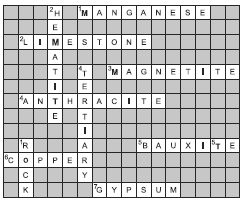
Ans. DOWN
1. ROCK
2. HEMATITE
3. COAL
4. TERTIARY
5. TIN
ACROSS
1. MANGANESE
2. LIMESTONE
3. MAGNETITE
4. ANTHRACITE
5. BAUXITE
6. COPPER
7. GYPSUM
Free study material for Social Science
Contemporary India Chapter 05 Minerals and Energy Resources Printable Worksheets and Exercises for Class 10 Social Science
Daily Practice Questions for Class 10 Social Science
Explore reliable practice questions for Contemporary India Chapter 05 Minerals and Energy Resources tailored for Class 10 Social Science learners. Use these structured worksheets to evaluate exam preparedness and strengthen problem-solving skills throughout the 2026 academic session.
Detailed Answers for Class 10 Social Science Contemporary India Chapter 05 Minerals and Energy Resources
Designed around the official curriculum for Class 10 Social Science, these practice sheets guarantee standard compliance. Reviewing step-by-step solutions after completion sharpens your accuracy and clarifies complex sub-topics within Contemporary India Chapter 05 Minerals and Energy Resources.
Complete Your Chapter Revision
Wrap up your chapter revision by testing your knowledge against standard objective question formats. Explore our full library of free, up-to-date printable assignments to maximize your academic results in upcoming CBSE evaluations.
FAQs
You can download the latest chapter-wise printable worksheets for Class 10 Social Science Contemporary India Chapter 05 Minerals and Energy Resources for free from StudiesToday.com. These have been made as per the latest CBSE curriculum for this academic year.
Yes, Class 10 Social Science worksheets for Contemporary India Chapter 05 Minerals and Energy Resources focus on activity-based learning and also competency-style questions. This helps students to apply theoretical knowledge to practical scenarios.
Yes, we have provided solved worksheets for Class 10 Social Science Contemporary India Chapter 05 Minerals and Energy Resources to help students verify their answers instantly.
Yes, our Class 10 Social Science test sheets are mobile-friendly PDFs and can be printed by teachers for classroom.
For Contemporary India Chapter 05 Minerals and Energy Resources, regular practice with our worksheets will improve question-handling speed and help students understand all technical terms and diagrams.