CBSE Class 11 Political Science Judiciary Worksheet

Read and download the CBSE Class 11 Political Science Judiciary Worksheet in PDF format. We have provided exhaustive and printable Class 11 Political Science worksheets for Indian Constitution at Work Chapter 6 Judiciary, designed by expert teachers. These resources align with the 2025-26 syllabus and examination patterns issued by NCERT, CBSE, and KVS, helping students master all important chapter topics.

Chapter-wise Worksheet for Class 11 Political Science Indian Constitution at Work Chapter 6 Judiciary

Students of Class 11 should use this Political Science practice paper to check their understanding of Indian Constitution at Work Chapter 6 Judiciary as it includes essential problems and detailed solutions. Regular self-testing with these will help you achieve higher marks in your school tests and final examinations.

Class 11 Political Science Indian Constitution at Work Chapter 6 Judiciary Worksheet with Answers

Question : Who was the Chief Justice of India in 2007?
a) KG Balakrishan
c) RK Balakrishnan
b) OM Balaswami
d) KK Bala Swami
Answer : A
 
Question : Right to life is conferred by which article?
a) Article 19
c) Article 21
b) Article 20
d) Article 22
Answer : C
 
Question : What it the full form of PIL?
a) Public Illegal Law
c) Personal Interest Litigation
b) Public Interest Litigation
d) Public Interest Limited)
Answer : B
 
Question : The cases which deal with theft, cheating and robbery are called ______________.
a) Robbery cases
c) Criminal cases
b) Illegal cases
d) None of these
Answer : C
 
Question : Civil cases include the cases dealt with:
a) Money
c) Marriage
b) Property
d) All of the them
Answer : D
 
Question : Which courts were first established in three presidency cities of Calcutta, Bombay and Madras in 1862?
a) Lower Court
c) Supreme Court
b) High Court
d) All of them
Answer : B
 
Question : If anyone’s fundamental rights are violated, he can go to the:
a) Lok Sabha
c) Parliament
b) Rajya Sabha
d) Court
Answer : D
 
Question : __________ plays a crucial role in protecting the Fundamental Rights of the citizens.
a) Legislative
c) Judiciary
b) Executive
d) None of them
Answer : C
 
Question : The Supreme Court was established on _________.
a) 26 January 1930
b) 26 January 1950
c) 26 January 1947
d) 26 January 1970
Answer : B
 
Question : The High Court of Delhi came up in
a) 1950
b) 1959
c) 1966
d) 1970
Answer :  C
 
Question : The number of High Court is
a) 30
b) 28
c) 25
d) 24
Answer :  D
 
Question : Who appoints the judges of the High Court?
a) The President of India
b) The Prime Minister of India
c) The governor of Delhi
d) The Chief Justice of the Supreme Court
Answer :  A
 
Question : Which one is not associated with civil law?
a) Divorce
b) Theft
c) Rent matters
d) Disputes related to sale of land
Answer :  C
 
Question : What is the system consisting of courts which interpret the constitution and award judgement?
a) Judiciary
b) Parliament
c) Police
d) Legislative
Answer :  A
 
Question : What is the term used for money given to make amends for an injury or a loss?
a) Donation
b) Compensation
c) Dispute
d) All of these
Answer :  B
 
Question : What is the act of breaking a law as well as to the breach or infringement of Fundamental Rights?
a) Violation
b) Acquit
c) Dispute
d) All of these
Answer : A
 
Question : Judiciary in India resolves the disputes between
a) Judiciary
b) State and Citizen
c) Citizen and Citizen
d) All of above
Answer : D
 
Question : Who is the final interpreter of our Constitution?
a) Judiciary
b) Government
c) Executive
d) Legislative
Answer : A
 
Question : Once appointed, a judge can be removed by:
a) District judge
b) Chief Minister
c) Prime Minister
d) None of these
Answer : D
 
Question : When was High Court under British Rule first established?
a) In 1862
b) In 1966
c) In 1866
d) In 1986
Answer : A
 
Question : How many High Courts are there in India currently?
a) 31
b) 21
c) 11
d) 01
Answer : B
 
Question : What type of cases are decided by under Civil Law?
a) Divorce
b) Rent matters
c) Sale of land
d) All of above
Answer : D
 
Question : The removal of persons from land or homes that they are currently living in, is called
a) violation
b) eviction
c) separation of power
d) judiciary
Answer : B
 
Question : How many judges are there in Supreme Court?
a) 26 judges
b) 36 judges
c) 46 judges
d) 16 judges
Answer : A
 
Question : The first Lok Adalat was held in the year:
a) 1983
b) 1984
c) 1985
d) 1986
Answer : C
 
Question : A Lok Adalat is generally presided over by the:
a) Retired judge
b) Governor of the state
c) Chief Minister of the state
d) Judge of the District Court
Answer :  A
 
Question : The idea of the Public Interest Litigation was given by:
a) President of India
b) Prime Minister of India
c) Supreme Court of India
d) Parliament
Answer :  C
 
Question : The Supreme Court of India consists of the Chief
a) 28 other judges
b) 27 other judges
c) 25 other judges
d) 26 other judges
Answer :  C
 
Question : A judge of the High Court remains in office till the age of:
a) 62 years
b) 65 years
c) 60 years
d) 64 years
Answer :  A
 
Question : An individual can go to the Supreme Court to appeal against the judgement of the:
a) Lok Adalats
b) Nyaya Panchayats
c) High Court
d) District Court
Answer :  C
 
Question : Civil cases are related to:
a) Kidnapping
b) cheating
c) disputes over property
d) robberies
Answer :  C
 
Question : To ensure the independence of the judiciary in India:
a) The Parliament can give judgement in criminal cases.
b) The judges can be easily removed
c) Our Constitution has various provisions that keep it free from the influence of the legislature and executive.
d) The executive can overrule the judgement given by the Supreme/High courts.
Answer :  C
 
Question : The only Union Territory which has a High Court of its own is:
a) Puducherry
b) National Capital Territory of Delhi
c) Chandigarh
d) Daman & Diu
Answer :  B
 
Question : There are 29 States but only:
a) 24 High Courts
b) 25 high courts
c) 26 High Court
d) 27 High Court
Answer : A
 
 
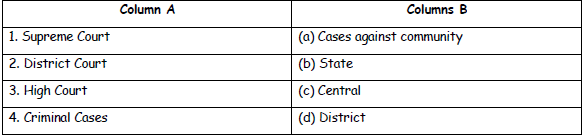
I. Match the Columns
M
Answers : 
1. (c) 2. (d) 3. (b) 4. (a)
 
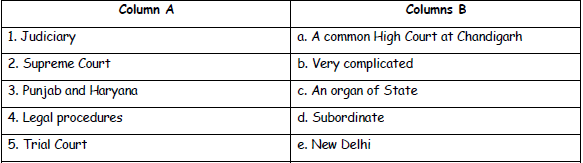
II. Match the Columns
 
Ma
Answers : 
1. (c) 2. (e) 3. (a) 4. (b) 5. (d)
 
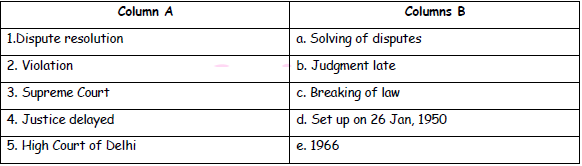
III. Match the Columns
Ma-
Answers : 
1. (a) 2. (c) 3. (d) 4. (b) 5. (e)
 
IV. Match the Columns
Mat
Answers : 
1. (b) 2. (c) 3. (e) 4. (a) 5. (d)
 
 
I. Fill in the blanks 
 
Question. ____________ is the organ of the government which settles disputes through deliberation of law.
Answer: 
Judiciary
 
Question. The ___________ takes decisions on a very large number of issues.
Answer: 
Court
 
Question. There are ___________ different levels of courts in our country.
Answer: 
Three
 
Question. Each state is divided into ___________ that are presided over by a District Judge.
Answer: 
Districts
 
Question. Each state has a High Court which is the __________ court of the state.
Answer: 
Highest
 
Question. The Supreme Court is presided over by the ___________ of India.
Answer: 
Chief Justice
 
Question. The ____________ court is more commonly known by different names.
Answer: 
Subordinate
 
Question. ____________ law deals with any harm or injury to right of individuals.
Answer: 
Civil 
 
 
Question. There are _________ different levels of courts in our country.
Answer: 
three
 
Question. The _______ play a significant role in protecting our Fundamental Rights.
Answer: 
courts
 
Question. Each state has a _______ which is the highest court of that state.
Answer:
High Court
 
Question. The decisions made by the ________ are binding on all other courts in India.
Answer: 
Supreme Court
 
Question. The Judiciary is the final interpreter of the ________.
Answer: 
Constitution
 
III. Fill in the blanks 
 
Question. Supreme Court is located in ___________.
Answer: 
New Delhi
 
Question. The Indian Judiciary consists of one Supreme Court with _______ Judges as on 26  November, 2007.
Answer: 
 26
 
Question. Dowry case falls in a crime against _________.
Answer: 
society
 
Question. India is a ________ country.
Answer: Democratic
 
Question. On 26 Jan, 1950, India became _________.
Answer: 
Republic
 
Question. The judge of the Supreme Court retires at the age of ________.
Answer: 
65 years
 
Question. The Supreme Court was established on _______.
Answer: 
26th January, 1950
 
Question. The highest court of the state is _______.
Answer: 
High Court
 
Question. Article 21 provides every citizen the ______.
Answer: 
Fundamental Right to Life
 
Question. There are ______ levels of court in India.
Answer: 
Three
 
I. True or False 
1. Life means something more than mere animal existence.
2. The separation of powers makes sure that legislature enjoys, considerable independence.
3. The Supreme Court is in New Delhi.
4. The appellate system shows the integrated system.
5. The Indian legal system deals with only criminal law cases.
 
Answers : 
1. True 2. False 3. True 4. True 5. True
 
II. True or False
1. The Supreme Court is presided over by the Chief Justice of India.
2. Poor people can approach only the lower courts.
3. The judiciary acts as per the wishes of the government.
4. The Public Interest Litigation (PIL) plays an important role in facilitating justice to all.
5. The Civil cases usually begin with the lodging of a First Information Report (FIR) with the police who investigate the crime after which a case is filed in the court.
 
Answers : 
1. True 2. False 3. False 4. True 5. False
 
III. True or False
 
1. The seven north-eastern states have a common High Court.
2. There are currently 27 High Courts in India.
3. There is only one Supreme Court in India.
4. A poor family may depend over by the Chief Justice of India.
5. The Supreme Court is presided over by the Chief Justice of India.
 
Answers : 
1. True 2. False 3. True 4. True 5. True
 
IV. True or False
1. The accused took the case to the High Court because they were unhappy with the decision of the Trial Court.
2. They went to the High Court after the Supreme Court had given its decision.
3. If they do not like the Supreme Court’s verdict, the accused can go back again to the Trial Court.
 
Answers : 
1. True 2. False 3. False
 
Very Short Answer Questions : -
 
Question :  What is Judiciary?
Answer : Judiciary is the organ of the government which settles disputes through interpretation of laws.
 
Question :  What do you mean by independent judiciary?
Answer : Independent judiciary means that the judiciary is not under government and does not act on its behalf.
 
Question :  What do you mean by violation?
Answer : Violation means breaking a law or encroaching someone’s Fundamental Rights.
 
Question :  What do you mean by integrated judicial system?
Answer : Integrated judicial system means that the decisions made by the higher courts are binding on the lower courts.
 
Question :  Explain the appellate system?
Answer : Appellate system means that a person can appeal to a higher court if she/he is not satisfied with the judgement passed by the lower court.
 
Question :  What does ‘to appeal’ refer to?
Answer : To appeal means to file a petition before a higher court.
 
Question : Describe civil law and criminal law.
Answer : Civil law deals with any harm or injury to rights of individuals while criminal law deals with the cases of theft, harassing, murder, etc.
 
Question :  What does ‘Acquit’ mean?
Answer : This refers to the court declaring that a person is not guilty of the crime for which he/she was tried by the court.
 
Short Answer Questions : -
 
Question : You read the one of the main functions of the judiciary is upholding the law and enforcing Fundamental Rights. Why do you think an independent judiciary is necessary to carry out this important function?
Answer : An independent judiciary will be able to protect our Fundamental Rights. Every citizen of India can approach the Supreme Court or High Court if his/her rights/laws are being violated.
The judiciary is above all the prejudices.
 
Question : Re-read the list of Fundamental Rights provided in chapter 1. How do you think the right to Constitutional Remedies connects to the idea of judicial review.
Answer : The Right to Constitutional Remedies allows every citizen to approach the court if their
fundamental rights have been violated by the government. The judiciary has the power to
modify or cancel law if it finds that they violate the basic structure of the constitution.
 
Question : Why do you think the introduction of Public Interest Litigation (PIL) in the 1980’s is a significant step in ensuring access to justice for all?
Answer : PIL has been devised to facilitate justice for all. It allows any individual or organisation to file a PIL in the High Court or in the Supreme Court on behalf of those whose rights were being violated. Its legal process is greatly simplified. By letter or telegram addressed to the
Supreme Court or the High Court can be treated as a PIL.
 
Question : Re-read excerpts from judgement on the ‘Olga Tellis vs Bombay Municipal Corporation’ case. Now write in your own words what the judges meant when they said that the right to livelihood was a part of the right to life.
Answer :  The judgement was that no person can live without the means of livelihood.
 
Question : Why is judiciary important?
Answer :  Judiciary is important as it performs several interpretative function like settlement of disputes, judicial precedents and protection of Fundamental Rights and enforces rule of law.
 
Question : Briefly explain the three different levels of courts in our country.
Answer : (i) The Indian judiciary consists of one Supreme Court which is the highest judiciary authority in our country, located in New Delhi and presided by the Chief Justice of India.
(ii) The High court is at the state level which is the highest judicial authority in a state.
(iii) The District court is at the state level.
 
Question : Describe Public Interest Litigation.
Answer : Public Interest Litigation or PIL is a mechanism to increase access to justice. It allows any individual or organisation to file a PIL in the High Court of the Supreme Court on behalf of those whose rights are being violated.
 
 
Long Answer Type Questions : -
 
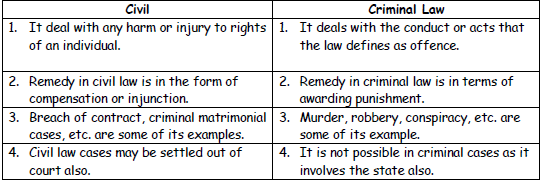
Question. Distinguish between civil law and criminal law.
 
Matc
 
Question. In the following illustration, fill in each tier with the judgement given by the various courts in the Sudha Goel case. Check your responses with others in class.
Answer : Lower Court : The lower court convicted Laxman, his mother Shakuntala and his brothers-in-law Subhash Ghandra and sentenced all three of them to death.
High Court : The High Court acquitted Laxman. Shakuntaka and Subhash Ghandra.
Supreme Court : The Supreme Court found Laxman and his mother guilty but acquitted the brother-in-law Subhash because there was no evidence against him. The Supreme Court decided to send the accused to prison for life.
 
Question. Keeping the Sudha Goel case in mind, tick the sentences that are true and correctly write the ones that are false.
(a) The accused too the case to the High Court because they were unhappy with the decision of the ‘Trial Court’
(b) They went to the High Court after the Trial Court had given its decision.
(c) If they do not like the Supreme Court predict, the accused can again go back to the trial court. 
Answers : 
(a) True (b) False (c) False
 
Question. Make sentences with each of the glossary words given in the textbook.
Answer : 
Acquit : The Supreme Court acquitted Mrs Shah of the charge of the murdering of her husband.
To Appeal : Mr Prakash approached the Supreme Court to appeal against the judgement of the High Court.
Compensation : He received one year’s salary as compensation for loss of office.
Eviction : The tenant is facing eviction, along with his wife and family.
Violation : They went to prison because they violated the law.
 
Question. Briefly describe the functions of Judiciary.
Answer :
The functions of Judiciary are:
(i) Settlement of Disputes: The Judiciary settles disputes and punishes the guilty. It solves disputes between
(a) Citizens
(b) Citizens and the government
(c)Two state governments
(d) The centre and the state government
(ii) Judicial Review: The Judiciary has the power to modify or cancel a particular law if it finds that it violates the basic structure of the Constitution which it is based on fairness and equity.
(iii) Upholding the Law and Enforcing Fundamental Rights: The Judiciary gives protection to citizens’ right. They can approach the Supreme Court or High Court if their Fundamental Rights are violated.
Indian Constitution at Work Chapter 01 Constitution: Why and How
CBSE Class 11 Political Science Constitution Why And How Worksheet
Indian Constitution at Work Chapter 02 Rights of the Indian Constitution
CBSE Class 11 Political Science Rights In The Indian Constitution Worksheet
Indian Constitution at Work Chapter 03 Election and Representation
CBSE Class 11 Political Science Election And Representation Worksheet
Indian Constitution at Work Chapter 04 Executive
CBSE Class 11 Political Science Executive Worksheet
Indian Constitution at Work Chapter 05 Legislature
CBSE Class 11 Political Science Legislature Worksheet
Indian Constitution at Work Chapter 06 Judiciary
CBSE Class 11 Political Science Judiciary Worksheet
Indian Constitution at Work Chapter 07 Federalism
CBSE Class 11 Political Science Federalism Worksheet
Indian Constitution at Work Chapter 08 Local Governments
CBSE Class 11 Political Science Local Governments Worksheet

CBSE Political Science Class 11 Indian Constitution at Work Chapter 6 Judiciary Worksheet

Students can use the practice questions and answers provided above for Indian Constitution at Work Chapter 6 Judiciary to prepare for their upcoming school tests. This resource is designed by expert teachers as per the latest 2026 syllabus released by CBSE for Class 11. We suggest that Class 11 students solve these questions daily for a strong foundation in Political Science.

Indian Constitution at Work Chapter 6 Judiciary Solutions & NCERT Alignment

Our expert teachers have referred to the latest NCERT book for Class 11 Political Science to create these exercises. After solving the questions you should compare your answers with our detailed solutions as they have been designed by expert teachers. You will understand the correct way to write answers for the CBSE exams. You can also see above MCQ questions for Political Science to cover every important topic in the chapter.

Class 11 Exam Preparation Strategy

Regular practice of this Class 11 Political Science study material helps you to be familiar with the most regularly asked exam topics. If you find any topic in Indian Constitution at Work Chapter 6 Judiciary difficult then you can refer to our NCERT solutions for Class 11 Political Science. All revision sheets and printable assignments on studiestoday.com are free and updated to help students get better scores in their school examinations.

Where can I download the 2025-26 CBSE printable worksheets for Class 11 Political Science Chapter Indian Constitution at Work Chapter 6 Judiciary?

You can download the latest chapter-wise printable worksheets for Class 11 Political Science Chapter Indian Constitution at Work Chapter 6 Judiciary for free from StudiesToday.com. These have been made as per the latest CBSE curriculum for this academic year.

Are these Chapter Indian Constitution at Work Chapter 6 Judiciary Political Science worksheets based on the new competency-based education (CBE) model?

Yes, Class 11 Political Science worksheets for Chapter Indian Constitution at Work Chapter 6 Judiciary focus on activity-based learning and also competency-style questions. This helps students to apply theoretical knowledge to practical scenarios.

Do the Class 11 Political Science Chapter Indian Constitution at Work Chapter 6 Judiciary worksheets have answers?

Yes, we have provided solved worksheets for Class 11 Political Science Chapter Indian Constitution at Work Chapter 6 Judiciary to help students verify their answers instantly.

Can I print these Chapter Indian Constitution at Work Chapter 6 Judiciary Political Science test sheets?

Yes, our Class 11 Political Science test sheets are mobile-friendly PDFs and can be printed by teachers for classroom.

What is the benefit of solving chapter-wise worksheets for Political Science Class 11 Chapter Indian Constitution at Work Chapter 6 Judiciary?

For Chapter Indian Constitution at Work Chapter 6 Judiciary, regular practice with our worksheets will improve question-handling speed and help students understand all technical terms and diagrams.