

Download Class 3 English Practice Worksheets
Access comprehensive chapter-wise worksheets for All Chapters using the CBSE Class 3 English Practice Worksheet Set 14. Designed to align with the 2026-27 academic syllabus for Class 3 English, these printable practice sets help students reinforce key concepts and improve their overall exam readiness.
Access All Chapters Practice Papers and Solutions
Access the complete worksheet PDF for Class 3 English below. Regular practice with these targeted academic tasks builds familiarity with standard question patterns and helps secure higher marks in final school examinations.
Q.1 Fill in the blanks.
Question (1). The shoemaker was too worried and ______________ to stitch the last pair of shoes.
Answer: tired
In simple words: The shoemaker was exhausted and stressed about his work.
Exam Tip: Remember key details from the story 'The Elves and the Shoemaker'.
Question (2). The elves worked quickly and ___________ , made shoes out of the leather and quietly slipped.
Answer: neatly
In simple words: The little elves finished their work cleanly and in a hurry.
Exam Tip: Pay attention to adverbs describing how the action was done.
Question (3). The shoemaker and his wife decided to ______________ the elves for their kindness.
Answer: reward
In simple words: They wanted to give a gift to show gratitude to the elves.
Exam Tip: Use appropriate action verbs that fit the context of showing thanks.
Question (4). One day the shoemaker had only one piece of ______________ left and no money to buy any more.
Answer: leather
In simple words: He had barely any raw material remaining to make shoes.
Exam Tip: Recall the exact material used by a shoemaker.
Question (5). The shoemaker and his wife had enough money to live very __________ .
Answer: happily
In simple words: After their business improved, they lived a joyful life.
Exam Tip: Adverbs of manner often describe the quality of living.
Question (6). The elves came back that night, they wore new clothes and danced with ______________ .
Answer: joy
In simple words: The elves were very happy with their tiny new clothes.
Exam Tip: Complete phrases with nouns denoting emotions.
Q.2 Answer in short.
Question (1). How did the elves come into the house ?
Answer: The elves came into the house by creeping in through the window when it was midnight.
In simple words: They entered secretly through the window at night.
Exam Tip: Answer short comprehension questions with precise references to the text.
Question (2). What change do we see in the shoemaker and his wife at the end of the story ?
Answer: At the end of the story, the shoemaker and his wife change from being poor and worried to becoming wealthy and prosperous.
In simple words: They became rich and lived happily ever after.
Exam Tip: Contrast the beginning situation with the final outcome.
Q.3 Write true or false.
Question (1). The shoemaker and his wife were lazy.
Answer: False
In simple words: They were hardworking people who faced bad times.
Exam Tip: Read carefully to distinguish character traits.
Question (2). The elves stitched the shoes because they wanted to stitch new clothes.
Answer: False
In simple words: The elves helped the poor shoemaker out of kindness.
Exam Tip: Understand the motivation behind character actions.
Question (3). The shoemaker and his wife decided to repay the elves.
Answer: True
In simple words: They made clothes and shoes as gifts to thank the elves.
Exam Tip: Verify statements against the plot progression.
Question (4). A rich lady bought the shoes for three cold coins.
Answer: False
In simple words: The shoes were sold to customers for good prices, making him prosperous.
Exam Tip: Check specific details in statements.
Q.4 Write opposites.
Question (1). Comfortable -
Answer: Uncomfortable
In simple words: The antonym of comfortable is uncomfortable.
Exam Tip: Use prefixes like 'un-' to form standard antonyms.
Question (2). Found -
Answer: Lost
In simple words: Found means discovered, and its opposite is lost.
Exam Tip: Memorize common verb antonym pairs.
Question (3). Hard -
Answer: Soft (or Easy)
In simple words: The opposite of hard is soft or easy depending on context.
Exam Tip: Provide the most direct antonym.
Question (4). Poor -
Answer: Rich
In simple words: Rich is the exact opposite of poor.
Exam Tip: Standard opposites should be spelled correctly.
Q.5 Write the new words by making changes where necessary.
Question (1). easy - ly =
Answer: easily
In simple words: Drop the 'y' and add 'ily' to form the adverb.
Exam Tip: Words ending in consonant + y change 'y' to 'i' before adding suffixes.
Question (2). multiply - ed =
Answer: multiplied
In simple words: Change 'y' to 'i' and add 'ed'.
Exam Tip: Apply regular spelling rules for past tense verbs ending in 'y'.
Question (3). love - ly =
Answer: lovely
In simple words: Combine the root word with the suffix directly.
Question (4). correct - ed =
Answer: corrected
In simple words: Simply append the suffix to form the past tense.
Exam Tip: Regular verbs form past tense by adding '-ed' directly.
Q.6 Write the correct spellings.
Question (1). expresion
Answer: expression
In simple words: Add the missing letter 's' for correct spelling.
Exam Tip: Watch out for double consonants in words like expression.
Question (2). sudenly
Answer: suddenly
In simple words: Ensure the double 'd' is included.
Exam Tip: Pay attention to middle double consonants.
Question (3). tomorow
Answer: tomorrow
In simple words: Correct spelling has a double 'r' and double 'ow'.
Exam Tip: Memorize common time-related vocabulary spellings.
Question (4). surprize
Answer: surprise
In simple words: Spell it with an 's' instead of a 'z'.
Exam Tip: Many words sound with a 'z' sound but are spelled with 's'.
Q.7 Underline verbs in the following sentences.
Question (1). The hunter searches for deer.
Answer: searches
In simple words: 'Searches' is the action word in the sentence.
Exam Tip: Verbs express actions performed by the subject.
Question (2). The postman brings us letter.
Answer: brings
In simple words: 'Brings' shows what the postman does.
Exam Tip: Identify action words easily by asking what the subject does.
Question (3). Jack and Jill went up the hill.
Answer: went
In simple words: 'Went' is the past tense verb indicating movement.
Exam Tip: Past tense action words are also verbs.
Question (4). Nita loves Ice-cream.
Answer: loves
In simple words: 'Loves' indicates a feeling, which functions as a verb.
Exam Tip: State of being and feeling words can also act as verbs.
Question (5). The sun rises in the east
Answer: rises
In simple words: 'Rises' is the action performed by the sun.
Exam Tip: Look for the action word associated with nature.
Question (6). The bulbul in the tree sings beautifully.
Answer: sings
In simple words: 'Sings' is what the bird does.
Exam Tip: Adverbs describe verbs, helping locate the verb easily.
Question (7). We stand in a queue in a bus-stop.
Answer: stand
In simple words: 'Stand' is the action word indicating posture/position.
Question (8). Dev listen to his favourite song.
Answer: listen (or listens)
In simple words: 'Listen' is the action of hearing music.
Exam Tip: Sensory actions are verbs.
Q.8 Circle the verbs in the given words.
Question (1). swims
Answer: swims
In simple words: 'Swims' is an action word (verb).
Exam Tip: Action words represent things you can do.
Question (2). book
Answer: Not a verb (It is a noun)
In simple words: A book is an object, so it is a noun.
Exam Tip: Distinguish between naming words (nouns) and action words (verbs).
Question (3). talk
Answer: talk
In simple words: 'Talk' is an action word.
Exam Tip: Communication words are verbs.
Question (4). read
Answer: read
In simple words: 'Read' is an action word.
Exam Tip: Educational activities are verbs.
Question (5). played
Answer: played
In simple words: 'Played' is a past tense action word.
Exam Tip: Past tense forms of action words are verbs.
Question (6). child
Answer: Not a verb (It is a noun)
In simple words: A child is a person, making it a noun.
Exam Tip: Names of persons, places, or things are nouns, not verbs.
(a) he was lazy
(b) he hid his money in it
(c) he was fishing
Answer : B
Question. Who said these words? “But, Sir, I have no money to pay!”
(a) Innkeeper
(b) Hodja
(c) Ali
Answer : C
Question. What did Misty eat from the Kitchen Cupboard
(a) brown sugar
(b) resins
(c) both, brown sugar and resins
Answer : A
Question. The simple past tense of arise is
(a) arose
(b) arising
Answer : A
Question. What do you mean by nibble?
(a) To take big bites
(b) To take small bites
(c) To chew and eat
Answer : B
Question. What does doze mean?
(a) Sleep in noon time
(b) Sleep for little while
(c) Sleep for long hours
Answer : B
Question. What do you mean by Peculiar:
(a) strange
(b) kind
(c) hardworking
Answer : A
Question. What do you mean by Barley?
(a) A bread loaf
(b) A cereal like wheat
(c) A cup of coffee
Answer : B
Question. Hodja was
(a) thief
(b) judge
(c) an innkeeper
Answer : B
Question. What is the meaning of “Dragged”
(a) To hug
(b) To love
(c) To pull forcibly
Answer : C
Question. Fill in the blank: He stole the tablecloth when the boy was_______.
Answer : sleeping
Question. State true or false : Other animals made fun of Sona.
Answer : true
Question. Fill in the blank : Sona stopped and dug his ____ into the sand.
Answer : feet
Question. Write the opposite gender for mare.
Answer : horse
Question. Write the opposite gender for lioness.
Answer : lion
Question. Underline the Proper nouns and circle the Common nouns.
(a) Cricket is a popular game.
herd bouquet galaxy stand pride
(b) Their names are Julie and Mary.
(c) Sunita Williams is an astronaut.
(d) The Ganga is the holy river in India.
(e) London is the capital of England.
(f) Rohit goes to school on Saturday.
(g) It is very hot in Africa during the month of June.
Answer : (a) Cricket
(b) Julie Mary
(c) Sunita Williams
(d) Ganga India
(e) London England.
(f) Rohit Saturday
(g) Africa June
Question. Underline the adjectives in the following sentences:
(a) Shobhit is an intelligent student.
(b) Archana is a pretty girl.
(c) Amit is solving a difficult sum.
(d) Ashoka was a great emperor.
Answer : (a) intelligent
(b) pretty
(c) difficult
(d) great
Question. Underline the adjectives of quantity in the following sentences:
(a) Few students are present in the classroom.
(b) There are twenty trees in the garden.
(c) There are no books on the table
(d) Some boys were playing cricket
Answer : (a)few
(b) twenty
(c) no
(d) some
Question. Underline the demonstrative adjectives in the following sentences:
(a) This book is mine.
(b) These books are yours.
(c) That car is small.
(d) Those grapes are sour.
Answer : (a) This
(b) These
(c) That
(d) Those
Question. Write the comparative and superlative degrees of the following adjectives:
(a) clean
(b) cold
(c) dark
(d) hard
Answer : (a) cleaner, cleanest
(b) colder, coldest
(c) darker, darkest
(d) harder, hardest
Question. Rewrite the sentences from simple present tense to present continuous tense.
(a) Steve eats rice and curd.
(b) Rita plays in the park.
Answer : (a) Steve is eating rice and curd.
(b) Rita is playing in the park.
Question. Add a full stop or an exclamation mark wherever necessary.
(a) What a relief
(b) Happy birthday
Answer : (a) What a relief!
(b) Happy birthday.
Question. Find out the verbs from the following sentences:
(a) The girl sings sweetly.
(b) He spoke very kindly to the girl.
(c) The sun rises in the east.
(d) They saw the movie last night.
Answer : (a) sings
(b) spoke
(c) rises
(d) saw
Question. Fill in the blanks with suitable verbs:
(a) I ____ coffee very much.
(b) I ____ cricket.
(c) She is _____ a letter.
(d) He is _____ the newspaper.
Answer : (a) love
(b) play
(c)writing
(d) reading
Question. Underline the prepositions in each sentence.
(a) Our neighbour’s dog ran through our garden.
(b) There is a rag hanging above the shelf.
(c) Salim lives across that busy street.
Answer : (a) Our neighbour’s dog ran through our garden.
(b) There is a rag hanging above the shelf.
(c) Salim lives across that busy street.
Question. Write five action words which you do every day?
Answer : Run, read, jump, sleep, laugh, brush. Write, read (any 5 )
Question. Fill in the blank: Action words are called as ________
Answer : Verbs
Q-1) Match the verbs with suitable nouns.
1) write aeroplane
2) cut pencil
3) sweep vegetables
4) read broom
5) fly book
Q-3) Fill in the blanks with suitable verbs.
1) __________________ a horse
2) __________________ the book
3) __________________ the bottle
4) __________________ your teeth
Q-4) Unscramble the following verbs and write their past tense.
Q-5) Fill in the blanks with is, are, was or were.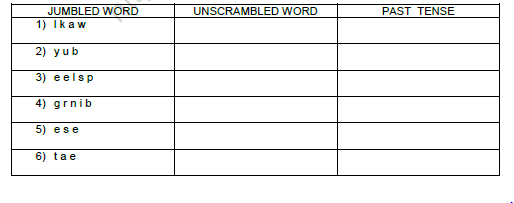
1) She _______ a good girl.
2) They __________ not in the room.
3) He __________ playing with a ball last evening.
4) The children ____________ sick yesterday.
5) Mohan _________ in class II last year.
6) The Red Fort ____ in Delhi.
Q-7) Fill in the blanks with has, have or had.
1) When Reena was small, she _____________ short hair. Now, she ___________ long hair.
2) Do you ____________ a bar of chocolate for me?
3) A butterfly ___________ beautiful wings.
4) The fishermen ____________ big boats.
5) When Niki was five years old, she ________ a doll house.
1) I always play tennis in the evening. But last evening I ________________ badminton.
2) Tommy runs after me everyday but yesterday he ____________ after a cat.
Parul _____ a small girl. She ________ to a school near her house. She loves to __________ a piece of cake to school. Her mother __________ cookies and cakes. But today Parul ___________ an orange. Her mother ___________ to the market to buy it. It ____ a hot day. She _________ an umbrella with her.
Conjunctions
3. I cannot come with you. I have my cricket coaching in the evening. (because)
Ans: I cannot come with you because I have my cricket coaching in the evening.
Q-1) Where did Rahul and Tanya hide?
_____________________________________________________________________
_____________________________________________________________________
Q-2) How did Ritika catch hold of Sid?
______________________________________________________________________
______________________________________________________________________
Q-3) Why was Aman crying?
______________________________________________________________________
______________________________________________________________________
Q-4) Answer in one or two words.
a) Whose parents went out for urgent work?
Ans) _______________ and _________________
b) Which game did the children play?
Ans) ______________________
c) Who made the telephone call?
Ans) ______________________
d) Where were the keys?
Ans) ______________________
e) What did the children watch on the television?
Ans) ______________________
Q-5) Make sentences
favourite - _______________________________________________________________
urgent - _________________________________________________________________
excitement - _____________________________________________________________
horrified- ________________________________________________________________
b) “Certainly! But don’t mess up the house.”
c) “Help me! Help me! I am locked inside.”
d) “Don’t weep. We are trying to open the door.”
e) “Calm down! The key is in the bedside table drawer.”
f) “Relax and enjoy the snacks.”
Question. A ________of bees hovering near the hive.
(a) herd
(b) gang
(c) swarm
Answer : C
Question. A ________ of cattle was grazing in the meadow.
(a) pack
(b) flock
(c) herd
Answer : C
Question. A noun that is the name of any male person or animal is said to be of the
(a) feminine gender
(b) common gender
(c) masculine gender
Answer : C
Question. Which of the following noun is the common gender?
(a) doctor
(b) king
(c) aunt
Answer : A
Question. Which of the following does not belong to the neuter gender?
(a) students
(b) lock
(c) chair
Answer : A
Question. What is the feminine gender of gander?
(a) horse
(b) bull
(c) goose
Answer : C
Question. The masculine gender of doe is ________
(a) colt
(b) buck
(c) duck
Answer : B
Question. child, teacher, parent , sibling are examples of _______gender.
(a) Neuter
(b) common
(c) masculine
Answer : B
Question. Choose True or False : Peahen is a feminine gender.
(a) True
(b) False
Answer : A
Question. Choose True or False: The opposite gender of ‘Sir’ is Lady.
(a) True
(b) False
Answer : B
Question. The plural of wolf is ________
(a) wolfs
(b) wolves
(c) wolfes
Answer : B
Question. Choose the incorrect response.
(a) child – children
(b) shoe - shoes
(c) city – citys
Answer : C
Question. There is a red________ under the chair.
(a) bag
(b) books
(c) pencils
Answer : A
Question. Which one is incorrect?
(a) foot - feet
(b) woman – womans
(c) tooth - teeth
Answer : B
Question. Who said this to whom:
“Shoo! No beggars! Move along quickly!”
Answer : Innkeeper
Question. Ali felt the soup was delicious, what does delicious mean?
Answer : very tasty
Question. What does flavor mean?
Answer : taste
Question. What is the meaning of rude
(a) helpful
(b) bad mannered
(c) kind
Answer : bad mannered
Question. Who was Peter?
Answer : Peter was a goatherd.
Question. Why did Heidi get upset?
Answer : Heidi was upset to know that grandmother was blind.
Contractions
SINGULAR -When a noun names only one person, place, animal, or thing, it is known as a Singular noun. For eg. Boy, city, child, tooth etc.
PLURAL -When a noun names more than one person,place,animal,or thing,it is known as a Plural noun. For eg. Boys, cities, children, teeth etc.
RULES TO FORM PLURAL NOUNS FROM SINGULAR:
Rule 1: Most words become plural by adding – s
eg – boy –boys, car – cars, roof - roofs, pencil – pencils, etc.
Rule 2: We add –es to a word that ends with s, ss,ch,sh,o, and x to form plurals.
eg – bus- buses,class – classes, bench – benches, brush – brushes, hero – heroes,
box – boxes, etc.
Rule 3: When a word ends with f or fe, we change the f or fe to – ves.
eg – leaf – leaves, calf – calves, knife – knives, wife – wives, etc.
Rule4: When a word ends with y, we change the y to – ies.
eg – baby – babies, story – stories, candy – candies, etc.
Rule 5: When the letter before y is a vowel, we form the plural by adding – s.
eg – toy – toys, tray – trays, key – keys, etc.
Rule – 6: Some words change their vowel to form plurals –
eg – man – men,tooth – teeth, foot – feet, goose – geese, etc.
Rule – 7: Some words change completely to form plurals -
eg – child – children, person – people, etc.
Rule – 8: Some noun used the same singular –
eg – deer – deer, series – series, sheep – sheep, spices – spices, etc.
Exercise 1 – Give plural of the following:
1 fruit - _________ 2 book - _____________
3 child- _________ 4 bus - ______________
5 glass - _________ 6 car - ______________
7 box - ___________ 8 deer - _____________
8 knife - ___________ 10 candy - _____________
Exercise 2 – Give singular of the following :
1 boys - _________ 2 stories - _____________
3 feet- _________ 4 sheep - ______________
5 people - _________ 6 brushes - ______________
7 men - ___________ 8 wives - _____________
8 leaves - ___________ 10 trays - _____________

3. What do these people do ? Choose the most suitable word from the brackets.
1) A baker _______________ bread . (bakes /shakes / cooks )
2) A hair dresser ___________ hair . ( cuts / grows/ plants )
3) A mechanic _____________ cars . (hates / makes / repairs )
4) A nurse ________________ after people in a hospital . ( looks / needs / sees )
5) A football player _____________ football. (buys/sleeps/plays)
6) A teacher _________________ students . (catches/ gives / teaches)
7 ) A singer _____________ in a choir . ( dances / eats / sings )
8) A shopkeeper ___________ goods in a shop . ( leaves/talks/sells)
9) A cook _______________dishes in a restaurant . ( buys / cooks / plays )
10) A journalist _____________ articles for newspaper . ( sees / rings / writes)
Q.I Complete the sentences-
1. Rahul and Ritika’s parents were going out for ___________________________________
2. While sipping the cold drink the children thought of _____________________________
3. Kanta told Rahul to make a _________________________________________________
4. While watching their favourite cartoon show, __________________________________
Q.II Who said to whom?
1. ”Can we call Aman, Tanya and Sid to play with us .”
__________________________________________
2. “ Dad must have locked the study room before leaving.”
__________________________________________
Q.III Fill in the blanks using opposites of the underlined words-
1. I cannot eat the whole pizza. Give me a ___________________ of it.
2. Raghav found the book, I had ______________ a few days back.
3. When I was coming from the market, I met Ankit. He was __________________ to the market.
4. He began his work very late. But _________________ it early.
Q.IV Match with the past tense wordscover told
scratch began
bring thought
think covered
hear worried
begin planned
tell scratched
worry heard
plan brought
Q1) Punctuate and rewrite the following sentences in the given space:
a) miss garima teaches us english
_____________________________________________________________
b) he goes for swimming every thursday
_____________________________________________________________
c) diwali is celebrated by the hindus
_____________________________________________________________
d) are you feeling well today
_____________________________________________________________
e) mr herman is going to a grocery shop to buy eggs butter jam and cookies
_____________________________________________________________
f) is this bus going to india gate or qutub minar
_____________________________________________________________
g) mt everest is the highest peak in the world
_____________________________________________________________
h) mrs tanya and i go for a walk to the japanese park in the evening
_____________________________________________________________
i) are you busy on this monday
_____________________________________________________________
j) the capital of china is beijing
_____________________________________________________________
Q2) Write one word for the following from the story ‘Arun meets an alien’ :
a) Pegazol got energy from this ____________________
b) Planet from which Pegazol came __________________
c) Pegazol’s home looked like a _____________________
d) This stuck out from the head of Pegazol _____________
e) Arun’s pet dog __________
f) Aliens came in this ______________
Q3) Find the past tense of the following words from the story:
look - __________ eat - ___________
hear - __________ open - __________
go - _____________ reply - ___________
smile - ____________ is - _____________
laugh - ___________ touch - ___________
Q4) Write two words for each given suffix:
-less a)___________________ b)____________________
-ment a) ___________________ b)____________________
-ly a)___________________ b)____________________
Q5) Imagine yourself meeting an alien. Draw its picture in the space given below and colour it:
Q6) Write 5 lines about your parents. Don’t forget to punctuate the lines:
Q1) Answer the following
a) What made Krishna scream ?
Ans)___________________
b) What did Krishna wear to Mohit’s birthday party?
Ans)__________________
Q2) Give opposites:
a few - ______________ forgot- _____________
best - ______________ busy - _____________
Q3) Who said to whom?
a) “ Mom , his mouth is burning.”
b) You must wish everybody.
Q4) Find the word from the text that means:
a) to give something to someone : ____________________
b) to tell what to do and what not to do :_______________
Q5) Unscramble the words used in the story ‘Krishna learns to obey’:
a) LCILSEHI - ______________
b) TEPLAS - _______________
c) WOLB - ________________
d) FEROFDE - ________________
Q 4)In each of these sentences a wrong homophone has been used . Underline the word, replace it with the correct homophone and rewrite the sentence in the space given.
1) Amita has blew eyes.
_____________________________________
2 ) I would like to sea the Taj Mahal on my visit to Agra.
_________________________________________________________
3) Please return them there books.
____________________________________________________________
4) Due drops look beautiful on red roses.
______________________________________________________________
Q5) Make sentence with each of the given homophone:
i) dew ii) fair iii) blue iv) brake
due fare blew break
____________________________________________
Free study material for English
All Chapters Printable Worksheets and Exercises for Class 3 English
Mastering All Chapters with Printable Worksheets
Access structured practice worksheets for All Chapters aligned with the 2026 CBSE curriculum. These downloadable exercises for Class 3 English help students build accuracy and reinforce core concepts for upcoming school tests.
Verified Solutions and NCERT Alignment
Each worksheet draws directly from authorized standard textbooks to maintain academic accuracy. Evaluating your finished exercises against expert-verified solutions helps master the formal presentation standards expected in school evaluations.
Additional Study Resources for Class 3 English
Follow up your worksheet practice by attempting the interactive online MCQ tests for All Chapters to evaluate your execution speed. All printable assignments and revision sheets on our platform are updated for the 2026 session and available free of charge.
FAQs
You can download the latest chapter-wise printable worksheets for Class 3 English All Chapters for free from StudiesToday.com. These have been made as per the latest CBSE curriculum for this academic year.
Yes, Class 3 English worksheets for All Chapters focus on activity-based learning and also competency-style questions. This helps students to apply theoretical knowledge to practical scenarios.
Yes, we have provided solved worksheets for Class 3 English All Chapters to help students verify their answers instantly.
Yes, our Class 3 English test sheets are mobile-friendly PDFs and can be printed by teachers for classroom.
For All Chapters, regular practice with our worksheets will improve question-handling speed and help students understand all technical terms and diagrams.