

Official Class 11 Mathematics Worksheets: Chapter 10 Conic Sections
Review targeted academic worksheets with the CBSE Class 11 Mathematics Conic Sections Worksheet Set 02. Built according to official educational standards for the 2026-27 term, these downloadable Class 11 Mathematics resources support effective daily practice and detailed self-evaluation for Chapter 10 Conic Sections.
Solved Practice Worksheets for Mathematics
View or download the dedicated CBSE Class 11 Mathematics Conic Sections Worksheet Set 02 resource below. Engaging with these practice papers under focused study conditions ensures continuous academic progress and mastery of the 2026-27 curriculum for Chapter 10 Conic Sections.
Question. If the length of the chord of the circle, x2 + y2 = r2 (r > 0) along the line, y – 2x = 3 is r, then r2 is equal to :
(a) 9/5
(b) 12
(c) 24/5
(d) 12/5
Answer : D
Question. The circle passing through the intersection of the circles, x2 + y2 - 6x = 0 and x2 + y2 - 4y = 0, having its centre on the line, 2x -3y +12 = 0, also passes through the point:
(a) (–1, 3)
(b) (–3, 6)
(c) (–3, 1)
(d) (1, –3)
Answer : B
Question. If a tangent to the circle x2 + y2 = 1intersects the coordinate axes at distinct points P and Q, then the locus of the midpoint of PQ is:
(a) x2 + y2 – 4x2y2 = 0
(b) x2 + y2 – 2xy = 0
(c) x2 + y2 – 16x2y2 = 0
(d) x2 + y2 – 2x2y2 = 0
Answer : A
Question. If the circles x2 + y2 + 5Kx + 2y + K = 0 and 2 (x2 + y2) + 2Kx + 3y – 1= 0, (K∈R), intersect at the points P and Q, then the line 4x + 5y – K = 0 passes through P and Q, for:
(a) infinitely many values of K
(b) no value of K.
(c) exactly two values of K
(d) exactly one value of K
Answer : B
Question. If the angle of intersection at a point where the two circles with radii 5 cm and 12 cm intersect is 90o, then the length (in cm) of their common chord is :
(a) 13/5
(b) 120/13
(c) 60/13
(d) 13/2
Answer : B
Question. A circle touching the x-axis at (3, 0) and making an intercept of length 8 on the y-axis passes through the point :
(a) (3, 10)
(b) (3, 5)
(c) (2, 3)
(d) (1, 5)
Answer : A
Question. All the points in the set S = {a + i / a - 1 : ∝ ∈ R} (i = √-1) lie on a:
(a) straight line whose slope is 1.
(b) circle whose radius is 1.
(c) circle whose radius is √2 .
(d) straight line whose slope is –1.
Answer : B
Question. The line x = y touches a circle at the point (1, 1). If the circle also passes through the point (1, –3), then its radius is:
(a) 3
(b) 2√2
(c) 2
(d) 3√2
Answer : B
Question. If a circle of radius R passes through the origin O and intersects the coordinate axes at A and B, then the locus of the foot of perpendicular from O on AB is :
(a) (x2 + y2)2 = 4R2 x2 y2
(b) (x2 + y2)3 = 4R2 x2 y2
(c) (x2 + y2)2 = 4Rx2 y2
(d) (x2 + y2) (x + y) = Rx2 y2
Answer : B
Question. If a line, y = mx + c is a tangent to the circle, (x – 3)2 + y2 = 1 and it is perpendicular to a line L1, where L1 is the tangent to the circle, x2 + y2 = 1 at the point (1/√2, 1/√2) ; then:
(a) c2 – 7c + 6 = 0
(b) c2 + 7c + 6 = 0
(c) c2 + 6c + 7 = 0
(d) c2 – 6c + 7 = 0
Answer : C
Question. Three circles of radii a, b, c (a < b < c) touch each other externally. If they have x-axis as a common tangent, then:
(a) 1/√a = 1/√b + 1/√c
(b) 1/√b = 1/√a + 1/√c
(c) a, b, c are in A.P
(d) √a, √b, √c are in A.P.
Answer : A
Question. A circle cuts a chord of length 4a on the x-axis and passes through a point on the y-axis, distant 2b from the origin.
Then the locus of the centre of this circle, is :
(a) a hyperbola
(b) an ellipse
(c) a straight line
(d) a parabola
Answer : D
Question. Let the tangents drawn from the origin to the circle, x2 + y2– 8x – 4y + 16 = 0 touch it at the points A and B. The (AB)2 is equal to:
(a) 52/5
(b) 56/5
(c) 64/5
(d) 32/5
Answer : C
Question. Let C1 and C2 be the centres of the circles x2 + y2 – 2x –2y – 2 = 0 and x2 + y2 – 6x –6y + 14 = 0 respectively. If P and Q are the points of intersection of these circles then, the area (in sq. units) of the quadrilateral PC1QC2 is :
(a) 8
(b) 6
(c) 9
(d) 4
Answer : D
Question. The common tangent to the circles x2 + y2 = 4 and x2 + y2 + 6x + 8y – 24 = 0 also passes through the point:
(a) (4, –2)
(b) (– 6, 4)
(c) (6, –2)
(d) (– 4, 6)
Answer : C
Question. If a circle C passing through the point (4, 0) touches the circle x2 + y2 + 4x – 6y = 12 externally at the point (1, – 1), then the radius of C is:
(a) 2√5
(b) 4
(c) 5
(d) √57
Answer : C
Question. If the circles x2 + y2 – 16x – 20y + 164 = r2 and (x – 4)2 + (y – 7)2 = 36 intersect at two distinct points, then:
(a) r > 11
(b) 0 < r < 1
(c) r = 11
(d) 1 < r < 11
Answer : D
Question. A square is inscribed in the circle x2 + y2 - 6x + 8y -103 = 0 with its sides parallel to the coordinate axes. Then the distance of the vertex of this square which is nearest to the origin is :
(a) 6
(b) √137
(c) √41
(d) 13
Answer : C
Question. Two circles with equal radii are intersecting at the points (0, 1) and (0, –1). The tangent at the point (0, 1) to one of the circles passes through the centre of the other circle.
Then the distance between the centres of these circles is :
(a) 1
(b) 2
(c) 2√2
(d) √2
Answer : B
Question. The sum of the squares of the lengths of the chords intercepted on the circle, x2 + y2 = 16, by the lines, x + y = n, n ∈ N, where N is the set of all natural numbers, is :
(a) 320
(b) 105
(c) 160
(d) 210
Answer : D
Question. A circle touches the y-axis at the point (0, 4) and passes through the point (2, 0). Which of the following lines is not a tangent to this circle?
(a) 4x – 3y + 17 = 0
(b) 3x – 4y – 24 = 0
(c) 3x + 4y – 6 = 0
(d) 4x + 3y – 8 = 0
Answer : D
Question. If a variable line, 3x + 4y – λ = 0 is such that the two circles x2 + y2 – 2x – 2y + 1 = 0 and x2 + y2 – 18x – 2y + 78 = 0 are on its opposite sides, then the set of all values of l is the interval :
(a) (2, 17)
(b) [13, 23]
(c) [12, 21]
(d) (23, 31)
Answer : C
Question. If the area of an equilateral triangle inscribed in the circle, x2 + y2 + 10x + 12y + c = 0 is 27√3 sq. units then c is equal to:
(a) 13
(b) 20
(c) – 25
(d) 25
Answer : D
Question. The straight line x + 2y = 1 meets the coordinate axes at A and B. A circle is drawn through A, B and the origin. Then the sum of perpendicular distances from A and B on the tangent to the circle at the origin is :
(a) √5/2
(b) 2√5
(c) √5/4
(d) 4√5
Answer : A
Question. Let L1 be a tangent to the parabola y2 = 4(x + 1) and L2 be a tangent to the parabola y2 = 8(x + 2) such that L1 and L2 intersect at right angles. Then L1 and L2 meet on the straight line :
(a) x + 3 = 0
(b) 2x + 1 = 0
(c) x + 2 = 0
(d) x + 2y = 0
Answer : A
Question. The locus of a point which divides the line segment oining the point (0, –1) and a point on the parabola, x2 = 4y, internally in the ratio 1 : 2, is:
(a) 9x2 – 12y = 8
(b) 9x2 – 3y = 2
(c) x2 – 3y = 2
(d) 4x2 – 3y = 2
Answer : A
Question. Equation of a common tangent to the parabola y2 = 4x and the hyperbola xy = 2 is :
(a) x + y + 1 = 0
(b) x – 2y + 4 = 0
(c) x + 2y + 4 = 0
(d) 4x + 2y + 1 = 0
Answer : C
Question. The centre of the circle passing through the point (0, 1) and touching the parabola y = x2 at the point (2,4) is:
(a) (-53/10, 16/5)
(b) (6/5, 53/10)
(c) (3/10, 16/5)
(d) (-16/5, 53/10)
Answer : D
Question. Let the latus ractum of the parabola y2 = 4x be the common chord to the circles C1 and C2 each of them having radius 2√5. Then, the distance between the centres of the circles C1 and C2 is :
(a) 8√5
(b) 8
(c) 12
(d) 4√5
Answer : B
Question. If y = mx + 4 is a tangent to both the parabolas, y2 =4x and x2 = 2by, then b is equal to:
(a) –32
(b) –64
(c) –128
(d) 128
Answer : C
Question. The tangents to the curve y = (x – 2)2 –1 at its points of intersection with the line x – y = 3, intersect at the point :
(a) (5/2, 1)
(b) (- 5/2, - 1)
(c) (5/2, 1)
(d) (- 5/2, 1)
Answer : C
Question. If the tangents on the ellipse 4x2 + y2 = 8 at the points (1, 2) and (a, b) are perpendicular to each other, then a2 is equal to :
(a) 128/17
(b) 64/17
(c) 4/17
(d) 2/17
Answer : D
Question. If the area of the triangle whose one vertex is at the vertex of the parabola, y2 + 4 (x – a2) = 0 and the other two vertices are the points of intersection of the parabola and y-axis, is 250 sq. units, then a value of ‘a’ is :
(a) 5√5
(b) 5(21/3)
(c) (10)2/3
(d) 5
Answer : A
Question. The tangent to the parabola y2 = 4x at the point where it intersects the circle x2 + y2 = 5 in the first quadrant, passes through the point :
(a) (- 1/3, 4/3)
(b) (1/4, 3/4)
(c) (3/4, 7/4)
(d) (1/4, 1/2)
Answer : C
Question. If the line ax + y = c, touches both the curves x2 + y2= 1 and y2 = 4√2x , then |c| is equal to
(a) 2
(b) 1/√2
(c) 1/2
(d) √2
Answer : D
Question. If the common tangent to the parabolas, y2 = 4x and x2 = 4y also touches the circle, x2 + y2= c2, then c is equal to:
(a) 1/2√2
(b) 1/√2
(c) 1/4
(d) 1/2
Answer : B
Question. Let P be a point on the parabola, y2 = 12x and N be the foot of the perpendicular drawn from P on the axis of the parabola. A line is now drawn through the mid-point M of PN, parallel to its axis which meets the parabola at Q. If the y-intercept of the line NQ is 4/3, then :
(a) PN = 4
(b) MQ = 1/3
(c) MQ = 1/4
(d) PN = 3
Answer : C
Question. The area (in sq. units) of the smaller of the two circles that touch the parabola, y2 = 4x at the point (1, 2) and the x-axis is:
(a) 8p (2 – v2)
(b) 4p (2 – √2 )
(c) 4p (3 + √2)
(d) 8p (3 – 2√2)
Answer : D
Question. The area (in sq. units) of an equilateral triangle inscribed in the parabola y2 = 8x, with one of its vertices on the vertex of this parabola, is :
(a) 64√3
(b) 256√3
(c) 192√3
(d) 128√3
Answer : C
Question. If one end of a focal chord AB of the parabola y2 = 8x is at A(1/√2, - 2) then the equation of the tangent to it at B is:
(a) 2x + y – 24 = 0
(b) x – 2y + 8 = 0
(c) x + 2y + 8 = 0
(d) 2x – y – 24 = 0
Answer : B
Question. If one end of a focal chord of the parabola, y2 = 16x is at (1, 4), then the length of this focal chord is:
(a) 25
(b) 22
(c) 24
(d) 20
Answer : A
Question. Axis of a parabola lies along x-axis. If its vertex and focus are at distance 2 and 4 respectively from the origin, on the positive x-axis then which of the following points does not lie on it?
(a) (5, 2√6)
(b) (8, 6)
(c) (6, 4√2)
(d) (4, – 4)
Answer : B
Question. If the parabolas y2 = 4b(x – c) and y2 = 8ax have a common normal, then which one of the following is a valid choice for the ordered triad (a, b, c)?
(a) (1/2, 2,3)
(b) (1, 1, 3)
(c)(1/2, 2,0)
(d) (1, 1, 0)
Answer : D
Question. The number of integral values of k for which the line, 3x + 4y = k intersects the circle, x2 + y2 - 2x - 4y + 4 = 0 at two distinct points is ________.
Answer : (9)
Question. Let PQ be a diameter of the circle x2 + y2 = 9. If a and b are the lengths of the perpendiculars from P and Q on the straight line, x + y = 2 respectively, then the maximum value of aβ is ______________.
Answer : (7)
Question. If the curves, x2 – 6x + y2 + 8 = 0 and x2 – 8y + y2 + 16 – k = 0, (k > 0) touch each other at a point, then the largest value of k is ______.
Answer : (36)
Question. The diameter of the circle, whose centre lies on the line x + y = 2 in the first quadrant and which touches both the lines x = 3 and y = 2, is __________.
Answer : (3)
100. Let a line y = mx (m > 0) intersect the parabola, y2 = x at a point P, other than the origin. Let the tangent to it at P meet the x-axis at the point Q, If area (ΔOPQ) = 4 sq. units, then m is equal to _______.
Answer : (0.5)
Q1. Find the equation of circle passing through pt (2, 4) and centre at the intersection of the line x – y = 4 and 2x + 3y = -7.
Q2. Find the centre and radius of each of the following circle:-
(a) x2 + y2 + 8x + 10y – 8 = 0
(b) x2 + y2 – x + 2y – 3 = 0
(c) 3x2 + 3y2 + 12x – 18y -11 = 0
Q3. Find the equation of the circle passing through the points (2, 3) and (-1, 1) and whose centre is on the line x – 3y – 11 = 0.
Q4. Find the equation of the circle concentric with the circle x2 + y2 + 4x + 6y + 11 = 0 and passing through the point (5, 4).
Q5. If a parabolic reflector is 18 cm in diameter and 56 cm deep, find the latus rectum. Find the depth when diameter is 12 cm. Also find the diameter when depth is 2 cm. (13.5 cm, 3/8 cm 6 √3 cm)
Q6. Find the equation of parabola which is symmetric about the y axis and passes through the point (-2, -3).
Q7. For each of the following parabolas, find the co-ordinates of the focus, axis, the equation of the directric and the length of latus rectum (i) 2y2 = 7x (ii) x2 = -12y (iii) y2 + 2x = 0
Q8. For each of the following ellipses, find the coordinator of the foci, the vertices the length of major axis, the minor axis the eccentricity and the length of the latus rectum :-
(i) 16x2 + 25y2 = 400 (ii) x2/4 + y2/25 = 1 (iii) 4x2 + 9y2 =1
Q9. Find the equation of ellipse whose foci are (+4, 0) and the eccentricity is 1/3
Q10. In each of the following hyperbolas, find the coordinates of the vertices and the foci, the eccentricity, the lengths of the axes and the latus rectum: - (i) x2 – 4y2 = 4 (ii) 49y2 – 16x2 = 784 (iii) y2/9 - x2/27 =1
Q11. Prove that eccentricity of the hyperbola x2 – 4y2 = 100 is √5/2
Q12. Find the equation of hyperbola whose foci are (+ 4, 0) and length of latus rectum is 12.
Q.1 Find the coordinates of the foci, the vertices, the length of major axis, the minor axis, the eccentricity and the length of the latus rectum of the ellipse x2/16 + y2/9 = 1.
Q.2 If a parabolic reflector is 20 cm in diameter and 5 cm deep, find the focus.
Q.3 Find the equation of the parabola with vertex (0,0), passing through the point (4,5) and symmetric about the x - axis.
Q.4 Find the equation of the circle which passes though the points (3,7), (5,5) and has its centre on the line x - 4y = 1.
Q.5 Find the equation of the circle which passes through the points (2, –2), and (3, 4) and whose centre lies on the line x + y = 2.
Q.6 Examine whether the points (2,3) lies inside, outside or on the circle x2 + y2 + 2x + 2y - 7 = 0.
Q.7 Find the equation of the hyperbola satisfying the give conditions: Vertices (0, ±3), foci (0, ±5).
Q.8 Find the coordinates of the foci, the vertices, the length of major axis, the minor axis, the eccentricity and the length of the latus rectum of the ellipse x2/25 + y2/100 = 1.
Q.9 Find the centre and radius of the circle : x2 + y2 - 8x + 10y - 12 = 0
Q.10 Find the equation of the hyperbola satisfying the give conditions: Foci (±4, 0), the latus rectum is of length 12.
Q.11 Find the equation of the circle with centre (–a, –b) and radius √a2 - b2
Q.12 Find the equation of a circle with centre (2, 2) and passes through the point (4, 5).
Q.13 An equilateral triangle is inscribed in the parabola y2 = 4ax, where one vertex is at the vertex of the parabola. Find the length of the side of the triangle.
Q.14 Find the equation of the parabola that satisfies the following conditions: Vertex (0, 0) passing through (2, 3) and axis is along x-axis.
Q.15 Find the radius of the circle x2 + y2 - 4x + 2y + 1 = 0. (1 mark)
Q.16 Find the equation of the ellipse that satisfies given conditions:Vertices (±6, 0), foci (±4, 0).
Q.17 Find the equation of the circle with radius 5 whose centre lies on x-axis and passes through the point (2,3).
Q.18 Find the equation of the circle with centre at (-3, 2) and radius 4. (1 mark)
Q.19 Find the equation for the ellipse that satisfies the given conditions: Major axis on the x-axis and passes through the points (4, 3) and (6, 2).
Q.20 Find the equation of the parabola with focus (5, 0) and directrix x = -5.
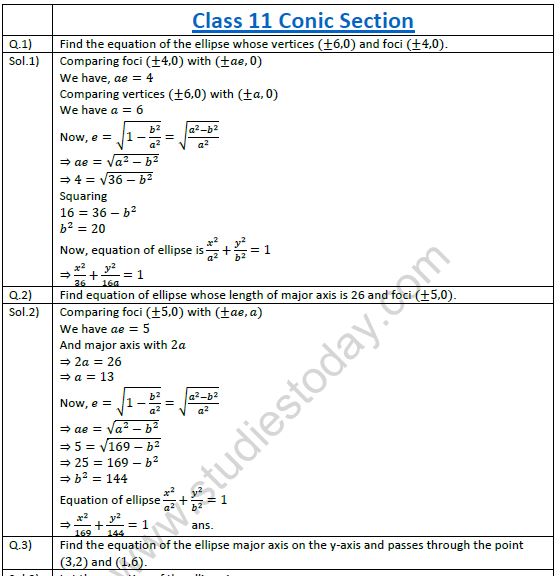
Question 1. Find the equation of the ellipse whose vertices (\pm 6,0) and foci (\pm 4,0).
Answer: Comparing the given foci \( (\pm 4, 0) \) with the standard form \( (\pm ae, 0) \), we find:
\( ae = 4 \)
Comparing the given vertices \( (\pm 6, 0) \) with the standard coordinates \( (\pm a, 0) \), we get:
\( a = 6 \)
The relationship between eccentricity \( e \), semi-major axis \( a \), and semi-minor axis \( b \) is given by:
\( e = \sqrt{1 - \frac{b^2}{a^2}} = \sqrt{\frac{a^2 - b^2}{a^2}} \)
\( \Rightarrow ae = \sqrt{a^2 - b^2} \)
Substituting \( ae = 4 \) and \( a = 6 \) into the formula:
\( 4 = \sqrt{36 - b^2} \)
Squaring both sides:
\( 16 = 36 - b^2 \)
\( \Rightarrow b^2 = 20 \)
The standard equation for a horizontally oriented ellipse is:
\( \frac{x^2}{a^2} + \frac{y^2}{b^2} = 1 \)
Substituting \( a^2 = 36 \) and \( b^2 = 20 \), we get the final equation:
\( \frac{x^2}{36} + \frac{y^2}{20} = 1 \).
In simple words: Since the foci and vertices lie along the x-axis, this is a horizontal ellipse. We find the semi-major axis length to be 6 and use the distance from the center to the foci to determine the semi-minor axis, giving us the final standard equation.
Exam Tip: Always make sure to confirm whether the major axis is horizontal or vertical. Foci of the form \( (\pm c, 0) \) indicate a horizontal major axis along the x-axis, which corresponds to the standard equation \( \frac{x^2}{a^2} + \frac{y^2}{b^2} = 1 \).
Question 2. Find equation of ellipse whose length of major axis is 26 and foci (\pm 5,0).
Answer: Comparing the given foci \( (\pm 5, 0) \) with the standard form \( (\pm ae, 0) \), we obtain:
\( ae = 5 \)
Since the length of the major axis is given as 26:
\( 2a = 26 \Rightarrow a = 13 \)
Using the standard eccentricity relation for an ellipse:
\( ae = \sqrt{a^2 - b^2} \)
Substituting our values into the formula:
\( 5 = \sqrt{13^2 - b^2} \)
\( \Rightarrow 5 = \sqrt{169 - b^2} \)
Squaring both sides:
\( 25 = 169 - b^2 \)
\( \Rightarrow b^2 = 144 \)
The equation of the ellipse is:
\( \frac{x^2}{a^2} + \frac{y^2}{b^2} = 1 \)
Substituting \( a^2 = 169 \) and \( b^2 = 144 \):
\( \frac{x^2}{169} + \frac{y^2}{144} = 1 \).
In simple words: We can easily find the horizontal radius \( a = 13 \) from the major axis length of 26. Then we use the distance from the center to the foci \( c = 5 \) to solve for \( b^2 = 144 \) and write the standard equation.
Exam Tip: Do not confuse the total length of the major axis \( 2a \) with the semi-major axis \( a \). Always divide the given length of the major axis by 2 first to get the value of \( a \).
Question 3. Find the equation of the ellipse major axis on the y-axis and passes through the point (3,2) and (1,6).
Answer: Since the major axis of the ellipse lies along the Y-axis, the standard equation is:
\( \frac{x^2}{b^2} + \frac{y^2}{a^2} = 1 \)
Substituting the coordinates of the point \( (3, 2) \) into the equation:
\( \frac{9}{b^2} + \frac{4}{a^2} = 1 \)
\( \Rightarrow 9a^2 + 4b^2 = a^2b^2 \dots(i) \)
Substituting the coordinates of the point \( (1, 6) \) into the equation:
\( \frac{1}{b^2} + \frac{36}{a^2} = 1 \)
\( \Rightarrow a^2 + 36b^2 = a^2b^2 \dots(ii) \)
Equating equations \( (i) \) and \( (ii) \):
\( 9a^2 + 4b^2 = a^2 + 36b^2 \)
\( \Rightarrow 8a^2 = 32b^2 \)
\( \Rightarrow a^2 = 4b^2 \)
Now, substitute \( a^2 = 4b^2 \) back into equation \( (i) \):
\( 9(4b^2) + 4b^2 = (4b^2)b^2 \)
\( \Rightarrow 36b^2 + 4b^2 = 4b^4 \)
\( \Rightarrow 40b^2 = 4b^4 \)
Since \( b^2 \neq 0 \), we divide by \( 4b^2 \):
\( b^2 = 10 \)
Using \( a^2 = 4b^2 \), we get:
\( a^2 = 4(10) = 40 \)
Therefore, the equation of the ellipse is:
\( \frac{x^2}{10} + \frac{y^2}{40} = 1 \).
In simple words: Since the ellipse is vertical, the denominator under \( y^2 \) must be larger. By substituting both given points into the equation, we can find a relationship between \( a^2 \) and \( b^2 \), which lets us solve for both values and write the final equation.
Exam Tip: For vertical ellipses where the major axis is along the Y-axis, always set up your equation as \( \frac{x^2}{b^2} + \frac{y^2}{a^2} = 1 \) where \( a^2 > b^2 \). This ensures that the larger denominator is correctly associated with the y-coordinate.
Question 4. Find e, vertices, foci, LR, length of transverse axis, Conjugate axis and equation of directrix of given hyperbola 5y^2 - 9x^2 = 36.
Answer: The given equation of the hyperbola is:
\( 5y^2 - 9x^2 = 36 \)
\( \Rightarrow -9x^2 + 5y^2 = 36 \)
Dividing both sides by 36 to convert it to standard form:
\( -\frac{x^2}{4} + \frac{y^2}{\frac{36}{5}} = 1 \)
\( \Rightarrow -\frac{x^2}{2^2} + \frac{y^2}{\left(\frac{6}{\sqrt{5}}\right)^2} = 1 \)
Comparing this with the standard equation of a vertical (conjugate) hyperbola \( -\frac{x^2}{a^2} + \frac{y^2}{b^2} = 1 \), we get:
\( a = 2 \) and \( b = \frac{6}{\sqrt{5}} \). Now, we calculate the required properties:
1) Centre: \( (0, 0) \)
2) Eccentricity (\( e \)):
\( e = \sqrt{1 + \frac{a^2}{b^2}} = \sqrt{1 + \frac{4}{\frac{36}{5}}} = \sqrt{1 + \frac{20}{36}} = \sqrt{1 + \frac{5}{9}} = \sqrt{\frac{14}{9}} = \frac{\sqrt{14}}{3} \)
3) Vertices:
\( (0, \pm b) = \left(0, \pm \frac{6}{\sqrt{5}}\right) \)
4) Foci:
\( (0, \pm be) = \left(0, \pm \frac{6}{\sqrt{5}} \times \frac{\sqrt{14}}{3}\right) = \left(0, \pm \frac{2\sqrt{14}}{\sqrt{5}}\right) \)
5) Latus Rectum (LR):
\( \text{LR} = \frac{2a^2}{b} = \frac{2 \times 4}{\frac{6}{\sqrt{5}}} = \frac{8\sqrt{5}}{6} = \frac{4\sqrt{5}}{3} \)
6) Length of Transverse Axis:
\( 2b = 2 \left(\frac{6}{\sqrt{5}}\right) = \frac{12}{\sqrt{5}} \)
7) Length of Conjugate Axis:
\( 2a = 2(2) = 4 \)
8) Equations of Directrices:
\( y = \pm \frac{b}{e} = \pm \frac{\frac{6}{\sqrt{5}}}{\frac{\sqrt{14}}{3}} = \pm \frac{18}{\sqrt{70}} \).
In simple words: We divide by 36 to write the hyperbola's equation in standard form. Since the x-term is negative, this is a vertical hyperbola. We then extract \( a \) and \( b \) to compute all of its features.
Exam Tip: For vertical hyperbolas of the form \( -\frac{x^2}{a^2} + \frac{y^2}{b^2} = 1 \), the transverse axis lies along the y-axis, meaning the vertices are \( (0, \pm b) \) and the eccentricity formula uses \( \frac{a^2}{b^2} \) under the radical.
Question 5. Find the equation of hyperbola with vertices (\pm 2,0) and foci (\pm 3,0).
Answer: Since the vertices and foci lie along the horizontal axis, this is a horizontal (transverse) hyperbola.
Comparing the vertices \( (\pm 2, 0) \) with \( (\pm a, 0) \), we find:
\( a = 2 \)
Comparing the foci \( (\pm 3, 0) \) with the standard form \( (\pm ae, 0) \), we get:
\( ae = 3 \)
Using the relation for the eccentricity of a hyperbola:
\( ae = \sqrt{a^2 + b^2} \)
Substitute our values into the formula:
\( 3 = \sqrt{4 + b^2} \)
Squaring both sides:
\( 9 = 4 + b^2 \)
\( \Rightarrow b^2 = 5 \)
The equation of the hyperbola is:
\( \frac{x^2}{a^2} - \frac{y^2}{b^2} = 1 \)
Substituting \( a^2 = 4 \) and \( b^2 = 5 \):
\( \frac{x^2}{4} - \frac{y^2}{5} = 1 \).
In simple words: With both vertices and foci on the x-axis, we have a horizontal hyperbola. We identify \( a = 2 \) and \( ae = 3 \), calculate \( b^2 = 5 \), and write the final standard equation.
Exam Tip: For any hyperbola, \( c^2 = a^2 + b^2 \) where \( c = ae \). This is a direct consequence of the eccentricity relationship, so you can solve for \( b^2 \) using the simple formula \( b^2 = c^2 - a^2 \).
Question 6. Find the equation of hyperbola with foci (0, \pm 13) and conjugate axis is of length 24.
Answer: Since the foci \( (0, \pm 13) \) lie on the Y-axis, this is a vertical (conjugate) hyperbola.
Comparing the foci with \( (0, \pm be) \), we find:
\( be = 13 \)
The length of the conjugate axis is given as 24, which means:
\( 2a = 24 \Rightarrow a = 12 \)
Using the standard eccentricity relation for a vertical hyperbola:
\( be = \sqrt{b^2 + a^2} \)
Substituting our values into the formula:
\( 13 = \sqrt{b^2 + 144} \)
Squaring both sides:
\( 169 = b^2 + 144 \)
\( \Rightarrow b^2 = 25 \)
The standard equation of a vertical hyperbola is:
\( -\frac{x^2}{a^2} + \frac{y^2}{b^2} = 1 \)
Substituting \( a^2 = 144 \) and \( b^2 = 25 \):
\( -\frac{x^2}{144} + \frac{y^2}{25} = 1 \).
In simple words: With foci on the y-axis, we have a vertical hyperbola. We use the conjugate axis length to get \( a = 12 \) and the focus distance to solve for \( b^2 = 25 \), then write the standard vertical hyperbola equation.
Exam Tip: For vertical hyperbolas, the transverse axis is along the y-axis and the conjugate axis is along the x-axis, meaning the conjugate axis length is \( 2a \) and the transverse axis length is \( 2b \).
Question 7. Find the equation of hyperbola with foci (\pm 3\sqrt{5}, 0) and latus rectum is of length 8.
Answer: Since the foci \( (\pm 3\sqrt{5}, 0) \) lie on the X-axis, we have a horizontal hyperbola.
Comparing the foci with \( (\pm ae, 0) \), we find:
\( ae = 3\sqrt{5} \)
The length of the latus rectum is 8, which gives:
\( \frac{2b^2}{a} = 8 \Rightarrow b^2 = 4a \dots(i) \)
Using the relation:
\( ae = \sqrt{a^2 + b^2} \)
Substitute \( ae = 3\sqrt{5} \) and \( b^2 = 4a \):
\( 3\sqrt{5} = \sqrt{a^2 + 4a} \)
Squaring both sides:
\( 45 = a^2 + 4a \)
\( \Rightarrow a^2 + 4a - 45 = 0 \)
\( \Rightarrow (a + 9)(a - 5) = 0 \)
This gives \( a = -9 \) or \( a = 5 \).
Since \( a \) represents a distance (semi-transverse axis), it must be positive. Thus, we reject \( a = -9 \) (which would also lead to an impossible \( b^2 = -36 \)).
For \( a = 5 \), using equation \( (i) \):
\( b^2 = 4(5) = 20 \)
The equation of the hyperbola is:
\( \frac{x^2}{a^2} - \frac{y^2}{b^2} = 1 \)
Substituting \( a^2 = 25 \) and \( b^2 = 20 \):
\( \frac{x^2}{25} - \frac{y^2}{20} = 1 \).
In simple words: Foci on the x-axis indicate a horizontal hyperbola. We combine the focal distance and the latus rectum length to form a quadratic equation in \( a \). We solve this to get \( a = 5 \) and then compute \( b^2 = 20 \).
Exam Tip: Discard any negative values for \( a \) or any solutions that would yield a negative value for \( b^2 \), since the square of a real number cannot be negative.
Question 8. Find the equation hyperbola with foci (0, \pm\sqrt{10}); passing through (2,3).
Answer: Since the foci lie on the Y-axis, we have a vertical hyperbola. Let its equation be:
\( -\frac{x^2}{a^2} + \frac{y^2}{b^2} = 1 \)
Since the point \( (2, 3) \) lies on this hyperbola:
\( -\frac{4}{a^2} + \frac{9}{b^2} = 1 \)
\( \Rightarrow -4b^2 + 9a^2 = a^2b^2 \dots(i) \)
Comparing the given foci \( (0, \pm\sqrt{10}) \) with \( (0, \pm be) \), we find:
\( be = \sqrt{10} \)
Using the vertical hyperbola relationship \( be = \sqrt{b^2 + a^2} \):
\( \sqrt{10} = \sqrt{b^2 + a^2} \)
Squaring both sides:
\( 10 = b^2 + a^2 \)
\( \Rightarrow b^2 = 10 - a^2 \)
Substitute \( b^2 = 10 - a^2 \) into equation \( (i) \):
\( -4(10 - a^2) + 9a^2 = a^2(10 - a^2) \)
\( \Rightarrow -40 + 4a^2 + 9a^2 = 10a^2 - a^4 \)
\( \Rightarrow a^4 + 3a^2 - 40 = 0 \)
Factoring the quadratic equation in \( a^2 \):
\( (a^2 + 8)(a^2 - 5) = 0 \)
Since \( a^2 \) must be a positive real number, we reject \( a^2 = -8 \). Thus:
\( a^2 = 5 \)
Now, we calculate \( b^2 \):
\( b^2 = 10 - 5 = 5 \)
Therefore, the equation of the hyperbola is:
\( -\frac{x^2}{5} + \frac{y^2}{5} = 1 \).
In simple words: Foci on the y-axis show we have a vertical hyperbola. We substitute the point (2,3) to get one relation, and use the focal distance to get another relation \( a^2 + b^2 = 10 \). Solving these together gives \( a^2 = 5 \) and \( b^2 = 5 \).
Exam Tip: When solving a bi-quadratic equation (such as \( a^4 + 3a^2 - 40 = 0 \)), treat \( a^2 \) as a single variable. Remember to reject the negative value since the square of any real semi-axis must be positive.
Miscellaneous
Question 9. A beam is supported at its ends by supports which are 12 meters a part. Since the load is concentrated at the centre, there is a deflection of 3 cm at the centre and the deflected beam is in the shape of a parabola. How far from the centre is the deflection 1cm?
Answer: Let the vertex of the parabola be at the lowest point (the center of the deflection), which we choose as the origin \( (0,0) \).
The span of the beam is 12 m = 1200 cm, so the half-span is 600 cm.
The maximum deflection at the center is 3 cm. Therefore, the ends of the beam are located at \( A(600, 3) \) and \( A'(-600, 3) \).
The standard equation of an upward-opening vertical parabola is:
\( x^2 = 4ay \)
Since the point \( A(600, 3) \) lies on this parabola:
\( 600^2 = 4a(3) \)
\( \Rightarrow 360000 = 12a \)
\( \Rightarrow a = 30000 \)
Substituting \( a = 30000 \) back into the parabola equation:
\( x^2 = 4(30000)y \)
\( \Rightarrow x^2 = 120000y \)
We want to find how far from the center the deflection is 1 cm. Since the maximum deflection at the center is 3 cm, a deflection of 1 cm means the vertical height \( y \) of the beam relative to the vertex is:
\( y = 3 - 1 = 2\text{ cm} \)
Let \( B(x, 2) \) be this point. Substituting \( y = 2 \) into our parabola equation:
\( x^2 = 120000(2) \)
\( \Rightarrow x^2 = 240000 \)
\( \Rightarrow x = \sqrt{240000} = 200\sqrt{6}\text{ cm} = 2\sqrt{6}\text{ m} \).
Therefore, the required distance from the center is \( 2\sqrt{6}\text{ m} \). In simple words: Treating the center of the deflected beam as the origin, the end of the beam is 600 cm horizontally and 3 cm vertically away. We use this to set up the parabolic equation, and then calculate the distance from the center where the deflection leaves a 2 cm vertical gap.
Exam Tip: Be sure to convert all measurements into the same unit (meters or centimeters) before starting your calculations. In this problem, keeping everything in centimeters avoids dealing with awkward decimals.
Question 10. The cable of a uniformly loaded suspension bridge hangs on the form of a parabola. The roadway which is horizontal & 100 m long is supported by vertical wire attached to the cable, the longest wire being 30m and the shortest being 6m. Find the length of a supporting wire attached to the roadway 18m from the middle.
Answer: Let the vertex of the parabola be at the origin \( (0,0) \), which is at the lowest point of the cable (6 m above the roadway).
Since the roadway is 100 m long, the half-length of the bridge is 50 m.
The height of the vertical wire at the end is 30 m, so the height relative to the vertex is:
\( 30 - 6 = 24\text{ m} \)
Thus, the coordinates of the end of the cable are \( A(50, 24) \).
Let the equation of the parabola be:
\( x^2 = 4ay \dots(i) \)
Since the point \( A(50, 24) \) lies on the parabola:
\( 50^2 = 4a(24) \)
\( \Rightarrow 2500 = 96a \)
\( \Rightarrow a = \frac{2500}{96} = \frac{625}{24} \)
Substituting this back into equation \( (i) \):
\( x^2 = 4 \left(\frac{625}{24}\right) y \)
\( \Rightarrow x^2 = \frac{2500}{24}y \)
We want to find the length of the supporting wire 18 m from the middle. Let \( y \) be the height of the cable at this point relative to the vertex, so the point \( B(18, y) \) lies on the parabola:
\( 18^2 = \frac{2500}{24}y \)
\( \Rightarrow 324 = \frac{2500}{24}y \)
\( \Rightarrow y = \frac{324 \times 24}{2500} \approx 3.11\text{ m} \).
Since the shortest wire at the vertex is 6 m long, the total length of the supporting wire is:
\( \text{Total length} = 6 + y = 6 + 3.11 = 9.11\text{ m} \). In simple words: We place our parabola's vertex at the lowest point of the cable. Since this lowest point is 6m above the road, a 30m cable at the end has a relative height of 24m. We use this to establish the equation, solve for the relative height at 18m, and add the original 6m back.
Exam Tip: Always remember to add the length of the shortest wire (\( 6\text{ m} \)) to the value of \( y \) at the end of the calculation to obtain the true length of the supporting wire from the roadway.
Free study material for Mathematics
Chapter 10 Conic Sections Printable Worksheets and Exercises for Class 11 Mathematics
Download Chapter Worksheets: Class 11 Mathematics
Explore reliable practice questions for Chapter 10 Conic Sections tailored for Class 11 Mathematics learners. Use these structured worksheets to evaluate exam preparedness and strengthen problem-solving skills throughout the 2026 academic session.
Concept Clarification for Chapter 10 Conic Sections
Designed around the official curriculum for Class 11 Mathematics, these practice sheets guarantee standard compliance. Reviewing step-by-step solutions after completion sharpens your accuracy and clarifies complex sub-topics within Chapter 10 Conic Sections.
Effective Revision Strategies for School Exams
Consistent engagement with these exercises builds familiarity with recurring exam themes. If specific areas within Chapter 10 Conic Sections cause trouble, utilize our dedicated NCERT solutions for Class 11 Mathematics to clear up doubts immediately.
FAQs
You can download the latest chapter-wise printable worksheets for Class 11 Mathematics Chapter 10 Conic Sections for free from StudiesToday.com. These have been made as per the latest CBSE curriculum for this academic year.
Yes, Class 11 Mathematics worksheets for Chapter 10 Conic Sections focus on activity-based learning and also competency-style questions. This helps students to apply theoretical knowledge to practical scenarios.
Yes, we have provided solved worksheets for Class 11 Mathematics Chapter 10 Conic Sections to help students verify their answers instantly.
Yes, our Class 11 Mathematics test sheets are mobile-friendly PDFs and can be printed by teachers for classroom.
For Chapter 10 Conic Sections, regular practice with our worksheets will improve question-handling speed and help students understand all technical terms and diagrams.