

Download Class 3 Science Worksheets for All Chapters
Review targeted practice sets for Class 3 Science All Chapters. Built according to official educational guidelines for the 2026-27 academic year, these downloadable worksheets support daily revision and core concept reinforcement.
Access All Chapters Questions and Exercises
Access the complete worksheet PDF for All Chapters below. Regular practice with these targeted questions builds familiarity with standard exam patterns and helps secure higher marks in final Science evaluations.
Mass (M)
• Mass is the amount of matter in an object.
• It is measured by beam balance.
• Its SI unit is kilogram (kg).
Weight (W)
• Weight is the vertical force exerted by a mass as a result of gravity.
• It is measured by spring balance and expressed by Newton(N).
• Weight (w) =mass (m) ×gravity (g).
Force(F)
• Force is a push or a pull of an object.
• It is measured by Newton meter
• There are many types of forces, such as Gravitational force, Magnetic force, Frictional force etc.
Pressure (P)
• Pressure is the effect that occurs when a force is applied on a surface.
• Pressure(P)= Force / area or P= F÷A
• It is expressed by Pascal(pa) =N/m2
Energy (E)
• Energy is the capacity to do wok.
• It is measured by calorimeter.
• The SI unit of work is Joule (J).
There are 3 types of energy, such as, kinetic energy, potential energy, and mechanical energy.
Waves
• A wave is a disturbance that travels through space and time, usually by the transfer of energy.
• There are 2 types of waves. They are:
1.Up and down waves. E.g. Sound wave, Transverse wave etc.
2.Back and forth wave. E.g. light wave.
• Crest is the highest point of a wave.
• Through is the lowest point of a wave.
Light wave
• Light is a form of energy that can be obtained from other forms of energy. It produces sensation of sight when it falls up on an object and our eyes.
Sources of light
1. Natural light sources are naturally existing bodies or objects that emit light of their own, such as, the sun, the moon, Stars etc.
2.Artificial (manmade) light sources are manmade (artificial) objects that give out light due to changes within their body, such as, light torch, light bulb, candle etc.
Materials
1 Transparent Substances
• These are substances through which light can pass completely. They cast no shadow at all. We see things through transparent materials. Example Water, Clear glass, Polythene etc.
2 Translucent Substances
• These are substances through which light can pass partially. They cast faint shadows. Example- tracing paper, oily paper, stained glass etc.
1.Opaque Substances
• These are materials which do not allow light to pass through them. They cast perfect shadows. We cannot see things through opaque objects. Examples Card board, Wood, Soil, Metal, Stones etc.
Properties of light
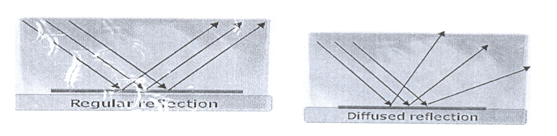
1. Reflection of light is the bouncing of light rays after falling on an object.
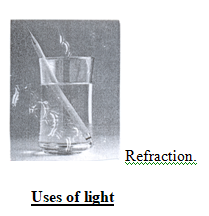
Refraction is the bending of light rays when the light passes from one medium to another.
Uses of light
• Light is used to see things easily with our eye. The image of an object is formed on the retina of your eye.
Sound
• Sound is the particular auditory effect produced by vibrating object.
• It can be transferred through a solid, a liquid, or a gas but not in vacuum. It travels fast in solid and slowest in gas.
• Sound wave makes your ear drum vibrate.
•Auditory range is the range of frequency that you can hear.
• Steps of hearing.
Objects → Air → ear drum → ear bones → hairs vibrate in the vibrates vibrates vibrates vibrates cochlea, sending a message to the brain.
Electricity
• Electric energy is a form of energy which can be obtained from other forms of energy. It can also be converted to other forms of energy.
Electric current
• Electric current is the movement of charges per unit time. Substances are grouped into insulators, conductors and semi conductors based on their ability to pass (allow the passage) of electric current.
1. Conductors are substances that allow the passage of electric current easily. They contain freely moving electrons.
Example- metal
2. Insulators are substances that do not allow the passage of electric current charge through them easily. They contain no freely moving electrons. Examples- non-metals
3. Semi conductors are substances that allow the flow of only small current (charge) through them. They contain few freely moving electrons. Example – silicon
Voltage
The difference of electric charges a cross the terminals of a battery is called voltage. Voltage is measured in a unit called volt (V).
Voltage = Eclectic current x Electric resistance
Symbolically V = (I) x (R) where I = current, V= voltage, R= resistance
Electric circuit
An electric circuit is a closed path along which the flow of electric current takes place. It consists of four basic parts (components).
1, Dry cell is part of electric circuit which is source of potential difference.
2. Connecting wire conduct electric current.
3. Electric bulb part of electric circuit which converts electric energy into heat and light.
4. Switch is part of electric circuit which off or on the flow of electric current.
Resistors (lamps) in parallel and series connection
There are two electrical circuits. These circuits can be connected in two ways in an electric circuit. 1. Series Circuits 2. Parallel circuits
Magnet
• A magnet is a device that attracts iron and products a magnetic field.
There are two types of magnet.
1. Bar magnet An electromagnet
• A magnet has two poles.
2. North pole (N) South pole(S)
• Properties of magnetic poles
1.Opposite poles repel each other.
2.Similar poles attract each other
Write the correct answer for the following questions
1.What instrument is used to measured:
Force_________ Energy__________ C. Atmospheric pressure _________
2.Write the five things that the forces can make objects to do.
1.________________ 3._________________ 5._____________________2.________________ 4.__________________
3.Write the SI unit for each of the following.
Pressure ________ B. Energy _______ C. Force________
4.List the three major properties of light.
1._______________ 2._______________ 3.__________________
5.Write at least three examples for types of equipment.
1.____________ 2._____________ 3.______________
1.____________ 2._____________ 3.______________
1.____________ 2._____________ 3.______________
6.What kind of lens is found in our eyes? _____________________________.
7.At what part of our eye is the image of an object formed?___________.
8.Write some sources of light.
Natural sources of light. B. Manmade source of light.
1._____________________ 1. ___________________
2._____________________ 2.___________________
9. Define the following terms.
Sound __________________________________________________________________
Light ____________________________________________________________________
Reflection_______________________________________________________________
Refraction______________________________________________________________
10. How sound can be formed? _______________________________________________.
11. Write the process of hearing of sounds by your ear.
12.What is auditory range?___________________________________________________
13.Write the transmission mediums of sound.
1.___________________ 2.__________________ 3.________________________
14. Write the major parts of ear.
1._____________________ 3. _________________ 5.___________________
2 ._____________________ 4.___________________
15. Define the following terms.
Insulator ________________________________________________________________
Conductor_______________________________________________________________
Circuit __________________________________________________________________
Magnets_________________________________________________________________
Gravity _________________________________________________________________
Light year_______________________________________________________________
16. List the two major types of circuits.
A._________________________________ B.____________________________
17. Write the uses of Ammeter and Voltmeter.
A. Ammeter. _____________________ B. Voltmeter_______________________
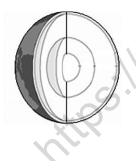
Water cycle
Draw the given diagram ,label it and answer the given question.
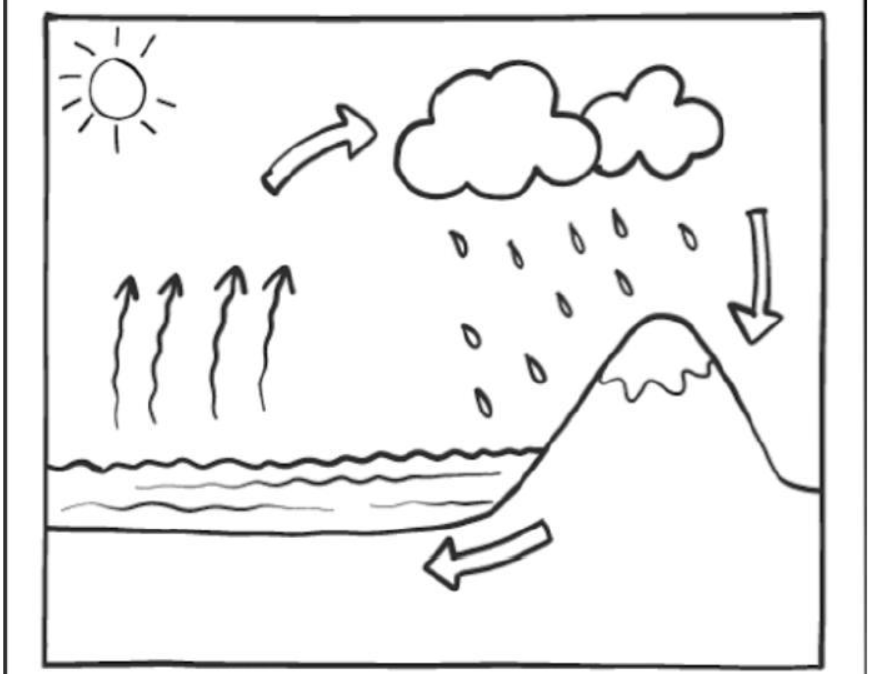
1. Water from the water bodies receive the heat of sun and get converted in to ______
2. Water vapour rises in to _____.
3. On cooling water vapour gets converted in to tiny drops of _______
4. These tiny drops cling together to form_______
5. When clouds become heavy they fall down as _______.
6. The process of changing water in to water vapour is known as ________.
7. The process of changing water vapour in to water is known as________.
8. The process of changing ice in to water is known as________.
9. The process of changing water in to ice is known as________.
Please click on below link to download CBSE Class 3 Science Worksheet G
All Chapters Practice Sheet and Solutions for Class 3 Science
CBSE Practice Material: Class 3 Science All Chapters
Review targeted practice exercises for Class 3 Science All Chapters. Curated to match official CBSE guidelines, these downloadable PDF sheets support daily revision and core concept reinforcement.
NCERT-Aligned Questions and Solutions
Built using the official NCERT book for Class 3 Science, these practice materials provide reliable academic guidance. Pair your practice with our recommended NCERT solutions to master optimal problem-solving approaches.
Next Steps in Your Exam Preparation
Follow up your worksheet practice by attempting the interactive online Science MCQ test for this chapter to evaluate your execution speed. All platform resources are free to access.
FAQs
You can download the teacher-verified PDF for CBSE Class 3 Science Worksheet Set 07 from StudiesToday.com. These practice sheets for Class 3 Science are designed as per the latest CBSE academic session.
Yes, our CBSE Class 3 Science Worksheet Set 07 includes a variety of questions like Case-based studies, Assertion-Reasoning, and MCQs as per the 50% competency-based weightage in the latest curriculum for Class 3.
Yes, we have provided detailed solutions for CBSE Class 3 Science Worksheet Set 07 to help Class 3 and follow the official CBSE marking scheme.
Daily practice with these Science worksheets helps in identifying understanding gaps. It also improves question solving speed and ensures that Class 3 students get more marks in CBSE exams.
All our Class 3 Science practice test papers and worksheets are available for free download in mobile-friendly PDF format. You can access CBSE Class 3 Science Worksheet Set 07 without any registration.