

Class 10 Social Science Practice Set: Work Life And Leisure
Access printable practice worksheets for Work Life And Leisure designed to align with the 2026-27 academic syllabus for Class 10 Social Science. These structured exercises help students evaluate their conceptual understanding and improve exam readiness.
Download Work Life And Leisure Worksheet PDF
View or download the dedicated Work Life And Leisure practice resource below. Engaging with these objective and subjective questions daily ensures continuous academic progress and mastery of the 2026-27 curriculum.
TOPIC/CHAPTER-07 : PRINT CULTURE
SUMMARY: In this chapter we will look at the development of print, from its beginnings in East Asia to its expansion in Europe and in India. We will understand the impact of the spread of technology and consider how social lives and cultures changed with the coming of print. We take for granted this world of print and often forget that there was a time before print. We may not realize that print itself has a history which has, in fact, shaped our contemporary world. What is this history? When did printed literature begin to circulate? How has it helped create the modern world? Lets delve into answering these questions.
ANCIENT PRINT CULTURE
Question
1 Trace the earliest development of Printing technology in China in 594A.D.
ANS.
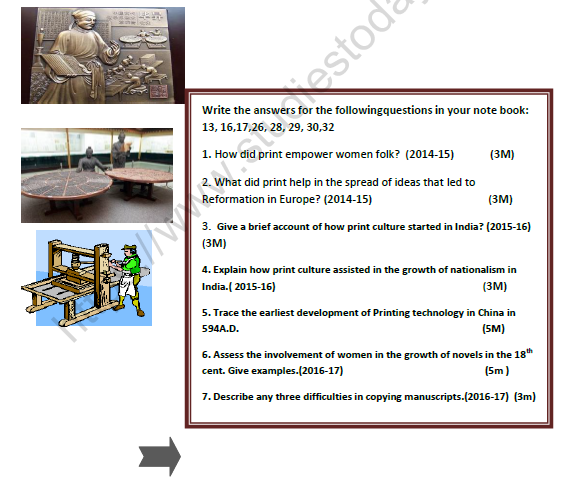
1. The earliest kind of print technology was developed in China, Japan and Korea. This was a system of hand printing. From AD 594 onwards, books in China were printed by rubbing paper against the inked surface of woodblocks.
2. As both sides of the thin, porous sheet could not be printed, the traditional Chinese ‘accordion book’were made which was folded and stitched at the side.
3. Text books for the civil service examination were printed in vast numbers under the sponsorship of the imperial state.
4. From the sixteenth century, the number of examination candidates went up and that increased the volume of print.
5. The Chinese Buddhist Missionaries also have contributed to the development of print.
2 Describe the development of print materials in urban China in the seventeenth century. OR
How did the use of print diversify in the 17TH cent. China. (2010-11)
Ans
1. By the seventeenth century, as urban culture bloomed in China, the uses of print diversified. Print was no longer used just by scholar officials. Merchants used print in their everyday life, as they collected trade information.
2. Reading increasingly became a leisure activity. The new readership preferred fictional narratives, poetry, autobiographies, anthologies of literary masterpieces, and romantic plays.
3. Many women began publishing their poetry and plays. Wives of scholar-officials published their works and courtesans wrote about their lives.
4. Western printing techniques and mechanical presses were imported in the late nineteenth century as Western powers established their outposts in China.
5. Shanghai became the hub of the new print culture, catering to the Western-style schools.
3 What is the contribution of Japanese artist Kitagawa Utamaro in the development of print in Japan?
4 Discuss the development of printing in Japan. (2012-13)
Ans
1. Buddhist missionaries from China introduced hand-printing technology into Japan around AD 768-770. The oldest Japanese book, printed in AD 868, is the Buddhist Diamond Sutra, containing six sheets of text and woodcut illustrations.
2. In medieval Japan, poets and prose writers were regularly published, and books were cheap and abundant.
3. In the late eighteenth century, in the flourishing urban circles at Edo (later to be known as Tokyo), illustrated collections of paintings depicted an elegant urban culture.
5 How did the use of paper and print reach Europe?
ANS.
1. For centuries, silk and spices from China flowed into Europe through the silk route.
2. In the eleventh century, Chinese paper reached Europe via the same route. Paper made possible the production of manuscripts, carefully written by scribes.
3. In 1295, Marco Polo, a great explorer, returned to Italy after many years of exploration in China. He brought the knowledge of Woodblock printing to Europe.
4. Italians began producing books with woodblocks, and soon the technology spread to other parts of Europe.
5. Because handwritten works were expensive merchants and students in the university towns bought the cheaper printed copies.
6 Describe three short comings of manuscripts that were overcome by the printing press.OR
Woodblocks printing became more and more popular in Europe. Give reasons. (2013-14)
ANS.
1. The production of handwritten manuscripts could not satisfy the ever-increasing demand for books.
2. Copying was an expensive, laborious and time-consuming business. Manuscripts were fragile, awkward to handle, and could not be carried around or read easily. Their circulation
therefore remained limited. With the growing demand for books, woodblock printing gradually became more and more popular.
3. By the early fifteenth century, woodblocks were being widely used in Europe to print textiles, playing cards, and religious pictures etc.
7 Describe the development of Johann Gutenberg’s Printing Press.(2013-14)
ANS.
1. Gutenberg was the son of a merchant and grew up on a large agricultural estate.
2. From his childhood he had seen wine and olive presses. Subsequently, he learnt the art of polishing stones, became a master goldsmith, and also acquired the expertise to create lead moulds used for making trinkets.
3. Drawing on this knowledge, Gutenberg adapted the existing technology to design his innovation. The olive press provided the model for the printing press, and moulds were used for casting the metal types for the letters of the alphabet.
4. Johann Guttenberg developed the first –known printing press in the 1430s.By 1448, Gutenberg perfected the system.
5. The first book he printed was the Bible. About 180 copies were printed and it took three years to produce them.
8. Explain briefly the ‘Print Revolution’ in Europe.
ANS.
1. In the hundred years between 1450 and 1550, printing presses were set up in most countries.
2. The second half of the fifteenth century saw 20 million copies of printed books flooding the markets in Europe.
3. The number of printed books went up in the sixteenth century to about 200 million copies. This shift from hand printing to mechanical printing led to the print revolution.
4. Print influenced the perceptions of people on religion, society and politics and opened up new ways of looking at things.
5. Print created the possibility of wide circulation of ideas, and introduced a new world of debate and discussion.
9. How did a reading public emerge in Europe in the place of a hearing public?
OR How did oral culture enter print and how was print material orally transmitted? (any 3 points) (2010-11)
ANS.
1. Printing Press reduced the cost of printing. With the printing press, a new reading public emerged. .
2. Books flooded the market, reaching out to an ever-growing readership. Access to books created a new culture of reading.
3. Printed books could reach out to wider sections of people. If earlier there was a hearing public, now a reading public came into being.
4. For the common people, the printers began publishing popular ballads and folk tales illustrated with pictures. These were read and recited at villages and taverns in towns.
10.“Not everyone welcomed the printed book, and those who did also had fears about it”. Comment.
OR Why did some people fear the effect of easily available printed books?
ANS.
1. Many were apprehensive of the effects that, the easier access to the printed word and the wider circulation of books, could have on people’s minds.
2. It was feared that if there was no control over what was printed and read then rebellious and irreligious thoughts might spread. If that happened the authority of ‘valuable’ literature would be destroyed.
3. Expressed by religious authorities and monarchs, as well as many writers and artists, this anxiety was the basis of widespread criticism of the new printed literature that had began to circulate.
11. Point out the effect of print on the religion (Protestant Reformation) in modern Europe. OR Why did Martin Luther say,” Printing is the ultimate gift of God and the greatest one.”? (2014- 15)
ANS.
1. In 1517, the religious reformer Martin Luther wrote Ninety Five Theses criticizing many of the practices and rituals of the Roman Catholic Church.
2. A printed copy of this was posted on a church door in Wittenberg. It challenged the Church to debate his ideas.
3.Luther’s writings were immediately reproduced in vast numbers and read widely. This lead to a division within the Church and to the beginning of the Protestant Reformation.
4.Luther’s translation of the New Testament sold 5,000 copies within a few weeks and a
Please click on below link to download CBSE Class 10 History Work Life And Leisure Worksheet Set B
Free study material for Social Science
Work Life And Leisure Practice Sheet and Solutions for Class 10 Social Science
Download Practice Sheet: Work Life And Leisure (Class 10 Social Science)
Explore reliable practice questions for Work Life And Leisure tailored for Class 10 Social Science learners. Use these structured worksheets to evaluate preparedness and strengthen problem-solving skills.
Concept Clarification for Work Life And Leisure
Each worksheet is structured around standard CBSE textbooks, allowing students to check their working steps and correct mistakes early in their revision.
Additional Study Resources for Class 10 Social Science
Follow up your worksheet practice by attempting the interactive online Social Science MCQ test for this chapter to evaluate your execution speed. All platform resources are free to access.
FAQs
You can download the teacher-verified PDF for CBSE Class 10 History Work Life And Leisure Worksheet Set 02 from StudiesToday.com. These practice sheets for Class 10 Social Science are designed as per the latest CBSE academic session.
Yes, our CBSE Class 10 History Work Life And Leisure Worksheet Set 02 includes a variety of questions like Case-based studies, Assertion-Reasoning, and MCQs as per the 50% competency-based weightage in the latest curriculum for Class 10.
Yes, we have provided detailed solutions for CBSE Class 10 History Work Life And Leisure Worksheet Set 02 to help Class 10 and follow the official CBSE marking scheme.
Daily practice with these Social Science worksheets helps in identifying understanding gaps. It also improves question solving speed and ensures that Class 10 students get more marks in CBSE exams.
All our Class 10 Social Science practice test papers and worksheets are available for free download in mobile-friendly PDF format. You can access CBSE Class 10 History Work Life And Leisure Worksheet Set 02 without any registration.