

Step-by-Step Textbook Solutions for Class 3 Mathematics Chapter 12 Can we share
Explore reliable textbook solutions for Chapter 12 Can we share tailored for Class 3 learners. Utilizing these Mathematics answers ensures thorough preparation and strengthens foundational knowledge before final NCERT evaluations.
Download Chapter 12 Can we share Textbook Solutions PDF
View or download the dedicated Chapter 12 Can we share solution resource below. Engaging with these textbook answers under focused study conditions ensures continuous academic progress and mastery of the 2026-27 curriculum for Mathematics.
1.
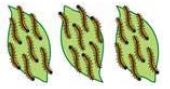
(a)There are ___ caterpillars.
Ans. 21 caterpillars.
(b) There are in ___ groups.
Ans. 3 groups.
(c) There are ___ caterpillars in each group.
Ans. (c) 7 caterpillars.
2.

(a) There are ___ laddoos.
Ans. 12 laddoos.
(b) They are in ___ groups.
Ans. 4 groups.
(c) There are __ laddoos in each group.
Ans. 3 ladoos.
3. Mummy bird brings 12 grains. How to distribute equally? Mummy bird starts by giving 1 grain to each baby. Then Mummy bird gives one grain to each baby. Each baby has got 2 grains now. How many grains are left?
Ans. 4 (As 12 – 4 – 4 = 4)
4. Now draw the jalebis on the plates below, so the plates, so that each plate has the same
number of jalebis.
Ans.

5. How many jalebis are there altogether?
Ans. 9 jalebis.
6. How many jalebis are there in each plate?
Ans. 3 jalebis.
7. Discuss in the class how you found the answer.
Ans. Take total jalebis 1 + 5 + 3 = 9
Now we want to place equally in 3 plates as 9 ÷ 3 = 3. So, put 3 jalebis in each plate.
8. If there are 60 bananas and two monkeys, how many will each monkey get?
Ans. 60 ÷ 2= 30 bananas.
9. Five friends found RS. 100. If they share it equally, how much will each get?
Ans. Rs, 100 ÷ 5 = Rs. 20
10. Hari Prashad has 30 metres of rope. He distributes it equally among his three children. Each child get ___ metres of rope.
Ans. 30 ÷ 3 = 10 metres of rope.
11. If there is 36 metres of rope, how much of rope will each child gets.
Ans. 36 ÷ 3 = 12 metres.
12. If there is 60 metres of rope, how much will each child get?
Ans. 60 ÷ 3 = 20.
13. Minku puts her 15 laddoos equally into 5 boxes.
(a) How many ladoos will there be in each box?
Ans. There will be 3 laddoos in each box. 15 ÷ 5 = 3.
(b) If she uses only 3 boxes, how many laddoos will there in each box?
Ans. There will be 5 laddoos in each box. 15 ÷ 3 = 5.
14. Share 25 bananas among 5 monkeys. How many bananas for each monkey?
Ans. 25 ÷ 5 = 5.
15. Share 12 balloons among 3 boys. How many balloons for each boy?
Ans. 12 v 3 =4. Every boy has 4 balloons.
16. There are 21 candles. Put them equally in 3 boxes. How many candles are there in each box?
Ans. 21 ÷ 3 = 7 candles.
17. There are 18 socks. How many girls can wear these socks?
Ans. 9 girls can wear these socks. 18 ÷ 2 = 9.
18. Raj has 36 minutes to make rotis. One roti takes 3 minutes. How many this can be make in this time?
Ans. He can make 12 rotis. 36 ÷ 3 = 12.
19. These are 24 footmarks of goats. So how many goats were there?
Ans. There are 6 goats, 24 ÷ 4= 6.
20. Some girls are playing a game with both their hands. The girls who are playing have 60 fingers altogether. How many girls are playing this game?
Ans. There are 10 girls. 60 ÷ 10 = 6.
21. Lakshmi has 27 potatoes to sell. There men came and bought equal amount of potatoes.
Ans. 27 ÷ 3 = 9 kg of potatoes.
22. In how many jumps will the frog reach 30?
Ans. 30 ÷ 2 = 15 jumps.
23. In how many jumps will the squirrel reach 27?
Ans. 27 ÷ 3 = 9 jumps.
24. Which number will the kangaroo reach in two jumps.
Ans. 30 x 2 = 60.
25. Who all will meet at the number 18?
Ans. Rabbit, Horse.
26. Will the rabbit ever be at number 18?
Ans. No.
27. How many jumps of the rabbit equal one jump of the horse?
Ans. 15 ÷ 5 = 3 jumps.
28. How many jumps of the horse equals two jumps of the kangaroo?
Ans. In two jumps of the kangaroo reach = 30 x 2 = 60.
Number of jumps taken by horse to reach 60 = 60 ÷ 15 = 4.
29. Which is the smallest number where the frog and the squirrel will meet?
Ans. The smallest number where the frog and the squirrel will meet is 2 x 3 = 6.
Free study material for Mathematics
Mathematics Class 3 Curriculum Solutions: Chapter 12 Can we share
Accessing Chapter 12 Can we share Solutions
Access structured NCERT textbook solutions for Chapter 12 Can we share. Designed in alignment with the latest academic curriculum for Class 3 Mathematics, these answers cover all end-of-chapter exercises to support daily learning and homework completion.
Concept-Driven Answers for Class 3 Mathematics
Beyond providing final answers, these guides offer step-by-step breakdowns for complex queries in the Class 3 Mathematics module. This approach helps students balance theoretical depth with practical problem-solving skills required for NCERT exams.
Maximizing Study Efficiency
Consistent practice with these solution guides cultivates faster problem-solving habits and clearer logical structuring. For a complete preparation experience, pair these textbook answers with our dedicated revision notes and sample papers for Class 3 Mathematics.
FAQs
The complete and updated NCERT Solutions Class 3 Mathematics Chapter 12 Can we share is available for free on StudiesToday.com. These solutions for Class 3 Mathematics are as per latest NCERT curriculum.
Yes, our experts have revised the NCERT Solutions Class 3 Mathematics Chapter 12 Can we share as per 2026 exam pattern. All textbook exercises have been solved and have added explanation about how the Mathematics concepts are applied in case-study and assertion-reasoning questions.
Toppers recommend using NCERT language because NCERT marking schemes are strictly based on textbook definitions. Our NCERT Solutions Class 3 Mathematics Chapter 12 Can we share will help students to get full marks in the theory paper.
Yes, we provide bilingual support for Class 3 Mathematics. You can access NCERT Solutions Class 3 Mathematics Chapter 12 Can we share in both English and Hindi medium.
Yes, you can download the entire NCERT Solutions Class 3 Mathematics Chapter 12 Can we share in printable PDF format for offline study on any device.