

Practice MCQs for NTSE SAT Physics Motion Circular Motion
Explore reliable objective questions for Motion Circular Motion tailored for NTSE SAT learners. Utilizing these Physics multiple-choice formats ensures thorough preparation and strengthens problem-solving speed for upcoming school assessments.
Access Motion Circular Motion Questions and Solutions
View or download the dedicated Motion Circular Motion MCQ resource below. Practicing these 50 objective questions regularly builds familiarity with standard exam patterns and helps secure higher marks in final Physics evaluations.
Question: A player completes a circular path of radius r in 40 s. At the end of 2 minutes 20 seconds, displacement will be :
- a) 2r
- b) 2 π r
- c) 7 π r
- d) Zero
Answer: 2r
Question: A body moves along the circumference of a circular track of radius R (Figure). What is displacement of the body when it covers 3/4th of its circumference ?
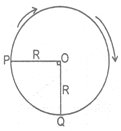
- a) 3R
- b)

- c)

- d)

Answer:
Question: The relation between linear velocity (v), angular velocity (w) and centripetal acceleration ar is :
- a)

- b)

- c)

- d) None of these
Answer:
Question: If the linear velocity of particle is increased by 10% and angular velocity is also increased by 10% then the percent change in centripetal acceleration is :
- a) 31%
- b) 21%
- c) 11%
- d) 10%
Answer: 21%
Question: A body of mass m is moving on a circular path of radius r. After half round the magnitude of the change in momentum of the body is :
- a) mv
- b) 2mv
- c)

- d) 4mv
Answer: 2mv
Question: A body of mass 10 kg revolves in a circle of diameter 0.40 m, making 1000 revolutions per minute. Calculate it’s linear velocity.
- a)

- b)

- c)

- d)
0.2 π m/s
Answer:
Question: A particle is moving in circular path of radius 35m, then its displacement and distance traveled in metre after completing half revolution will be :

- a) 0, 220
- b) 220, 0
- c) 70, 110
- d) 110, 70
Answer: 70, 110
Question: A body is whirled in a horizontal circle of radius 20 cm. It has an angular velocity of 10 rad/s. What is the linear velocity at any point on the circular path ?
- a) 10 m/s
- b) 2 m/s
- c) 20 m/s
- d) √2 m/s
Answer: 2 m/s
Question: A body of mass m is moving on a circular path of radius r with constant speed V. After half round the change in momentum of the body is :
- a) mv
- b) 2mv
- c)

- d) 4mv
Answer: 2mv
Question: If the linear velocity of particle is increased by 10% and angular velocity is also increased by 10% then the percent change in centripetal acceleration is :
- a) 31%
- b) 21%
- c) 11%
- d) 10%
Answer: 21%
Free study material for Physics
Motion Circular Motion Objective Questions & Solutions for NTSE SAT Physics
Download Multiple Choice Questions: Motion Circular Motion (NTSE SAT Physics)
Test your conceptual understanding of Motion Circular Motion with these targeted multiple-choice questions. Designed in alignment with the latest NTSE curriculum for NTSE SAT Physics, these problem sets build accuracy and prepare students for objective exams.
Concept Clarification for Motion Circular Motion
Built using the official NCERT book for NTSE SAT, these Physics objective sets provide reliable academic guidance. Pair your practice with our recommended NCERT solutions to master optimal problem-solving approaches.
Additional Study Resources for NTSE SAT Physics
Follow up your worksheet practice by attempting the interactive online Physics MCQ test for this chapter to evaluate your execution speed. All platform resources are free to access.
FAQs
You can get most exhaustive NTSE SAT Physics Motion Circular Motion MCQs for free on StudiesToday.com. These MCQs for NTSE SAT Physics are updated for the 2026-27 academic session as per NTSE examination standards.
Yes, our NTSE SAT Physics Motion Circular Motion MCQs include the latest type of questions, such as Assertion-Reasoning and Case-based MCQs. 50% of the NTSE paper is now competency-based.
By solving our NTSE SAT Physics Motion Circular Motion MCQs, NTSE SAT students can improve their accuracy and speed which is important as objective questions provide a chance to secure 100% marks in the Physics.
Yes, Physics MCQs for NTSE SAT have answer key and brief explanations to help students understand logic behind the correct option as its important for 2026 competency-focused NTSE exams.
Yes, you can also access online interactive tests for NTSE SAT Physics Motion Circular Motion MCQs on StudiesToday.com as they provide instant answers and score to help you track your progress in Physics.