

Mathematics Concept Notes for Class 8: Chapter 13 Direct and Inverse Proportions
Explore reliable concept summaries and revision materials through the CBSE Class 8 Mathematics Direct And Inverse Proportion Notes Set 01. Tailored for Class 8 learners, utilizing these notes for Mathematics Chapter 13 Direct and Inverse Proportions ensures thorough preparation and strengthens core academic definitions before final evaluations.
Download Chapter 13 Direct and Inverse Proportions Revision Notes PDF
View or download the dedicated Chapter 13 Direct and Inverse Proportions revision resource below. Engaging with these structured concept notes daily ensures continuous academic progress and mastery of the 2026-27 curriculum for Mathematics.
Direct and Inverse Proportion
12.1 Introduction to Proportions
We come across many such situations in our day-to-day life, where we need to see variation in one quantity bringing in variation in the other quantity.
For example:
i) If the number of articles purchased increases, the total cost also increases.
ii) More the money deposited in a bank, more is the interest earned.
iii) As the speed of a vehicle increases, the time taken to cover the same distance decreases.
iv) For a given job, more the number of workers, less will be the time taken to complete the work.
Observe that change in one quantity leads to change in the other quantity. This means that both the quantities are in proportion
12.2 Direct Proportion
If the cost of 1 kg of sugar is Rs 18, then what would be the cost of 3 kg sugar? It is Rs 54. Similarly, we can find the cost of 5 kg or 8 kg of sugar. Study the following table.
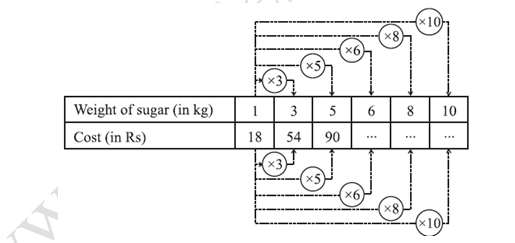
Observe that as weight of sugar increases, cost also increases in such a manner that their ratio remains constant.
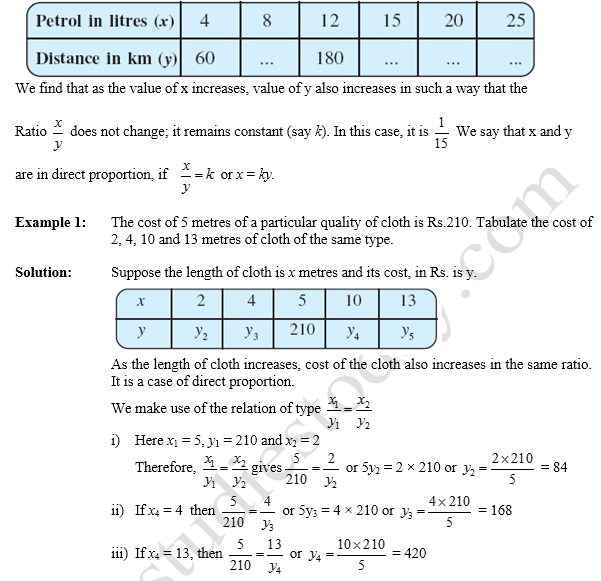
Take one more example. Suppose a car uses 4 litres of petrol to travel a distance of 60 km. How far will it travel using 12 litres? The answer is 180 km. How did we calculate it? Since petrol consumed in the second instance is 12 litres, i.e., three times of 4 litres, the distance travelled will also be three times of 60 km. In other words, when the petrol consumption becomes three-fold, the distance travelled is also three fold the previous one. Let the consumption of petrol be x litres and the corresponding distance travelled be y km. Now, complete the following table:
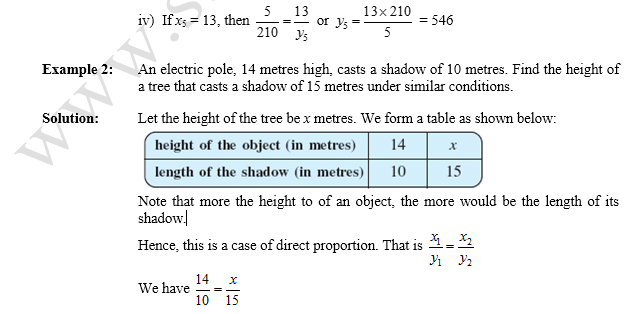
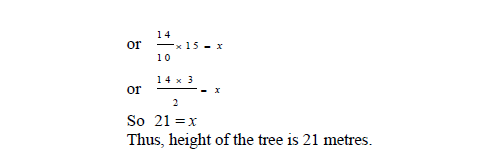
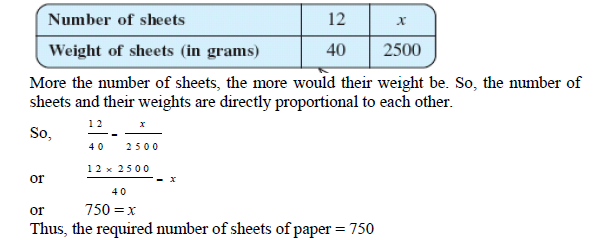
Example 3: If the weight of 12 sheets of thick paper is 40 grams, how many sheets of the same paper would weigh 2(1/2) kilograms?
Solution: Let the number of sheets which weigh 2(1/2) kg be x. We put the above information in the form of a table as shown below:
12.3 Inverse Proportion
Two quantities may change in such a manner that if one quantity increases, the other quantity decreases and vice versa. For example, as the number of workers increases, time taken to finish the job decreases. Similarly, if we increase the speed, the time taken to cover a given distance decreases. To understand this, let us look into the following situation.
Zaheeda can go to her school in four different ways. She can walk, run, cycle or go by car. Study the following table.
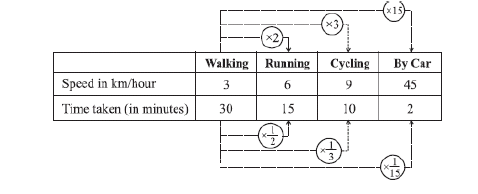
Observe that as the speed increases, time taken to cover the same distance decreases. As Zaheeda doubles her speed by running, time reduces to half. As she increases her speed to three times by cycling, time decreases to one third. Similarly, as she increases her speed to 15 times, time decreases to one fifteenth. (Or, in other words the ratio by which time decreases is inverse of the ratio by which the corresponding speed increases). We can say that speed and time change inversely in proportion
Thus two quantities x and y are said to vary in inverse proportion, if there exists a relation of the type x y = k between them, k being a constant. If y1, y2 are the values of y corresponding to the values x1, x2 of x respectively then x1y1 = x2y2 (= k), or x1/x2 = y2/y1 . We say that x and y are in inverse proportion.
Example 4: 6 pipes are required to fill a tank in 1 hour 20 minutes. How long will it take if only 5 pipes of the same type are used?
Solution: Let the desired time to fill the tank be x minutes. Thus, we have the following table.
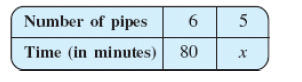
Lesser the number of pipes, more will be the time required by it to fill the tank. So, this is a case of inverse proportion. Hence, 80 × 6 = x × 5 [x1 y1 = x2 y2] or (80*6) / 5 = x or x = 96
Thus, time taken to fill the tank by 5 pipes is 96 minutes or 1 hour 36 minutes.
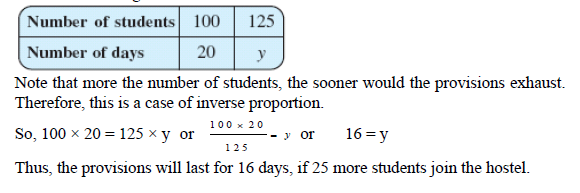
Example 8: There are 100 students in a hostel. Food provision for them is for 20 days. How long will these provisions last, if 25 more students join the group?
Solution: Suppose the provisions last for y days when the number of students is 125. We have the following table
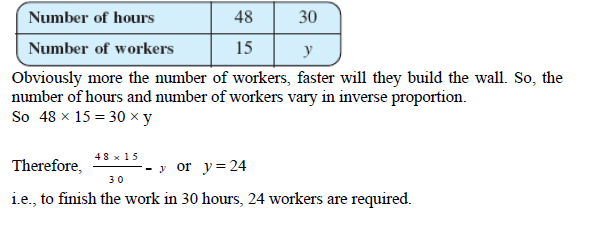
Example 9: If 15 workers can build a wall in 48 hours, how many workers will be required to do the same work in 30 hours?
Solution: Let the number of workers employed to build the wall in 30 hours be y. We have the following table
Please click the link below to download pdf file for CBSE Class 8 Direct and Inverse Proportion Concepts.
Free study material for Mathematics
Revision Notes and Key Concepts for Class 8 Mathematics Chapter 13 Direct and Inverse Proportions
Key Concepts and Summary for Class 8 Mathematics Chapter 13 Direct and Inverse Proportions
Explore reliable chapter overviews for Chapter 13 Direct and Inverse Proportions tailored for Class 8 learners. Use these structured points to grasp difficult themes and ensure solid preparation for upcoming assessments.
NCERT-Aligned Chapter Summary and Notes
Each chapter summary is structured around standard CBSE textbooks, allowing students to check their understanding and clarify complex ideas early in their revision.
Next Steps in Your Exam Preparation
Wrap up your chapter revision by testing your knowledge against standard question formats. Everything on our platform is provided free of charge.
FAQs
You can download the teacher prepared revision notes for CBSE Class 8 Mathematics Direct And Inverse Proportion Notes Set 01 from StudiesToday.com. These notes are designed as per 2026-27 academic session to help Class 8 students get the best study material for Mathematics.
Yes, our CBSE Class 8 Mathematics Direct And Inverse Proportion Notes Set 01 include 50% competency-based questions with focus on core logic, keyword definitions, and the practical application of Mathematics principles which is important for getting more marks in 2026 CBSE exams.
Yes, our CBSE Class 8 Mathematics Direct And Inverse Proportion Notes Set 01 provide a detailed, topic wise breakdown of the chapter. Fundamental definitions, complex numerical formulas and all topics of CBSE syllabus in Class 8 is covered.
These notes for Mathematics are organized into bullet points and easy-to-read charts. By using CBSE Class 8 Mathematics Direct And Inverse Proportion Notes Set 01, Class 8 students fast revise formulas, key definitions before the exams.
No, all study resources on StudiesToday, including CBSE Class 8 Mathematics Direct And Inverse Proportion Notes Set 01, are available for immediate free download. Class 8 Mathematics study material is available in PDF and can be downloaded on mobile.