

Download CBSE Class 11 Business Studies Assignments
Explore structured practice materials through the CBSE Class 11 Business Studies Small Business Assignment. Tailored for Class 11 learners, utilizing these Business Studies assignments ensures thorough preparation and strengthens foundational knowledge before final CBSE evaluations.
Access CBSE School Assignments and Answers
Access the complete assignment PDF for Class 11 Business Studies below. Regular practice with these targeted academic tasks builds familiarity with standard question patterns and helps secure higher marks in final school evaluations.
Mcq Questions for Ncert Class 11 Business Studies MSME and Business Entrepreneurship
• Gist of the Lesson
Role of small scale industries in socio economic development of India
• Employment generation
• Output generation
• Export promotion
• Balance regional development
• Development of entrepreneurship
• Complementary to large scale industries
Role of small scale industries in rural India
• Generation of employment in rural areas
• Multiple source of income
• Prevent migration
• Mobilization of local resources
• Rural industrialization
• Reduction in income inequalities
• Equitable distribution of national income
Problems of small scale industries
• Finance
• Management skills
• Marketing
• Quality
• Under utilization of capacity
• Raw materials
• Labor
• Technology
• Global competition
Measures taken by the government
• Protective measures
• Credit and finance
• Marketing assistance
• Incentives
• Institutional support
Question. The main objective of entrepreneurship development is to
(a) to increase literacy
(b) to increase number of entrepreneurs
(c) to increase GDP
(d) All of the above
Answer : B
Question. Sundeep is individual with surplus cash and interested to invest in upcoming start-ups. Which method is suitable for him?
(a) Crowd funding
(b) Venture capital
(c) Boot strapping
(d) Angel investment
Answer : A
Question. Literary work is protected under
(a) Patent
(b) Trademark
(c) Copyright
(d) Crowd funding
Answer : C
Question. M/s XYZ a small scale enterprise has following investments in its business
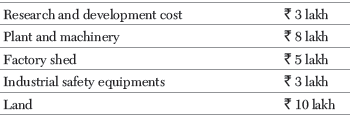
Research and development cost ₹ 3 lakh Plant and machinery ₹ 8 lakh Factory shed ₹ 5 lakh Industrial safety equipments ₹ 3 lakh Land ₹ 10 lakh Decide the category to which M/s XYZ belongs?
(a) micro enterprise
(b) small enterprise
(c) medium enterprise
(d) cottage industry
Answer : A
Question. ……… is the funding a project by raising money from a large number of people for a common goal.
(a) Boot strapping
(b) Crowdsourcing
(c) Venture capitals
(d) Angel investments
Answer : B
Question. Statement I Small industries are able to maintain good personal relations with customers.
Statement II Small scale industries suffer from lack of adequate working capital.
Alternatives
(a) Statement I is correct and Statement II is wrong
(b) Statement II is correct and Statement I is wrong
(c) Both the statements are correct
(d) Both the statements are incorrect
Answer : C
Question. Statement I The purpose of geographical indications is to encourage innovation in manufacturing field.
Statement II Certification mark certifies the quality of product.
Alternatives
(a) Statement I is correct and Statement II is wrong
(b) Statement II is correct and Statement I is wrong
(c) Both the statements are correct
(d) Both the statements are incorrect
Answer : B
Question. Entrepreneurship development leads to the establishment of industries. This helps in …. .
(a) capital formation
(b) economic growth
(c) Both (a) and (b)
(d) None of these
Answer : C
Assertion–Reasoning MCQs :
Question. Assertion (A) Entrepreneurship development helps in capital formation of country.
Reason (R) Entrepreneurs develop and produce substituted products of imported goods and prevent the over-dependence on the other countries.
(a) Both Assertion (A) and Reason (R) are true and Reason (R) is the correct explanation of Assertion (A)
(b) Both Assertion (A) and Reason (R) are true, but Reason (R) is not the correct explanation of Assertion (A)
(c) Assertion (A) is true, but Reason (R) is false
(d) Assertion (A) is false, but Reason (R) is true
Answer : B
Question. Assertion (A) Small scale industries enjoy the advantage of low cost of production.
Reason (R) The establishment and running cost of small-scale industries are minimum. Locally available resources are less expensive.
(a) Both Assertion (A) and Reason (R) are true and Reason (R) is the correct explanation of Assertion (A)
(b) Both Assertion (A) and Reason (R) are true, but Reason (R) is not the correct explanation of Assertion (A)
(c) Assertion (A) is true, but Reason (R) is false
(d) Assertion (A) is false, but Reason (R) is true
Answer : A
Question. Assertion (A) Small scale industries capture the opportunity at the right time by saving time correctly.
Reason (R) Small scale industries are small in size, which allows them to take quick decisions.
(a) Both Assertion (A) and Reason (R) are true and Reason (R) is the correct explanation of Assertion (A)
(b) Both Assertion (A) and Reason (R) are true, but Reason (R) is not the correct explanation of Assertion (A)
(c) Assertion (A) is true, but Reason (R) is false
(d) Assertion (A) is false, but Reason (R) is true
Answer : A
Question. Assertion (A) Entrepreneurship development is considered as a continuous process.
Reason (R) Entrepreneurship development involves learning which is a never-ending process.
(a) Both Assertion (A) and Reason (R) are true and Reason (R) is the correct explanation of Assertion (A)
(b) Both Assertion (A) and Reason (R) are true, but Reason (R) is not the correct explanation of Assertion (A)
(c) Assertion (A) is true, but Reason (R) is false
(d) Assertion (A) is false, but Reason (R) is true
Answer : A
Question. Assertion (A) Small scale industries can be opened anywhere in the country, without any locational constraints and the benefits of industrialisation can be reoped by every region.
Reason (R) The latent skills and talents of people can be channelled into business ideas, which can be converted into reality with little or nil capital investment anywhere.
(a) Both Assertion (A) and Reason (R) are true and Reason (R) is the correct explanation of Assertion (A)
(b) Both Assertion (A) and Reason (R) are true, but Reason (R) is not the correct explanation of Assertion (A)
(c) Assertion (A) is true, but Reason (R) is false
(d) Assertion (A) is false, but Reason (R) is true
Answer : C
Question. Assertion (A) Entrepreneurship development helps in generating employment opportunities.
Reason (R) Entrepreneurship development enables the economy to utilise and explore the abundant of natural resources.
(a) Both Assertion (A) and Reason (R) are true and Reason (R) is the correct explanation of Assertion (A)
(b) Both Assertion (A) and Reason (R) are true, but Reason (R) is not the correct explanation of Assertion (A)
(c) Assertion (A) is true, but Reason (R) is false
(d) Assertion (A) is false, but Reason (R) is true
Answer : B
Question. Assertion (A) The industrial units for whom the output ismanufactured are referred to as ‘main units’.
Reason (R) Ancillary small industrial unit manufactures parts, components, sub-assemblies, tools or intermediate products for other industrial units.
(a) Both Assertion (A) and Reason (R) are true and Reason (R) is the correct explanation of Assertion (A)
(b) Both Assertion (A) and Reason (R) are true, but Reason (R) is not the correct explanation of Assertion (A)
(c) Assertion (A) is true, but Reason (R) is false
(d) Assertion (A) is false, but Reason (R) is true
Answer : D
Case Based MCQs :
Three friends, after completing their graduation, decided to open their own business and to create employment opportunities for others too. After their meeting with the manager of DIC, they attended entrepreneurship development programme. As a result of their entrepreneurship, Zayka Food Industries is created and operated successfully by them.
To create a feeling of belongingness in the customers and for branding purposes, they started to use ‘hat’ as a symbol on all their products. Soon, this become an intellectual property for the company. After getting a good response in the market, now one of them is planning to set up a new unit “Laajwaab Foods and Beverages Industry” in rural area ofOdisha and opted for labour intensive technique, due to easy availability of cheap labour.
The finance manager has estimated the investment of ₹ 2 crore to acquire plant and machinery and ₹ 80 lakhs for meeting operating expenses of this new unit. The company did not want to dilute the ownership and did not want any interference from investors/lenders. Also, it expects good cash flow return from the new unit.
For arrangement of finance and availing professional services that facilitates the development of new business, they approached a body which is located in their universities.
Question. The finance manager has estimated the investment of ₹ 2 crore to acquire plant and machinery and ₹ 80 lakh for meeting operating expenses of this new unit. The company did not want to dilute the ownership and did not want any interference from investors/lenders. Also, it expects good cash flow return from the new unit. Which form of capital would be better for the company?
(a) Equity capital
(b) Long-term loans
(c) Preference capital
(d) Loans fromcommercial bank
Answer : B
Question. Post-training stage of ED programme does not include
(a) Management Skill Development
(b) Guidance in Project Implementation
(c) Sustaining Motivation
(d) Providing-follow up
Answer : A
Question. “For arrangement of finance and availing professional services that facilitates the development of new business, they approached a body which is located in their universities.’’ Which way to fund start-up is highlighted here?
(a) Accelerators
(b) Incubators
(c) Private equity
(d) Venture capital
Answer : B
Question. “To create a feeling of belongingness in the customers and for branding purposes, they started to use ‘hat’ as a symbol on all their products.” Which IPR is highlighted in the line?
(a) Patents
(b) Copyrights
(c) Trademarks
(d) Trade secrets
Answer : C
Question. Which category of SSI, ‘‘Lajawaab Foods and Beverage Industries’’ belongs to?
(a) Micro enterprises
(b) Small enterprises
(c) Medium enterprises
(d) Cottage industry
Answer : B
Question. Which of the following is not a feature of entrepreneurship?
(a) Systematic activity
(b) Risk element
(c) Profession
(d) Dynamic process
Answer : C
Important Mcq Questions for Ncert Class 11 Business Studies MSME and Business Entrepreneurship
Question. Explain any 3 incentives offered by got to small scale enterprise so that they can contribute in the development of overpopulated country like India.
Answer:
• Protective measures
• Credit and finance
• Marketing assistance
• Incentives
• Institutional support
• Long Answer Type Questions:
Question. The path of small scale industries is full if hurdles.” In the light of this statement, discuss the problems faced by small scale industries.
Answer: The following Problems of small scale industries should be explained
• Finance
• Management skills
• Marketing
• Quality
• Under utilization of capacity
• Raw materials
• Labor
• Technology
• Global competition
Question. Describe the role of small business in rural India.
Answer:
The following points should be explained
• Generation of employment in rural areas
• Multiple source of income
• Prevent migration
• Mobilization of local resources
• Rural industrialization
• Reduction in income inequalities
• Equitable distribution of national income
Question. Identify any 6 major industry groups in the small sector in India.
Answer:
1. Food products
2. Chemicals and chemical products
3. Hosiery and garments
4. Leather and leather products
5. Repair services
6. Beverages, tobacco and tobacco products.
Question. Mention the forms of support to small industries by the govt.
Answer:
1. Institutions for credit facilities.
2. Provision of training facilities.
3. Supply of machinery on hire purchase system.
4. Technical assistance.
5. Financial assistance for technological up gradation.
6. Incentives for setting up enterprises in backward areas.
Short Answer Type Questions :
Question. What are some of the key action points of Start India Initiative?
Answer: Action points of Start India Initiatives are as follows (any three)
(i) Simplification and Handholding In order to make compliance for startups, friendly and flexible, simplifications are announced. Government of India has launched a mobile app and a website for easy online registration.
(ii) Startup India Hub The objective is to create a single point of contact for the entire startup ecosystem and enable knowledge exchange and access to funding. Start-up India Hub will be key stakeholder of entrepreneurs. It will be their friend, mentor and guide to hold their hand.
(iii) Legal Support and Fast-tracking Patent Examination The scheme for Startups Intellectual Property Protections (SIPP) is envisaged to facilitate protection of patents, trademarks and designs of innovative and interested startups.
(iv) Easy Exit In the event of a business failure and wind up of operations, procedures are being adopted to reallocate capital and resources towards more productive avenues. This will promote experimentation with new and innovative ideas, without fearing complex and long drawn exit process. A start-up can close its business within 90 days from the date of application of winding up.
Question. What are the three types of enterprises with respect to manufacturing?
Answer: The three types of enterprises with respect to manufacturing are
(i) Micro Enterprise In micro enterprise, the investment in plant and machinery does not exceed ₹ 25 lakh.
(ii) Small Enterprise In small enterprise, the investment in plant and machinery is more than ₹ 25 lakh but does not exceed ₹ 5 crore.
(iii) Medium Enterprise In medium enterprise, the investment in plant and machinery is more than ₹ 5 crore but does not exceed ₹ 10 crore.
Question. ST foods Inc is a company preparing Rajasthani food. The company has 23 outlets in Rajasthan andGujarat. The company prepares its foods with recipes unique to it and uniform across outlets. These recipes have been the driving force of business and are not known to general public. Identify and explain the intellectual property right discussed.
Answer: The IPR discussed is trade secret. It is an information that
(i) is not generally known to public.
(ii) confers economic benefit.
(iii) is the subject of reasonable efforts by the holder to maintain its secrecy. For example CoCa Cola’s recipe is trade secret. KFC keep secret ingredients in its recipe.
(iv) is protected without any procedural formalities for an unlimited period.
Question. Highlight the importance of small scale industries in Indian employment and GDP context.
Answer: Following points highlight the importance of SSIs in Indian employment and GDP
(i) Contribution in GDP Small industries in India account for 95% of the industrial units of the country. They contribute almost 40% of the gross industrial value added and 45% of the total exports (direct and indirect) from India.
(ii) Employment Generation In India, small industries are the second largest employers of human resources, after agriculture. They generate more employment opportunities per unit of capital invested as compared to large industries. Thus, they are considered good for countries like India, that have surplus labour and less capital.
Question. What are the different forms of support offered to small industries by the government?
Answer: Forms of support offered to small industries by the government are
(i) Institutional support in respect of credit facilities.
(ii) Provision of developed sites for construction of sheds.
(iii) Provision of training facilities.
(iv) Supply of machinery on hire export marketing.
(v) Technical and financial assistance for technological upgradation.
(vi) Special incentives for setting up of enterprises in backward areas.
Question. Chris and Craig were having a discussion about entrepreneurship development. Chris suggested that there were no pre-requisites for entrepreneurship development whereas Craig suggested that there are some pre-requisites. Who – Chris or Craig is correct? Explain.
Answer: Craig is correct because there are some pre-requisites for entrepreneurship development. Following are the pre-requisites
(i) Intelligence
(ii) Motivation
(iii) Knowledge
(iv) Sustained efforts
(v) Human factor
(vi) Government assistance/Grant
(vii) Opportunity
(viii) Industrial technology
Free study material for Business Studies
Download Practice Assignments: Class 11 Business Studies Chapter 09 MSME And Business Entrepreneurship
Revision Assignment: Chapter 09 MSME And Business Entrepreneurship (CBSE)
Review targeted chapter assignments for Class 11 Business Studies Chapter 09 MSME And Business Entrepreneurship. Built according to official CBSE guidelines, these downloadable problem sets help students build accuracy and prepare effectively for school tests.
Maximize Exam Scores with Chapter Practice Sets
- Exam Alignment: Questions strictly follow contemporary CBSE sample papers and grading schemes.
- Comprehensive Coverage: Features objective drills, case studies, and structured descriptive problems for Chapter 09 MSME And Business Entrepreneurship.
- Pacing & Precision: Regular problem-solving builds critical calculation speed and test-taking accuracy.
Effective Strategy for Class 11 Business Studies Assignments
- Concept Foundation: Review the NCERT book for Class 11 Business Studies thoroughly before diving into assignment tasks.
- Self-Evaluation: Solve exercises independently before inspecting professional answer guides.
- Progress Monitoring: Note down complex formulas or concepts, clearing them up using available online practice aids.
FAQs
You can download free PDF assignments for Class 11 Business Studies Chapter 09 MSME And Business Entrepreneurship from StudiesToday.com. These practice sheets have been updated for the 2026-27 session covering all concepts from latest NCERT textbook.
Yes, our teachers have given solutions for all questions in the Class 11 Business Studies Chapter 09 MSME And Business Entrepreneurship assignments. This will help you to understand step-by-step methodology to get full marks in school tests and exams.
Yes. These assignments are designed as per the latest CBSE syllabus for 2026. We have included huge variety of question formats such as MCQs, Case-study based questions and important diagram-based problems found in Chapter 09 MSME And Business Entrepreneurship.
Practicing topicw wise assignments will help Class 11 students understand every sub-topic of Chapter 09 MSME And Business Entrepreneurship. Daily practice will improve speed, accuracy and answering competency-based questions.
Yes, all printable assignments for Class 11 Business Studies Chapter 09 MSME And Business Entrepreneurship are available for free download in mobile-friendly PDF format.