

Official CBSE Assignments for Class 11 Business Studies
Access comprehensive school assignments for Chapter 08 Sources Of Business Finance using the CBSE Class 11 Business Studies Sources Of Business Finance Assignment. Designed to align with the 2026-27 CBSE academic guidelines, these practice sets help Class 11 Business Studies students reinforce core concepts and improve their problem-solving accuracy.
Solved Practice Assignments for Business Studies
Access the complete assignment PDF for Class 11 Business Studies below. Regular practice with these targeted academic tasks builds familiarity with standard question patterns and helps secure higher marks in final school evaluations.
SOURCES OF BUSINESS FINANCE
Introduction:
Business cannot be run without money. Funds required to carry out business is called Business Finance. This chapter throws light on how the finances for the business can be arranged, what are the sources of funding and what terms and conditions are governed with each type of funding.
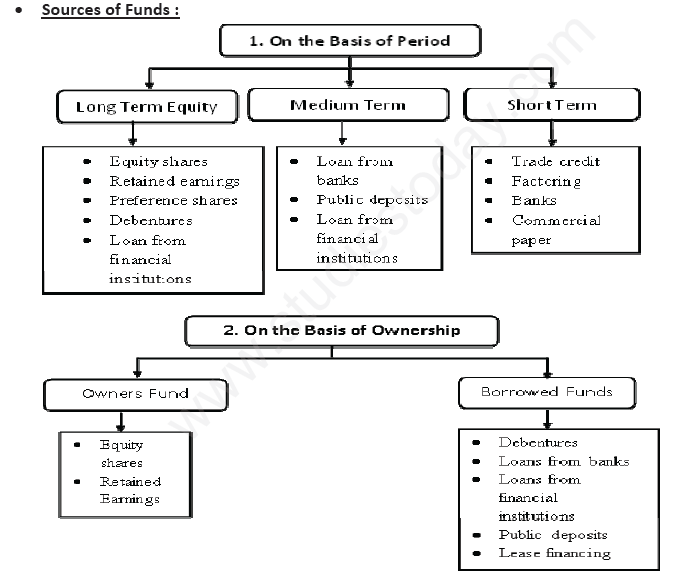
Sources of Funds:
Funds can be classified under different categories based on period, ownership, and source of generation.
1. On the Basis of Period:
- Long Term: Equity shares, Retained earnings, Preference shares, Debentures, Loan from financial institutions.
- Medium Term: Loan from banks, Public deposits, Loan from financial institutions.
- Short Term: Trade credit, Factoring, Banks, Commercial paper.
2. On the Basis of Ownership:
- Owners Fund: Equity shares, Retained Earnings.
- Borrowed Funds: Debentures, Loans from banks, Loans from financial institutions, Public deposits, Lease financing.
3. On the Basis of Source of Generation:
- Internal Sources: Equity share capital, Retained earnings.
- External Sources: Financial institutions, Loan from banks, Preference shares, Public deposits, Debenture, Lease financing, Commercial papers, Trade credit, Factoring.
Share: The amount of capital to be raised from public is divided into units of equal values. These units are known as SHARE.
Equity (Ordinary) shares are those which do not carry any special or preferential rights.
Equity Share Merits:
1. Convenience
2. No charge on assets
3. No obligation
4. Dependable
5. Growth and Expansion
Equity Share Demerits:
1. Low dividend
2. Uncertain
3. Unbalanced growth
4. Misuse and Speculation
Debenture: It constitutes the borrowed funds of the company. It is an acknowledgement of debt. Debenture capital may be called DEBT CAPITAL.
Types Of Debentures:
- Secured and Unsecured
- Redeemable and Irredeemable
- Convertible and Non-Convertible
- Registered and Bearer
Debentures Merits:
1. Regular return
2. Safety of investment
3. Economic sources
4. Flexibility
5. Tax relief
Debentures Demerits:
1. Charge on assets
2. No voting rights
3. Permanent burden of interests
Differences between Shares and Debentures
| BASIS | SHARES | DEBENTURES |
|---|---|---|
| 1. Types of funds | Owner's funds | Borrowed funds |
| 2. Return | Flexible | Fixed |
| 3. Voting rights | Available | No voting rights |
| 4. Status of holders | Owners of the company | Creditors of the company |
| 5. Redemption | Not redeemable | Mostly Redeemable |
| 6. Charge | No charge on assets | Charge on assets |
| 7. Degree of risk for holders | High | Low |
Public deposits:
Refers to the unsecured deposits invited by companies from the public. It can invite for a period of six months to 3 years. Public deposit cannot exceed 25% of its share capital & resources.
MERITS:
1. Simplicity
2. Economical
3. No charge on assets
4. No loss on control
DEMERITS:
1. Uncertainty
2. Temporary finance
3. Unsuitable for new company
Lease financing: A lease is a contractual agreement whereby the owner of an asset grants rights to use the asset to other party for rent.
Short term funds:
1. Trade credit: refers to the credit extended by one trader to another for purchasing goods or service. Small and new firms are usually more dependent on trade credit.
2. Factoring: It has emerged as a popular source of short term finance. It is a financial service whereby the factor is responsible for all credit control and debt collection from the buyers and provides protection against any bad debt losses to the firm. Two methods of Factoring are Recourse factoring and Non-Recourse factoring.
3. Commercial Paper (C.P.): It is an unsecured promissory note issued by firm to raise funds for a short period says 90 days to 364 days. Only firms having good credit rating can issue the C.P.
Loans From Commercial Banks:
Business can raise finance from commercial banks in the following ways:
- Term Loan: For medium term.
- Cash Credit: Interest is charged on the amount actually withdrawn.
- Discount of bill: Banks provide short term finance in exchange for bill.
- Overdraft: Current Account holders is allowed to overdraw his A/c.
Loans from financial Institutions:
Institutional finance means finance arranged from financial institutions other than commercial banks like IFCI, ICICI, IDBI, SFI etc.
International Sources of Finance:
Financial institutions and investors in foreign countries can invest in the shares and debentures of Indian companies. Two main instruments used by Indian companies to tap international sources of finance are:
1. ADR (American Depository Receipt):
- Rose from equity markets in USA.
- Funds from ADR are available in US Dollars.
- No broker is needed. Issued only to American citizens.
2. GDR (Global Depository Receipt):
- Traded on a stock exchange in Europe or US or both.
- No voting right.
Factors affecting choice of Source of Funds:
1. TIME PERIOD: Long term finance is raised through shares and debentures. Short term finance is raised through trade credit, commercial paper, etc.
2. RISK: There is least risk on Equity shares as the capital need not be repaid. But in case of loan, interest has to be paid.
3. CONTROL: Issue of equity shares may lead to dilution of control but debt involves no dilution of control.
4. EARNINGS: Stability of earnings are important because loan should be raised only when earning are sufficient.
5. TASK IMPACT: Interest on debenture is tax deductible. Dividend is not tax deductible.
VSA (Very Short Answer Type Questions) (1 Mark)
Question 1. What is commercial paper?
Answer: Commercial Paper (C.P.) is an unsecured promissory note issued by a firm to raise funds for a short period, typically ranging from 90 days to 364 days. It is issued only by firms having a high credit rating.
In simple words: It is a short-term unsecured note used by creditworthy companies to borrow money quickly.
Exam Tip: Remember the maturity period of 90 to 364 days and that only top-rated companies can issue it.
Question 2. What is ADR?
Answer: ADR stands for American Depository Receipt. It is a financial instrument issued by a US bank representing shares of a non-US company, traded in American stock markets in US Dollars.
In simple words: It allows foreign companies to trade their shares in American stock markets.
Exam Tip: State clearly that ADRs are issued specifically to American citizens and denominated in US Dollars.
Question 3. What is meant by convertible debenture?
Answer: Convertible debentures are those debentures that can be converted into equity shares after a specified period of time in accordance with the terms of the issue.
In simple words: These are loans that can later be turned into company shares.
Exam Tip: Highlight the option of conversion from debt to equity.
Question 4. Explain the term 'Factoring'?
Answer: Factoring is a financial service where a financial institution (the factor) assumes responsibility for credit control, debt collection, and protection against bad debts for a firm in exchange for a fee.
In simple words: Outsourcing the collection of money from customers to a specialized agency.
Exam Tip: Mention credit control and bad debt protection as key functions of a factor.
SA (Short Answer Type Questions) (3 or 4 Marks)
Question 1. Describe the various types of finance?
Answer: Business finance can be classified into three types based on the time period:
1. Long-term finance: Required for meeting permanent or fixed capital needs of the business, lasting for more than 5 years (e.g., equity shares, debentures).
2. Medium-term finance: Required for a period ranging from 1 year to 5 years, usually for modernization or expansion (e.g., medium-term loans from banks).
3. Short-term finance: Required for meeting day-to-day operational expenses, lasting for a period not exceeding one year (e.g., trade credit, commercial paper, bank overdraft).
In simple words: Finances are divided into long-term, medium-term, and short-term based on how long the funds are needed.
Exam Tip: Clearly state the duration ranges for each category for full marks.
Question 2. Explain three sources of owned funds.
Answer: Three primary sources of owned funds are:
1. Equity Shares: The capital raised by issuing equity shares represents ownership capital, bearing the maximum risk and carrying voting rights.
2. Retained Earnings: The undistributed profits of a business that are plowed back into operations for expansion and growth.
3. Preference Shares: Shares that carry preferential rights with respect to payment of dividend and repayment of capital over equity shares.
In simple words: Owned funds are contributed by owners and include equity shares, retained profits, and preference shares.
Exam Tip: Define owned funds briefly before listing the three sources.
Question 3. Explain any two types of preference shares.
Answer: Two types of preference shares are:
1. Cumulative Preference Shares: These shares carry the right to accumulate unpaid dividends from past years if profits are insufficient in any given year.
2. Participating Preference Shares: These shares are entitled to participate in surplus profits remaining after equity shareholders have been paid a specified dividend.
In simple words: Cumulative shares carry forward unpaid dividends, while participating shares get a share in extra profits.
Exam Tip: Distinguish clearly between cumulative and participating features.
Question 4. Explain the advantages of equity share.
Answer: The advantages of equity shares are:
1. Permanent Capital: Equity share capital is not refunded during the lifetime of the company, providing stable long-term funds.
2. No Charge on Assets: Raising capital through equity shares does not require mortgaging company assets.
3. Borrowing Capacity: A strong equity base enhances the creditworthiness and borrowing capacity of the firm.
4. Voting Rights: Equity shareholders enjoy voting rights, giving them control over the management of the company.
In simple words: Equity shares provide permanent capital without asset mortgages and give owners voting control.
Exam Tip: List at least four clear points with descriptive sub-headings.
LA (Long Answer Type Questions) (5 or 6 Marks)
Question 1. Distinguish between Equity shares and Preference shares.
Answer: Distinction between Equity shares and Preference shares:
1. Dividend: Equity shares receive fluctuating dividends depending on profits, whereas preference shares receive a fixed rate of dividend.
2. Priority of Payment: Preference shareholders have priority over equity shareholders in the payment of dividend and repayment of capital during liquidation.
3. Voting Rights: Equity shareholders have voting rights and control management, while preference shareholders generally do not have voting rights except under special circumstances.
4. Redemption: Equity shares are not redeemed during the lifetime of the company, whereas preference shares are redeemable after a fixed period.
In simple words: Preference shares get fixed dividends and priority, while equity shares carry voting rights and variable returns.
Exam Tip: Present the answer using comparative points or a structured format.
Question 2. What are retained profits? Discuss their merits and demerits.
Answer: Retained profits refer to that portion of net profits which is not distributed as dividends but is retained within the business for future use (plowing back of profits).
Merits:
1. Dependable Source: It is an internal source of finance, reducing dependence on external agencies.
2. No Dilution of Control: It does not involve dilution of equity ownership or voting rights.
3. Economic: There are no floatation costs like brokerage or underwriting commission.
Demerits:
1. Uncertainty: Profits fluctuate from year to year, making it an uncertain source of finance.
2. Dissatisfaction among Shareholders: Excessive retention deprives shareholders of higher current dividends.
3. Misuse of Funds: Availability of surplus funds may lead to reckless spending or unprofitable investments.
In simple words: Retained profits are saved earnings reinvested in the business, offering cheap internal funding but risking shareholder dissatisfaction.
Exam Tip: Divide the answer clearly into definition, merits, and demerits headings.
Question 3. Explain the disadvantages of shares.
Answer: The disadvantages of shares (specifically equity shares) include:
1. Risk of Fluctuation: Dividend returns on equity shares are uncertain, leading to fluctuations in market value.
2. Dilution of Control: Issue of additional equity shares increases the number of owners, diluting the existing control of management.
3. High Cost of Issue: Raising capital through shares involves considerable floatation costs such as prospectus printing, advertising, and underwriting fees.
4. Inflexible: Share capital cannot be easily returned during periods of low fund requirement, creating surplus idle capital.
In simple words: Shares can dilute management control, involve high issue costs, and offer uncertain returns.
Exam Tip: Focus on equity shares when discussing share disadvantages unless specified otherwise.
Question 4. Explain the merits and demerits of public deposits.
Answer: Public deposits refer to unsecured deposits invited directly from the public by companies for periods ranging from 6 months to 3 years.
Merits:
1. Simple Procedure: The procedure for raising public deposits is simpler than issuing shares or debentures.
2. Economical: Interest paid on public deposits is generally lower than borrowing costs from financial institutions.
3. No Charge on Assets: Deposits are unsecured, so company assets remain free from charges or mortgages.
4. Maintenance of Control: Depositors do not get voting rights, ensuring management control remains intact.
Demerits:
1. Uncertainty: Public deposits are an unreliable source because public response can be unpredictable.
2. Short-term Maturity: They are typically available for short periods and unsuitable for long-term project financing.
3. Risk for Investors: Being unsecured, public deposits carry a higher risk for depositors if the company faces financial distress.
In simple words: Public deposits are quick and cheap unsecured loans from the public, but they are uncertain and limited to short terms.
Exam Tip: Highlight the unsecured nature and short-term tenure of public deposits.
HOTS (Higher Order Thinking Skills)
Question 1. Name the capital invested in permanent assets.
Answer: Fixed Capital.
In simple words: Money used to buy long-term assets like machinery and buildings.
Exam Tip: Keep the term precise and direct.
Question 2. What is self financing?
Answer: Self financing refers to the reinvestment of retained earnings or undistributed profits of a business into its own operations without relying on external sources.
In simple words: Financing business growth using one's own saved profits.
Exam Tip: Link self-financing directly to retained earnings.
Question 3. Name the agreement where by the owner of the asset grants another party the right to use the asset in return for a periodic payment.
Answer: Lease agreement (Lease financing).
In simple words: Renting an asset for regular payments.
Exam Tip: Use the exact commercial term 'Lease Financing'.
Question 4. Name the funds needed for day to day operations of business.
Answer: Working Capital.
In simple words: Short-term money needed for daily expenses like wages and raw materials.
Exam Tip: Distinguish clearly between fixed capital and working capital.
Gist of the Lesson:
- Finance is the life blood of business.
- Business finance is of three types - Long term, Medium term, Short term.
- There are two sources of business finance - Owned funds, Borrowed funds.
- Shares are of two types - Equity and Preference shares.
- Retained profits refer to the undistributed profits which are re-invested in business.
- Debentures are creditorsip security.
- ADRs and GDRs are the main International sources of finance.
Free study material for Business Studies
CBSE Class 11 Business Studies Assignments for Chapter 08 Sources Of Business Finance
Revision Assignment: Chapter 08 Sources Of Business Finance (CBSE)
Review targeted chapter assignments for Class 11 Business Studies Chapter 08 Sources Of Business Finance. Built according to official CBSE guidelines, these downloadable problem sets help students build accuracy and prepare effectively for school tests.
Maximize Exam Scores with Chapter Practice Sets
- Syllabus Compliance: Sets reflect current CBSE evaluation criteria and official marking frameworks.
- Multi-Format Practice: Includes varied problem types designed to deepen comprehension across all sub-topics.
- Time Management: Routine practice optimizes pacing to finish school examinations comfortably within schedule.
Effective Strategy for Class 11 Business Studies Assignments
- Textbook Review: Always study the core NCERT book for Class 11 Business Studies prior to beginning the assignment.
- Independent Attempt: Solve Chapter 08 Sources Of Business Finance questions on your own initially before cross-checking with expert solutions.
- Error Tracking: Record challenging concepts in a dedicated notebook and practice online MCQ tests for revision.
FAQs
You can download free PDF assignments for Class 11 Business Studies Chapter 08 Sources Of Business Finance from StudiesToday.com. These practice sheets have been updated for the 2026-27 session covering all concepts from latest NCERT textbook.
Yes, our teachers have given solutions for all questions in the Class 11 Business Studies Chapter 08 Sources Of Business Finance assignments. This will help you to understand step-by-step methodology to get full marks in school tests and exams.
Yes. These assignments are designed as per the latest CBSE syllabus for 2026. We have included huge variety of question formats such as MCQs, Case-study based questions and important diagram-based problems found in Chapter 08 Sources Of Business Finance.
Practicing topicw wise assignments will help Class 11 students understand every sub-topic of Chapter 08 Sources Of Business Finance. Daily practice will improve speed, accuracy and answering competency-based questions.
Yes, all printable assignments for Class 11 Business Studies Chapter 08 Sources Of Business Finance are available for free download in mobile-friendly PDF format.