

Download CBSE Class 8 Science VBQs: Chapter 15 Some Natural Phenomena
Explore authentic value-based practice materials through the CBSE Class 8 Science Some Natural Phenomena VBQs. Tailored for Class 8 learners, utilizing these Science VBQs ensures thorough preparation and strengthens moral reasoning skills before final CBSE evaluations.
Access CBSE Value Based Questions and Answers
Navigate directly to the solved Science Value Based Questions using the digital viewer below. Each practice set includes detailed solutions, allowing students to instantly cross-check their work and understand the ethical dimensions of the topic.
Question. Why does a stone floor feel colder than a carpeted floor on a cold winter night?
(a) The stone floor is at a lower temperature than the room temperature.
(b) The carpet is at a higher temperature than the room temperature.
(c) The stone floor conducts away heat from our body faster than the carpet.
(d) Our body can absorb heat from the carpet but not from the stone floor.
Answer : C
Question. In the working of which of these is air resistance desirable and important?
(a) superfast trains
(b) pendulums
(c) pendulums
(d) fighter aeroplanes
Answer : B
Question. June 21/22 of any year is ________________
(a) when day and night are of equal duration throughout the world
(b) The Winter Solstice in the Southern Hemisphere.
(c) The longest day in all parts of the world.
(d) The shortest day in all parts of the world.
Answer : B
Question. The Tropic of Cancer at 23.5°N latitude marks the northern limit of the places on earth where the Sun is ever exactly overhead. Why is this limit at 23.5o and not some other latitude?
(a) It is exactly one-fourth of 90°, the total number of degrees of latitude.
(b) The earth's axis of rotation is tilted by that much - 23.5°;
(c) The limit has been agreed to by all the nations of the world.
(d) There is no reason, and the limit has been fixed arbitrarily.
Answer : B
Question. In a certain locality, flooding occurs if the total rainfall over a three-day period exceeds 40 mm. How many times would flooding have occurred in the locality during the entire week?
(a) Never
(b) Once
(c) Twice
(d) Thrice
Answer : B
Question. Read the paragraph about water salinity given below and answer the question that follows: 97% of the water found on earth is salty. The average salinity of the oceans is 35 ppt (parts per thousand). Rainfall, evaporation, river runoff and ice formation can affect salinity. For example, the Black Sea is so diluted by river runoff, its average salinity is only 16 ppt. Freshwater salinity is usually less than 0.5 ppt. Water between 0.5 ppt and 17 ppt is called brackish. Which of these is likely to be or contain brackish water?
(a) Monsoon rains received in coastal regions of India.
(b) An estuary (where river water meets ocean water).
(c) Water in the middle of a large ocean like the Pacific.
(d) Tidal waves that occur during high tide in the oceans.
Answer : B
Question. Cooling due to radiation occurs when the heat absorbed by the Earth during the day is radiated into space in the evening. Under which of these evening conditions would cooling due to radiation be maximum?
(a) cloudy and windy
(b) rainy
(c) clear and dry
(d) cloudy but dry
Answer : C
Question. The diagram shows the flow of winds over a mountain As air rises on the windward side of the mountain, the air's temperature decreases. Which process usually causes this temperature decrease?
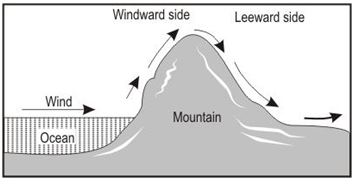
(a) expansion of rising air
(b) compression of rising air
(c) precipitation from clouds
(d) evaporation from clouds
Answer : A
Question. Study this graph showing the recorded change in ocean tides in a coastal city on a single day. (1 foot = 0.305 metres)The total difference between the height of the water at its minimum and maximum levels is about:
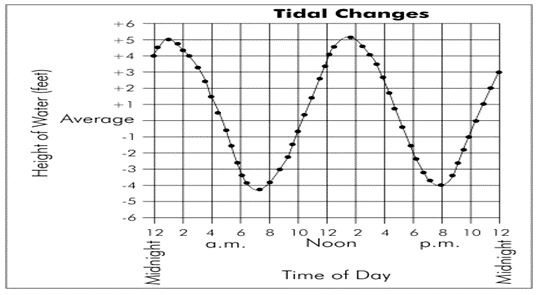
(a) 5 feet
(b) 6 feet
(c) 9 feet
(d) 12 feet
Answer : C
Question. Study this graph showing the recorded change in ocean tides in a coastal city on a single day. (1 foot = 0.305 metres)<According to the pattern shown on the graph, the next high tide will occur at approximately
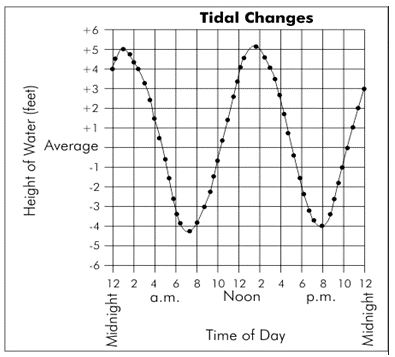
(a) 12:30 a.m.
(b) 2:00 a.m.
(c) 3:15 a.m.
(d) 4:00 a.m.
Answer : A
Question. Study the map shown here. About how long is the coastline of Gujarat state (shown with a grey shadow)?
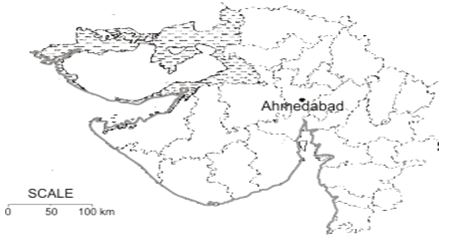
(a) 800 km
(b) 1600 km
(c) 2400 km
(d) 2600 km
Answer : B
Question. Study the contour map shown below. Which point (A, B, C or D) is likely to be at the same altitude as the point P shown?

(a) A
(b) B
(c) C
(d) D
Answer : D
Question. When a plastic spoon is rubbed on a woollen cloth and held above a mixture of salt and pepper, pepper jumps to the spoon. Choose the best reason for this:
(a) Air pushes the pepper towards the spoon.
(b) The spoon temporarily gets magnetised.
(c) The spoon temporarily gets charged with static electricity.
(d) Gravitational attraction pulls the pepper to the spoon.
Answer : C
Question. The term 'monsoon' refers to:
(a) Rains, anytime, anywhere in the world.
(b) Post-summer rains anywhere in the world.
(c) Rains, anytime, in and near India.
(d) Post-summer rains in and near India.
Answer : D
Question. The annual rainfall of many leading Indian cities is given in the map below: Which of these cities is likely to have the heaviest rainfall?
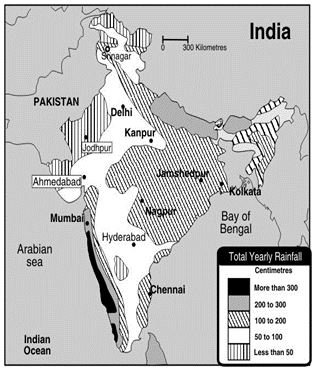
(a) Mumbai
(b) Kolkata
(c) Delhi
(d) Chennai
Answer : A
Question. Which of the following cannot be changed easily by friction?
(a) A plastic scale
(b) A copper rod
(c) An inflated balloon
(d) A woollen cloth
Answer : B
Question. When a glass rod is rubbed with a piece of silk cloth the rod
(a) and the cloth both acquire a positive charge.
(b) becomes positively charged while the cloth has a negative charge.
(c) and the cloth both acquire a negative charge.
(d) becomes negatively charged while the cloth has a positive charge
Answer : B
Write T against true and F against false in the following statements.
(a) Like charges attract each other.
Answer : False
(b) A charged glass rod attracts a charged plastic straw.
Answer : True
(c) Lightning conductor cannot protect a building from lightning.
Answer : False
(d) Earthquakes can be predicted in advance.
Answer : False
Question. Explain why a charged body loses its charge if we touch it with our hand.
Answer : Our body is a conductor of electricity. When we touch a charged body with our hand, the charged body loses charge to the earth through our body.
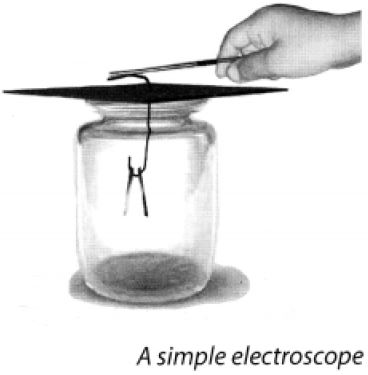
Question. Describe with the help of a diagram an instrument which can be used to detect a charged body.
Answer : Electroscope is a device which is used to detect the charge on a body. It works on the principle that like charges repel each other while unlike charges attract each other. It consists of a metal rod with thin metal strip or leaf attached to it at the bottom.
Question. Sometimes, a crackling sound is heard while taking off a sweater during winters. Explain.
Answer : When we take out sweater, Woolen sweater gets charged due to friction between the sweater and the body. This results in crackling sound.
Question. List three states in India where earthquakes are more likely to strike.
Answer : Kashmir, Rajasthan and Gujarat.
Question. Name the scale on which the destructive energy of an earthquake is measured. An earthquake measures 3 on this scale. Would it be recorded by a seismograph? Is it likely to cause much damage?
Answer : The destructive energy of an earthquake is measured on a scale called Richter scale. It has reading from 1 to 10. Earthquake with more than 7 values can cause much damage.
An earthquake measure 3 on this scale will be recorded by a seismograph. But it is not likely to cause much damage.
Question. Suppose you are outside your home and an earthquake strikes. What precaution would you take to protect yourself?
Answer : (i) Move to open space. Find a clean spot away from buildings, trees and overhead power lines. Drop to the ground.
(ii) If we are in a car or a bus, will not come out. Drive slowly to a clear spot and remain in it till the earthquake stops.
Question. Suggest three measures to protect ourselves from lightning.
Answer : (i) Do not use TV or cable phone during lightning.
(ii) Stay indoors or under covered area.
(iii) Don’t take bath during lightning.
Question. The weather department has predicted that a thunderstorm is likely to occur on a certain day. Suppose you have to go out on that day. Would you carry an umbrella? Explain.
Answer : No, it is not advisable to carry
Question. Explain why a charged balloon is repelled by another charged balloon whereas an uncharged balloon is attracted by another charged balloon?
Answer : We know that same charges repel and opposite charges attract each other. A charged balloon is repelled by another charged balloon because both carry same type of charges. On the other hand, an uncharged balloon is attracted by another charged balloon as they have opposite charges.
Free study material for Science
VBQs with Answers for Class 8 Science Chapter 15 Some Natural Phenomena
Moral Practice Exercises: Class 8 Science Chapter 15 Some Natural Phenomena
Review important VBQs for Chapter 15 Some Natural Phenomena tailored for Class 8 learners. These structured exercises highlight core values and practical concepts essential for high-scoring exam performance.
NCERT-Aligned VBQ Solutions
Each question includes structured solution guides mapped directly to standard CBSE textbooks, helping students evaluate their reasoning and correct mistakes early.
Complete Your Chapter Revision
Practicing value-based problems regularly connects abstract concepts to everyday experiences, ensuring stronger performance across school examinations and board assessments.
FAQs
The latest collection of Value Based Questions for Class 8 Science Chapter 15 Some Natural Phenomena is available for free on StudiesToday.com. These questions are as per 2026 academic session to help students develop analytical and ethical reasoning skills.
Yes, all our Science VBQs for Chapter 15 Some Natural Phenomena come with detailed model answers which help students to integrate factual knowledge with value-based insights to get high marks.
VBQs are important as they test student's ability to relate Science concepts to real-life situations. For Chapter 15 Some Natural Phenomena these questions are as per the latest competency-based education goals.
In the current CBSE pattern for Class 8 Science, Chapter 15 Some Natural Phenomena Value Based or Case-Based questions typically carry 3 to 5 marks.
Yes, you can download Class 8 Science Chapter 15 Some Natural Phenomena VBQs in a mobile-friendly PDF format for free.