

Official Class 4 Social Science Worksheets: Water
Review targeted academic worksheets with the CBSE Class 4 Social Studies Water Worksheet. Built according to official educational standards for the 2026-27 term, these downloadable Class 4 Social Science resources support effective daily practice and detailed self-evaluation for Water.
Solved Practice Worksheets for Social Science
Access the complete worksheet PDF for Class 4 Social Science below. Regular practice with these targeted academic tasks builds familiarity with standard question patterns and helps secure higher marks in final school examinations.
Q.1 Multiple choice questions.
(1) How much time does it take for layer of soil to be formed ?
(a) Hundreds of years
(b) Thousand of years
(c) One year
(d) Millions of years
Answer: (b) Thousand of years
It takes thousands of years for nature to break down rocks and form a thin layer of fertile topsoil.
In simple words: Soil formation is a very slow natural process that takes thousands of years.
Exam Tip: Remember that soil is a non-renewable resource on a human timescale because it takes ages to form.
(2) Which of the following soils is the most fertile ?
(a) Alluvial soil
(b) Red soil
(c) Black soil
(d) Desert soil
Answer: (a) Alluvial soil
Alluvial soil is deposited by rivers and contains rich minerals, making it extremely fertile and ideal for agriculture.
In simple words: Alluvial soil is the best soil for growing crops.
Exam Tip: Alluvial soil is found mostly in river plains and is very important for food production in India.
(3) Which among the following types of soil can becomes as hard as stone when it dries ?
(a) Black soil
(b) Laterite soil
(c) Red soil
(d) Desert soil
Answer: (b) Laterite soil
Laterite soil becomes extremely hard like a stone when exposed to the sun and dry air because of its high iron oxide content.
In simple words: Laterite soil turns hard like stone upon drying.
Exam Tip: Laterite soil is often used for making bricks for construction.
(4) Red soil is found in which of the following states ?
(a) Tamilnadu & Karnataka
(b) West Bengal & Assam
(c) Jammu & Kashmir
(d) Gujarat & Rajasthan
Answer: (a) Tamilnadu & Karnataka
Red soil covers large parts of peninsular India, including Tamil Nadu, Karnataka, and parts of Andhra Pradesh.
In simple words: Red soil is found in southern states like Tamil Nadu and Karnataka.
Exam Tip: Red soil gets its color from the presence of iron oxide.
(5) Which among the following can be grown in the mountain soil ?
(a) Spices
(b) Tobacco
(c) Jowar & Bajra
(d) Sugarcane
Answer: (a) Spices
Mountain or forest soil is rich in humus and is suitable for plantation crops like tea, coffee, and spices.
In simple words: Spices and tea grow well in hill and mountain soils.
Exam Tip: Mountain slopes are ideal for tea, coffee, and tropical spices due to heavy rainfall and sloping terrain.
Q-2 Short Answers.
(1) Name any two ways to prevent soil erosion.
Answer: Two ways to prevent soil erosion are:
1. Planting more trees (afforestation or reforestation), as plant roots hold the soil firmly.
2. Step farming (terracing) on hilly slopes to slow down the flow of water.
In simple words: Growing plants and building steps on hills stop soil from washing away.
Exam Tip: Keywords to include are afforestation and terrace farming.
(2) Draw and name two animals which live in the soil.
Answer: Two animals that live in the soil are Earthworms and Ants.
In simple words: Earthworms and ants make their homes underground in the soil.
Exam Tip: Earthworms are often called farmers friends because they make the soil loose and fertile.
(3) What do you understand by the term soil erosion ?
Answer: Soil erosion is the removal or washing away of the topmost fertile layer of soil by natural forces like wind and water, or by human activities.
In simple words: Soil erosion is the loss of topsoil caused by wind, water, or cutting down trees.
Exam Tip: Always mention that erosion specifically affects the topsoil, which is the most fertile part.
(4) What are natural causes for soil erosion ?
Answer: The main natural causes for soil erosion are strong winds and fast-flowing rainwater or floods.
In simple words: Heavy rain and strong winds blow or wash the soil away.
Exam Tip: Wind and running water are the two primary agents of natural soil erosion.
(5) What is deforestation ?
Answer: Deforestation is the large-scale cutting down or clearing of forests by human beings for agriculture, housing, or industrial purposes.
In simple words: Cutting down trees in large numbers is called deforestation.
Exam Tip: Deforestation leads directly to severe soil erosion because tree roots are no longer there to hold the soil.
Q.3 Answer the following question.
(1) List five uses of soil.
Answer: Five uses of soil are:
1. It provides a medium for plants to grow and produce food.
2. It serves as a home for many animals and microorganisms like earthworms and ants.
3. It is used to make bricks, pots, and tiles for construction and pottery.
4. It absorbs rainwater and helps maintain groundwater levels.
5. It provides essential minerals and nutrients required by vegetation.
In simple words: Soil helps grow food, gives shelter to small animals, is used to make bricks, and stores underground water.
Exam Tip: List simple and distinct points to secure full marks.
(2) Define soil. Name the agents that help in the formation of soil.
Answer: Soil is the loose, uppermost layer of the Earth's crust made up of tiny rock particles, decayed organic matter (humus), water, and air.
The main agents that help in the formation of soil are the sun (heat), wind, running water, and rain, which break down big rocks into smaller pieces over thousands of years.
In simple words: Soil is the top layer of earth where plants grow. Sun, wind, and water break rocks down to form soil.
Exam Tip: Ensure you include both the definition and the weathering agents (sun, wind, water) to get full credit.
(3) In what ways we can conserve soil ?
Answer: We can conserve soil through the following ways:
1. By planting more trees and shrubs (afforestation) to bind soil particles together.
2. By stopping the cutting down of forests (deforestation) and overgrazing by animals.
3. By practicing terrace farming on hill slopes to reduce the speed of flowing water.
4. By building embankments along river banks to prevent floods from washing away soil.
In simple words: We can save soil by planting trees, stopping overgrazing, and farming in steps on hills.
Exam Tip: Soil conservation means protecting soil from erosion and loss of fertility.
Fill in the blanks :
Question. Mumbai faces ______ sea.
Answer : Arabian
Question. A lake created behind a dam is called ______ .
Answer : reservoir
Question. Water is a ______ natural resource.
Answer : renewable
Question. ______ fourth of the Earth is covered by water bodies.
Answer : One
Question. Rainwater that seeps into the ground is called ______ .
Answer : ground water
Answer in one word:
Question. What is barrier built across a river called?
Answer : Dam
Question. Name the highest dam in India.
Answer : Tehri Dam
Question.Which of these is the main source of fresh water ?
Answer :. Rain
Question. Which lake in Odisha is famous for migratory birds.
Answer : Chilika lake
Question. In which state is tank irrigation popular?
Answer : Andhra Pradesh
Very Short Answer Type Questions :
Question. What is a multi-purpose project?
Answer : Most of the dams are built to serve many purposes .Such dams are called multi-purpose
Question. Name five sources of water.
Answer : Five sources of water are rain, groundwater, lakes ,rivers, and oceans.
Question. Name the three states of water
Answer : The three states of water are solid, liquid and gases.
Question. How do we treat dirty water to make it fit for drinking?
Answer : Boiling, chlorination, and sedimentation are three ways to treat dirty water.
Question. For which two main purposes is water used?
Answer : The two main purposes for which water is used are human consumption and irrigation.eg Hirakud Dam and Bhakra Nangal Dam
Short Answer Type Questions :
Question. Write some important dams in India.
Answer : Some important dams are: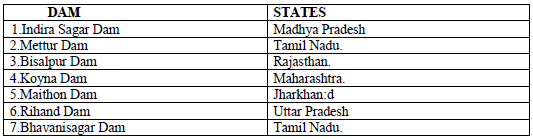
Question. Write the functions of multi-purpose projects.
Answer : The main function of multi-purpose projects are:
1. Supply of water for domestic needs
2. Breeding fish
3. Control of floods
4. Generation of hydroelectricity
5. Promotion of tourism
6. Irrigation
7. Navigation
Question. What are the main uses of water?
Answer : Water can be used for direct and indirect purposes. Direct purposes include bathing, drinking, and cooking, while examples of indirect purposes are the use of water in processing wood to make paper and in producing steel for automobiles. The bulk of the world's water is used for agriculture, industry, and electricity.
Long Short Answer Type Questions :
Question. Write methods to conserve water.
Answer : Water conservation means using less water or recycling used water so that it can be used again. Methods to conserve water are:
1. Check your toilet for leaks.
2. Take shorter showers -A typical shower uses five to ten gallons of water a minute. Limit your showers .Use buckets
3. Turn off the water while brushing your teeth-Before brushing, wet your brush and fill glass for rinsing your mouth.
4. Turn off the water while shaving -Fill the bottom of the sink with a few inches of warm water in which to rinse your razor. Rather than using open tap.
5. If you wash dishes by hand, don't leave the water running for rinsing .
6. Water your lawn only when it needs it
7. Water during the cool parts of the day -Early morning is better
8. Use a broom to clean driveways, sidewalks and steps -Using a hose wastes hundreds of gallons of water.
9. Tell your children not to play with the hose and sprinklers -Children love to play under a hose or sprinkler on a hot day. This practice is extremely wasteful of precious water and should be discouraged.
Question. Draw the diagram of conservation of water.
Answer : 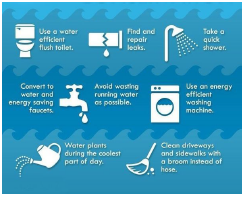
Download Class 4 Social Science Water Practice Worksheets
Daily Practice Questions for Class 4 Social Science
Review targeted practice exercises for Class 4 Social Science Water. Curated to match official CBSE guidelines, these printable problem sets support daily revision and improve overall test readiness.
Detailed Answers for Class 4 Social Science Water
Built using official NCERT guidelines for Class 4 Social Science, these practice sheets provide reliable academic support. Cross-reference your completed work with our detailed solutions to learn standard answer-writing formats for CBSE exams.
Complete Your Chapter Revision
Wrap up your chapter revision by testing your knowledge against standard objective question formats. Explore our full library of free, up-to-date printable assignments to maximize your academic results in upcoming CBSE evaluations.
FAQs
You can download the latest chapter-wise printable worksheets for Class 4 Social Science Water for free from StudiesToday.com. These have been made as per the latest CBSE curriculum for this academic year.
Yes, Class 4 Social Science worksheets for Water focus on activity-based learning and also competency-style questions. This helps students to apply theoretical knowledge to practical scenarios.
Yes, we have provided solved worksheets for Class 4 Social Science Water to help students verify their answers instantly.
Yes, our Class 4 Social Science test sheets are mobile-friendly PDFs and can be printed by teachers for classroom.
For Water, regular practice with our worksheets will improve question-handling speed and help students understand all technical terms and diagrams.