

Official Class 11 Physics Worksheets: Chapter 10 Thermal Properties Of Matter
Access comprehensive chapter-wise worksheets for Chapter 10 Thermal Properties Of Matter using the CBSE Class 11 Physics Thermal Properties Of Matter Worksheet Set 01. Designed to align with the 2026-27 academic syllabus for Class 11 Physics, these printable practice sets help students reinforce key concepts and improve their overall exam readiness.
Solved Practice Worksheets for Physics
Navigate directly to the solved Physics worksheets using the digital viewer below. Each practice set includes detailed step-by-step solutions, allowing students to instantly cross-check their work and identify areas requiring further revision.
Very Short Answer Type Questions :
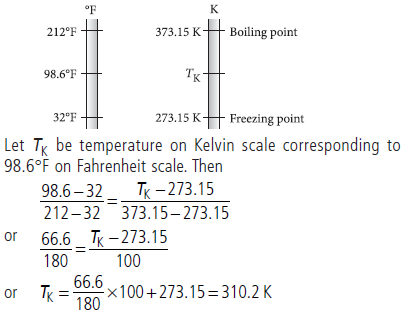
Question: The temperature on a Fahrenheit scale is 98.6°F? What is the corresponding temperature on a Kelvin scale?
Answer :
Question: How does running hot water on a jar lid loosen it ?
Answer : The metal expands more than the glass and consequently lid pulls away from the jar.
The hot water helps the metal to expand.
Question: The graph between two temperature scales A and B is shown in figure. Between upper fixed point and lower fixed point there are 150 equal division on scale A and 100 on scale B. What is the relationship for conversion between the two scales ?
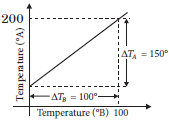
Answer : From the graph, for the scale A,
Lower fixed point = 50°A
Upper fixed point = 200°A
For the scale B,
Lower fixed point = 0° B
Upper fixed point = 100° B
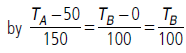
- The relationship between the two scales A and B is given
Question: Thermal conductivity of air is less than that of felt but felt is a better heat insulator in comparison to air. Why?
Answer : Free air is able to transmit heat by convection currents. But in case of felt, there are fine holes which trap air and do heat allow its movement. Obviously, convection currents cannot be set in the felt.
Question: Why are we advised to store medicines below 86 °F ?
Answer : A temperature of 86° F is equal to 30° C. Above this temperature, chemical reactions may take place resulting in a change in the composition of the medicine. The medicine may then become ineffective or even harmful.
Question: The temperature gradient in a rod 0.5 m long is 40 °C per metre. The temperature of the hotter end is 30 °C. What is the temperature of its colder end?
Answer : As temperature gradient = T1 – T2 / x ,
where, T1 = 30 °C, x = 0.5 m, T2 = ?
Temperature of colder end = 30 – 0.5 × 40 = 10 °C
Question: Why does a metal bar appear hotter than a wooden bar at the same temperature?
Equivalently it also appears cooler than wooden bar if they are both colder than room temperature.
Answer : Since the conductivities of metals are very high compared to wood. So on touching a hot metal with a finger, heat flows faster to the finger from metal and feels the heat.
Similarly, when one touches a cold metal the heat from the finger to the metal bar from the body.
Question: Two identical rectangular strips, one of copper and the other of steel, are riveted to form a bimetallic strip. What will happen on heating ?
Answer : The coefficient of linear expansion is more for copper than for steel. As such, when the bimetallic strip is heated, it will bend in such a way that the copper strip will occupy the convex side, i.e., the outer side.
Question: Specific heat of aluminium metal is 24.4 J/mole K. Express the specific heat in J/kg K.
Answer : Specific heat of aluminium metal
= 24.4 J/mole K
= 24.4 x 1000 j/Kg K = 904 J/kg K ≈ 900 J/kg K.
Question: What is the temperature of the triple-point of water on an absolute scale whose unit interval size is equal to that of the Fahrenheit scale?
Answer : The unit interval size of Fahrenheit scale is 212 – 32 = 180 divisions
Also we know that the unit interval size of absolute scale is 100.
- Triple point of water on an absolute scale having 180 divisions is given by
T= 273.16 / 100 x 180 = 491.16
Short Answer Type Questions :
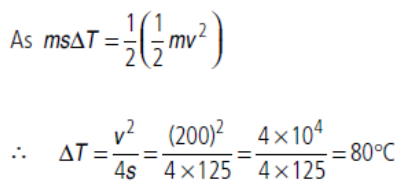
Question: A lead bullet strikes against a fixed steel plate with a velocity 200 m s–1. If the impact is perfectly inelastic and the heat produced is equally shared between the bullet and the target, what is the rise in temperature of the bullet?
(specific heat capacity of lead = 125 J kg–1 K–1)
Answer : Since the target is fixed, both bullet and plate will be finally at rest.
The kinetic theory is converted into low energy.
But recries half of his heat energy and its temperature rises.
Question: What is the effect of pressure on melting point of a substance? What is the regelation.
Give its one practical application.
Answer : Effect of pressure on melting point : The melting point of those substances which expand on melting (e.g., paraffing wax, phosphorus, sulphur, etc.) increases with the increase in pressure while the melting point of those substances which contract on melting (e.g., ice, cast iron, bismuth etc.) decreases with increase in pressure.
Regelation : The phenomenon in which ice melts when pressure is increased and again freezes when pressure is removed is called regelation.
Example : Skating is possible due to the formation of water layer below the skates. Water is formed due to the increase of pressure and it acts as a lubricant.
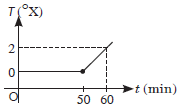
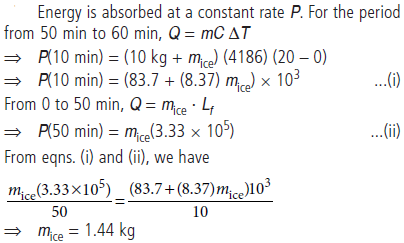
Question: A calorimeter contains 10 kg of water and some ice. Variation of temperature with time, when the calorimeter is heated over a slow burner is as shown in graph. Ignoring heat absorbed by calorimeter, find the amount of ice present.
Answer :
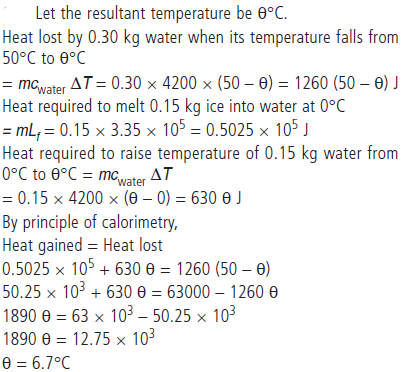
Question: 0.15 kg of ice at 0°C is mixed with 0.30 kg of water at 50°C in a container. Find the resultant temperature. Given the Latent heat of fusion of ice = 3.35 ×× 105 J/kg and cwater = 4200 J kg–1 K–1
Answer :
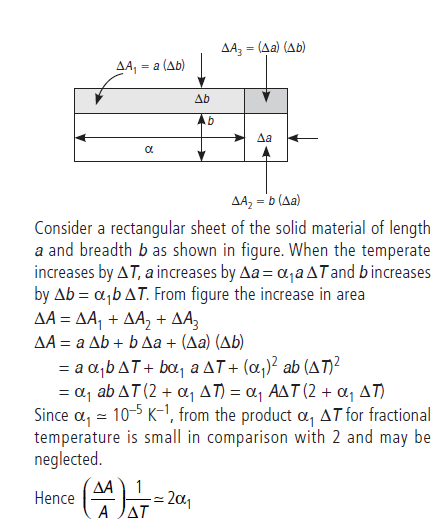
Question: Show that the coefficient of area expansions, (ΔA/A)/ΔT, of a rectangular sheet of the solid is twice its linear expansivity, α1.
Answer :
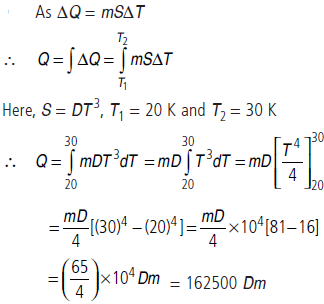
Question: The specific heat of many solids at low temperatures varies with absolute temperature T according to the relations S = DT3, where D is a constant. What is the heat energy required to raise the temperature of a mass m of such a solid from T1 = 20 K to T2 = 30 K ?
Answer :
Question: Define the terms heat capacity and water equivalent. Give their CGS and SI units.
Answer : The heat capacity of a substance can be defined by the amount of heat required to change its temperature by one degree. It is also called thermal capacity which is a physical property of matter.
The SI unit of heat capacity is low per kelvin and the unit of heat capacity in CGS is calorie/°C.
The water equivalent of a body is defined as the mass of water which requires the same amount heat as is required by the given body for the same rise of temperature.
Water equivalent = Mass × Specific heat
or w = mc
The CGS unit of water equivalent is g and the SI unit is kg.
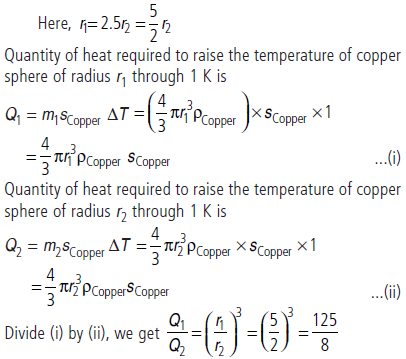
Question: Find the ratio of heat required to raise the temperatures of two copper spheres of radii r1 and r2 (r1 = 2.5r2) through 1 K.
Answer :
Question: Draw experimental curves between wavelength λ and intensity of radiation Eλ emitted by a black body maintained at different constant temperatures.
Answer :
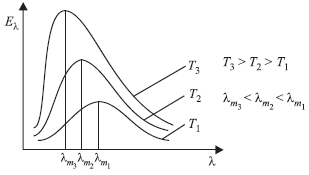
As the temperature of the body increases, the wavelength at which the spectral intensity (Eλ) is maximum shifts towards left. Therefore it is also called Wien’s displacement law.
Question: Two ideal gas thermometers A and B use oxygen and hydrogen respectively. The following observations are made :
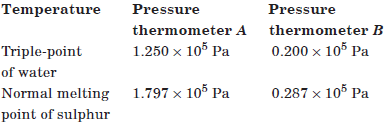
(a) What is the absolute temperature of normal melting point of sulphur as read by thermometers A and B ?
(b) What do you think is the reason behind the slightly difference in answers of thermometers A and B ? (The thermometers are not faulty). What further procedure is needed in the experiment to reduce the discrepancy between the two readings ?
Answer : (a) Let T be the melting point of sulphur.
The triple point of water, Ttr = 273.16 K
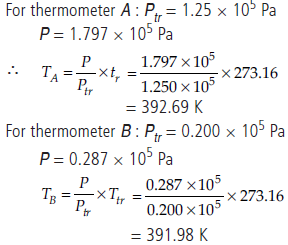
(b) The discrepancy arises because the gases are not perfectly ideal. To reduce the discrepancy, readings should be taken at lower pressure as in that case, the gases approach to the ideal gas behaviour.
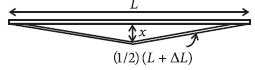
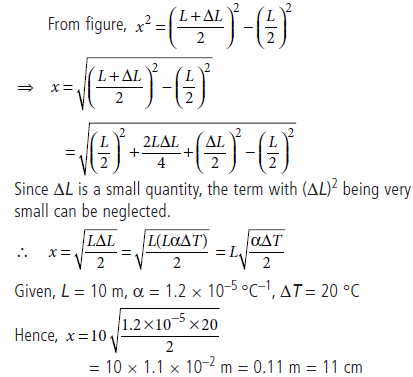
Question: A rail track made of steel having length 10 m is clamped on a railway line at its two ends. On a summer day due to rise in temperature by 20°C, it is deformed as shown in figure. Find x (displacement of the centre) if coefficient of linear expansion of steel is, αsteel = 1.2 × 10⁻⁵ °C–1
Answer :
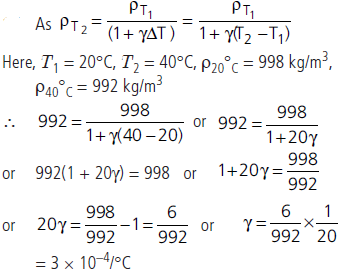
Question: The density of water at 20°C is 998 kg/m3 and at 40°C is 992 kg/m3. Find the coefficient of volume expansion of water.
Answer :
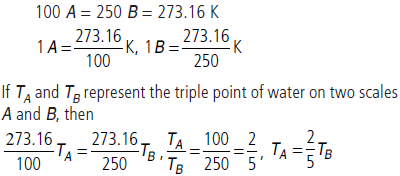
Question: Two absolute scales A and B have triplepoints of water defined to be 100 A and 250 B. What is the relation between TA and TB?
Answer : Here, triple point of water on scale, A = 100 A
triple point of water on scale, B = 250 B
triple point of water on kelvin scale = 273.16 K According to question
Question: (a) Calorimeters are made of metals not glass. Why ?
(b) What is calorimetry ?
(c) Which has the highest specific heat capacity : hydrogen or water?
Answer : (a) This is because metals are good conductors of heat and have low specific heat capacity.
(b) The branch of physics that deals with the measurement of heat is called calorimetry.
(c) Hydrogen has the highest specific heat capacity (not molar specific heat capacity). Its value is 14400 J kg–1 K–1
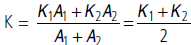
Question: Two rods A and B of different materials are welded together as shown in figure. Their thermal conductivities are K1 and K2. Find the thermal conductivity of the composite rod.
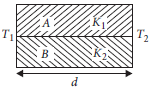
Answer : Equivalent thermal conductivity of the composite rod in parallel combination will be,
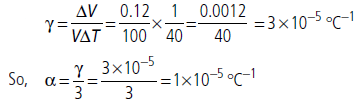
Question: The volume of a metal block changes by 0.12%, when it is heated through 40°°C. Find the coefficient of linear expansion for material of block.
Answer :
Question: Explain briefly the anomalous expansion of water. How the fishes can survive in the extreme winter when lakes ponds are frozen?
Answer : Water shows unusual expansion, when it is cooled from from 4° C to 0° C degree. The unusual behaviour of water, when it expands below 4° C to 0° C is called anomalous expansion of water. The anomalous expansion of water helps preserve aquatic life during very cold weather. When temperature falls, the top layer of water in a pond contracts, becomes denser and sinks to the bottom. A circulation is thus set up until the entire water in the pond reaches its maximum density at 4°C. If the temperature falls further, the top layer expands and remains on the top till it freezes. Thus even though the upper layer are frozen the water near the bottom is at 4°C and the fishes etc. can survive in it easily.
Question: During summers in India, one of the common practice to keep cool is to make ice balls of crushed ice, dip it in flavoured sugar syrup and sip it. For this a stick is inserted into crushed ice and is squeezed in the palm to make it into the ball. Equivalently in winter, in those areas where it snows, people make snow balls and throw around. Explain the formation of ball out of crushed ice or snow in the light of P–T diagram of water.
Answer : Refer to the P-T diagram of water and double headed arrow. Increasing pressure at 0°C and 1 atm takes ice into liquid state and decreasing pressure in liquid state at 0°C and 1 atm takes water to ice state.
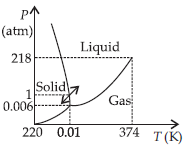
When crushed ice is squeezed, some of it melts, filling up gap between ice flakes. Upon releasing pressure, this water freezes binding all ice flakes making the ball more stable.
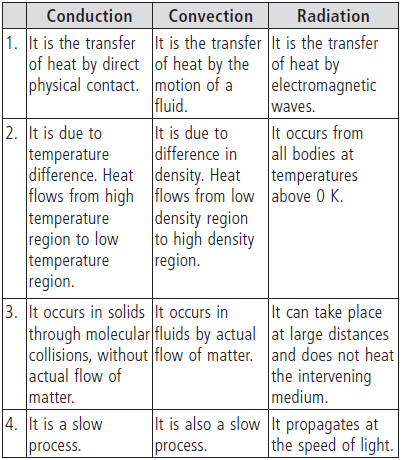
Question: Differentiate between three modes of heat transmission.
Answer :
Question: (a) On what factors does the amount of heat flowing through a body [conductivity] depend?
Obtain the expression for the heat conducted.
(b) Define coefficient of thermal conductivity. Write its SI unit.
(c) Define thermal conductivity.
Answer : (a) The amount of heat Q flowing through a body depends on various factors
(i) It is directly proportional to the cross-sectional area A.
(ii) It is directly proportional to the temperature difference (T1 – T2) between the opposite faces.
(iii) It is directly proportional to time t for which the heat flows.
(iv) It is inversely proportional to thickness x of the block, and.
(v) It depends on the nature of the material of the block.

(b) Thermal conductivity is the ability of a given material to conduct or transfer heat. It is donated by K. Materials with high thermal conductivity are used in heat sinks and materials with low values of K used as thermal insulators.
K = Qd/AΔT
It SI unit is m–1 K–1.
Its SI unit is J s–1 m–1 K–1 or W m–1 K–1.
(c) The ability of material to conduct the heat through it is known as thermal conductivity.
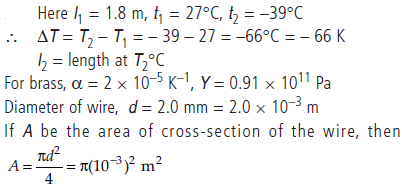
Question: A brass wire 1.8 m long at 27°C is held taut with little tension between two rigid supports. If the wire is cooled to a temperature of –39°C, what is the tension developed in the wire, if its diameter is 2.0 mm? Coefficient of linear expansion of brass = 2.0 × 10⁻⁵ K–1; Young’s modulus of brass = 0.91 × 10¹¹ Pa.
Answer :
Long Answer Type Questions :
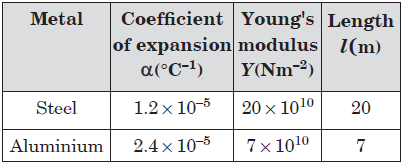
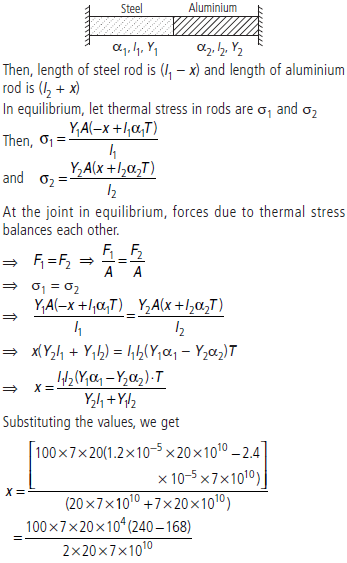
Question: Two rods one of steel and other of aluminium is equal to cross-sectional area are joined together and the free ends are fixed between two rigid supports as shown in the figure.
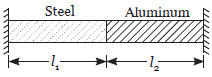
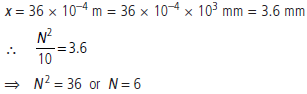
Temperature of surroundings is increased by 100°C. If displacement of joint rods is (N2/10) mm, then find the value of N with the help of following table.
Answer : If allowed to expand the rods increase in length by l1a1T and l2a2T. Because of walls, there is no free expansion. If one expands, the other would compress. Let the junction shift by x towards steel side (towards left).
Question: Explain why?
(a) A body with large reflectivity is a poor emitter?
(b) A brass tumbler feels much colder than a wooden tray on a chilly day?
(c) The Earth without its atmosphere would be inhospitably cold?
(d) Heating systems based on circulation of steam are more efficient in warming a building than those based on circulation of hot water?
Answer : (a) We know that a + r + t = 1
Where a, r and t are absorbance, reflectance and transmittance respectively of the surface of the body, t is also called emittance (e). Also according to Kirchhoff’s law e ∝ a, that is good absorbers are good emitters and hence poor reflectors and vice-versa i.e., if r is large (i.e., large reflectively) a is smaller and hence e is smaller i.e., poor emitter.
(b) The thermal conductivity of brass is high i.e., brass is a good conductor of heat. So when a brass tumbler is touched, heat quickly flows from human body to the tumbler. Consequently, the tumbler appears colder. On the other hand, wood is a bad conductor of heat. So heat does not flow from the human body to the wooden tray, thus it appears relatively hotter.
(c) Gases are generally insulators. The Earth’s atmosphere acts like an insulating blanket around it and does not allow heat to escape out but reflects it back to the Earth. If this atmosphere is absent, then the Earth would naturally be colder as all its heat would have escaped out.
(d) This is because steam has much higher heat capacity (540 cal g–1) than the heat capacity of water (80 cal g–1) at the same temperature. Thus heating systems based on circulation of steam are more efficient than those based on circulation of hot water.
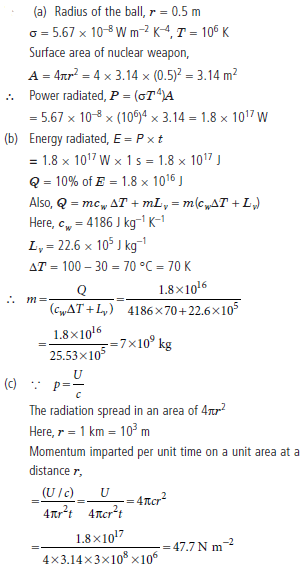
Question: According to Stefan’s law of radiation, a black body radiates energy σT 4 from its unit surface area every second where T is the surface temperature of the black body and σ = 5.67 × 10⁻⁸ W m–2 K–4 is known as Stefan’s constant. A nuclear weapon may be thought of as a ball of radius 0.5 m. When detonated, it reaches temperature of 103 K and can be treated as a black body.
(a) Estimate the power it radiates.
(b) If surrounding has water at 30 °C, how much water can 10% of the energy produced evaporate
in 1 s?
[sw = 4186.0 J kg–1 K–1, Lv = 22.6 × 10⁵ J kg–1]
(c) If all this energy U is in the form of thermal radiation, corresponding momentum is p = U/c. How much momentum per unit time does it impart on unit area at a distance of 1 km?
Answer :
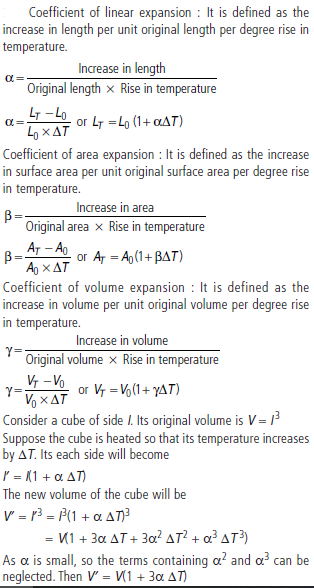
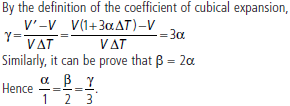
Question: What is meant by coefficient of linear expansion, superficial expansion and cubical expansion? Derive the relationship between them.
Answer : Coefficient of linear expansion : It is defined as the increase in length per unit original length per degree rise in temperature.
Free study material for Physics
CBSE Class 11 Physics Worksheets for Chapter 10 Thermal Properties Of Matter
Mastering Chapter 10 Thermal Properties Of Matter with Printable Worksheets
Access structured practice worksheets for Chapter 10 Thermal Properties Of Matter aligned with the 2026 CBSE curriculum. These downloadable exercises for Class 11 Physics help students build accuracy and reinforce core concepts for upcoming school tests.
Verified Solutions and NCERT Alignment
Designed around the official curriculum for Class 11 Physics, these practice sheets guarantee standard compliance. Reviewing step-by-step solutions after completion sharpens your accuracy and clarifies complex sub-topics within Chapter 10 Thermal Properties Of Matter.
Additional Study Resources for Class 11 Physics
Wrap up your chapter revision by testing your knowledge against standard objective question formats. Explore our full library of free, up-to-date printable assignments to maximize your academic results in upcoming CBSE evaluations.
FAQs
You can download the latest chapter-wise printable worksheets for Class 11 Physics Chapter 10 Thermal Properties Of Matter for free from StudiesToday.com. These have been made as per the latest CBSE curriculum for this academic year.
Yes, Class 11 Physics worksheets for Chapter 10 Thermal Properties Of Matter focus on activity-based learning and also competency-style questions. This helps students to apply theoretical knowledge to practical scenarios.
Yes, we have provided solved worksheets for Class 11 Physics Chapter 10 Thermal Properties Of Matter to help students verify their answers instantly.
Yes, our Class 11 Physics test sheets are mobile-friendly PDFs and can be printed by teachers for classroom.
For Chapter 10 Thermal Properties Of Matter, regular practice with our worksheets will improve question-handling speed and help students understand all technical terms and diagrams.