

Download Class 11 Physics Practice Worksheets
Explore structured practice materials through the CBSE Class 11 Physics Motion In Straight Line Worksheet. Tailored for Class 11 learners, utilizing these Physics worksheets ensures thorough preparation and strengthens problem-solving accuracy before final school evaluations.
Access Chapter 02 Motion in a Straight Line Practice Papers and Solutions
Navigate directly to the solved Physics worksheets using the digital viewer below. Each practice set includes detailed step-by-step solutions, allowing students to instantly cross-check their work and identify areas requiring further revision.
Motion In Straight Line MCQ Questions with Answers Class 11 Physics
Question- Area under velocity-time curve over a given interval of time represents
(a) acceleration
(b) momentum
(c) velocity
(d) displacement
Answer-(d)
Question-The displacement of a body is zero. The distance covered
(a) is zero
(b) is not zero
(c) may or may not be zero
(d) depends upon the acceleration
Answer-(c)
Question-The slope of velocity-time graph for motion with uniform velocity is equal to
(a) final velocity
(b) initial velocity
(c) zero
(d) none of these
Answer-(c)
Question-Speed is in general _____ in magnitude than that of the velocity.
(a) equal
(b) greater or equal
(c) smaller
(c) none of these
Answer-(b)
Question-The slope of the tangent drawn on position-time graph at any instant is equal to the instantaneous
(a) acceleration
(b) force
(c) velocity
(d) momentum
Answer-(c)
Question-Which of the following is a one dimensional motion ?
(a) Landing of an aircraft
(b) Earth revolving around the sun
(c) Motion of wheels of a moving train
(d) Train running on a straight track
Answer-(d)
Question- The numerical ratio of displacement to distance for a moving object is
(a) always less than 1
(b) always equal to 1
(c) always more than 1
(d) equal to or less than 1
Answer-(d)
Question-The ratio of the numerical values of the average velocity and average speed of a body is
(a) unity
(b) unity or less
(c) unity or more
(d) less than unity
Answer-(b)
Question-The distance travelled by a body is directly proportional to the time taken. Its speed
(a) increases
(b) decreases
(c) becomes zero
(d) remains constant
Answer-(d)
Question-The location of a particle has changed. What can we say about the displacement and the distance covered by the particle?
(a) Neither can be zero
(b) One may be zero
(c) Both may be zero
(d) One is +ve, other is –ve
Answer-(a)
Question-A body is moving along a straight line path with constant velocity. At an instant of time the distance travelled by it is S and its displacement is D, then
(a) D < S
(b) D > S
(c) D = S
(d) D ≤ S
Answer-(c)
Question-Which of the following can be zero, when a particle is in motion for some time?
(a) Distance
(b) Displacement
(c) Speed
(d) None of these
Answer-(b)
Question-What is the numerical ratio of velocity to speed of an object ?
(a) Always equal to one
(b) Always less than one
(c) Always greater than one
(d) Either less than or equal to one.
Answer-(d)
Question-If distance covered by a particle is zero, what can you say about its displacement?
(a) It may or may not be zero
(b) It cannot be zero
(c) It is negative
(d) It must be zero
Answer-(d)
Question- Velocity-time curve for a body projected vertically upwards is
(a) parabola
(b) ellipse
(c) hyperbola
(d) straight line
Answer-(d)
Question- The graph between displacement and time for a particle moving with uniform acceleration is a/an
(a) straight line with a positive slope
(b) parabola
(c) ellipse
(d) straight line parallel to time axis
Answer-(b)
Question- A body is thrown upwards and reaches its maximum height.At that position
(a) its acceleration is minimum
(b) its velocity is zero and its acceleration is also zero
(c) its velocity is zero but its acceleration is maximum
(d) its velocity is zero and its acceleration is the acceleration due to gravity.
Answer-(d)
Question- What determines the nature of the path followed by the particle?
(a) Speed
(b) Velocity
(c) Acceleration
(d) Both (b) and (c)
Answer-(d)
Question- An object accelerated downward under the influence of force of gravity. The motion of object is said to be
(a) uniform motion
(b) free fall
(c) non uniformly accelerated motion
(d) None of these
Answer-(b)
Question- Stopping distance of a moving vehicle is directly proportional to
(a) square of the initial velocity
(b) square of the initial acceleration
(c) the initial velocity
(d) the initial acceleration
Answer-(a)
Question- Acceleration of a particle changes when
(a) direction of velocity changes
(b) magnitude of velocity changes
(c) speed changes
(d) Both (a) and (b)
Answer-(c)
Question- The area under acceleration time graph gives
(a) distance travelled
(b) change in acceleration
(c) force acting
(d) change in velocity
Answer-(d)
Question- A body is thrown vertically upwards. If air resistance is to be taken into account, then the time during which the body rises is
(a) equal to the time of fall
(b) less than the time of fall
(c) greater than the time of fall
(d) twice the time of fall
Answer-(b)
Question- The acceleration of a moving body can be found from
(a) area under velocity - time graph
(b) area under distance -time graph
(c) slope of the velocity- time graph
(d) slope of distance-time graph
Answer-(c)
Question- Velocity time curve for a body projected vertically upwards is
(a) parabola
(b) ellipse
(c) hyperbola
(d) straight line
Answer-(d)
Question- The path of a particle moving under the influence of a force fixed in magnitude and direction is
(a) straight line
(b) circle
(c) parabola
(d) ellipse
Answer-(a)
Question- If a body travels with constant acceleration, which of the following quantities remains constant ?
(a) Displacement
(b) Velocity
(c) Time
(d) None of these.
Answer-(d)
Question- Acceleration is described as rate of change of
(a) distance with time
(b) velocity with distance
(c) velocity with time
(d) distance with velocity
Answer-(c)
Question- An object accelerated downward under the influence of force of gravity. The motion of object is said to be
(a) uniform motion
(b) free fall
(c) non uniformly accelerated motion
(d) None of these
Answer-(b)
Question- A metro train starts from rest and in 5 s achieves 108 km/h.After that it moves with constant velocity and comes to rest after travelling 45 m with uniform retardation. If total distance travelled is 395 m, find total time of travelling.
(a) 12.2 s
(b) 15.3 s
(c) 9 s
(d) 17.2 s
Answer-(d)
Question- Free fall of an object (in vacuum) is a case of motion with
(a) uniform velocity
(b) uniform acceleration
(c) variable acceleration
(d) constant momentum
Answer-(b)
Question- Two balls A and B of same mass are thrown from the top of the building. A thrown upward with velocity v and B, thrown down with velocity v, then
(a) velocity A is more than B at the ground
(b) velocity of B is more than A at the ground
(c) both A &B strike the ground with same velocity
(d) None of these
Answer-(c)
Question- The total distance travelled by the body in the given time is equal to
(a) the area which v– t graph encloses with displacement axis
(b) the area which x – t graph encloses with time axis
(c) the area which v – t graph encloses with time axis
(d) the area which a – t graph encloses with axis
Answer-(c)
Question- If the v-t graph is a straight line inclined to the time axis, then
(a) a = 0 (b) a ≠ 0
(c) a = constant ≠ 0
(d) a ≠ constant ≠ 0
Answer-(c)
Question- A particle moves 2m east then 4m north then 5 m west.The distance is
(a) 11m
(b) 10m
(c) –11m
(d) 5m
Answer-(a)
Question- The ball is projected up from ground with speed 30 m/sec.What is the average velocity for time 0 to 4 sec?
(a) 10 m/sec
(b) 20 m/sec
(c) 15 m/sec
(d) zero
Answer-(a)
Question- For a moving body at any instant of time
(a) if the body is not moving, the acceleration is necessarily zero
(b) if the body is slowing, the retardation is negative
(c) if the body is slowing, the distance is negative
(d) if displacement, velocity and acceleration at that instant are known, we can find the displacement at any given time in future.
Answer-(d)
Question- A particle moves from (2,3) m to (4,1) m. The displacement vector is
(a) 2i + 2jm
(b) –2i – 2jm
(c) 2i – 2jm
(d) –2i + 2jm
Answer-(c)
Question- A ball thrown vertically upwards after reaching a maximum height h, returns to the starting point after a time of l0 s. Its displacement is
(a) h
(b) 2 h
(c) 10 h
(d) zero
Answer-(d)
Question- If a train travelling at 20 m/s is to be brought to rest in a distance of 200 m, then its retardation should be
(a) 1 m/s2
(b) 2 m/s2
(c) 10 m/s2
(d) 20 m/s2
Answer-(a)
Question- A body starts from rest and travels ‘s’ m in 2nd second, then acceleration is
(a) 2s m/s2
(b) 3s m/s2
(c) 2/3 s m/s2
(d) 2/3 s m/s2
Answer-(c)
Question- Two trains, each Xm long are travelling in opposite direction with equal velocity 20 m/s. The time of crossing is
(a)X/40 s
(b)X/20 s
(c)2X/20 s
(d) Zero
Answer-(a)
Question- Choose the wrong statement from the following.
(a) The motion of an object along a straight line is a rectilinear motion
(b) The speed in general is less than the magnitude of the velocity
(c) The slope of the displacement-time graph gives the velocity of the body
(d) The area under the velocity-time graph gives the displacement of the body
Answer-(b)
Question- A passenger in a moving train tosses a coin. If the coin falls behind him, the train must be moving with
(a) an acceleration
(b) a deceleration
(c) a uniform speed
(d) any of the above
Answer-(a)
Question- A ball is dropped from the top of a tower of height 100 m and at the same time another ball is projected vertically upwards from ground with a velocity 25 ms–1. Then the distance from the top of the tower, at which the two balls meet is
(a) 68.4 m
(b) 48.4 m
(c) 18.4 m
(d) 78.4 m
Answer-(d)
Question- If the displacement of a body varies as the square of elapsed time, then its
(a) velocity is constant
(b) velocity varies non-uniformly
(c) acceleration is constant
(d) acceleration changes continuously
Answer-(c)
Question. A particle has moved from one position to another position
(a) its distance is zero
(b) its displacement is zero
(c) neither distance nor displacement is zero
(d) average velocity is zero
Answer: C
Question. The displacement of a particle is given by √x = t +1. Which of the following statements about its velocity is true ?
(a) It is zero
(b) It is constant but not zero
(c) It increases with time
(d) It decreases with time
Answer: C
Question. The displacement-time graphs of two particles A and B are straight lines making angles of respectively 30º and 60º with the time axis. If the velocity of A is vA and that of B is vB, the value of vA/vB is
(a) 1/2
(b) 1/ √3
(c) √3
(d) 1/3
Answer: D
Question. The acceleration of a particle is increasing linearly with time t as bt. The particle starts from the origin with an initial velocity v0. The distance travelled by the particle in time t will be
(a) v0t+1/3 bt2
(b) v0t+1/3 bt3
(c) v0t+1/6 bt3
(d) v0t+1/2 bt2
Answer: C
Question. The displacement of a body is zero. The distance covered
(a) is zero
(b) is not zero
(c) may or may not be zero
(d) depends upon the acceleration
Answer: C
Question. The slope of the velocity time graph for retarded motion is
(a) positive
(b) negative
(c) zero
(d) can be +ve, –ve or zero
Answer: B
Question. A body is thrown upwards and reaches its maximum height.
At that position
(a) its acceleration is minimum
(b) its velocity is zero and its acceleration is also zero
(c) its velocity is zero but its acceleration is maximum
(d) its velocity is zero and its acceleration is the acceleration due to gravity.
Answer: D
Question. The area of the acceleration-displacement curve of a body gives
(a) impulse
(b) change in momentum per unit mass
(c) change in KE per unit mass
(d) total change in energy
Answer: C
Question. The deceleration experienced by a moving motorboat after its engine is cut off, is given by dv/dt = – kv3 where k is constant. If v0 is the magnitude of the velocity at cut-off,
the magnitude of the velocity at a time t after the cut-off is
(a) v0/√(2v02kt+1)
(b) v0e-kt
(c) v0/2
(d) v0
Answer: A
Question. A stone is dropped into a well in which the level of water is h below the top of the well. If v is velocity of sound, the time T after which the splash is heard is given by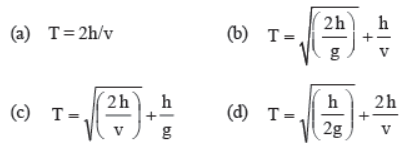
Answer: B
Question. The initial velocity of a particle is u (at t = 0) and the acceleration a is given by f t.
Which of the following relation is valid?
(a) v = u + f t2
(b) v = u + f t2/2
(c) v = u + f t
(d) v = u
Answer: B
Question. The displacement x of a particle varies with time according to the relation x = a/b(1-e-bt). Then select the false alternatives.
(a) At t = 1/b , the displacement of the particle is nearly 2/3(a/b)
(b) the velocity and acceleration of the particle at t = 0 are a and –ab respectively
(c) the particle cannot go beyond x = a/b
(d) the particle will not come back to its starting point at t → ∞
Answer: D
Question. The ratio of the numerical values of the average velocity and average speed of a body is always:
(a) unity
(b) unity or less
(c) unity or more
(d) less than unity
Answer: B
Question. Two cars A and B are travelling in the same direction with velocities vA and vB (vA>vB). When the car A is at a distance d behind the car B the driver of the car A applies brakes producing a uniform retardation a. There will be no collision when
(a) d<(vA-vB)2/2a
(b) d<v2A-v2B/2a
(c) d>(vA-vB)2/2a
(d) d>v2A-v2B/2a
Answer: C
Question. A person travels along a straight road for the first half time with a velocity v1 and the second half time with a velocity v2. Then the mean velocity v is given by 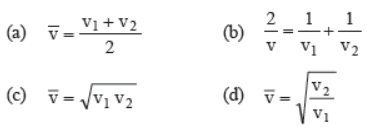
Answer: A
Question. Two bodies of masses m1 and m2 fall from heights h1 and h2 respectively. The ratio of their velocities, when they hit the ground is
(a) h1/h2
(b) √h1/h2
(c) m1h1/m1h2
(d) h12/h22
Answer: B
Question. If the displacement of a particle varies with time as √x = t + 7 , the
(a) velocity of the particle is inversely proportional to t
(b) velocity of the particle is proportional to t
(c) velocity of the particle is proportional to √t
(d) the particle moves with a constant acceleration
Answer: B
Question. A particle covers half of the circle of radius r. Then the displacement and distance of the particle are respectively
(a) 2πr, 0
(b) 2r, πr
(c) πr/2 ,2r
(d) πr, r
Answer: B
Question. The study of motion, without consideration of its cause is studied in
(a) statistics
(b) kinematics
(c) mechanics
(d) modern physics
Answer: B
Question. It is given that t = px2 + qx, where x is displacement and t is time. The acceleration of particle at origin is
(a) -2p/q3
(b) -2q/p3
(c) 2p/q3
(d) 2q/p3
Answer: A
Question. The displacement x of a particle moving along a straight line at time t is given by
x = a0 + a1 t + a2 t2
What is the acceleration of the particle
(a) a1
(b) a2
(c) 2 a2
(d) 3 a2
Answer: C
Question. Figure shows the v-t graph for two particles P and Q. Which of the following statements regarding their relative motion is true ?
Their relative velocity is 
(a) is zero
(b) is non-zero but constant
(c) continuously decreases
(d) continuously increases
Answer: D
Question. A point traversed half of the distance with a velocity v0. The half of remaining part of the distance was covered with velocity v1 & second half of remaining part by v2 velocity.
The mean velocity of the point, averaged over the whole time of motion is
(a) v0+v1+v2/3
(b) 2v0+v1+v2/3
(c) v0+2v1+2v2/3
(d) 2v0(v1+v2)/(2v0+v1+v2)
Answer: D
Question. Which of the following changes when a particle is moving with uniform velocity?
(a) Speed
(b) Velocity
(c) Acceleration
(d) Position vector
Answer: D
Question. The distance through which a body falls in the nth second is h. The distance through which it falls in the next second is
(a) h
(b) h + g/2
(c) h – g
(d) h + g
Answer: D
Question. A passenger travels along the straight road for half the distance with velocity v1 and the remaining half distance with velocity v2. Then average velocity is given by
(a) v1v2
(b) v22/ v12
(c) (v1 + v2 )/2
(d) 2v1v2 / (v1 + v2)
Answer: D
Question. When the speed of a car is v, the minimum distance over which it can be stopped is s. If the speed becomes n v, what will be the minimum distance over which it can be stopped during same retardation
(a) s/n
(b) n s
(c) s/n2
(d) n2 s
Answer: D
Question. The velocity of a particle at an instant is 10 m/s. After 5 sec, the velocity of the particle is 20 m/s. Find the velocity at 3 seconds before from the instant when velocity of a particle is 10m/s.
(a) 8 m/s
(b) 4 m/s
(c) 6 m/s
(d) 7 m/s
Answer: B
Question. A particle experiences constant acceleration for 20 seconds after starting from rest. If it travels a distance s1 in the first 10 seconds and distance s2 in the next 10 seconds, then
(a) s2 = s1
(b) s2 = 2 s1
(c) s2 = 3 s1
(d) s2 = 4 s1
Answer: C
Question. The position x of a particle varies with time (t) as x = A t2 – B t3. The acceleration at time t of the particle will be equal to zero. What is the value of t?
(a) 2A/3B
(b) A/B
(c) A/3B
(d) zero
Answer: C
Question. The acceleration of a particle, starting from rest, varies with time according to the relation a = -sω2 sinωt
The displacement of this particle at a time t will be
(a) s sin ω t
(b) s ω cos ω t
(c) s ω sin ω t
(d) -1/2(sω2 sinωt)t2
Answer: A
Question. A steel ball is bouncing up and down on a steel plate with a period of oscillation of 1 second. If g = 10 ms–2, then it bounces up to a height of
(a) 5 m
(b) 10 m
(c) 2.5 m
(d) 1.25 m
Answer: D
Question. A body travels 2 m in the first two second and 2.20 m in the next 4 second with uniform deceleration. The velocity of the body at the end of 9 second is
(a) – 10 ms-1
(b) – 0.20 ms-1
(c) – 0.40 ms-1
(d) – 0.80 ms-1
Answer: B
Question. A particle is moving along a straight line path according to the relation
s2 = at2 + 2bt + c
s represents the distance travelled in t seconds and a, b, c are constants. Then the acceleration of the particle varies as
(a) s–3
(b) s3/2
(c) s–2/3
(d) s 2
Answer: A
Question. A stone thrown vertically upwards with a speed of 5 m/sec attains a height H1. Another stone thrown upwards from the same point with a speed of 10 m/sec attains a height H2.
The correct relation between H1 and H2 is
(a) H2 = 4H1
(b) H2 = 3H1
(c) H1 =2H2
(d) H1 = H2
Answer: A
Question. A body covers 26, 28, 30, 32 meters in 10th, 11th, 12th and 13th seconds respectively. The body starts
(a) from rest and moves with uniform velocity
(b) from rest and moves with uniform acceleration
(c) with an initial velocity and moves with uniform acceleration
(d) with an initial velocity and moves with uniform velocity
Answer: C
Question. A stone thrown upward with a speed u from the top of the tower reaches the ground with a velocity 3u. The height of the tower is
(a) 3u2/g
(b) 4u2/g
(c) 6u2/g
(d) 9u2/g
Answer: B
Question. A smooth inclined plane is inclined at an angle θ with horizontal. A body starts from rest and slides down the inclined surface.
Then the time taken by it to reach the bottom is
(a) √(2h/g
(b) √(2l/g
(c) 1/sinθ √2h/g
(d) sinθ√(2h)/g
Answer: C
Question. A ball is dropped downwards, after 1 sec another ball is dropped downwards from the same point. What is the distance between them after 3 sec?
(a) 25 m
(b) 20 m
(c) 50 m
(d) 9.8 m
Answer: A
Question. Two trains are each 50 m long moving parallel towards each other at speeds 10 m/s and 15 m/s respectively. After what time will they pass each other?
(a) 5√2/3 sec
(b) 4 sec
(c) 2 sec
(d) 6 sec
Answer: B
Question. The displacement of a particle is given by
y = a + b t + c t2 – d t4
The initial velocity and acceleration are respectively
(a) b, – 4 d
(b) – b, 2 c
(c) b, 2 c
(d) 2 c, – 4 d
Answer: C
Question. A train of 150 m length is going towards north direction at a speed of 10 ms–1. A parrot flies at a speed of 5 ms–1 towards south direction parallel to the railway track. The time taken by the parrot to cross the train is equal to
(a) 12 s
(b) 8 s
(c) 15 s
(d) 10 s
Answer: D
Question. A point moves with uniform acceleration and v1, v2 and v3 denote the average velocities in t1, t2 and t3 sec. Which of the following relation is correct?
(a) (v1 - v2 ):(v2 - v3 ) = (t1 - t2 ): (t2 + t3 )
(b) (v1 - v2 ):(v2 - v3 ) = (t1 + t2 ): (t2 + t3 )
(c) (v1 - v2 ):(v2 - v3) = (t1 - t2 ): (t1 - t3)
(d) (v1 - v2 ):(v2 - v3 ) = (t1 - t2 ): (t2 - t3 )
Answer: B
Question. A bus starts moving with acceleration 2 m/s2. A cyclist 96 m behind the bus starts simultaneously towards the bus at 20 m/s. After what time will he be able to overtake the bus?
(a) 4 sec
(b) 8 sec
(c) 12 sec
(d) 16 sec
Answer: B
Question. A ball is projected vertically upwards with kinetic energy E.
The kinetic energy of the ball at the highest point of its flight will be
(a) E
(b) E /√2
(c) E/2
(d) zero
Answer: D
Free study material for Physics
Chapter 02 Motion in a Straight Line Printable Worksheets and Exercises for Class 11 Physics
Daily Practice Questions for Class 11 Physics
Explore reliable practice questions for Chapter 02 Motion in a Straight Line tailored for Class 11 Physics learners. Use these structured worksheets to evaluate exam preparedness and strengthen problem-solving skills throughout the 2026 academic session.
Detailed Answers for Class 11 Physics Chapter 02 Motion in a Straight Line
Each worksheet draws directly from authorized standard textbooks to maintain academic accuracy. Evaluating your finished exercises against expert-verified solutions helps master the formal presentation standards expected in school evaluations.
Complete Your Chapter Revision
Follow up your worksheet practice by attempting the interactive online MCQ tests for Chapter 02 Motion in a Straight Line to evaluate your execution speed. All printable assignments and revision sheets on our platform are updated for the 2026 session and available free of charge.
FAQs
You can download the latest chapter-wise printable worksheets for Class 11 Physics Chapter 02 Motion in a Straight Line for free from StudiesToday.com. These have been made as per the latest CBSE curriculum for this academic year.
Yes, Class 11 Physics worksheets for Chapter 02 Motion in a Straight Line focus on activity-based learning and also competency-style questions. This helps students to apply theoretical knowledge to practical scenarios.
Yes, we have provided solved worksheets for Class 11 Physics Chapter 02 Motion in a Straight Line to help students verify their answers instantly.
Yes, our Class 11 Physics test sheets are mobile-friendly PDFs and can be printed by teachers for classroom.
For Chapter 02 Motion in a Straight Line, regular practice with our worksheets will improve question-handling speed and help students understand all technical terms and diagrams.