

Download Class 3 Environmental Studies Practice Worksheets
Access comprehensive chapter-wise worksheets for All Chapters using the CBSE Class 3 EVS Practice Worksheet Set 09. Designed to align with the 2026-27 academic syllabus for Class 3 Environmental Studies, these printable practice sets help students reinforce key concepts and improve their overall exam readiness.
Access All Chapters Practice Papers and Solutions
Navigate directly to the solved Environmental Studies worksheets using the digital viewer below. Each practice set includes detailed step-by-step solutions, allowing students to instantly cross-check their work and identify areas requiring further revision.
Q1. Give one word answer.
Question 1(a). Natural satellite of the earth.
Answer: Moon
In simple words: The Moon travels around the Earth naturally.
Exam Tip: Remember that natural satellites are not made by humans.
Question 1(b). Inner core of the earth is made of this .
Answer: Iron and nickel
In simple words: The center of our planet is solid metal.
Exam Tip: Learn the three main layers of the Earth: crust, mantle, and core.
Question 1(c). Star that points towards the north direction .
Answer: Pole Star (Polaris)
In simple words: Sailors used this bright star to find north at night.
Question 1(d). The star closest to the earth .
Answer: Sun
In simple words: The Sun is the star that gives us daytime light and heat.
Exam Tip: Do not confuse planets with stars; the Sun is our closest star.
Question 1(e). The part of the earth covered by water .
Answer: Oceans (or Hydrosphere / Three-fourths / 71 percent)
In simple words: Most of our Earth is covered with blue oceans.
Exam Tip: Earth is often called the Blue Planet because of this.
Q2. Fill in the blanks .
Question 2(a). The solar batteries are used in _____________________ and _____________________.
Answer: Calculators, artificial satellites (Acceptable answers: solar toys, street lights, watches)
In simple words: Solar batteries convert sunlight into electrical energy for small gadgets.
Exam Tip: Solar energy is a renewable energy source obtained from the Sun.
Question 2(b). The moon reflects the light of the ______________________ .
Answer: Sun
In simple words: The Moon does not have its own light; it shines because sunlight bounces off it.
Exam Tip: Only stars produce their own light; moons and planets reflect light.
Question 2(c). After the full moon,the size of the moon ___________________________.
Answer: decreases (gets smaller / wanes)
In simple words: The bright part of the moon shrinks day by day after a full moon.
Exam Tip: Waning means decreasing in visible size.
Question 2(d). ____________________ revolves around the earth.
Answer: Moon
In simple words: The Moon goes around our planet in a fixed path called an orbit.
Exam Tip: Revolution is movement around another body.
Q3. Tick the correct option .
Question 3(a). We see the crescent moon after the ( full moon / new moon ) .
(a) full moon
(b) new moon
Answer: (b) new moon
In simple words: Right after the completely dark New Moon, a thin curved crescent shape appears.
Exam Tip: Memorize the order of lunar phases starting from the New Moon.
Question 3(b). The plants grow on ( crust / core ) .
(a) crust
(b) core
Answer: (a) crust
In simple words: Plants grow on the outermost solid layer of the Earth.
Exam Tip: The crust is the solid rocky shell we live on.
Question 3(c). ( Great Bear / Polar bear ) is a constellation .
(a) Great Bear
(b) Polar bear
Answer: (a) Great Bear
In simple words: Groups of stars form patterns called constellations, like the Great Bear (Ursa Major).
Exam Tip: Polar bear is an animal, whereas Great Bear is a star pattern.
Question 3(d). The other name for the New Moon is ( Poornima / Amavasya ) .
(a) Poornima
(b) Amavasya
Answer: (b) Amavasya
In simple words: Amavasya is the night when the moon is completely dark.
Exam Tip: Poornima is the Full Moon night.
Question 3(e). The ( Sun / petroleum ) is a free source of energy .
(a) Sun
(b) petroleum
Answer: (a) Sun
In simple words: Sunlight is freely available in nature for everyone.
Exam Tip: Petroleum is an exhaustible fossil fuel that costs money.
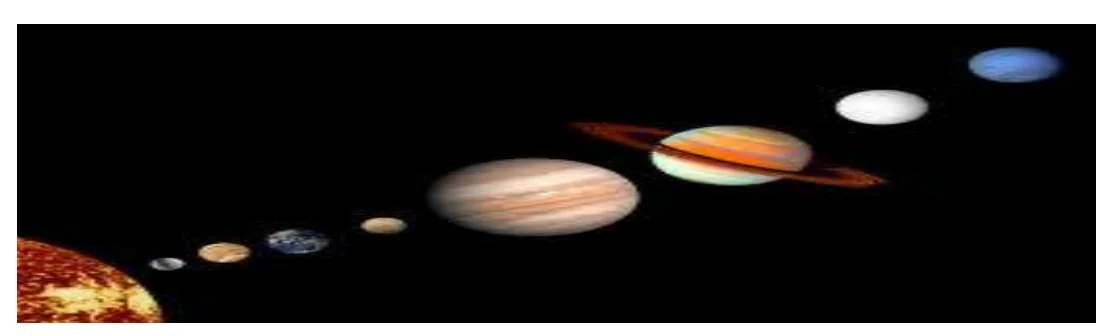
Question 4. Picture shows the planets that move around the sun .Let us name them in order .
Mercury , ____________ , Earth ,______________ , Jupiter ,______________ , ____________ , Neptune .
Answer: Mercury, Venus, Earth, Mars, Jupiter, Saturn, Uranus, Neptune.
In simple words: The eight planets in order from the Sun are Mercury, Venus, Earth, Mars, Jupiter, Saturn, Uranus, and Neptune.
Exam Tip: Use a mnemonic like "My Very Educated Mother Just Served Us Noodles" to remember planet order.
Q5. Write differences between the following .
Question 5(a). Sun versus Moon
Answer:
Sun: 1. It is a star. 2. It has its own light and heat. 3. It is stationary at the center of the solar system.
Moon: 1. It is a natural satellite. 2. It does not have its own light; it reflects sunlight. 3. It revolves around the Earth.
In simple words: The Sun is a glowing star, while the Moon is a rocky body reflecting sunlight.
Exam Tip: Always present differences in point-by-point comparative form.
Question 5(b). Rotation versus Revolution
Answer:
Rotation: 1. Movement of a planet on its own axis. 2. It causes days and nights. 3. Earth takes 24 hours to complete one rotation.
Revolution: 1. Movement of a planet around another body in a fixed path (orbit). 2. It causes changes in seasons. 3. Earth takes 365 days to complete one revolution around the Sun.
In simple words: Rotation is spinning on an axis, while revolution is orbiting around the Sun.
Exam Tip: Remember rotation = days/nights, revolution = seasons.
Question 6. What are constellations ?
Answer: Groups of stars that form recognizable patterns or shapes in the night sky are called constellations. Examples include the Great Bear and Orion.
In simple words: Constellations are connect-the-dot pictures made by stars in the sky.
Exam Tip: Mention at least one common example to score full marks.
Question 7. What will happen if there is no Sun ?
Answer: If there is no Sun, there will be total darkness and extreme freezing cold on Earth. Life cannot exist because plants would not be able to make food, and all water would freeze into ice.
In simple words: Without the Sun, Earth would become a dark, frozen rock with no life.
Exam Tip: Highlight light, heat, and plant survival as key points.
Question 8. Name these phases of moon.
Answer:
1. Full Moon
2. Gibbous Moon (Waxing Gibbous)
3. Half Moon (First Quarter)
4. Crescent Moon (Waxing Crescent)
5. New Moon
In simple words: The moon changes its visible shape from a thin crescent to a full bright circle and back again.
Exam Tip: Identify phases carefully by looking at the illuminated white portion from left to right.

Students must free download and practice these worksheets to gain more marks in exams.
Download Class 3 Environmental Studies All Chapters Practice Worksheets
Mastering All Chapters with Printable Worksheets
Explore reliable practice questions for All Chapters tailored for Class 3 Environmental Studies learners. Use these structured worksheets to evaluate exam preparedness and strengthen problem-solving skills throughout the 2026 academic session.
Verified Solutions and NCERT Alignment
Designed around the official curriculum for Class 3 Environmental Studies, these practice sheets guarantee standard compliance. Reviewing step-by-step solutions after completion sharpens your accuracy and clarifies complex sub-topics within All Chapters.
Additional Study Resources for Class 3 Environmental Studies
Consistent engagement with these exercises builds familiarity with recurring exam themes. If specific areas within All Chapters cause trouble, utilize our dedicated NCERT solutions for Class 3 Environmental Studies to clear up doubts immediately.
FAQs
You can download the latest chapter-wise printable worksheets for Class 3 Environmental Studies All Chapters for free from StudiesToday.com. These have been made as per the latest CBSE curriculum for this academic year.
Yes, Class 3 Environmental Studies worksheets for All Chapters focus on activity-based learning and also competency-style questions. This helps students to apply theoretical knowledge to practical scenarios.
Yes, we have provided solved worksheets for Class 3 Environmental Studies All Chapters to help students verify their answers instantly.
Yes, our Class 3 Environmental Studies test sheets are mobile-friendly PDFs and can be printed by teachers for classroom.
For All Chapters, regular practice with our worksheets will improve question-handling speed and help students understand all technical terms and diagrams.