

Class 3 English Practice Sheet: CBSE Class 3 English Hurt No Living Thing Worksheet
Access comprehensive chapter-wise worksheets for Hurt No Living Thing using the CBSE Class 3 English Hurt No Living Thing Worksheet. Designed to align with the 2026-27 academic syllabus for Class 3 English, these printable practice sets help students reinforce key concepts and improve their overall exam readiness.
Download Hurt No Living Thing Worksheet PDF with Answers
Access the complete worksheet PDF for Class 3 English below. Regular practice with these targeted academic tasks builds familiarity with standard question patterns and helps secure higher marks in final school examinations.
CBSE Class 3 English Practice Worksheets (90) - Hurt No Living Thing
Worksheets have become an integral part of the education system. Worksheets are very critical for every student to practice his/ her concepts. Students, teachers and parents can download all CBSE educational material and extremely well prepared worksheets from this website. All revision worksheets, Sample papers, Question banks and easy to learn study notes for all classes and subjects have been prepared based on the latest guidelines sent by CBSE. All CBSE educational material is developed by our panel of teachers, have also been submitted by thousands of teachers and students. The study material has been carefully compiled by the best teachers in India. Worksheets have been submitted by teachers of various CBSE schools and also have been carefully developed keeping into consideration the latest CBSE syllabus.
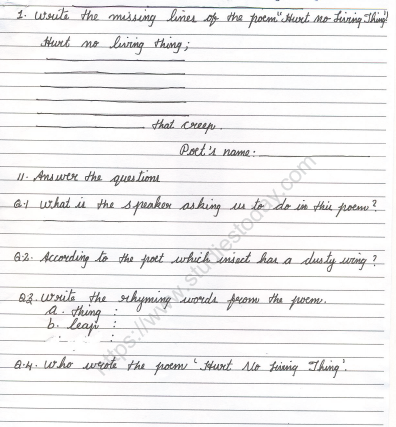

Question 1. Write the missing lines of the poem "Hurt no Living Thing"
Hurt no living thing;
__________________
__________________
__________________
__________________ That creep.
Poet's name: ___________________
Answer:
Hurt no living thing;
Ladybird, nor butterfly,
Nor moth with dusty wing,
Nor cricket chirping cheerily,
Nor grasshopper so light of leap,
Nor dancing gnat, nor beetle fat,
Nor harmless worms that creep.
Poet's name: Christina Rossetti
In simple words: This poem teaches us to be kind to all small creatures and insects, like butterflies and beetles, and never to harm them.
Exam Tip: Be sure to memorize the correct order of the insects in the poem, starting with the ladybird and butterfly.
II. Answer the questions
Question Q.1. What is the speaker asking us to do in this poem?
Answer: The speaker is asking us to be kind and not to hurt any living creature, no matter how small or tiny it is.
In simple words: The speaker tells us to be gentle and not to harm any insects or small animals.
Exam Tip: When writing this answer, mention that we should protect even the smallest creatures like worms and beetles.
Question Q.2. According to the poet which insect has a dusty wing?
Answer: According to the poet, the moth is the insect that has a dusty wing.
In simple words: The moth has dusty wings in this poem.
Exam Tip: Use the exact word "moth" from the poem to get full marks.
Question Q.3. Write the rhyming words from the poem.
a. thing : ___________
b. leap : ___________
Answer:
a. thing : wing
b. leap : creep
In simple words: Rhyming words are words that have the same ending sound, like thing and wing, or leap and creep.
Exam Tip: Rhyming words are always found at the end of the lines of the poem, so check there first.
Question Q.4. Who wrote the poem 'Hurt No Living Thing'.
Answer: Christina Rossetti wrote the poem "Hurt No Living Thing".
In simple words: The poem was written by Christina Rossetti.
Exam Tip: Always make sure to write the full name of the poet with correct spelling.
Unit - 10: Listening to Whales Sing
I. Word Meanings
Question I. Word meanings:-
a) gliding
b) cord
c) spout
d) form
e) panic
Answer:
a) gliding - moving smoothly and quietly without any effort
b) cord - a thick, strong string or rope
c) spout - a tube or pipe through which a stream of water is sprayed
d) form (foam) - a white mass of tiny bubbles on the surface of water
e) panic - a sudden, very strong feeling of fear or worry
In simple words: These are the meanings of new words from the story. They help us understand what we read.
Exam Tip: Try to learn these definitions by heart as they help improve your vocabulary and reading skills.
II. Make Meaningful Sentences
Question II. Make meaningful sentences:-
a) Listened
b) creatures
c) wrapped
Answer:
a) Listened: We sat quietly and listened to the beautiful songs of the birds.
b) creatures: Whales are some of the largest and most amazing creatures in the ocean.
c) wrapped: She wrapped the warm woolen scarf around her neck before going out.
In simple words: We used the given words to write complete, meaningful sentences of our own.
Exam Tip: When making sentences, make sure your sentence starts with a capital letter and ends with a period.
III. Answer the Following Questions
Question Q1. What are whales?
Answer: Whales are very large marine mammals that live in the ocean and breathe air.
In simple words: Whales are giant animals that live in the sea, but they are mammals, not fish.
Exam Tip: Remember to mention that whales are mammals, not fish, as this is an important scientific fact.
Question Q2. How do whales breathe?
Answer: Whales breathe by coming up to the surface of the water and blowing air out of their blowholes.
In simple words: Whales come to the top of the ocean to breathe air through holes on their heads.
Exam Tip: Make sure to include the word "blowholes" in your answer, as it is the key term.
Question Q3. What is the first rule in water safety lessons?
Answer: The first rule in water safety lessons is to never swim alone without a buddy or adult supervision.
In simple words: The most important rule is that you must never go into the water by yourself.
Exam Tip: Emphasize the concept of "never swimming alone" for full marks on water safety questions.
Unit - 12: The Lost Camel
Worksheet - 12
I. Tick the Right Answers
Question I(a). The king wanted money and men to build a new palace because....
i- he wanted a palace better than the one his neighbour was building.
ii- he wanted to take more money from his people.
iii- his palace was very old and uncomfortable.
Answer: i- he wanted a palace better than the one his neighbour was building.
In simple words: The king wanted to build a grand new palace just because he wanted it to be better than his neighbor's palace.
Exam Tip: This shows that the king's motivation was jealousy and competitiveness with his neighbour.
Question I(b). The ministers asked the king.....
i- to raise the money from the people.
ii- to start a war with his neighbour.
iii- not to spend money on building a new palace.
Answer: iii- not to spend money on building a new palace.
In simple words: The wise ministers advised the king not to waste money on a new palace.
Exam Tip: This option highlights the wisdom of the ministers who cared about the kingdom's wealth.
Question I(c). The lost camel was.....
i- lame and was carrying wheat.
ii- blind and was carrying honey.
iii- lame, blind and was carrying honey and wheat.
Answer: iii- lame, blind and was carrying honey and wheat.
In simple words: The missing camel had a limp, was blind in one eye, and was loaded with wheat and honey.
Exam Tip: Remember all three characteristics of the camel to answer this question correctly.
Question I(d). The ministers described the camel well because....
i- they had seen him.
ii- they noticed several things as they walked along the road.
iii- they had magical powers.
Answer: ii- they noticed several things as they walked along the road.
In simple words: The ministers were very smart and observed small clues on the ground as they walked.
Exam Tip: This question emphasizes the value of careful observation and logical thinking.
Question I(e). In the end, the king......
i- punished the ministers for stealing the camel.
ii- dismissed them again from his kingdom.
iii- realised that the ministers were...
Answer: iii- realised that the ministers were very wise and clever.
In simple words: At last, the king understood that the ministers did not steal the camel but were just highly intelligent.
Exam Tip: Since the last sentence is incomplete in the question sheet, finish it with a positive statement about the ministers' wisdom.
II. Kevin's Weekend To-Do List
Question II. Kevin had a list of things to do on the weekend. The things he did are marked ✓ and those he didn't do are marked ✗. Make a list of the things he did and the things he didn't do.
i- clean the windows ✓
ii- water the plants ✗
iii- take his pet dog for a walk ✓
iv- ride the bicycle to the park ✗
v- clean his bedroom ✗
vi- do his homework ✓
Answer:
Things Kevin did:
- clean the windows
- take his pet dog for a walk
- do his homework
Things Kevin didn't do:
- water the plants
- ride the bicycle to the park
- clean his bedroom
In simple words: We separated the list of tasks Kevin completed from the ones he left unfinished based on the checkmarks and crosses.
Exam Tip: Look carefully at each symbol (✓ for yes, ✗ for no) before placing the activity in the correct category.
III. Fill in the Blanks with Opposites
Question III. Complete the sentences with the opposites of the words in the box:-
Kind, pack, tie, usual, comfortable, fair.
i- Ayub: Did your trip get cancelled?
Ben: Yes. And we had to ____________ our suitcases!
ii- Ayub: They didn't feed the cats.
Ben: I know. They're so ____________
iii- Ayub: I got an eraser free with this pencil.
Ben: But that is ____________! I didn't get one when I bought the same pencil.
iv- Ayub: Look. This knot is loose.
Ben: Let's ____________ it fully so that we can tie it again properly.
v- Ayub: Everyday the last bell rings at 3:30. Why is it ringing at 3:00 today?
Ben: Yes, it's ____________
Answer:
i- unpack (opposite of pack)
ii- unkind (opposite of kind)
iii- unfair (opposite of fair)
iv- untie (opposite of tie)
v- unusual (opposite of usual)
In simple words: We completed the sentences by changing each word in the box to its opposite meaning by adding "un-".
Exam Tip: Most of the words in this list form their opposites by adding the prefix "un-", such as unkind, unpack, untie, unusual, and unfair.
IV. Past Tense Sentences
Question IV. Change the verbs in the brackets into the past tense and rewrite these sentences:-
i- Sama (eat) sandwiches for lunch yesterday.
ii- I (clean) the living room this morning.
iii- I (not see) you in the playground yesterday.
iv- He (not bring) the book I wanted.
v- We (not take) the train last night.
Answer:
i- Sama ate sandwiches for lunch yesterday.
ii- I cleaned the living room this morning.
iii- I did not see you in the playground yesterday.
iv- He did not bring the book I wanted.
v- We did not take the train last night.
In simple words: We rewrote the sentences by changing each action word inside the brackets to show that it happened in the past.
Exam Tip: Remember that negative past tense sentences use "did not" followed by the main verb in its simple form, like "did not see" or "did not bring".
V. Choose the Correct Verb Form
Question V. Circle the right words to complete the sentences:-
- Samara (came/comes) home early today.
i- Dhurv and his father (are leaving/left) for Delhi in the car last evening.
ii- I didn't (see/saw) Amita in the supermarket.
v- I (stayed/am staying) home yesterday, due to the rains.
v- Sam (write/wrote) a letter to me last week.
vi- I didn't (heard/hear) the bell ring.
Answer:
- Samara came home early today.
i- Dhurv and his father left for Delhi in the car last evening.
ii- I didn't see Amita in the supermarket.
v- I stayed home yesterday, due to the rains.
v- Sam wrote a letter to me last week.
vi- I didn't hear the bell ring.
In simple words: We picked the correct action words that fit the time mentioned in each sentence, like "last evening" or "yesterday".
Exam Tip: Words like "last week", "last evening", and "yesterday" indicate the past tense, so choose past-tense verbs like "left", "stayed", and "wrote".
CBSE Class 3 English Worksheets for Hurt No Living Thing
Practice Exercises for Class 3 English Hurt No Living Thing
Explore reliable practice questions for Hurt No Living Thing tailored for Class 3 English learners. Use these structured worksheets to evaluate exam preparedness and strengthen problem-solving skills throughout the 2026 academic session.
Step-by-Step Solutions and Practice Guidelines
Built using official NCERT guidelines for Class 3 English, these practice sheets provide reliable academic support. Cross-reference your completed work with our detailed solutions to learn standard answer-writing formats for CBSE exams.
Enhance Speed with Online Practice
Follow up your worksheet practice by attempting the interactive online MCQ tests for Hurt No Living Thing to evaluate your execution speed. All printable assignments and revision sheets on our platform are updated for the 2026 session and available free of charge.
FAQs
You can download the latest chapter-wise printable worksheets for Class 3 English Hurt No Living Thing for free from StudiesToday.com. These have been made as per the latest CBSE curriculum for this academic year.
Yes, Class 3 English worksheets for Hurt No Living Thing focus on activity-based learning and also competency-style questions. This helps students to apply theoretical knowledge to practical scenarios.
Yes, we have provided solved worksheets for Class 3 English Hurt No Living Thing to help students verify their answers instantly.
Yes, our Class 3 English test sheets are mobile-friendly PDFs and can be printed by teachers for classroom.
For Hurt No Living Thing, regular practice with our worksheets will improve question-handling speed and help students understand all technical terms and diagrams.