

Class 3 English Practice Sheet: CBSE Class 3 English The Enormous Turnip Worksheet
Review targeted academic worksheets with the CBSE Class 3 English The Enormous Turnip Worksheet. Built according to official educational standards for the 2026-27 term, these downloadable Class 3 English resources support effective daily practice and detailed self-evaluation for Unit 3 The Enormous Turnip.
Download Unit 3 The Enormous Turnip Worksheet PDF with Answers
Access the complete worksheet PDF for Class 3 English below. Regular practice with these targeted academic tasks builds familiarity with standard question patterns and helps secure higher marks in final school examinations.


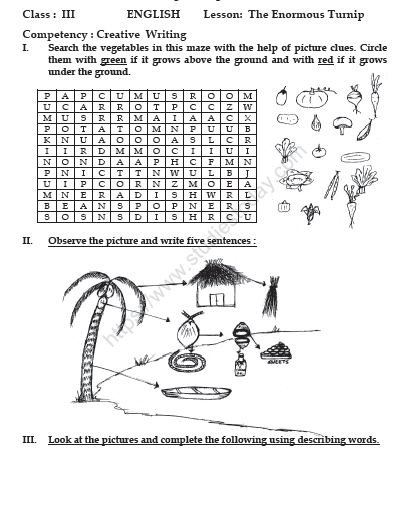
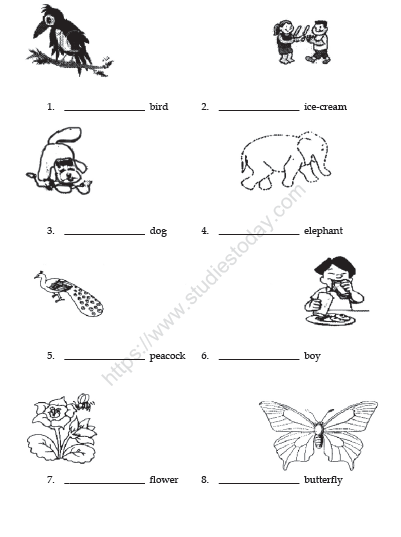
KENDRIYA VIDYALAYA SANGATHAN - Bangalore Region - Class : III ENGLISH - Lesson : The Enormous Turnip
Competency: Spelling
I. Find the names of vegetables in the word search. Circle them :
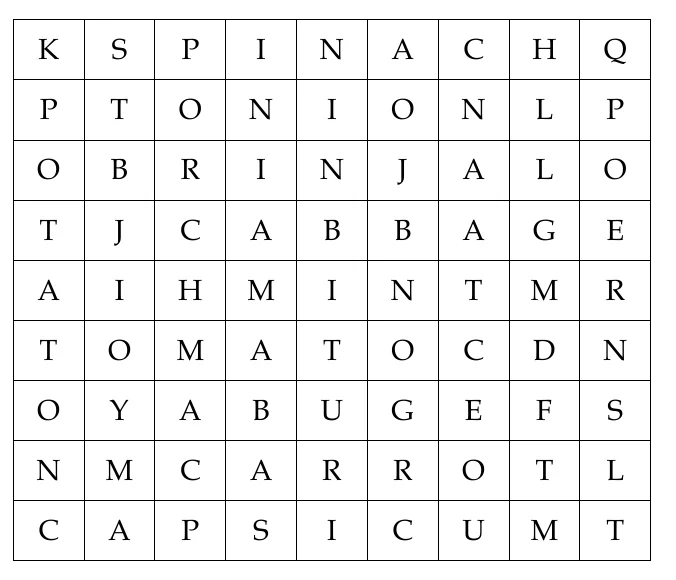
Question 1. Find the names of vegetables in the word search and circle them.
Answer: SPINACH, ONION, BRINJAL, CABBAGE, TOMATO, CARROT, CAPSICUM
In simple words: Each vegetable name is hidden in a row of letters, read from left to right.
Exam Tip: Find the first letter of the word, then check the letters that follow it in the same row.
Competency: Grammar
I. Write the plurals of the following :
Question 2. Write the plurals of the following words: 1. potato 2. pea 3. turnip 4. cabbage 5. chilly
Answer: 1. potatoes 2. peas 3. turnips 4. cabbages 5. chillies
In simple words: Words ending in o take es, a consonant before y changes y to ies, and most others just add s.
Exam Tip: Say the plural aloud; if it sounds right, check the ending.
II. Let us find the hidden words in enormous :
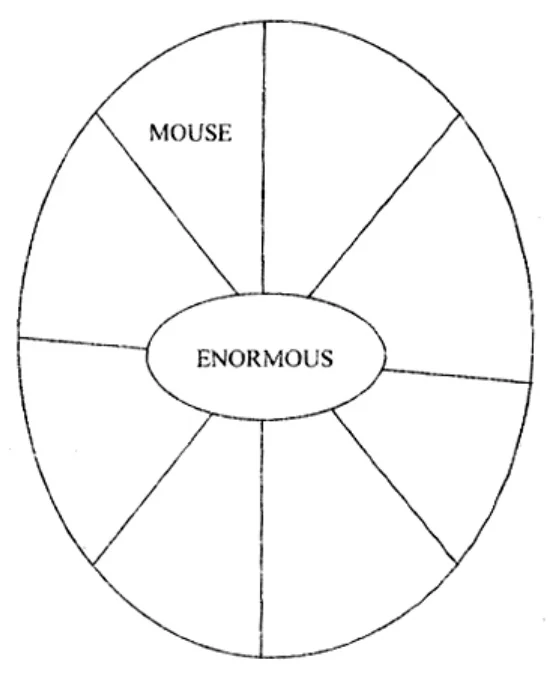
Question 3. Find the hidden words in the word enormous and write them in the sections of the wheel.
Answer: NO, OR, NORM, US, MO, OU
In simple words: Hidden words are small words made of letters that appear next to each other inside a bigger word.
Exam Tip: Read the letters in pairs or threes next to each other inside the word.
III. Fill in their colours :
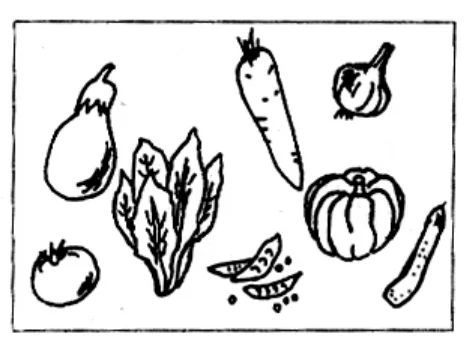
Question 4. Fill in the colours of the vegetables in the picture.
Answer: Brinjal - purple; spinach - green; carrot - orange; onion - brown; pumpkin - orange; tomato - red; peas - green; chilli - green
In simple words: Colour each vegetable the colour you see in real life.
Exam Tip: Look at the real vegetable to pick the right colour.
Competency: Grammar (continued)
IV. Who goes to market to bring vegetables and fruit in your house ? _____ Do you go along ? What have you seen in the market? Write your experience in 5 sentences.
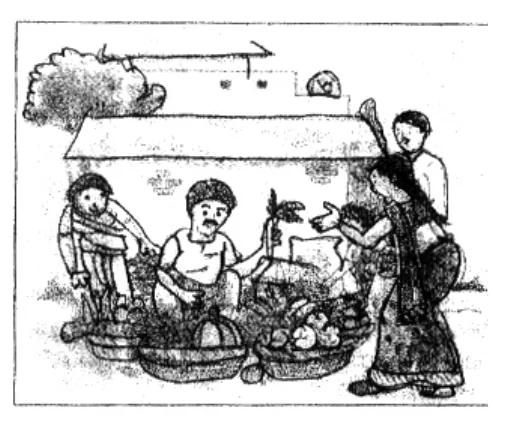
Question 5. Who goes to the market to bring vegetables and fruit to your house? Do you go along? What have you seen in the market? Write your experience in 5 sentences.
Answer: This is a creative task. Sample answer: My mother goes to the market to buy vegetables and fruit. Yes, I sometimes go along with her. In the market I saw many baskets of fresh vegetables. There were tomatoes, potatoes and onions. The shopkeeper weighed the vegetables on a scale.
In simple words: Write what you did and saw at the market, in five short sentences.
Exam Tip: Use simple sentences about one thing you saw at a time.
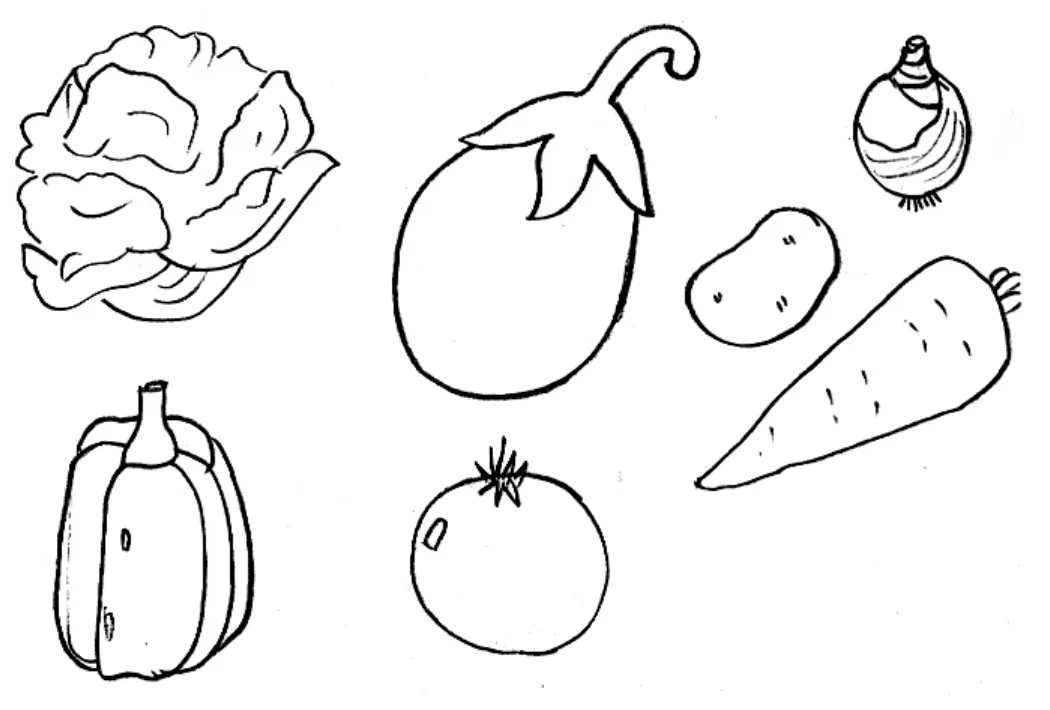
V. Name the vegetables in the basket :
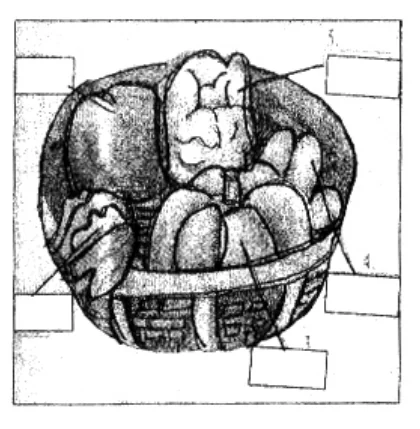
Question 6. Name the vegetables in the basket (1 to 5).
Answer: Look at each numbered box and name the vegetable it points to (for example tomato, cabbage, capsicum, potato, brinjal).
In simple words: Look at the picture and say the name of each vegetable that the number points to.
Exam Tip: Follow the line from each number to the vegetable it points to.
VI. Write another word for the following :
Question 7. Write another word for: 1. old 2. enormous 3. planted 4. boy
Answer: 1. ancient (or aged) 2. huge (or giant) 3. sown (or grown) 4. lad (or child)
In simple words: A synonym is a word that means nearly the same as another word.
Exam Tip: Think of a word that means the same thing as the given word.
Competency: Reading
I. Read the following conversation and answer the questions :
Dev : These will become big one day and I’ll climb on them and sit on their branches.
Veena : And I’ll sit in their shade and read a book.
Dev : And then they will give us fruits.
Father : Also, they will make the place green and beautiful. You know, we get wood from them.
Veena : And we make bats, pencils, tables, chairs etc., out of wood.
Dev : Our teacher told that the paper of a book was once a tree. They also cause rainfall and make the place cool.
Father : They take in carbon-di-oxide and give out oxygen which is important for us.
Dev : We get rubber too from them.
Father : So, you understand that they are very useful to us.
Now repeat this line after me :
‘One who loves trees, loves himself besides others. So love trees.’
Question 8. What are Dev, Veena and their father talking about?
Answer: They are talking about trees.
In simple words: The family is talking about how useful trees are.
Exam Tip: Look for the main topic that the speakers keep returning to.
Question 9. What had Dev’s teacher told about trees?
Answer: The teacher told Dev that the paper of a book was once a tree.
In simple words: Paper comes from trees.
Exam Tip: Find the sentence that starts with the words Our teacher told.
Question 10. Pick out the plural form of the word from the passage: 1) table 2) branch 3) tyre
Answer: 1) tables 2) branches 3) tyres (the word tyre is not in the passage, so write its plural as tyres)
In simple words: A plural word means more than one.
Exam Tip: Plurals of words ending in ch take es, as in branches.
Question 11. Which line did Father ask Dev and Veena to repeat?
Answer: ‘One who loves trees, loves himself besides others. So love trees.’
In simple words: Father asked them to repeat a line about loving trees.
Exam Tip: Look for the line in quotation marks that says Now repeat this line.
Question 12. What did you understand from this passage?
Answer: This is a creative task. Sample answer: Trees are very useful to us. They give us fruit, wood, shade, rubber and oxygen, and they make the place cool and green. So we should love and protect trees.
In simple words: Trees help us in many ways, so we must take care of them.
Exam Tip: Write the main message in your own words.
Question 13. Pick out two words from the passage which have double letters in their spelling.
Answer: green, cool (tree and rubber also have double letters)
In simple words: Double letters are two same letters written one after the other.
Exam Tip: Look for two same letters side by side, like oo or ee.
Question 14. Fill in the blanks with words from the passage: 1) Trees cause ______ and make the place ______ 2) Trees give us ______ to rest on a sunny day.
Answer: 1) rainfall; cool 2) shade
In simple words: Trees bring rain, keep the place cool and give shade.
Exam Tip: Read the sentence and find the word that fits its meaning.
Question 15. Pick out the opposites from the passage: 1) ugly × ______ 2) warm × ______
Answer: 1) ugly × beautiful 2) warm × cool
In simple words: Opposites are words with meanings that are the reverse of each other.
Exam Tip: Find the word in the passage that means the reverse of the given word.
Free study material for English
CBSE Class 3 English Worksheets for Unit 3 The Enormous Turnip
Daily Practice Questions for Class 3 English
Review targeted practice exercises for Class 3 English Unit 3 The Enormous Turnip. Curated to match official CBSE guidelines, these printable problem sets support daily revision and improve overall test readiness.
Detailed Answers for Class 3 English Unit 3 The Enormous Turnip
Designed around the official curriculum for Class 3 English, these practice sheets guarantee standard compliance. Reviewing step-by-step solutions after completion sharpens your accuracy and clarifies complex sub-topics within Unit 3 The Enormous Turnip.
Complete Your Chapter Revision
Consistent engagement with these exercises builds familiarity with recurring exam themes. If specific areas within Unit 3 The Enormous Turnip cause trouble, utilize our dedicated NCERT solutions for Class 3 English to clear up doubts immediately.
FAQs
You can download the latest chapter-wise printable worksheets for Class 3 English Unit 3 The Enormous Turnip for free from StudiesToday.com. These have been made as per the latest CBSE curriculum for this academic year.
Yes, Class 3 English worksheets for Unit 3 The Enormous Turnip focus on activity-based learning and also competency-style questions. This helps students to apply theoretical knowledge to practical scenarios.
Yes, we have provided solved worksheets for Class 3 English Unit 3 The Enormous Turnip to help students verify their answers instantly.
Yes, our Class 3 English test sheets are mobile-friendly PDFs and can be printed by teachers for classroom.
For Unit 3 The Enormous Turnip, regular practice with our worksheets will improve question-handling speed and help students understand all technical terms and diagrams.