

Official Class 11 English Worksheets: Note Making and Summarization
Review targeted practice sets for Class 11 English Note Making and Summarization. Built according to official educational guidelines for the 2026-27 academic year, these downloadable worksheets support daily revision and core concept reinforcement.
Chapter-wise Practice Material: Note Making and Summarization
Navigate directly to the printable exercises for Note Making and Summarization using the digital viewer below. Each practice set allows students to isolate specific topics for thorough review and uninterrupted practice alongside standard textbooks.
NOTE MAKING & SUMMARIZATION
Note making is an advanced writing skill which is acquiring increasing importance due to knowledge explosion. There is a need to remember at least the main points of any given subject. Note making is a useful skill which comes in handy not only in attempting questions but also in preparing you for life. Notes form an essential part of your academic life & help you in the following ways.
o Notes help you to remember the information you have gathered.
o Notes come in handy for making quick revision before exams.
o Lengthy lessons can be condensed into short relevant pieces by making notes.
o Notes help in understanding the texts better.
How to make notes
• Read the passage carefully.
• Heading
What is the main idea of the passage? Frame a heading based on the central idea and write it in the middle of the page.
• Subheadings
How has the main idea been presented and developed? Are there two or three subordinate/associated ideas? You can frame subheadings based on these.
• Points
Are there further details or points of the subtitles that you wish to keep in these notes? Indent, i.e., suitably space and number. All subheadings should be written at a uniform distance from the margin.
• Indenting
All points should also maintain the same distance away from the margin.
Important characteristics of note-making:
• Do not use complete sentences.
• The main points and supporting details are clearly distinguished.
• Certain words are often dropped: articles, words that are repeated, verbs which can be understood in the context, relative pronouns, conjunctions etc. but not at the cost of clarity.
• Avoid unnecessary facts, examples, illustrations etc.
• Condensed information is organized and recorded in a systematic manner that brings out the structure of the original text.
• Headings and supporting details are numbered.
• Provide Key to the abbreviations used at the end.
• Use abbreviations, symbols and numbers wherever necessary. Use standard abbreviations and symbols as far as possible.
Your notes should look like this
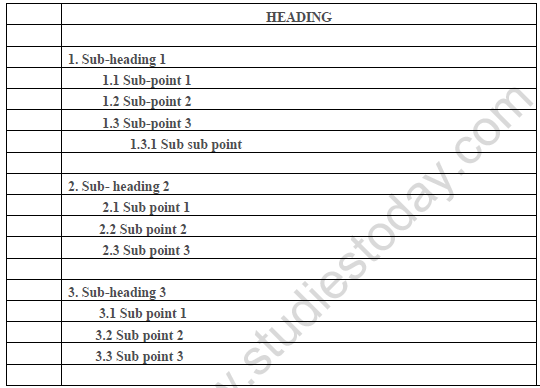
Notice that indenting, i.e., shifting from the margin has been used to clearly indicate subheadings, points and sub points. Subheadings, though separated by points, occur below one another. Points come below one another, and sub points to these are further indented. Such use of indenting gives your notes a visual character. At a glance you can see the main idea and its aspects. You may also use other forms of numbering like:
1. ____________________________________
a)…………………………………………………
b)…………………………………………………
c)……………………………………………….
2. ___________________________________________
a) …………………………………………..
(i) ………………………………….
b)…………………………………………………….
c)………………………………………………………….
3. ________________________________________
a)…………………………………………………………
b)……………………………………………………
c)………………………………………………
(i) ……………………………….
(ii) ……………………………………………..
SUMMARIZATION
Summarizing and note-making go together. In fact the next step to note-making is writing a summary. The point to bear in mind is that the notes we make on a subject can either be expanded into a detailed account or condensed into a summary. The summary is written on the basis of the notes made on the text. The summary should not exceed 80 words depending on the length of the text.
STEPS IN WRITING A SUMMARY:
1. Read the text and make notes ( as discussed in note-making)
2. Use the notes and make a draft summary without referring to the original text.
3. Read the draft summary to ensure that you have included all the main points. At the same time, make sure that it does not exceed the word limit.
4. Delete all unnecessary details.
5. Check the language for its correction and precision.
6. The summary should be within the word limit.
TIPS FOR MAINTAINING PRECISION:
1. Avoid repetition of subject.
2. The summary should be in normal English and not in ‘note form’ which means that they should be written in complete sentences, but they have to be short.
3. No abbreviations and symbols should be used.
4. Write the summary based on the notes that you have made without going back to the text. It will help you to achieve good results.
5. Your summary should read as a single coherent paragraph.
Abbreviations
Making your own abbreviations:
a. Keep the main sounds of the word. For example, edn. (education), progm. (programme).
b. You should not abbreviate every word.
c. As a general rule, the heading should not be abbreviated. You may use abbreviations in subheadings
Please click on below link to download CBSE Class 11 English Note Making and Summarization Worksheet Set B
Free study material for English
Note Making and Summarization Practice Sheet and Solutions for Class 11 English
Note Making and Summarization Printable Worksheet for Class 11 English
Review targeted practice exercises for Class 11 English Note Making and Summarization. Curated to match official CBSE guidelines, these downloadable PDF sheets support daily revision and core concept reinforcement.
How to Use These Practice Sheets
Each worksheet is structured around standard CBSE textbooks, allowing students to check their working steps and correct mistakes early in their revision.
Enhance Speed with Online Practice
Follow up your worksheet practice by attempting the interactive online English MCQ test for this chapter to evaluate your execution speed. All platform resources are free to access.
FAQs
You can download the teacher-verified PDF for CBSE Class 11 English Note Making and Summarization Worksheet Set 02 from StudiesToday.com. These practice sheets for Class 11 English are designed as per the latest CBSE academic session.
Yes, our CBSE Class 11 English Note Making and Summarization Worksheet Set 02 includes a variety of questions like Case-based studies, Assertion-Reasoning, and MCQs as per the 50% competency-based weightage in the latest curriculum for Class 11.
Yes, we have provided detailed solutions for CBSE Class 11 English Note Making and Summarization Worksheet Set 02 to help Class 11 and follow the official CBSE marking scheme.
Daily practice with these English worksheets helps in identifying understanding gaps. It also improves question solving speed and ensures that Class 11 students get more marks in CBSE exams.
All our Class 11 English practice test papers and worksheets are available for free download in mobile-friendly PDF format. You can access CBSE Class 11 English Note Making and Summarization Worksheet Set 02 without any registration.