

Download Class 11 Accountancy Worksheets for Chapter 03 Recording of Transactions-I
Review targeted practice sets for Class 11 Accountancy Chapter 03 Recording of Transactions-I. Built according to official educational guidelines for the 2026-27 academic year, these downloadable worksheets support daily revision and core concept reinforcement.
Access Chapter 03 Recording of Transactions-I Questions and Exercises
Access the complete worksheet PDF for Chapter 03 Recording of Transactions-I below. Regular practice with these targeted questions builds familiarity with standard exam patterns and helps secure higher marks in final Accountancy evaluations.
CBSE Class 11 Accountancy Source Documents MCQs
Question. Journal is a part of ____________.
a) Recording
b) Classifying
c) Summarising
d) Analysing
Answer. A
Question. Sales return account is ____________.
a) Credited
b) Debited
c) Sometimes credited and sometimes debited
d) None of them
Answer. B
Question. Interest on drawings is an _________ for a proprietor.
a) Asset
b) Income
c) Expense
d) None of them
Answer. C
Question. Outstanding salary is an example of ___________.
a) Real account
b) Nominal account
c) Personal account
d) None of them
Answer. C
Question. When two or more transactions relating to one particular account take place on the same date, in such case when only one journal entry is passed such a journal entry is called ___________.
a) Opening entry
b) Closing entry
c) Compound journal entry
d) None of them
Answer. C
Question. Ledger is a part of __________.
a) Recording
b) Classifying
c) Summarising
d) analysing
Answer. B
Question. Income tax paid should be debited to _________.
a) Income tax account
b) Proprietor’s account
c) Drawings account
Answer. C
Question. What will be the amount of goodwill in opening entry, if the following balances appear in the books of RR & Sons?
Assets-Cash in Hand Rs 430; Cash at Bank Rs 2,675; Sundry Debtors Rs 7,495; Closing Stock Rs 9,000; Machinery and Equipments Rs 6,000.Liabilities and Capital-Creditor,
Rs 5,600; Capital Rs 25,000.
(a) Rs 5,000
(b) Rs 10,600
(c) Rs 5,600
(d) None of these
Answer. A
Question. Closing stock is valued at cost or net realisable value whichever is higher.
(a) True
(b) False
(c) Can’t say
(d) Partially true
Answer. B
Question. Which of the following is the correct adjustment entry for closing stock?
(a) Closing Stock A/c Dr
To Trading A/c
(b) Closing Stock A/c Dr
To P&L A/c
(c) Trading A/c Dr
To Closing Stock A/c
(d) None of the above
Answer. A
Question. What will be the journal entry if depreciation is charged @ 10% per annum for 1 month on furniture worth Rs 30,000?
(a) Depreciation on Furniture A/c Dr 250
To Furniture A/c 250
(b) Depreciation on Furniture A/c Dr 3,000
To Furniture A/c 3,000
(c) Furniture A/c Dr 250
To Depreciation on Furniture A/c 250
(d) None of the above
Answer. A
Question. How is interest on capital treated in journal?
(a) Interest on capital account is debited and Bank account is credited.
(b) Interest on capital account is debited and Capital account is credited.
(c) Interest on capital account is debited and Drawings account is credited.
(d) None of the above
Answer. B
Question. How is interest on drawings amounting to Rs 250 treated in journal?
(a) Interest on drawings account is debited and Drawings account is credited.
(b) Bank account is debited and Interest on drawings account is credited.
(c) Drawings account is debited and Interest on drawings account is credited.
(d) None of the above
Answer. B
Question. What will be the journal entry if salaries of Rs 20,000 are unpaid?
(a) Outstanding Salaries A/c Dr 20,000
To Salaries A/c 20,000
(b) Salaries A/c Dr 20,000
To Outstanding Salaries A/c 20,000
(c) Salaries A/c Dr 20,000
To Cash A/c 20,000
(d) None of the above
Answer. B
Question. What will be the journal entry for adjustment of advanced commission if commission of Rs 2,500 is received, half of which is in advance?
(a) Commission A/c Dr 2,500
To Comm. Received in Advance A/c 2,500
(b) Commission A/c Dr 1,250
To Comm. Received in Advance A/c 1,250
(c) Cash A/c Dr 2,500
To Comm. A/c 2,500
(d) None of the above
Answer. B
Question. How is income received in advance treated in journal?
(a) Concerned income account is debited and Bank account is credited.
(b) Income received in advance account is debited and Concerned income account is credited.
(c) Concerned income account is debited and Income received in advance account is credited.
(d) None of the above
Answer. C
Question. How is accrued income of Rs 2,500 treated in journal?
(a) Accrued income account is debited and Bank account is credited.
(b) Accrued income account is debited and Income account is credited.
(c) Income account is debited and Accrued income account is credited.
(d) None of the above
Answer. B
Question.. A ……… is the principal book of accounting system which contains all the accounts related to assets, liabilities, revenues and expenses.
(a) journal
(b) ledger
(c) purchase book
(d) sales book
Answer. B
Question. Ledger is called as book of final entry.
(a) True
(b) False
(c) Can’t say
(d) Partially true
Answer. A
Question. Which of the following points out utility of a ledger?
(a) To keep a chronological record of all transactions.
(b) The net result of all transactions in respect of a particular account on a given date can be ascertained only from the ledger.
(c) It is bulky.
(d) None of the above
Answer. B
Question. Which of the following correctly distinguishes between a ledger and a journal?
(a) The journal is the book of first entry (original entry); the ledger is the book of second entry.
(b) The journal is the book for chronological record; the ledger is the book for analytical record.
(c) The journal, as a book of source entry, gets greater importance as legal evidence than the ledger.
(d) All of the above
Answer. D
Question. Transaction is the basis of classification of data within the journal while account is the basis of classification of data within the ledger.
(a) True
(b) False
(c) Can’t say
(d) Partially true
Answer. A
Question. All ledger accounts can be classified in which of the following groups?
(a) Incomes and expenses
(b) Permanent accounts and temporary accounts
(c) Losses and gains
(d) Assets and liabilities
Answer. B
Question. In a ledger, all permanent accounts are balanced and carried forward to the next accounting period.
(a) True
(b) False
(c) Can’t say
(d) Partially true
Answer. A
Question. The temporary accounts are closed at the end of the accounting period by transferring them to the trading and profit and loss account.
(a) True
(b) False
(c) Can’t say
(d) Partially true
Answer. A
Question. All temporary accounts appears in the balance sheet.
(a) True
(b) False
(c) Can’t say
(d) Partially true
Answer. B
Question. ……… is the process of transferring the entries from the books of original entry (journal) to the ledger.
(a) Recording
(b) Drafting
(c) Posting
(d) None of the above
Answer. C
CBSE Class 11 Accountancy Chapter 3 Source Documents Fill in The Blanks
Question. A book in which transactions are recorded for the first time in chronological order is called – – – –– – – .
Answer. journal
Question. A brief description of the transaction written after the entry is called – – – – –.
Answer. Narration
Question. GST paid by the purchaser of goods and/or services is – – – –.
Answer. Input GST
Question. The process of recording the transactions in journal is called – – – –.
Answer. Journalising
Question. The book in which accounts are maintained is called – – – –.
Answer. Ledger
Question. The process of transferring the entries from the books of original entry to ledger is called – – – –.
Answer. posting
Question. Salaries paid to Gopal will be debited to – – – – – A/c.
Answer. salaries
Question. If the proprietor withdraws goods for personal use the account to be credited is – – – –.
Answer. Purchases
Question. Ledger is a book of – – – – entry.
Answer. final
Question. The discount which is allowed by the seller of the goods to the customer for making prompt payment is called – – – discount.
Answer. cash
Question. An account is opened in the name of the proprietor, he is represented by – – – – A/c.
Answer. Capital
Question. An entry in which more than one account is debited or credited is called – – – – entry.
Answer. Compound
CBSE Class 11 Accountancy Chapter 3 Source Documents True And False
1. Ledger is the book of original entry. (False)
2. The process of recording transactions in journal is known as Journalising. (True)
3. Brief description of a transaction in a journal entry is known as narration. (True)
4. Both cash discount & trade discount are shown in the journal entry. (False)
5. Ledger is a permanent record of all transactions. (True)
6. The process of transferring transactions from journal to ledger is known as posting. (True)
7. If wages are paid for installation of Machinery, then wages A/c will be debited. (False)
8. Ledger is a book in which only real & nominal accounts are maintained. (False)
CBSE Class 11 Accountancy Chapter 3 Source Documents Match The Following
Question. Match items in List I with terms in List II using the codes given below the lists-
List –I List –II
1. The books in which a transaction is a. Narration
recorded for the first time from a source
document are called
2. Each entry will be followed by a b. Books of original entry
brief description which is known as
c. Books of final entry
Answer. 1 –b, 2- a
Question. Match items in List I with terms in List II using the codes given below the lists-
List –I List –II
1. Goods withdrawn for personal use is a. Charity
2. Goods distributed as free samples is b. Drawings
c. Advertisement
Answer. 1B, 2- c
Question. Match items in List I with terms in List II using the codes given below the lists-
List –I List –II
1. In case of a small business, a. Subsidiary books
transactions are recorded in a
book called as
2. If the size of business increases, b. Ledger
transactions are recorded in
c. Trial balance
d. Journal
Answer.s 1-d , 2-a
Question. Match items in List I with terms in List II using the codes given below the lists-
List –I List –II
1. Ledger folio is recorded in a. Trial balance
2. Journal folio is recorded in b. Financial statement
c. Journal
d. Ledger
Answer. 1-c, 2 –d
Question. Match items in List I with terms in List II using the codes given below the lists-
List –I List –II
1. All accounts are open a. Journal
on separate pages in a
book called as
2. The book prepared with b. Trial balance
debit and credit balances of
ledger accounts
c. Ledger
Answer. 1-c, 2-b
Question. Match items in List I with terms in List II using the codes given below the lists-
List –I List –II
1. Capital account shows which balance a. Debit balance
2.Bank account shows which balance b. Credit balance
Answer. 1-b, 2 –a
CBSE Class 11 Accountancy Chapter 3 Source Documents Case Based MCQs
Direction Read the following case study and answer questions on the basis of the same.
Dev is the owner of a trading firm with a capital of Rs 25,000. During the year 2021, he bought goods at the list price of Rs 1,00,000 from Rani less 20% trade discount and 2 % cash discount and paid 40% by cheque. He sold goods to Preeti at the list price of Rs 2,00,000 less 20% trade discount and 2% cash discount and she paid 50% by cheque. He also sold goods to Tanu for Rs40,000 allowing her a trade discount of 5% and cash discount of 10 %. She paid 1/4th of the amount in cash at the time of purchase. He received cash from Jaya for a bad debt written-off last year amounting to Rs 400.
Question. Why does Dev give cash discount to his customers?
(a) Because he sells goods to them at a very high price.
(b) To encourage quick payment.
(c) To make some profit even if goods are sold at catalogue price.
(d) None of the above
Answer. B
Question. How is a trade discount different from cash discount?
(i) Trade discount is allowed when goods are purchased in a specified quantity whereas cash discount is allowed when payment is made on or before a specified date.
(ii) Trade discount is not recorded separately in the books of account whereas cash discount is separately recorded in the books of account.
(a) Only (i)
(b) Only (ii)
(c) Both (i) and (ii)
(d) Neither (i) nor (ii)
Answer. C
Question. What is the amount paid to Rani by cheque?
(a) Rs 40,000
(b) Rs 32,000
(c) Rs 31,360
(d) None of the above
Answer. C
Question. What is the amount received in bank (via cheque) from Preeti on sale of goods to her?
(a) Rs 1,00,000
(b) Rs 78,400
(c) Rs 80,000
(d) None of these
Answer. B
Question. What would be the journal entry passed for bad debts of Rs 400 recovered from Jaya?
(a) Cash A/c Dr 400
To Bad Debts 400
(b) Cash A/c Dr 400
To Bad Debts Recovered 400
(c) Cash A/c Dr 400
To Jaya 400
(d) None of the above
Answer. A
Direction Read the following case study and answer questions on the basis of the same.
Shobhit has a trading business in Delhi. All his transactions occur within the limits of Delhi. Shobhit bought goods of Rs 1,00,000 on credit. He sold them for Rs 1,35,000 in the same state on credit. He paid for railway transport
Rs 8,000. He bought computer printer for
Rs 10,000. He paid postal charges Rs 2,000.
Assuming CGST @ 5% and SGST @ 5%, you are required to answer the following questions.
Question. By what amount will creditors account be credited for the purchases of Rs 1,00,000?
(a) Rs 1,00,000
(b) Rs 1,05,000
(c) Rs 1,10,000
(d) None of these
Answer. C
Question. ‘‘He sold them for Rs 1,35,000 in the same state on credit.’’ By what amount will debtors be debited while passing journal entry?
(a) Rs 1,35,000
(b) Rs 1,41,500
(c) Rs 1,48,500
(d) None of these
Answer. C
Question. What will be the total amount paid on account of transport charges?
(a) Rs 8,000
(b) Rs 8,400
(c) Rs 8,800
(d) None of the above
Answer. C
Question. What journal entry would have been passed by Shobhit in case he had resorted to inter-state purchase of goods on which GST is levied?
(a) Purchases A/c Dr
Input CGST A/c Dr
Input SGST A/c Dr
To Cash
(b) Purchases A/c Dr
Input IGST A/c Dr
To Cash
(c) Purchases A/c Dr
Input SGST A/c Dr
To Cash
(d) None of the above
Answer. B
Question. What is the journal entry passed for return of intra-state purchase of goods on which GST is levied assuming that Shobhit returned the goods?
(a) Creditors A/c Dr
To Purchases Return A/c
To Input CGST A/c
To Input SGST A/c
(d) Purchases Return A/c Dr
Input IGST A/c Dr
To Cash
(c) Purchases Return A/c Dr
Input SGST A/c Dr
To Cash
(d) None of the above
Answer. A
JOURNAL AND LEDGER
1. Journalise the following transactions in the books of Himanshu of Delhi:
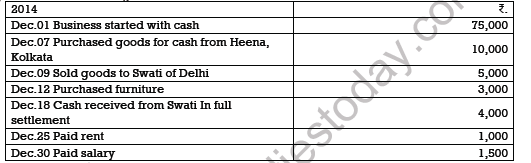
CGST and SGST @ 6% each are levied and IGST @ 12% is levied on sale as well as purchase of goods.
2. Enter the following Transactions in the Journal of Mudit , Maharashtra:.
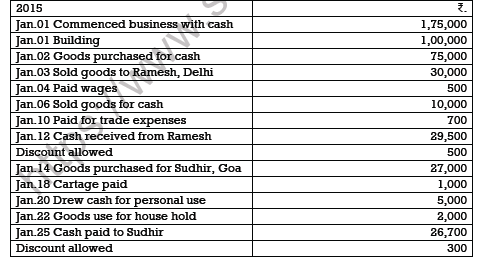
CGST and SGST @ 6% each are levied and IGST @ 12% is levied on sale as well as purchase of goods.
3. Journalise the following transactions:
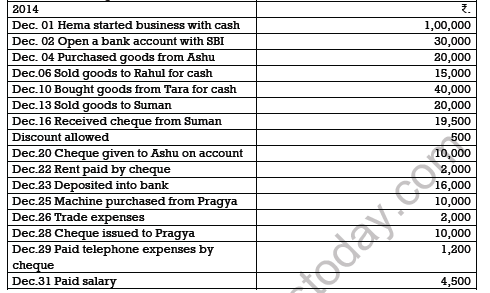
4. Jouranlise the following transactions in the books of Harpreet Bros.:
(a) ₹.1,000 due from Rohit are now a bad debt.
(b) Goods worth ₹.2,000 were used by the proprietor.
(c) Charge depreciation @ 10% p.a. for two month on machine costing ₹.30,000.
(d) Provide interest on capital of ₹. 1,50,000 at 6% p.a. for 9 months.
(e) Rahul become insolvent, who owed ₹. 2,000. A final dividend of 60 paise in a rupee is received from his estate.
5. Prepare Journal from the transactions given below:
(a) Cash paid for installation of machine ₹. 500
(b) Goods given as charity ₹. 2,000
(c) Interest charged on capital @7% p.a. when total capital were ₹. 70,000.
(d) Received ₹.1,200 of a bad debts written-off last year.
(e) Goods destroyed by fire ₹. 2,000
(f) Rent outstanding ₹. 1,000
(g) Interest on drawings ₹. 900
(h) Sudhir Kumar who owed me ₹. 3,000 has failed to pay the amount. He pays me a compensation of 45 paise in a rupee.
(i) Commission received in advance ₹. 7,000
6. Journalise the following transactions, post to the ledger:

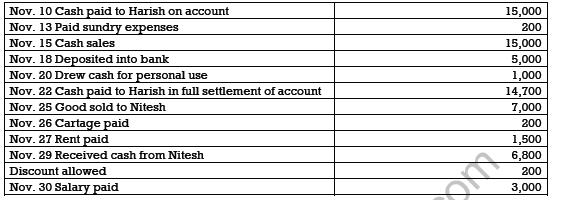
7. Journalise the following transactions in the journal of M/s Goel Brothers and post them to the ledger.
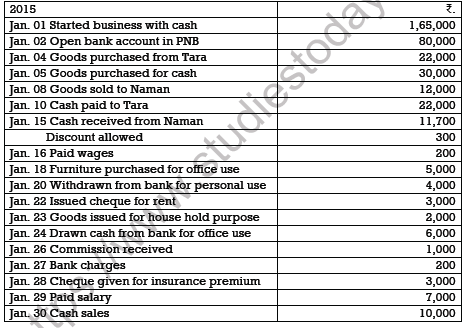
8 Give journal entries of M/s Mohit traders, Post them to the Ledger from the following transactions:
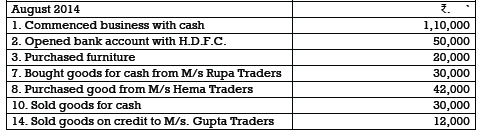
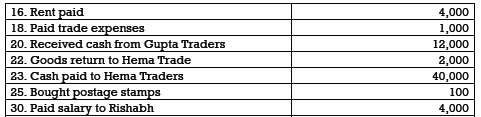
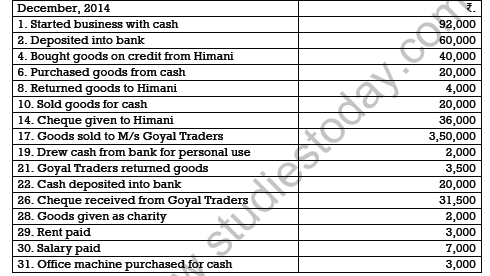
9. Journalise the following transaction in the Books of the M/s Bhanu Traders and Post them into the Ledger.
Please click on below link to download CBSE Class 11 Accountancy Journal And Ledger Worksheet Set A
Free study material for Accountancy
Chapter 03 Recording of Transactions-I Practice Sheet and Solutions for Class 11 Accountancy
CBSE Practice Material: Class 11 Accountancy Chapter 03 Recording of Transactions-I
Explore reliable practice questions for Chapter 03 Recording of Transactions-I tailored for Class 11 Accountancy learners. Use these structured worksheets to evaluate preparedness and strengthen problem-solving skills.
NCERT-Aligned Questions and Solutions
Each worksheet is structured around standard CBSE textbooks, allowing students to check their working steps and correct mistakes early in their revision.
Next Steps in Your Exam Preparation
Explore our broader library of printable assignments, chapter notes, and mock tests designed to support continuous revision and secure higher marks in CBSE assessments.
FAQs
You can download the teacher-verified PDF for CBSE Class 11 Accountancy Journal And Ledger Worksheet Set 01 from StudiesToday.com. These practice sheets for Class 11 Accountancy are designed as per the latest CBSE academic session.
Yes, our CBSE Class 11 Accountancy Journal And Ledger Worksheet Set 01 includes a variety of questions like Case-based studies, Assertion-Reasoning, and MCQs as per the 50% competency-based weightage in the latest curriculum for Class 11.
Yes, we have provided detailed solutions for CBSE Class 11 Accountancy Journal And Ledger Worksheet Set 01 to help Class 11 and follow the official CBSE marking scheme.
Daily practice with these Accountancy worksheets helps in identifying understanding gaps. It also improves question solving speed and ensures that Class 11 students get more marks in CBSE exams.
All our Class 11 Accountancy practice test papers and worksheets are available for free download in mobile-friendly PDF format. You can access CBSE Class 11 Accountancy Journal And Ledger Worksheet Set 01 without any registration.