

Download NCERT Solutions for Class 8 Science Chapter 15 Some Natural Phenomena
Explore reliable textbook solutions for Chapter 15 Some Natural Phenomena tailored for Class 8 learners. Utilizing these Science answers ensures thorough preparation and strengthens foundational knowledge before final NCERT evaluations.
Access NCERT Solutions and Answers
View or download the dedicated Chapter 15 Some Natural Phenomena solution resource below. Engaging with these textbook answers under focused study conditions ensures continuous academic progress and mastery of the 2026-27 curriculum for Science.
NCERT Solutions for Class 8 Science for chapter 15 Some Natural Phenomena
1. Which of the following cannot be charged easily by friction?
(a) A plastic scale
(b) A copper rod
(c) An inflated balloon
(d) A woollen cloth
Answer: The correct option is (b).
Explanation: Charging by friction is possible only in non-conducting materials. As the copper rod is a conducting material therefore, it cannot be charged by friction.
2. When a glass rod is rubbed with a piece of silk cloth the rod
(a) and the cloth both acquire positive charge.
(b) becomes positively charged while the cloth has a negative charge.
(c) and the cloth both acquire negative charge.
(d) becomes negatively charged while the cloth has a positive charge.
Answer: The correct option is (b).
Explanation: When an object is rubbed with another object, the two objects acquire charges. By convention, it is considered that the charge acquired by the glass rod is positive and charge acquired by the cloth is negative.
3. Write T against true and F against false in the following statements.
(a) Like charges attract each other. (T/F)
(b) A charged glass rod attracts a charged plastic straw. (T/F)
(c) Lightning conductor cannot protect a building from lightning. (T/F)
(d) Earthquakes can be predicted in advance. (T/F)
Answer:
(a) False
Explanation: Like charges always repel each other while unlike charges attract each other.
(b) True
Explanation: A charged glass rod has positive charges on its surface while a charged plastic straw has negative charges on its surface.
(c) False
Explanation: The lightning conductor transfers all the atmospheric charge to the Earth. Hence, lightning does not affect the building.
(d) False
Explanation: There is no instrument in the world which can predict the earthquake in advance.
4. Sometimes, a crackling sound is heard while taking off a sweater during winters. Explain.
Answer: The sweater gets charged when it is taken off. It is because of the friction between the sweater and the body. Thus, crackling sound is produced during this process.
5. Explain why a charged body loses its charge if we touch it with our hand.
Answer: When a person touches a charged object, its charge is conducted by his body to the earth. Hence, the charged body loses its charge.
6. Name the scale on which the destructive energy of an earthquake is measure An earthquake measures 3 on this scale. Would it be recorded by a seismograph? Is it likely to cause much damage?
Answer: Richter scale is used to measure the destructive energy of an earthquake. This scale has the readings from 1 to 10. Seismograph is used to measure the reading of magnitude 3 on the Richter scale. When Richter scale shows a reading of magnitude 3, the earthquake will not cause much damage. An earthquake of magnitudes higher than 5 is considered destructive in nature.
7. Suggest three measures to protect ourselves from lightning.
Answer:
(i) Keep away from electrical wires, telephone cables, metal pipes, etc.
(ii) If you are driving car, then remain there until the lightning is over. Close the windows of the car immediately.
(iii) During lighting, do not take bath in running water.
8. Explain why a charged balloon is repelled by another charged balloon whereas an uncharged balloon is attracted by another charged balloon?
Answer: Two charged balloons have similar nature of charges. As like charges always repel each other hence, two charged balloons will repel each other. When a charged balloon is brought near an uncharged balloon, the uncharged balloon acquires charges on its surface due to induction. Since unlike charges attract each other, a charged body always attracts an uncharged body. Therefore, an uncharged balloon is attracted by another charged balloon.
9. Describe with the help of a diagram an instrument which can be used to detect a charged body.
Answer:
An electroscope is used to detect a charged body. A simple electroscope is shown in the following figure.
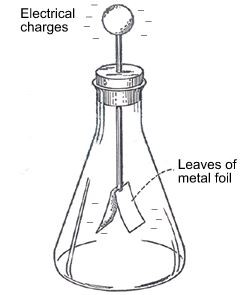
It consists of a metal rod. At one end of the rod, two leaves of aluminium foil are fixed and at the other end, there is a metal disc. The leaves of aluminium foil are placed inside a conical flask and the flask is corked to isolate the leaves from air. When the metal disc is touched with a charged body, the aluminium strips move away from each other. This happens because some of the charges of the body are transferred to the strips through the metal rod. This method of charging a body is called charging by conduction. The nature of charges on both the leaves and the charged body are the similar. Hence, both the leaves of the aluminium foil will move away from each other. If the body was not charged, then the leaves of the foil would remain as they were before. They would not repel each other.
10. List three states in India where earthquakes are more likely to strike.
Answer: Jammu and Kashmir, Gujarat and Assam are three major states of India where earthquakes are more likely to strike.
11. Suppose you are outside your home and an earthquake strikes. What precaution would you take to protect yourself?
Answer:
(i) If you are travelling in a bus or a car, then do not come out when an earthquake strikes.
(ii) Rush to find an open field away from tall buildings, installations, tall trees, and electric wires and poles during an earthquake.
12. The weather department has predicted that a thunderstorm is likely to occur on a certain day. Suppose you have to go out on that day. Would you carry an umbrella? Explain.
Answer: No. One should not carry an umbrella during thunderstorm. The charge flows from the clouds during thunderstorm and it can travel through the metallic rod of the umbrella. This may give an electric shock to the person who is carrying it. Thus, it is not safe to carry an umbrella during lightning.
Free study material for Science
NCERT Solutions for Class 8 Science Chapter 15 Some Natural Phenomena
Textbook Solutions for Class 8 Science Chapter 15 Some Natural Phenomena
Access structured NCERT textbook solutions for Chapter 15 Some Natural Phenomena. Designed in alignment with the latest academic curriculum for Class 8 Science, these answers cover all end-of-chapter exercises to support daily learning and homework completion.
Mastering Theoretical and Practical Questions
Clear, methodical explanations accompany every challenging problem within the Class 8 Science text. Engaging with these detailed answers lays a solid foundation for advanced learning and improves foundational clarity for upcoming assessments.
Effective Self-Study and Homework Assistance
Consistent practice with these solution guides cultivates faster problem-solving habits and clearer logical structuring. For a complete preparation experience, pair these textbook answers with our dedicated revision notes and sample papers for Class 8 Science.
FAQs
The complete and updated NCERT Solutions Class 8 Science Chapter 15 Some Natural Phenomena is available for free on StudiesToday.com. These solutions for Class 8 Science are as per latest NCERT curriculum.
Yes, our experts have revised the NCERT Solutions Class 8 Science Chapter 15 Some Natural Phenomena as per 2026 exam pattern. All textbook exercises have been solved and have added explanation about how the Science concepts are applied in case-study and assertion-reasoning questions.
Toppers recommend using NCERT language because NCERT marking schemes are strictly based on textbook definitions. Our NCERT Solutions Class 8 Science Chapter 15 Some Natural Phenomena will help students to get full marks in the theory paper.
Yes, we provide bilingual support for Class 8 Science. You can access NCERT Solutions Class 8 Science Chapter 15 Some Natural Phenomena in both English and Hindi medium.
Yes, you can download the entire NCERT Solutions Class 8 Science Chapter 15 Some Natural Phenomena in printable PDF format for offline study on any device.