

Official NCERT Solutions for Class 8 Science: Chapter 01 Crop production and management
Explore reliable textbook solutions for Chapter 01 Crop production and management tailored for Class 8 learners. Utilizing these Science answers ensures thorough preparation and strengthens foundational knowledge before final NCERT evaluations.
Chapter-wise Solutions for Science: Chapter 01 Crop production and management
View or download the dedicated Chapter 01 Crop production and management solution resource below. Engaging with these textbook answers under focused study conditions ensures continuous academic progress and mastery of the 2026-27 curriculum for Science.
NCERT Solutions for Class 8 Science for chapter 1 Crop production and management
Exercises
Question- 1. Select the following word from the following list and fill in the blanks
Float, water, crop, nutrients, preparation
a) The same kind of plants grown and cultivated on a large scale at a place is called ______.
b) The first step before growing crop is ______of the soil.
c) Damaged seed would ______ on top of water.
d) For growing a crop, sufficient sunlight and _____ and____ from the soil are essential.
Answer:
a) The same kind of plants grown and cultivated on a large scale at a place is called crop.
b) The first step before growing crop is preparation of the soil.
c) Damaged seed would float on top of water.
d) For growing a crop, sufficient sunlight and water and nutrients from the soil are essential.
Question- 2 Match items in column A with those in column B.
|
Column A |
Column B |
|
Kharif crops |
Food for cattle |
|
Rabi crops |
Urea and super phosphate |
|
Chemical fertlilisers |
Animal excreta, cow dung, urine and plant waste |
|
Organic manure |
Wheat, gram, pea |
|
Paddy and maize |
Answer:
|
Column A |
Column B |
|
Kharif crops |
Paddy and maize |
|
Rabi crops |
Wheat, gram, pea |
|
Chemical fertlilisers |
Urea and super phosphate |
|
Organic manure |
Animal excreta, cow dung, urine and plant waste |
Question- 3 Give two examples of each:
a) Kahrif crop b) Rabi crop
Answer:
a) Two examples of Kharif crop are paddy and maize. b)Two examples of rabi crops are wheat and gram.
Question- 4 Write a paragraph in your own words on each of the following.
a) Preparation of soil b) Sowing
c) Weeding d) Threshing
Answer:
a) Preparation of soil: Before growing a crop, a farmer first prepares the soil of the field. During preparation, he turns the soil by the help of plough or a cultivator and loosens it. Loosening of soil allows the new germinating roots of the plants to penetrate deep into the soil. The loose soil also facilitates easy breathing to the roots even when they go deep into the soil. The loosened soil helps in the growth of earthworms and microbes present in the soil which further turn and loosen the soil and add humus to it. Turning and loosening of soil brings the nutrient-rich soil to the top so that plants can use these nutrients.
b)Sowing: After soil preparation, the farmer’s next job is to sow the seeds. First, good quality and high yielding seeds are selected. Seeds are sown with the help of a tool called seed drill. This tool facilitates the sowing of seeds uniformly at proper distances and depths and saves time and labour. It ensures that seeds get covered by the soil after sowing. This prevents damage caused by birds.
c) Weeding: The undesirable plants that grow naturally along with the main crop planted are called weeds. These weeds compete with the main crop plant for water, nutrients, sunshine and space. Weeds can be controlled by weeding. Weeding is the removal of weeds from the field. Weeding can be done by tilling and by using weedicides. Some weeds interfere even in harvesting and may be poisonous for animals and human beings.
d)Threshing: After harvesting a crop, its grain seeds need to be separated from the chaff. This process of separation of grain seeds from chaff is called threshing. This is done with the help of a machine called combine which is in fact a combined harvester and a thresher.
Question- 5 Explain how fertlisers are different from manure.
Answer:
|
Fertiliser |
Manure |
|
It is a chemical substance which is rich in particular nutrients. |
It is a natural substance acquired by the decomposition of organic waste such as cattle dung, human waste and plant residues. |
|
It decreases the soil fertility. |
It increases the fertility of soil by replenishing the nutrients. |
|
It does not provide any humus to the soil. |
It provides a lot of humus to the soil. |
|
It is very rich in nutrients like nitrogen, phosphorus and potassium. |
It is relatively less rich in plant nutrients. |
|
It is responsible for soil and water pollution. |
It does not cause soil and water pollution. |
Question- 6 What is irrigation? Describe two methods of irrigation which conserve water.
Answer: Irrigation is a process by which water is supplied to crops. The time and frequency of irrigation depends on the seasons, crops and soil types.
Two methods of irrigation that help in conservation of water are:
- Sprinkler system: in this system perpendicular pipes with rotating nozzles on top are joined to the main pipe at regular intervals. With the help of a pump water is allowed to flow through main pipe under high pressure. From the main pipes the water escapes outside through the rotating nozzles. This system works efficiently in sandy soil where sufficient water is not available.
- Drip irrigation: In this system, water is dropped at the root of the plants, drop by drop. Water is not wasted in this type of irrigation and this method is used for watering fruit plants and gardens.
Question- 7 If wheat is sown in the kharif season, what would happen? Discuss.
Answer: If wheat is sown in the kharif season (from June to October), it has to face adverse climatic conditions and the entire wheat crop might get destroyed. Wheat is a rabi crop. Therefore, it requires low temperature, less humidity, less water and moderate sunshine. But if it is sown in kharif season, it would receive lot of water, excess temperature, and humidity. These climatic conditions would not favour the growth of the crop.
Question- 8 Explain how soil gets affected by the continuous plantation of crops in a field.
Answer: Continuous plantation of crops in a field causes depletion of certain nutrients like phosphorus, nitrogen and potassium etc. Plants are depended on these nutrients for their proper growth and functioning. Depletion of these nutrients from the soil would directly affect the yield of the crops sown in the depleted soil.
Questiom - 9 What are weeds? How can we control them?
Answer: The undesirable plants that grow naturally along with the main crop are called weeds. These weeds compete with the main crop plant for water, nutrients, sunshine and space. Weeds can be controlled by weeding. Weeding is the removal of weeds from the field. Weeding can be done by:
Tilling: In this method, the weeds are either manually uprooted or cut from soil. The uprooted and cut weeds are then left in the field so that they would decay and act as the manure.
Using weedicides: In this method, certain chemicals called weedicides such as 2, 4-D are sprayed on the fields to kill the weeds. Weedicides are used during the vegetative growth of weeds.
Question - .10 Arrange the following boxes in proper order to make a flow chart of sugarcane crop production.
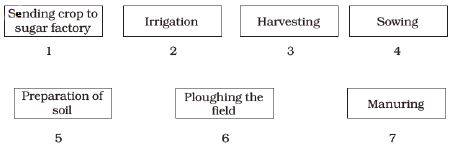
Answer :-
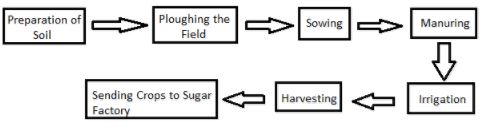
Q.11 Complete the following word puzzle with the help of clues given below.
Down
1. Providing water to the crops.
2. Keeping crop grains for a long time under proper conditions.
5. Certain plants of the same kind grown on a large scale.
Across
3. A machine used for cutting the matured crop.
4. A rabi crop that is also one of the pulses.
6. A process of separating the grain chaff.
1. IRRIGATION
2. STORAGE
5. CROP
Across
3. HARVESTOR
4. GRAM
6. WINNOWING
Free study material for Science
Step-by-Step Textbook Answers: Class 8 Science Chapter 01 Crop production and management
Chapter Exercise Answers for Class 8 Science
Access structured NCERT textbook solutions for Chapter 01 Crop production and management. Designed in alignment with the latest academic curriculum for Class 8 Science, these answers cover all end-of-chapter exercises to support daily learning and homework completion.
Detailed Answer Guides for Chapter 01 Crop production and management
Each solution includes detailed reasoning to foster genuine comprehension of Chapter 01 Crop production and management concepts. Reviewing these step-by-step breakdowns allows learners to master both analytical and descriptive questions expected in school evaluations.
Complete Preparation Kit for Class 8 Exams
These resources act as an effective roadmap for daily homework tasks and independent study. Supplement your review of Chapter 01 Crop production and management with official sample papers and interactive practice tests available on our platform free of charge.
FAQs
The complete and updated NCERT Solutions Class 8 Science Chapter 1 Crop production and management is available for free on StudiesToday.com. These solutions for Class 8 Science are as per latest NCERT curriculum.
Yes, our experts have revised the NCERT Solutions Class 8 Science Chapter 1 Crop production and management as per 2026 exam pattern. All textbook exercises have been solved and have added explanation about how the Science concepts are applied in case-study and assertion-reasoning questions.
Toppers recommend using NCERT language because NCERT marking schemes are strictly based on textbook definitions. Our NCERT Solutions Class 8 Science Chapter 1 Crop production and management will help students to get full marks in the theory paper.
Yes, we provide bilingual support for Class 8 Science. You can access NCERT Solutions Class 8 Science Chapter 1 Crop production and management in both English and Hindi medium.
Yes, you can download the entire NCERT Solutions Class 8 Science Chapter 1 Crop production and management in printable PDF format for offline study on any device.