

Download NCERT Solutions for Class 3 Environmental Studies Chapter 11 From Here To There
Access comprehensive textbook solutions for Chapter 11 From Here To There using the official curriculum guides for Class 3 Environmental Studies. Designed to align with the 2026-27 NCERT standards, these detailed answers help students reinforce core academic concepts.
Access NCERT Solutions and Answers
View or download the dedicated Chapter 11 From Here To There solution resource below. Engaging with these textbook answers under focused study conditions ensures continuous academic progress and mastery of the 2026-27 curriculum for Environmental Studies.
NCERT Solutions for Class 3 EVS for Chapter 11 From Here To There
1. Have you ever travelled in a train? When?
Ans.Yes, I travelled in a train when I go to my grandfather house.
2. Can a train move anywhere? Why?
Ans.No, a train can move only on the iron roads.
3. What is meant by ‘roads of iron’?
Ans.Roads of iron mean railways tracks.
4. What places did the train pass by? Make a list.
Ans.Meadows, Hills, Temples, Mills, Village wells, Potato field.
5. Which all vehicles did the children travel in.
Ans.Bus, train, car, boat, horse, cycle, rickshaw, oxen cart, aeroplane, metro train.
6. Write in front of each picture what the vehicles is used for. In the spaces provided, draw the pictures of some other vehicles. Write their names and what they used for. Are all these vehicles used for our travel?
Ans.

Hand cart is used by various fruit and vegetable sellers to carry fruits vegetables and other articles.

Cycle for the disabled is used by disable people to move from one place to another.

Mail Van is used to take mail from one place to another.
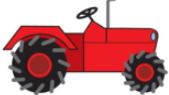
Tractor is used by farmers for tilling the field.
7. Name of some vehicles are given in the centre of a wheel. Join these on one side to the number of wheels each vehicle has end on the other, join them to what is used to run them.
Ans.
|
Vehicle |
No. of vehicle |
Driven by |
|
Bus |
Four or more than four |
Petrol/Diesel |
|
Bullock cart |
Two |
Animals |
|
Cart |
Four |
Humans |
|
Scooter |
Two |
Petrol |
|
Rickshaw |
Three |
Humans |
|
Car |
Four |
Petrol |
|
Metro rail |
More than four |
Electricity |
|
Train |
More than four |
Electricity |
|
Boat |
None |
Humans |
|
Truck |
Four |
Diesel |
|
Bicycle |
Two |
Humans |
|
Motorcycle |
Two |
Petrol |
8. Find out from our elders- How did people travel fifty years ago? Were the present means of travel available at that time also?
Ans.Fifty years ago people travel by bus, bullock cart, train, rickshaw, Cycle, etc. No. Present means of travel (like aeroplane, metro rail etc.) were not available at that time.
9. If anybody make a “chhuk-chhuk” sound you know at once that it is being made for a train. From the sounds given below can you tell which vehicle it is? One example is given.
Ans.Chhuk – Chhuk – Train
Peen – peen – Scooter
Pon – Pon – Truck
Tup – Tup – Horse Cart
Gharr-Gharr – Motorcycle
Tring-Tring – Bicycle
10. These are the sounds of single vehicles. How does it sound when many vehicles run together on the road making different noises? Isn’t there a lot of noise?
Ans.All the sounds get mixed and it creates a lot of noise.
11. Where have you heard the maximum noise?
Ans.In the airport.
12. Do you like so much noise? Why?
Ans.No, because it causes pain in ears.
13. What all can you see in the picture?
Ans.We can see the flames and smoke emitting from building. We can also see the fire-brigade men working to control the fire. We can also see the ambulance and the police van.
14. Which vehicles can you see in the picture.
Ans.An ambulance, a police van, fire brigade van.
15. What are these vehicles doing?
Ans.Fire brigade men are trying to control the fire. Ambulance is taking patients to the hospital.
Free study material for Environmental Studies
Step-by-Step Textbook Answers: Class 3 Environmental Studies Chapter 11 From Here To There
Accessing Chapter 11 From Here To There Solutions
Review comprehensive exercise answers for Class 3 Environmental Studies Chapter 11 From Here To There. Fully updated to match current NCERT syllabus guidelines, these textbook solutions help students verify their work and maintain accurate study notes.
Concept-Driven Answers for Class 3 Environmental Studies
Each solution includes detailed reasoning to foster genuine comprehension of Chapter 11 From Here To There concepts. Reviewing these step-by-step breakdowns allows learners to master both analytical and descriptive questions expected in school evaluations.
Maximizing Study Efficiency
These resources act as an effective roadmap for daily homework tasks and independent study. Supplement your review of Chapter 11 From Here To There with official sample papers and interactive practice tests available on our platform free of charge.
FAQs
The complete and updated NCERT Solutions Class 3 Environmental Studies Chapter 11 From Here To There is available for free on StudiesToday.com. These solutions for Class 3 Environmental Studies are as per latest NCERT curriculum.
Yes, our experts have revised the NCERT Solutions Class 3 Environmental Studies Chapter 11 From Here To There as per 2026 exam pattern. All textbook exercises have been solved and have added explanation about how the Environmental Studies concepts are applied in case-study and assertion-reasoning questions.
Toppers recommend using NCERT language because NCERT marking schemes are strictly based on textbook definitions. Our NCERT Solutions Class 3 Environmental Studies Chapter 11 From Here To There will help students to get full marks in the theory paper.
Yes, we provide bilingual support for Class 3 Environmental Studies. You can access NCERT Solutions Class 3 Environmental Studies Chapter 11 From Here To There in both English and Hindi medium.
Yes, you can download the entire NCERT Solutions Class 3 Environmental Studies Chapter 11 From Here To There in printable PDF format for offline study on any device.