

Step-by-Step Textbook Solutions for Class 11 Geography Chapter 03 Interior of the Earth
Review structured textbook solutions for Class 11 Geography Chapter 03 Interior of the Earth. Built according to NCERT guidelines for the 2026-27 academic year, these downloadable answers support daily revision and problem-solving accuracy.
Download Chapter 03 Interior of the Earth Textbook Solutions PDF
Navigate directly to the solved Geography textbook exercises using the digital viewer below. Each solution includes detailed step-by-step explanations, allowing students to instantly cross-check their work and identify areas requiring further revision.
NCERT Solution for Class 11 Geography for chapter 3 Interior of the Earth
1. Multiple choice question
(i) Which one of the following earthquake waves is more destructive?
(a) P-waves
(b) S-waves
(c) Surface waves
(d) None of the above
Answer: (c) Surface waves
(ii) Which one of the following is a direct source of information about the interior of the earth?
(a) Earthquake waves
(b) Volcanoes
(c) Gravitational force
(d) Earth magnetism
Answer: (b) Volcanoes
(iii) Which type of volcanic eruptions have caused Deccan Trap formations?
(a) Shield
(b) Flood
(c) Composite
(d) Caldera
Answer: (b) Flood
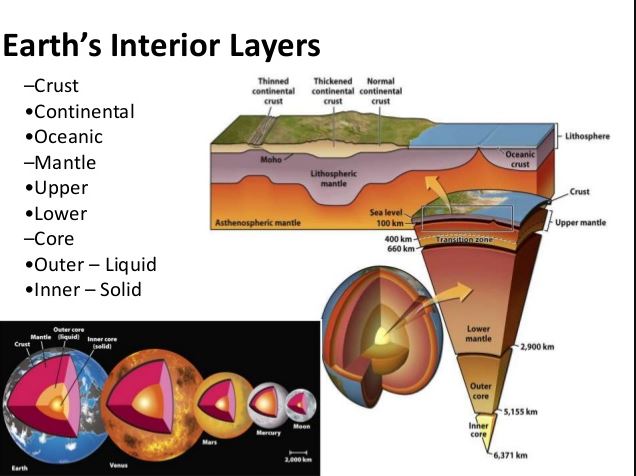
(iv) Which one of the following describes the lithosphere?
(a) upper and lower mantle
(b) crust and upper mantle
(c) crust and core
(d) mantle and core
Answer: (b) crust and upper mantle
2. Answer the following questions in about 30 words
(i) What are body waves?
Answer: Body waves are those earthquake waves, which are generated due to release of energy at the focus and move in all directions travelling through the body of the earth.
(ii) Name the direct sources of information about the interior of the earth.
Answer: Rocks obtained from mining areas and materials obtained from volcanic eruption are the direct sources of information about the interior of the earth.
(iii) Why do earthquake waves develop shadow zone?
Answer: A seismic shadow zone is an area of the Earth's surface where seismographs cannot detect an earthquake after its seismic waves have passed through the Earth. It was observed that seismographs located at any distance within 105° from the epicentre, recorded the arrival of both P and S-waves. However, a zone between 105° and 145° from epicentre was identified as the shadow zone for both the types of waves.
(iv) Briefly explain the indirect sources of information of the interior of the earth other than those of seismic activity.
Answer: Temperature, pressure, and density of materials at different depths are the some of the indirect sources of information of the interior of the earth. Analysis of properties of matter indirectly provides information about the interior of the earth. The other indirect sources include gravitation, and magnetic field study, etc.
3. Answer the following questions in about 150 words
(i) What are the effects of propagation of earthquake waves on the rock mass through which they travel?
Answer: The earthquake waves cause vibration in the different layers of the earth through which they travel. P- waves vibrate parallel to the direction of the wave and exert pressure on material in the direction of the propagation. As a result, it creates density differences in the materials leading to stretching and squeezing of the material. Other three waves vibrate perpendicular to the direction of propagation. The direction of vibrations of S- waves is perpendicular to the wave direction in the vertical plane. Hence, they create troughs and crests in the material through which they pass. Surface waves are considered to be the most damaging waves as these waves move along the surface.
(ii) What do you understand by intrusive forms? Briefly describe various intrusive forms.
Answer: Intrusive forms are an igneous rock body that forms from crystallised magma under the Earth's surface. Some of the major intrusive volcanic forms are following:
Batholith is the largest intrusive form made by solidification of the molten lava within the earth. These are granitic bodies. Batholiths are the cooled portion of magma chambers.
Laccoliths are large dome-shaped intrusive bodies with a level base. The Karnataka plateau is spotted with domal hills of granite rocks.
Lopolith is a large igneous intrusion, which is lenticular in shape with a depressed central region. It develops into a saucer shape, concave to the sky body.
Phacolith is a pluton parallel to the bedding plane or foliation of folded country rock.
Sill is a tabular sheet intrusion that has intruded between older layers of sedimentary rock, beds of volcanic lava or tuff, or even along the direction of foliation in metamorphic rock.
Dike or dyke is a sheet of rock that formed in a fracture in a pre-existing rock body.
Free NCERT Textbook Explanations: Class 11 Geography Chapter 03 Interior of the Earth
Textbook Solutions for Class 11 Geography Chapter 03 Interior of the Earth
Explore reliable textbook solutions for Chapter 03 Interior of the Earth tailored for Class 11 learners. Utilizing these complete exercise answers ensures your preparation aligns exactly with official NCERT standards for Geography.
Mastering Theoretical and Practical Questions
Clear, methodical explanations accompany every challenging problem within the Class 11 Geography text. Engaging with these detailed answers lays a solid foundation for advanced learning and improves foundational clarity for upcoming assessments.
Effective Self-Study and Homework Assistance
Frequent review of these structured answers builds strong analytical capabilities and response efficiency. Maximize your academic readiness by combining these textbook solutions with our curated study materials and mock evaluations for Class 11 Geography.
FAQs
The complete and updated NCERT Solutions Class 11 Geography Chapter 3 Interior of the Earth is available for free on StudiesToday.com. These solutions for Class 11 Geography are as per latest NCERT curriculum.
Yes, our experts have revised the NCERT Solutions Class 11 Geography Chapter 3 Interior of the Earth as per 2026 exam pattern. All textbook exercises have been solved and have added explanation about how the Geography concepts are applied in case-study and assertion-reasoning questions.
Toppers recommend using NCERT language because NCERT marking schemes are strictly based on textbook definitions. Our NCERT Solutions Class 11 Geography Chapter 3 Interior of the Earth will help students to get full marks in the theory paper.
Yes, we provide bilingual support for Class 11 Geography. You can access NCERT Solutions Class 11 Geography Chapter 3 Interior of the Earth in both English and Hindi medium.
Yes, you can download the entire NCERT Solutions Class 11 Geography Chapter 3 Interior of the Earth in printable PDF format for offline study on any device.