

Official NCERT Solutions for Class 11 Geography: Chapter 07 Composition and Structure of Atmosphere
Explore reliable textbook solutions for Chapter 07 Composition and Structure of Atmosphere tailored for Class 11 learners. Utilizing these Geography answers ensures thorough preparation and strengthens foundational knowledge before final NCERT evaluations.
Chapter-wise Solutions for Geography: Chapter 07 Composition and Structure of Atmosphere
Navigate directly to the solved Geography textbook exercises using the digital viewer below. Each solution includes detailed step-by-step explanations, allowing students to instantly cross-check their work and identify areas requiring further revision.
NCERT Solution for Class 11 Geography for chapter 8 Composition and Structure of Atmosphere
1. Multiple choice question
(i) Which one of the following gases constitutes the major portion of the atmosphere?
(a) Oxygen
(b) Nitrogen
(c) Argon
(d) Carbon dioxide
Answer: (b) Nitrogen
(ii) Atmospheric layer important for human beings is:
(a) Stratosphere
(b) Mesosphere
(c) Troposphere
(d) Ionosphere
Answer: (c) Troposphere
(iii) Sea salt, pollen, ash, smoke soot, fine soil — these are associated with:
(a) Gases
(b) Dust particles
(c) Water vapour
(d) Meteors
Answer: (b) Dust particles
(iv) Oxygen gas is in negligible quantity at the height of atmosphere:
(a) 90 km
(b) 120 km
(c) 100 km
(d) 150 km
Answer: (b) 120 km
(v) Which one of the following gases is transparent to incoming solar radiation and opaque to outgoing terrestrial radiation?
(a) Oxygen
(b) Nitrogen
(c) Helium
(d) Carbon dioxide
Answer: (d) Carbon dioxide
2. Answer the following questions in about 30 words
(i) What do you understand by atmosphere?
Answer: Atmosphere is a mixture of different gases and it envelopes the earth all round. It contains life-giving gases like oxygen for humans and animals and carbon dioxide for plants.
(ii) What are the elements of weather and climate?
Answer: The main elements of weather and climate are temperature, pressure, winds, humidity, clouds and precipitation.
(iii) Describe the composition of atmosphere.
Answer: The atmosphere is composed of gases, water vapour and dust particles.
(iv) Why is troposphere the most important of all the layers of the atmosphere?
Answer: The troposphere is the lowermost layer of the atmosphere. This layer contains dust particles and water vapour. All types of changes in climate and weather take place in this layer. This is the most important layer for all biological activity.
3. Answer the following questions in about 150 words
(i) Describe the composition of the atmosphere.
Answer: The atmosphere is composed of a number of gases, water vapour and dust particles. Nitrogen and Oxygen are two main gases, which form over 99% of the total volume of the atmosphere. The other gases are argon, carbon dioxide, neon, helium ozone hydrogen, methane, etc. The following chart gives percentage of permanent gases in the atmosphere:
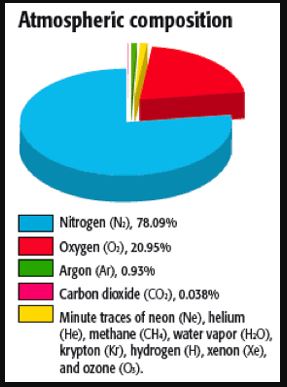
Water vapour is the most important element of the atmosphere. The average amount of water vapour is nearly 2% of the atmosphere by volume, it may-vary from 4% in the worm and wet tropics to less than 1% in dry and cold areas of deserts and the polar regions.
Dust particles comprise the third major component of the atmosphere. They are derived from different sources and include: sea salts, smoke-soot, fine soil, ash, pollen, dust, etc.
(ii) Draw a suitable diagram for the structure of the atmosphere and label it and describe it.
Answer: Structure of the Atmosphere: The atmosphere consists of different layers with varying density and temperature.
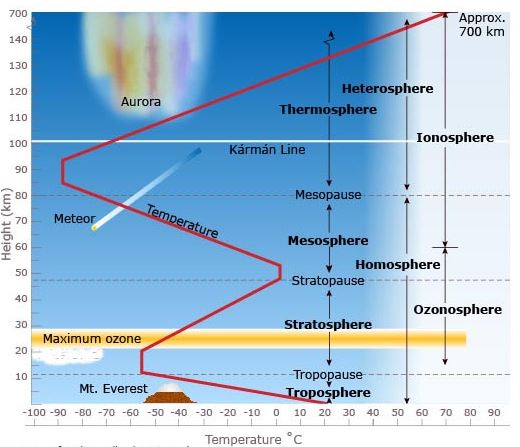
Troposphere: This is the lowermost layer of the atmosphere. Its average height is 16 km, although it is only 10 km at the poles and extends up 18 km at the equator. Temperature decreases with height in this layer, roughly at-the rate of 1°C for 165 metres of ascent. This is known as normal lapse rate.
Stratosphere: It extends up to a height of 50 km. The temperature remains almost constant in its lower portion, up to a height of 20 km.
Mesosphere: It lies above the stratosphere, and extends upto a height of 80 km. The upper limit of mesosphere is known as the mesopause.
Ionosphere: The Ionosphere is located between 80 and 400 km above the mesopause. Temperature here starts increasing with height. It contains electrically charged particles known as ions, and hence, it is known as ionosphere. Radio waves transmitted from the earth are reflected back to the earth by ionosphere.
Exosphere: The exosphere is the outermost layer of the Earth's atmosphere. It starts at an altitude of about 500 km and goes out to about 10,000 km. Temperatures in the Earth’s exosphere remain constant with altitude, averaging about 1500 Km.
Free NCERT Textbook Explanations: Class 11 Geography Chapter 07 Composition and Structure of Atmosphere
Textbook Solutions for Class 11 Geography Chapter 07 Composition and Structure of Atmosphere
Review comprehensive exercise answers for Class 11 Geography Chapter 07 Composition and Structure of Atmosphere. Fully updated to match current NCERT syllabus guidelines, these textbook solutions help students verify their work and maintain accurate study notes.
Mastering Theoretical and Practical Questions
Beyond providing final answers, these guides offer step-by-step breakdowns for complex queries in the Class 11 Geography module. This approach helps students balance theoretical depth with practical problem-solving skills required for NCERT exams.
Effective Self-Study and Homework Assistance
Consistent practice with these solution guides cultivates faster problem-solving habits and clearer logical structuring. For a complete preparation experience, pair these textbook answers with our dedicated revision notes and sample papers for Class 11 Geography.
FAQs
The complete and updated NCERT Solutions Class 11 Geography Chapter 7 Composition and Structure of Atmosphere is available for free on StudiesToday.com. These solutions for Class 11 Geography are as per latest NCERT curriculum.
Yes, our experts have revised the NCERT Solutions Class 11 Geography Chapter 7 Composition and Structure of Atmosphere as per 2026 exam pattern. All textbook exercises have been solved and have added explanation about how the Geography concepts are applied in case-study and assertion-reasoning questions.
Toppers recommend using NCERT language because NCERT marking schemes are strictly based on textbook definitions. Our NCERT Solutions Class 11 Geography Chapter 7 Composition and Structure of Atmosphere will help students to get full marks in the theory paper.
Yes, we provide bilingual support for Class 11 Geography. You can access NCERT Solutions Class 11 Geography Chapter 7 Composition and Structure of Atmosphere in both English and Hindi medium.
Yes, you can download the entire NCERT Solutions Class 11 Geography Chapter 7 Composition and Structure of Atmosphere in printable PDF format for offline study on any device.