

Practice MCQs for NTSE SAT Physics Types Of Motion Distance and Displacement
Access targeted multiple-choice questions for Types Of Motion Distance and Displacement designed to align with the latest NTSE academic syllabus for NTSE SAT Physics. These objective practice sets help students evaluate their conceptual understanding and improve exam readiness.
Access Types Of Motion Distance and Displacement Questions and Solutions
View or download the dedicated Types Of Motion Distance and Displacement MCQ resource below. Practicing these 50 objective questions regularly builds familiarity with standard exam patterns and helps secure higher marks in final Physics evaluations.
Question: A particle experiences constant acceleration for 20 s after starting from rest. If it travels a distance X1, in the first 10 s and distance X2, in the remaining 10s, then which of the following is true ?
- a) X1 = 2X2
- b) X1 = X2
- c) X2 = 3X1
- d) None of these
Answer: X2 = 3X1
Question: A particle experiences constant acceleration for 20 s after starting from rest. If it travels a distance X1, in the first 10 s and distance X2, in the remaining 10s, then which of the following is true ?
- a)
X1 = 2X2
- b)
X1 = X2
- c)
X2 = 3X1
- d) None of these
Answer: X2 = 3X1
Question: A train passes over a 400 m long bridge. If the speed of the train is 30 m/s and the train takes 20s to cross the bridge, find the length of the train :
- a) 400 m
- b) 600 m
- c) 800 m
- d) 200 m
Answer: 200 m
Question: A ball is thrown up with a certain velocity. It attains a height of 40 m and comes back to the thrower. Then the :
- a) Total distance covered by it is 40 m
- b) Total displacement covered by it is 80 m
- c) Total displacement is zero
- d) Total distance covered by it is zero
Answer: Total displacement is zero
Question: From the top of a tower, a particle is projected upwards and it reaches the ground after 5 second. The initial velocity of the particle is 12 m/s, the height of the tower is :
- a) 55 m
- b) 65 m
- c) 75 m
- d) 85 m
Answer: 65 m
Question: Two bodies of different masses ma and mb are dropped from two different heights a and b. The ratio of times taken by the two bodies to drop through these distance is :
- a)

- b) a2 : b2
- c) a : b
- d)

Answer:
Question: A particle experiences a constant accelerating force after starting from rest. If it travels a distance x in the first two seconds and distance y in next two seconds, then :
- a) y = 4x
- b) y = 3x
- c) y = 2x
- d) y = x
Answer: y = 3x
Question: A lead ball and a snow ball of identical radius are released from a certain height in vacuum. The time taken by both of them to reach the ground are :
- a) Unequal
- b) Exactly equal
- c) Roughly equal
- d) In the ratio of the density of lead and snow
Answer: Exactly equal
Question: Which of the following curves do not represent motion in one dimension : (v = velocity, t = time)
- a)
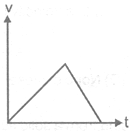
- b)

- c)

- d)
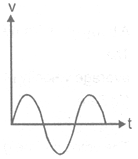
Answer:
Question: A girl swims in a swimming pool of length 100m. She swims from one end to another end and reaches the starting point again in 2 minutes the average speed of the swimmer is :
- a) 100 ms-1
- b) 0.83 ms-1
- c) 1.67 ms-1
- d) Zero
Answer: 1.67 ms-1
Question: A device used to measure the distance is known as :
- a) Speedometer
- b) Sonometer
- c) Odometer
- d) Galvanometer
Answer: Odometer
Question: For the velocity time graph shown in figure the distance covered by the body in the last two seconds of its motion is what fraction of the total distance covered ?
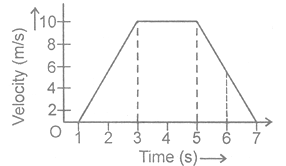
- a) 1/2
- b) 1/4
- c) 1/3
- d) 2/3
Answer: 1/4
Question: The velocity-time graph of a body moving in a straight line is shown in figure. The displacement and distance traveled by the body in 6 seconds are respectively :
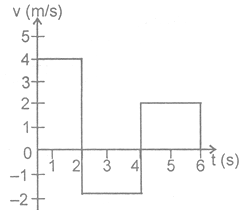
- a) 16 m, 8 m
- b) 8 m, 16 m
- c) 16 m , 16 m
- d) 8 m, 8 m
Answer: 8 m, 16 m
Question: A device used to measure the distance is known as
- a) Speedometer
- b) Sonometer
- c) Odometer
- d) Galvanometer
Answer: Odometer
Question: A particle experiences a constant accelerating force after starting from rest. If it travels a distance x in the first two seconds and distance y in next two seconds, then :
- a) y = 4x
- b) y = 3x
- c) y = 2x
- d) y = x
Answer: y = 3x
Free study material for Physics
Multiple Choice Questions (MCQs) for NTSE SAT Physics Types Of Motion Distance and Displacement
About Types Of Motion Distance and Displacement MCQs for NTSE SAT Physics
Review structured objective questions for NTSE SAT Physics Types Of Motion Distance and Displacement. Built according to official NTSE guidelines, these MCQ sets support daily revision and core concept reinforcement.
How to Verify Your MCQ Answers
Each question includes structured solution keys mapped directly to standard NTSE textbooks, helping students evaluate their reasoning and correct mistakes early in their revision.
Enhance Speed with Online MCQ Tests
Explore our broader library of printable assignments, chapter notes, and mock tests designed to support continuous revision and secure higher marks in NTSE assessments.
FAQs
You can get most exhaustive NTSE SAT Physics Types Of Motion Distance and Displacement MCQs for free on StudiesToday.com. These MCQs for NTSE SAT Physics are updated for the 2026-27 academic session as per NTSE examination standards.
Yes, our NTSE SAT Physics Types Of Motion Distance and Displacement MCQs include the latest type of questions, such as Assertion-Reasoning and Case-based MCQs. 50% of the NTSE paper is now competency-based.
By solving our NTSE SAT Physics Types Of Motion Distance and Displacement MCQs, NTSE SAT students can improve their accuracy and speed which is important as objective questions provide a chance to secure 100% marks in the Physics.
Yes, Physics MCQs for NTSE SAT have answer key and brief explanations to help students understand logic behind the correct option as its important for 2026 competency-focused NTSE exams.
Yes, you can also access online interactive tests for NTSE SAT Physics Types Of Motion Distance and Displacement MCQs on StudiesToday.com as they provide instant answers and score to help you track your progress in Physics.