

Practice MCQs for NTSE SAT Physics Light Reflection and Mirror
Review structured MCQ sets for NTSE SAT Physics Light Reflection and Mirror. Built according to official NTSE guidelines, these downloadable questions support daily revision and core concept reinforcement.
Access Light Reflection and Mirror Questions and Solutions
View or download the dedicated Light Reflection and Mirror MCQ resource below. Practicing these 50 objective questions regularly builds familiarity with standard exam patterns and helps secure higher marks in final Physics evaluations.
Question: Quantum theory of light was given by :
- a) Newton
- b) Plank
- c) Faraday
- d) None of these
Answer: Plank
Question: Which of the following correctly represents graphical relation between angle of incidence (i) and angle of reflection(r) ?
- a)
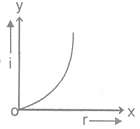
- b)
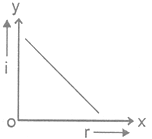
- c)
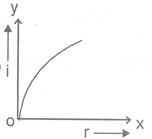
- d)
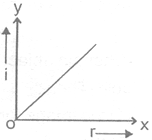
Answer:
Question: A convex mirror of focal length f (in air) is immersed in a liquid  The focal length of the mirror in liquid will be:
- a)

- b)

- c) f
- d)

Answer: f
Question: An observer runs towards a plane mirror with a velocity x m/s. What is the velocity fo his image which will appear to move towards him ?
- a) 2 x m/s
- b)

- c) x m/s
- d)

Answer: 2 x m/s
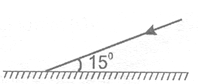
Question: When a ray of light strikes a plane mirror at an angle of 150 with the mirror, what will be the angle through which the ray get deviated ?
- a) 1500
- b) 300
- c) 750
- d) None of these
Answer: 300
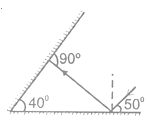
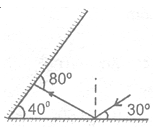
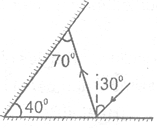
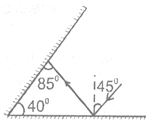
Question: Which of the following correctly depicts reflections in case of plane mirrors inclined at 40° ?
- a)
- b)
- c)
- d)
Answer:
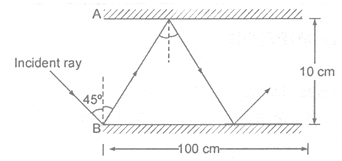
Question: Two parallel plane mirrors A and B are placed at a separation 10 cm as shown is figure. A ray incident on the corner of mirror B at an angle of incidence 450. Find the number of times rays is reflected from mirror A:
- a) 4
- b) 5
- c) 6
- d) 7
Answer: 5
Question: A virtual image larger than the object can be produced by :
- a) Convex mirror
- b) Concave mirror
- c) Plane mirror
- d) Concave lens
Answer: Concave mirror
Question: When a object is placed in front of convex mirror of focal length 20 cm at a distance 25 cm from the pole. The : (1) the image formed is erected (2) the image formed is inverted (3) the image formed is real (4) the image formed is virtual
- a) 2 and 4 are correct
- b) 2 and 3 are correct
- c) 1 and 3 are correct
- d) 1 and 4 are correct
Answer: 1 and 4 are correct
Question: Rainbow is formed due to :
- a) Reflection and dispersion of light through a water droplet
- b) Refraction and dispersion of light through a water droplet
- c) Only dispersion of light
- d) Only refraction of light
Answer: Refraction and dispersion of light through a water droplet
Question: A boy is moving towards a plane mirror with 5 cm/s. What will be the relative velocity of the boy w.r.t. the image of the boy :
- a) 5 cm/s
- b) 10 cm/s
- c) 15 cm/s
- d) 20 cm/s
Answer: 10 cm/s
Question: A spherical mirror and spherical lens have each focal length of -10cm. The mirror and lens are :
- a) Both convex
- b) Both concave
- c) Mirror is convex and lens in concave
- d) Mirror is concave and lens is convex
Answer: Both concave
Question: In a room lighted by an electric bulb, it is found that he shadow of the ceiling fan hung in the centre falling on a wall opposite to the door. What can you say about the position of the bulb ?
- a) On the wall having the door
- b) On the wall facing the door
- c) On the wall of your right as your enter the room
- d) On the wall on your left as you enter the room
Answer: On the wall on your left as you enter the room
Question: The linear magnification for a mirror is the ratio of the size of the image to the size of the object, and is denoted by m. Then m is equal to (symbols have their usual meanings) :
- a)

- b)

- c)

- d) None of these
Answer:
Question: Two plane mirrors are inclined at angles of 300, 400, 500 and 600, turn by turn. At which angle of the mirror there would be the maximum number of images ?
- a) A 300
- b) At 400
- c) At 500
- d) At 600
Answer: A 300
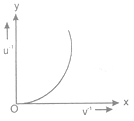
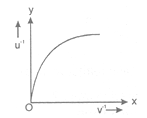
Question: Which of the following correctly depicts the graphical variation in case of spherical mirror ?
- a)
- b)
- c)
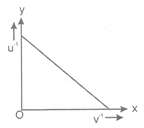
- d)
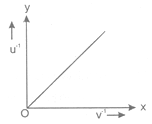
Answer:
Question: A virtual image larger than the object can be produced by :
- a) Convex mirror
- b) Concave mirror
- c) Plane mirror
- d) Concave lens
Answer: Concave mirror
Question: Quantum theory of light was given by :
- a) Newton
- b) Plank
- c) Faraday
- d) None of these
Answer: Plank
Question: A boy is moving towards a plane mirror with 5 cm/s. What will be the relative velocity of the boy w.r.t. the image of the boy :
- a) 5 cm/s
- b) 10 cm/s
- c) 15 cm/s
- d) 20 cm/s
Answer: 10 cm/s
Question: Two plane mirrors are inclined at angles of 300, 400, 500 and 600, turn by turn. At which angle of the mirror there would be the maximum number of images ?
- a) A 300
- b) At 400
- c) At 500
- d) At 600
Answer: A 300
Free study material for Physics
Multiple Choice Questions (MCQs) for NTSE SAT Physics Light Reflection and Mirror
Download Multiple Choice Questions: Light Reflection and Mirror (NTSE SAT Physics)
Test your conceptual understanding of Light Reflection and Mirror with these targeted multiple-choice questions. Designed in alignment with the latest NTSE curriculum for NTSE SAT Physics, these problem sets build accuracy and prepare students for objective exams.
Concept Clarification for Light Reflection and Mirror
Each question includes structured solution keys mapped directly to standard NTSE textbooks, helping students evaluate their reasoning and correct mistakes early in their revision.
Additional Study Resources for NTSE SAT Physics
Explore our broader library of printable assignments, chapter notes, and mock tests designed to support continuous revision and secure higher marks in NTSE assessments.
FAQs
You can get most exhaustive NTSE SAT Physics Light Reflection and Mirror MCQs for free on StudiesToday.com. These MCQs for NTSE SAT Physics are updated for the 2026-27 academic session as per NTSE examination standards.
Yes, our NTSE SAT Physics Light Reflection and Mirror MCQs include the latest type of questions, such as Assertion-Reasoning and Case-based MCQs. 50% of the NTSE paper is now competency-based.
By solving our NTSE SAT Physics Light Reflection and Mirror MCQs, NTSE SAT students can improve their accuracy and speed which is important as objective questions provide a chance to secure 100% marks in the Physics.
Yes, Physics MCQs for NTSE SAT have answer key and brief explanations to help students understand logic behind the correct option as its important for 2026 competency-focused NTSE exams.
Yes, you can also access online interactive tests for NTSE SAT Physics Light Reflection and Mirror MCQs on StudiesToday.com as they provide instant answers and score to help you track your progress in Physics.