

Download BITSAT MCQs for BITSAT Physics: Semiconductor Electronics Materials Devices and Simple Circuits
Review structured MCQ sets for BITSAT Physics Semiconductor Electronics Materials Devices and Simple Circuits. Built according to official BITSAT guidelines, these downloadable questions support daily revision and core concept reinforcement.
Chapter-wise Objective Questions: Semiconductor Electronics Materials Devices and Simple Circuits
Access the complete set of multiple-choice questions for Semiconductor Electronics Materials Devices and Simple Circuits below. This focused format allows students to isolate specific topics for thorough review and uninterrupted practice alongside official BITSAT textbooks.
Question: In the circuit given below, V(t) is the sinusoidal voltage source, voltage drop VAB(t) across the resistance R is
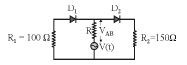
- a) Is half wave rectified
- b) Is full wave rectified
- c) Has the same peak value in the positive and negative half cycles
- d) Has different peak values during positive and negative half cycle
Answer: Has different peak values during positive and negative half cycle
Question: In CE transistor amplifier, the audio signal voltage across the collector resistance of 2 kΩ is 2 V. If the base resistance is 1kΩ and the current amplification of the transistor is 100, the input signal voltage is
- a) 2 mV
- b) 3 mV
- c) 10 mV
- d) 0.1 mV
Answer: 10 mV
Question: An oscillator is nothing but an amplifer with
- a) Positive feedback
- b) Negative feedback
- c) Large gain
- d) No feedback
Answer: Positive feedback
Question: Assuming the diodes to be of silicon with forward resistance zero, the current I in the following circuit is
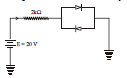
- a) 0
- b) 9.65 mA
- c) 10 mA
- d) 10.35 mA
Answer: 10 mA
Question: For a CE transistor amplifier, the audio signal voltage across the collector resistance of 2.0 kΩ is 2.0 V. Suppose the current amplification factor of the transistor is 100, What should be the value of RB in series with VBB supply of 2.0V if the dc base current has to be 10 times the signal current?
- a) 14 kΩ
- b) 18 kΩ
- c) 10 kΩ
- d) 5 kΩ
Answer: 14 kΩ
Question: The combination of gates shown below yields
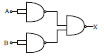
- a) OR gate
- b) NOT gate
- c) XOR gate
- d) NAND gate
Answer: OR gate
Question: Transfer characteristics [output voltage (V0) vs input voltage (V1)] for a base biased transistor in CE configuration is as shown in the figure. For using transistor as a switch, it is used
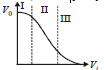
- a) in region (III)
- b) both in region (I) and (III)
- c) in region (II)
- d) in region (I)
Answer: both in region (I) and (III)
Question: If in a p-n junction diode, a square input signal of 10 V is applied as shown 

Then the output signal across RL will be
- a)

- b)

- c)

- d)

Answer:
Question: The output of an OR gate is connected to both the inputs of a NAND gate. The combination will serve as a:
- a) NOT gate
- b) NOR gate
- c) AND gate
- d) OR gate
Answer: NOR gate
Question: In a semiconductor diode, the barrier potential offers opposition to
- a) Holes in P-region only
- b) Free electrons in N-region only
- c) Majority carriers in both regions
- d) Majority as well as minority carriers in both regions
Answer: Majority carriers in both regions
Question: A transistor has a base current of 1 mA and emitter current 90 mA. The collector current will be
- a) 90 mA
- b) 1 mA
- c) 89 mA
- d) 91 mA
Answer: 89 mA
Question: A d.c. battery of V volt is connected to a series combination of a resistor R and an ideal diode D as shown in the figure below. The potential difference across R will be

- a) 2V when diode is forward biased
- b) Zero when diode is forward biased
- c) V when diode is reverse biased
- d) V when diode is forward biased
Answer: V when diode is reverse biased
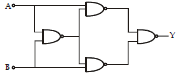
Question: Truth table for system of four NAND gates as shown in figure is :
- a)

- b)

- c)

- d)

Answer:
Question: In a common base amplifier the phase difference between the input signal voltage and the output voltage is
- a) 0
- b) π/4
- c) π/2
- d) π
Answer: 0
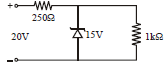
Question: A zener diode, having breakdown voltage equal to 15V, is used in a voltage regulator circuit shown in figure. The current through the diode is
- a) 10 mA
- b) 15 mA
- c) 20 mA
- d) 5 mA
Answer: 5 mA
Question: In an unbiased n-p junction electrons diffuse from n-region to p-region because :
- a) Holes in p-region attract them
- b) Electrons travel across the junction due to potential difference
- c) Only electrons move from n to p region and not the vice-versa
- d) Electron concentration in n-region is more compared to that in p-region
Answer: Electron concentration in n-region is more compared to that in p-region
Question: In common emitter amplifier, the current gain is 62. The collector resistance and input resistance are 5 kΩ an 500Ω respectively. If the input voltage is 0.01 V, the output voltage is
- a) 0.62 V
- b) 6.2 V
- c) 62 V
- d) 620 V
Answer: 6.2 V
Question: An oscillator is nothing but an amplifer with
- a) Positive feedback
- b) Negative feedback
- c) Large gain
- d) No feedback
Answer: Positive feedback
Question: The output of an OR gate is connected to both the inputs of a NAND gate. The combination will serve as a:
- a) NOT gate
- b) NOR gate
- c) AND gate
- d) OR gate
Answer: NOR gate
Question: In a semiconductor diode, the barrier potential offers opposition to
- a) Holes in P-region only
- b) Free electrons in N-region only
- c) Majority carriers in both regions
- d) Majority as well as minority carriers in both regions
Answer: Majority carriers in both regions
Free study material for Physics
Multiple Choice Questions (MCQs) for BITSAT Physics Semiconductor Electronics Materials Devices and Simple Circuits
About Semiconductor Electronics Materials Devices and Simple Circuits MCQs for BITSAT Physics
Explore reliable practice questions for Semiconductor Electronics Materials Devices and Simple Circuits tailored for BITSAT Physics learners. Use these multiple-choice formats to evaluate preparedness and strengthen problem-solving skills.
How to Verify Your MCQ Answers
Built using the official NCERT book for BITSAT, these Physics objective sets provide reliable academic guidance. Pair your practice with our recommended NCERT solutions to master optimal problem-solving approaches.
Enhance Speed with Online MCQ Tests
Explore our broader library of printable assignments, chapter notes, and mock tests designed to support continuous revision and secure higher marks in BITSAT assessments.
FAQs
You can get most exhaustive BITSAT Physics Semiconductor Electronics Materials Devices and Simple Circuits MCQs for free on StudiesToday.com. These MCQs for BITSAT Physics are updated for the 2026-27 academic session as per BITSAT examination standards.
Yes, our BITSAT Physics Semiconductor Electronics Materials Devices and Simple Circuits MCQs include the latest type of questions, such as Assertion-Reasoning and Case-based MCQs. 50% of the BITSAT paper is now competency-based.
By solving our BITSAT Physics Semiconductor Electronics Materials Devices and Simple Circuits MCQs, BITSAT students can improve their accuracy and speed which is important as objective questions provide a chance to secure 100% marks in the Physics.
Yes, Physics MCQs for BITSAT have answer key and brief explanations to help students understand logic behind the correct option as its important for 2026 competency-focused BITSAT exams.
Yes, you can also access online interactive tests for BITSAT Physics Semiconductor Electronics Materials Devices and Simple Circuits MCQs on StudiesToday.com as they provide instant answers and score to help you track your progress in Physics.