

Physics Objective Questions and Answers: System Of Particles and Rotational Motion
Review structured MCQ sets for BITSAT Physics System Of Particles and Rotational Motion. Built according to official BITSAT guidelines, these downloadable questions support daily revision and core concept reinforcement.
Download System Of Particles and Rotational Motion MCQs with Answers
View or download the dedicated System Of Particles and Rotational Motion MCQ resource below. Practicing these 50 objective questions regularly builds familiarity with standard exam patterns and helps secure higher marks in final Physics evaluations.
Question: A thin but rigid semicircular wire frame of radius r is hinged at O and can rotate in its own vertical plane. A smooth peg P starts from O and moves horizontally with constant speed v0, lifting the frame upward as shown in figure.

Find the angular velocity ω of the frame when its diameter makes an angle of 60° with the vertical :
- a) v0/r
- b) v0/2r
- c) 2v0/r
- d) v0r
Answer: v0/r
Question: A circular disc of radius R and thickness  has moment inertia I about an axis passing through its centre perpendicular to its plane. It is melted and recasted into a solid sphere. The moment of nertia of the sphere about its diameter is
- a) I
- b)

- c)

- d)

Answer:
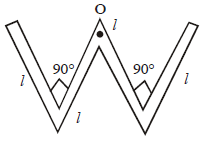
Question: A thin rod of length 4l and mass 4m is bent at the points as shown in figure. What is the moment of inertia of the rod about the axis passes through point O and perpendicular to the plane of paper?
- a)

- b)

- c)

- d)

Answer:
Question: An equilateral prism of mass m rests on a rough horizontal surface with coefficient of friction μ. A horizontal force F is applied on the prism as shown in the figure.
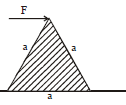
If the coefficient of friction is sufficiently high so that the prism does not slide before toppling, then the minimum force required to topple the prism is –
- a)

- b)

- c)

- d)

Answer:
Question: A particle of mass ‘m’ is projected with a velocity v making an angle of 30° with the horizontal. The magnitude of angular momentum of the projectile about the point of projection when the particle is at its maximum height ‘h’ is
- a)

- b) zero
- c)

- d)

Answer:
Question: A disc is performing pure rolling on a smooth stationary surface with constant angular velocity as shown in figure. At any instant, for the lower most point of the disc –
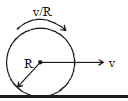
- a) velocity is v, acceleration is zero
- b) velocity is zero, acceleration is zero
- c) velocity is v, acceleration is v2/R
- d) velocity is zero, acceleration is v2/R
Answer: velocity is zero, acceleration is v2/R
Question: What is the moment of inertia of a solid sphere of density r and radius R about its diameter?
- a)

- b)

- c)

- d)

Answer:
Question: A wheel of radius R rolls on the ground with a uniform velocity v. The relative acceleration of topmost point of the wheel with respect to the bottom most point is
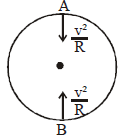
- a)

- b)

- c)

- d)

Answer:
Question: A constant torque of 31.4 N-m is exerted on a pivoted wheel. If angular acceleration of wheel is 4πrad/s2 , then the moment of inertia of the wheel is
- a) 2.5 kg m2
- b) 3.5 kg m2
- c) 4.5 kg m2
- d) 5.5 kg m2
Answer: 2.5 kg m2
Question: The ratio of the accelerations for a solid sphere (mass ‘m’ and radius ‘R’) rolling down an incline of angle ‘θ’ without slipping and slipping down the incline without rolling is :
- a) 5 : 7
- b) 2 : 3
- c) 2 : 5
- d) 7 : 5
Answer: 5 : 7
Question: A system consists of three particles, each of mass m and located at (1, 1), (2, 2) and (3, 3). The coordinates of the centre of mass are
- a) (1, 1)
- b) (2, 2)
- c) (3, 3)
- d) (6, 6)
Answer: (2, 2)
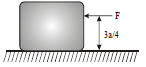
Question: A uniform cube of side a and mass m rests on a rough horizontal table. A horizontal force F is applied normal to one of the faces at a point that is directly above the centre of the face, at a height 3a/4 above the base. The minimum value of F for which the cube begins to topple an edge is (assume that cube does not slide)
- a)

- b)

- c)

- d)

Answer:
Question: A thin uniform circular disc of mass M and radius R is rotating in a horizontal plane about an axis passing through its centre and perpendicular to the plane with angular velocity ω. Another disc of same mass but half the radius is gently placed over it coaxially. The angular speed of the composite disc will be :
- a) (5/4) ω
- b) (4/5) ω
- c) (2/5) ω
- d) (5/2) ω
Answer: (4/5) ω
Question: One solid sphere and disc of same radius are falling along an inclined plane without slipping. One reaches earlier than the other due to
- a) Different radius of gyration
- b) Different sizes
- c) Different friction
- d) Different moment of inertia
Answer: Different radius of gyration
Question: Two uniform solid spheres having unequal masses and unequal radii are released from rest from the same height on a rough incline. If the spheres roll without slipping,
- a) The heavier sphere reaches the bottom first
- b) The bigger sphere reaches the bottom first
- c) The two spheres reach the bottom together
- d) The information given is not sufficient to tell which sphere will reach the bottom first.
Answer: The two spheres reach the bottom together
Question: A thin wire of length L and uniform linear mass density r is bent into a circular loop with centre at O as shown in the figure. The moment of inertia of the loop about the axis XX' is :

- a)

- b)

- c)

- d)

Answer:
Question: A smooth sphere A is moving on a friction less horizontal plane with angular speed ω and centre of mass velocity v. It collides elastically and head on with an identical sphere B at rest. Neglect friction everywhere. After the collision, their angular speeds are ωA and ωB, respectively. Then
- a) ωA< ωB
- b) ωA= ωB
- c) ωA= ω
- d) ωB= ω
Answer: ωA= ω
Question: One solid sphere and disc of same radius are falling along an inclined plane without slipping. One reaches earlier than the other due to
- a) Different radius of gyration
- b) Different sizes
- c) Different friction
- d) Different moment of inertia
Answer: Different radius of gyration
Question: A system consists of three particles, each of mass m and located at (1, 1), (2, 2) and (3, 3). The coordinates of the centre of mass are
- a) (1, 1)
- b) (2, 2)
- c) (3, 3)
- d) (6, 6)
Answer: (2, 2)
Question: Two uniform solid spheres having unequal masses and unequal radii are released from rest from the same height on a rough incline. If the spheres roll without slipping,
- a) The heavier sphere reaches the bottom first
- b) The bigger sphere reaches the bottom first
- c) The two spheres reach the bottom together
- d) The information given is not sufficient to tell which sphere will reach the bottom first
Answer: The two spheres reach the bottom together
Free study material for Physics
Practice MCQs for BITSAT Physics System Of Particles and Rotational Motion
About System Of Particles and Rotational Motion MCQs for BITSAT Physics
Explore reliable practice questions for System Of Particles and Rotational Motion tailored for BITSAT Physics learners. Use these multiple-choice formats to evaluate preparedness and strengthen problem-solving skills.
How to Verify Your MCQ Answers
Each question includes structured solution keys mapped directly to standard BITSAT textbooks, helping students evaluate their reasoning and correct mistakes early in their revision.
Enhance Speed with Online MCQ Tests
Wrap up your chapter revision by testing your knowledge against standard question formats. Everything on our platform is provided free of charge.
FAQs
You can get most exhaustive BITSAT Physics System Of Particles and Rotational Motion MCQs for free on StudiesToday.com. These MCQs for BITSAT Physics are updated for the 2026-27 academic session as per BITSAT examination standards.
Yes, our BITSAT Physics System Of Particles and Rotational Motion MCQs include the latest type of questions, such as Assertion-Reasoning and Case-based MCQs. 50% of the BITSAT paper is now competency-based.
By solving our BITSAT Physics System Of Particles and Rotational Motion MCQs, BITSAT students can improve their accuracy and speed which is important as objective questions provide a chance to secure 100% marks in the Physics.
Yes, Physics MCQs for BITSAT have answer key and brief explanations to help students understand logic behind the correct option as its important for 2026 competency-focused BITSAT exams.
Yes, you can also access online interactive tests for BITSAT Physics System Of Particles and Rotational Motion MCQs on StudiesToday.com as they provide instant answers and score to help you track your progress in Physics.