

Practice MCQs for BITSAT Physics Ray Optics and Optical Instruments
Explore reliable objective questions for Ray Optics and Optical Instruments tailored for BITSAT learners. Utilizing these Physics multiple-choice formats ensures thorough preparation and strengthens problem-solving speed for upcoming school assessments.
Access Ray Optics and Optical Instruments Questions and Solutions
Navigate directly to the 50 objective questions for Ray Optics and Optical Instruments using the digital viewer below. Each practice set includes verified answer keys, allowing students to instantly cross-check their work and identify areas requiring further revision.
Question: Two plano-concave lenses (1 and 2) of glass of refractive index 1.5 have radii of curvature 25 cm and 20 cm. They are placed in contact with their curved surface towards each other and the space between them is filled with liquid of refractive index 4/3. Then the combination is

- a) Convex lens of focal length 70 cm
- b) Concave lens of focal length 70 cm
- c) Concave lens of focal length 66.6 cm
- d) Convex lens of focal length 66.6 cm
Answer: Concave lens of focal length 66.6 cm
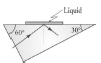
Question: On a hypotenuse of a right angle prism (30° – 60° – 90°) of refractive index 1.50, a drop of liquid is placed as shown in figure. Light is allowed to fall normally on the short face of the prism. In order that the ray of light may get totally reflected, the maximum value of refractive index is :
- a) 1.30
- b) 1.47
- c) 1.20
- d) 1.25
Answer: 1.30
Question: A biconvex lens has a radius of curvature of magnitude 20 cm. Which one of the following options best describe the image formed of an object of height 2 cm placed 30 cm from the lens?
- a) Virtual, upright, height = 1 cm
- b) Virtual, upright, height = 0.5 cm
- c) Real, inverted, height = 4 cm
- d) Real, inverted, height = 1cm
Answer: Real, inverted, height = 4 cm
Question: For the angle of minimum deviation of a prism to be equal to its refracting angle, the prism must be made of a material whose refractive index :
- a) lies between √2 and 1
- b) lies between 2 and √2
- c) is less than 1
- d) is greater than 2
Answer: lies between 2 and √2
Question: A lens having focal length f and aperture of diameter d forms an image of intensity I. Aperture of diameter  in central region of lens is covered by a black paper. Focal length of lens and intensity of image now will be respectively;
- a)

- b)

- c)

- d)

Answer:
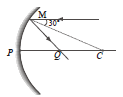
Question: A ray parallel to principal axis is incident at 30° from normal on concave mirror having radius of curvature R. The point on principal axis where rays are focussed is Q such that PQ is
- a)

- b)

- c)

- d)

Answer:
Question: A planoconvex lens fits exactly into a planoconcave lens. Their plane surface are parallel to each other. If the lenses are made of different materials of refractive indices μ1 & μ2 and R is the radius of curvature of the curved surface of the lenses, then focal length of combination is
- a)

- b)

- c)

- d)

Answer:
Question: The magnifying power of a telescope is 9. When it is adjusted for parallel rays, the distance between the objective and the eye piece is found to be 20 cm. The focal length of lenses are
- a) 18 cm, 2 cm
- b) 11 cm, 9 cm
- c) 10 cm, 10 cm
- d) 15 cm, 5 cm
Answer: 18 cm, 2 cm
Question: When light is refracted, which of the following does not change ?
- a) Wavelength
- b) Frequency
- c) Velocity
- d) Amplitude
Answer: Frequency
Question: A Convex lens of crown glass (μ = 1.525) will behave as a divergent lens if immersed in
- a) water (μ = 1.33)
- b) in a medium of μ = 1.525
- c) carbon disulphide (μ = 1.66)
- d) it cannot act as a divergent lens
Answer: carbon disulphide (μ = 1.66)
Question: Wavelength of light used in an optical instrument are λ1 = 4000Å and λ2 = 5000 Å, then ratio of their respective resolving powers (corresponding to λ1 and λ2) is
- a) 16 : 25
- b) 9 : 1
- c) 4 : 5
- d) 5 : 4
Answer: 5 : 4
Question: A thin convergent glass lens (μg = 1.5) has a power of + 5.0 D. When this lens is immersed in a liquid of refractive index m, it acts as a divergent lens of focal length 100 cm. The value of m must be
- a) 4/3
- b) 5/3
- c) 5/4
- d) 6/5
Answer: 5/3
Question: A vessel of depth 2d cm. is half filled with a liquid of refractive index μ1 and the upper half with a liquid of refractive index μ2. The apparent depth of the vessel seen perpendicularly is –
- a)

- b)

- c)

- d)

Answer:
Question: A plano-convex lens of focal length 30 cm has its plane surface silvered. An object is placed 40 cm from the lens on the convex side. The distance of the image from the lens is
- a) 18 cm
- b) 24 cm
- c) 30 cm
- d) 40 cm
Answer: 24 cm
Question: Time taken to cross a 4 mm window glass of refractive index 1.5 will be-
- a) 2 × 10⁻⁸ sec
- b) 2 × 10⁸ sec
- c) 2 × 10–11 sec
- d) 2 × 10¹¹ sec
Answer: 2 × 10–11 sec
Question: A fish looking up through the water sees the outside world contained in a circular horizon. If the refractive index of water is 4/3 and the fish is 12 cm. below the surface, the radius of this circle in cm is –
- a) 36 √5
- b) 4 √5
- c) 36 √7
- d) 36/ √7
Answer: 36/ √7
Question: An air bubble under water shines brightly because of the phenomenon of :
- a) Diffraction
- b) Dispersion
- c) Interference
- d) Total internal reflection
Answer: Total internal reflection
Question: A vessel is half filled with a liquid of refractive index μ. The other half of the vessel is filled with an immiscible liquid of refrative index 1.5 μ. The apparent depth of the vessel is 50% of the actual depth. Then μ is
- a) 1.4
- b) 1.5
- c) 1.6
- d) 1.67
Answer: 1.67
Question: A biconvex lens has a radius of curvature of magnitude 20 cm. Which one of the following options best describe the image formed of an object of height 2 cm placed 30 cm from the lens?
- a) Virtual, upright, height = 1 cm
- b) Virtual, upright, height = 0.5 cm
- c) Real, inverted, height = 4 cm
- d) Real, inverted, height = 1cm
Answer: Real, inverted, height = 4 cm
Question: When light is refracted, which of the following does not change ?
- a) Wavelength
- b) Frequency
- c) Velocity
- d) Amplitude
Answer: Frequency
Free study material for Physics
Practice MCQs for BITSAT Physics Ray Optics and Optical Instruments
About Ray Optics and Optical Instruments MCQs for BITSAT Physics
Explore reliable practice questions for Ray Optics and Optical Instruments tailored for BITSAT Physics learners. Use these multiple-choice formats to evaluate preparedness and strengthen problem-solving skills.
How to Verify Your MCQ Answers
Each question includes structured solution keys mapped directly to standard BITSAT textbooks, helping students evaluate their reasoning and correct mistakes early in their revision.
Enhance Speed with Online MCQ Tests
Wrap up your chapter revision by testing your knowledge against standard question formats. Everything on our platform is provided free of charge.
FAQs
You can get most exhaustive BITSAT Physics Ray Optics and Optical Instruments MCQs for free on StudiesToday.com. These MCQs for BITSAT Physics are updated for the 2026-27 academic session as per BITSAT examination standards.
Yes, our BITSAT Physics Ray Optics and Optical Instruments MCQs include the latest type of questions, such as Assertion-Reasoning and Case-based MCQs. 50% of the BITSAT paper is now competency-based.
By solving our BITSAT Physics Ray Optics and Optical Instruments MCQs, BITSAT students can improve their accuracy and speed which is important as objective questions provide a chance to secure 100% marks in the Physics.
Yes, Physics MCQs for BITSAT have answer key and brief explanations to help students understand logic behind the correct option as its important for 2026 competency-focused BITSAT exams.
Yes, you can also access online interactive tests for BITSAT Physics Ray Optics and Optical Instruments MCQs on StudiesToday.com as they provide instant answers and score to help you track your progress in Physics.