

Download BITSAT MCQs for BITSAT Physics: Oscillations
Review structured MCQ sets for BITSAT Physics Oscillations. Built according to official BITSAT guidelines, these downloadable questions support daily revision and core concept reinforcement.
Chapter-wise Objective Questions: Oscillations
View or download the dedicated Oscillations MCQ resource below. Practicing these 50 objective questions regularly builds familiarity with standard exam patterns and helps secure higher marks in final Physics evaluations.
Question: The following figure depict a circular motion. The radius of the circle, the period of revolution, the initial position and the sense of revolution are indicated on the figure.

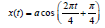
The simple harmonic motion of the x-projection of the radius vector of the rotating particle P can be shown as
- a)
- b)

- c)

- d)

Answer:
Question: A point particle of mass 0.1 kg is executing S.H.M. of amplitude of 0.1 m. When the particle passes through the mean position, its kinetic energy is 8 × 10⁻³ Joule. Obtain the equation of motion of this particle if this initial phase of oscillation is 45º.
- a)

- b)

- c)

- d)

Answer:
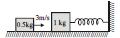
Question: A 1 kg mass is attached to a spring of force constant 600 N/m and rests on a smooth horizontal surface with other end of the spring tied to wall as shown in figure. A second mass of 0.5 kg slides along the surface towards the first at 3m/s. If the masses make a perfectly inelastic collision, then find amplitude and time period of oscillation of combined mass
- a)

- b)

- c)

- d)

Answer:
Question: Vertical displacement of a Planck with a body of mass m on it is varying according to law y = sin ωt +√3 cosωt. The minimum value of ω for which the mass just breaks off the Planck and the moment it occurs first after t = 0, are given by
- a)

- b)

- c)

- d)

Answer:
Question: A load of mass m falls from a height h on to the scale pan hung from the spring as shown in the figure. If the spring constant is k and mass of the scale pan is zero and the mass m does not bounce relative to the pan, then the amplitude of vibration is

- a) mg/d
- b)

- c)

- d)

Answer:
Question: The displacement of a particle is given at time t, by: x = Asin(-2ωt) + B sin2 ωt. Then
- a) the motion of the particle is SHM with an amplitude of

- b) the motion of the particle is not SHM, but oscillatory with a time period of T = π/ω
- c) the motion of the particle is oscillatory with a time period of T = π/2ω
- d) the motion of the particle is a periodic
Answer: the motion of the particle is SHM with an amplitude of
Question: Two particles P and Q describe S.H.M. of same amplitude a, same frequency f along the same straight line. The maximum distance between the two particles is a √2. The initial phase difference between the particle is –
- a) zero
- b) π/2
- c) π/6
- d) π/3
Answer: π/2
Question: A tunnel has been dug through the centre of the earth and a ball is released in it. It executes S.H.M. with time period
- a) 42 minutes
- b) 1 day
- c) 1 hour
- d) 84.6 minutes
Answer: 84.6 minutes
Question: An instantaneous displacement of a simple harmonic oscillator is x = A cos (ωt + π/4). Its speed will be maximum at time
- a) π/4 ω
- b) π/2 ω
- c) π/ω
- d) 2 π/ω
Answer: π/4 ω
Question: One end of a long metallic wire of length L tied to the ceiling. The other end is tied with a mass less spring of spring constant K. A mass hangs freely from the free end of the spring. The area of cross section and the young’s modulus of the wire are A and Y respectively. If the mass slightly pulled down and released, it will oscillate with a time period T equal to :
- a) 2π √(m/ K)
- b) 2π √m(YA+KL) / (YAK)
- c) 2π √(mYA / KL)
- d) 2π √(mL / YA)
Answer: 2π √m(YA+KL) / (YAK)
Question: Which of the following expressions corresponds to simple harmonic motion along a straight line, where x is the displacement and a, b, c are positive constants?
- a) a + bx – cx2
- b) bx2
- c) a – bx + cx2
- d) – bx
Answer: – bx
Question: A mass m is suspended from a spring of force constant k and just touches another identical spring fixed to the floor as shown in the figure. The time period of small oscillations is

- a)

- b)

- c)

- d)

Answer:
Question: A simple pendulum has time period 't'. Its time period in a lift which is moving upwards with acceleration 3 ms–2 is
- a)

- b)

- c)

- d)

Answer:
Question: In case of a forced vibration, the resonance wave becomes very sharp when the
- a) Restoring force is small
- b) Applied periodic force is small
- c) Quality factor is small
- d) Damping force is small
Answer: Damping force is small
Question: A pendulum bob carries a +ve charge +q. A positive charge +q is held at the point of support. Then the time period of the bob is –
- a) greater than 2π √L / g
- b) less than 2π √L / g
- c) equal to 2π √L / g
- d) equal to 2π √2L / g
Answer: greater than 2π √L / g
Question: Two oscillating systems; a simple pendulum and a vertical spring-mass-system have same time period of motion on the surface of the Earth. If both are taken to the moon, then–
- a) Time period of the simple pendulum will be more than that of the spring-mass system.
- b) Time period of the simple pendulum will be equal is that is of the spring-mass system.
- c) Time period of the simple pendulum will be less than of the spring-mass system
- d) Nothing can be said definitely without observation
Answer: Time period of the simple pendulum will be more than that of the spring-mass system.
Question: One end of a spring of force constant k is fixed to a vertical wall and other to a body of mass m resting on a smooth horizontal surface there is another wall at a distance x0 from the body. The spring is then compressed by 2x0 and released. The time taken to strike the wall is :

- a)

- b)

- c)

- d)

Answer:
Question: The potential energy of a particle (Ux) executing S.H.M. is given by
- a)

- b)

- c)

- d) Ux = a constant
Answer:
Question: A child swinging on swing in sitting position stands up. The time period of the swing will
- a) Increase
- b) Decrease
- c) Remain same
- d) Increase if the child is tall and decrease if the child is short.
Answer: Decrease
Question: The height of liquid column in a U tube is 0.3 meter. If the liquid in one of the limbs is depressed and then released, then the time period of liquid column will be-
- a) 0.11 sec
- b) 19 sec
- c) 1.1 sec
- d) 2 sec
Answer: 1.1 sec
Free study material for Physics
Oscillations Objective Questions & Solutions for BITSAT Physics
About Oscillations MCQs for BITSAT Physics
Test your conceptual understanding of Oscillations with these targeted multiple-choice questions. Designed in alignment with the latest BITSAT curriculum for BITSAT Physics, these problem sets build accuracy and prepare students for objective exams.
How to Verify Your MCQ Answers
Built using the official NCERT book for BITSAT, these Physics objective sets provide reliable academic guidance. Pair your practice with our recommended NCERT solutions to master optimal problem-solving approaches.
Enhance Speed with Online MCQ Tests
Wrap up your chapter revision by testing your knowledge against standard question formats. Everything on our platform is provided free of charge.
FAQs
You can get most exhaustive BITSAT Physics Oscillations MCQs for free on StudiesToday.com. These MCQs for BITSAT Physics are updated for the 2026-27 academic session as per BITSAT examination standards.
Yes, our BITSAT Physics Oscillations MCQs include the latest type of questions, such as Assertion-Reasoning and Case-based MCQs. 50% of the BITSAT paper is now competency-based.
By solving our BITSAT Physics Oscillations MCQs, BITSAT students can improve their accuracy and speed which is important as objective questions provide a chance to secure 100% marks in the Physics.
Yes, Physics MCQs for BITSAT have answer key and brief explanations to help students understand logic behind the correct option as its important for 2026 competency-focused BITSAT exams.
Yes, you can also access online interactive tests for BITSAT Physics Oscillations MCQs on StudiesToday.com as they provide instant answers and score to help you track your progress in Physics.