

Refer to CBSE Class 10 Maths HOTs Question Bank Set 02. We have provided exhaustive High Order Thinking Skills (HOTS) questions and answers for Class 10 Mathematics All Chapters. Designed for the 2026-27 exam session, these expert-curated analytical questions help students master important concepts and stay aligned with the latest CBSE, NCERT, and KVS curriculum.
Download Class 10 Mathematics All Chapters HOTS Practice
Every Class 10 Mathematics student should practice these HOTS Questions to tackle difficult exam problems. Use the provided solutions to improve your critical thinking and boost your overall performance in Class 10.
Get All Chapters HOTS PDF for Class 10 Mathematics
Number System
Question 1. Show that square of any positive odd integer is of the form 8q+1 for some integer q.
Answer: Let \( a \) be any positive odd integer. According to Euclid's division lemma, any odd integer can be written in the form \( 4m + 1 \) or \( 4m + 3 \) for some integer \( m \).
*Case 1*: If \( a = 4m + 1 \):
\( a^2 = (4m + 1)^2 \)
\( = 16m^2 + 8m + 1 \)
\( = 8(2m^2 + m) + 1 \)
\( = 8q + 1 \), where \( q = 2m^2 + m \) is an integer.
*Case 2*: If \( a = 4m + 3 \):
\( a^2 = (4m + 3)^2 \)
\( = 16m^2 + 24m + 9 \)
\( = 16m^2 + 24m + 8 + 1 \)
\( = 8(2m^2 + 3m + 1) + 1 \)
\( = 8q + 1 \), where \( q = 2m^2 + 3m + 1 \) is an integer.
Thus, the square of any positive odd integer is always of the form \( 8q + 1 \).
In simple words: When you square any odd number and divide the result by 8, you will always be left with a remainder of 1.
Exam Tip: Clearly define the two cases using the algebraic forms of odd integers to ensure your proof is logically complete and scores full marks.
Question 2. Find whether the decimal representation (expansion) of the numbers (i) 51/120 (ii) 637/7280 terminating or non-terminating
Answer:
(i) \( \frac{51}{120} \)
First, simplify the fraction by dividing the numerator and denominator by their greatest common divisor, which is 3:
\( \frac{51}{120} = \frac{17}{40} \)
The prime factorization of the denominator is:
\( 40 = 2^3 \times 5 \)
Since the prime factors of the denominator consist only of 2 and 5, the decimal expansion is terminating.
(ii) \( \frac{637}{7280} \)
First, simplify the fraction. The prime factorization of 637 is \( 7^2 \times 13 \). Dividing both the numerator and the denominator by \( 7 \times 13 = 91 \):
\( \frac{637}{7280} = \frac{7}{80} \)
The prime factorization of the simplified denominator is:
\( 80 = 2^4 \times 5 \)
Since the prime factors of the denominator consist only of 2 and 5, this decimal expansion is also terminating.
In simple words: Simplify the fraction first. If the prime factorization of the bottom number only contains 2s and 5s, the decimal will eventually stop.
Exam Tip: Always reduce the fraction to its lowest terms before checking the prime factorization of the denominator, as unsimplified factors can lead to an incorrect answer.
Question 3. The decimal expansion of following numbers, will terminate after how many places
(i) \( \frac{47}{2^3 \cdot 5^2} \)
(ii) \( \frac{359}{2 \times 5^4} \)
Answer:
(i) For \( \frac{47}{2^3 \cdot 5^2} \):
The highest power between the factors in the denominator (\( 2^3 \) and \( 5^2 \)) is 3 (from \( 2^3 \)).
Therefore, the decimal expansion will terminate after 3 decimal places.
(ii) For \( \frac{359}{2 \times 5^4} \):
The highest power between the factors in the denominator (\( 2^1 \) and \( 5^4 \)) is 4 (from \( 5^4 \)).
Therefore, the decimal expansion will terminate after 4 decimal places.
In simple words: Look at the powers of 2 and 5 at the bottom of the fraction. Whichever power is bigger tells you exactly how many steps after the decimal point the number ends.
Exam Tip: You can find the exact number of decimal places without dividing; simply identify the maximum exponent of either 2 or 5 in the denominator.
Question 4. Prove that 3 + 2\( \sqrt{5} \) is an irrational number.
Answer: Let us assume, on the contrary, that \( 3 + 2\sqrt{5} \) is a rational number.
Therefore, we can find co-prime integers \( a \) and \( b \) (where \( b \neq 0 \)) such that:
\( 3 + 2\sqrt{5} = \frac{a}{b} \)
\( \implies 2\sqrt{5} = \frac{a}{b} - 3 \)
\( \implies 2\sqrt{5} = \frac{a - 3b}{b} \)
\( \implies \sqrt{5} = \frac{a - 3b}{2b} \)
Since \( a \) and \( b \) are integers, \( \frac{a - 3b}{2b} \) is a rational number.
This implies that \( \sqrt{5} \) is a rational number.
But this contradicts the known fact that \( \sqrt{5} \) is an irrational number.
This contradiction has arisen due to our incorrect assumption that \( 3 + 2\sqrt{5} \) is rational.
Hence, \( 3 + 2\sqrt{5} \) is an irrational number.
In simple words: We start by pretending the number is rational. Rearranging the formula shows that a known irrational number would have to equal a rational one, which is impossible. Thus, our original guess must be wrong.
Exam Tip: Clearly write down each algebraic step and mention the contradiction between the rational expression and the irrational root to score full marks.
Polynomials
Question 5. Find all zeroes of the polynomials \( x^4 - 5x^3 - 9x^2 + 15x + 18 \) if two of its zeroes are \( \sqrt{3} \) and \( -\sqrt{3} \)
Answer: Since two of the zeroes are \( \sqrt{3} \) and \( -\sqrt{3} \), the corresponding factors of the polynomial are \( (x - \sqrt{3}) \) and \( (x + \sqrt{3}) \).
The product of these factors is:
\( (x - \sqrt{3})(x + \sqrt{3}) = x^2 - 3 \)
Therefore, \( x^2 - 3 \) is a factor of the given polynomial \( p(x) = x^4 - 5x^3 - 9x^2 + 15x + 18 \).
Now, we divide the polynomial \( p(x) \) by \( x^2 - 3 \) using polynomial division:
\( \frac{x^4 - 5x^3 - 9x^2 + 15x + 18}{x^2 - 3} = x^2 - 5x - 6 \)
To find the remaining zeroes, we set the quotient to zero and solve the quadratic equation:
\( x^2 - 5x - 6 = 0 \)
\( \implies x^2 - 6x + x - 6 = 0 \)
\( \implies x(x - 6) + 1(x - 6) = 0 \)
\( \implies (x - 6)(x + 1) = 0 \)
This gives:
\( x = 6 \) or \( x = -1 \)
Thus, all the zeroes of the given polynomial are \( \sqrt{3} \), \( -\sqrt{3} \), \( 6 \), and \( -1 \).
In simple words: We multiply the two given roots to get a simpler formula, divide our main equation by it, and then solve the remaining quadratic equation to find the other two roots.
Exam Tip: Always perform the long division carefully. Getting a remainder of zero confirms that your initial quadratic factor was calculated correctly.
Question 6. Find all zeroes of the polynomial \( x^4 - 4x^3 - 2x^2 + 12x - 3 \) if two of its zeroes are \( 2 \pm \sqrt{3} \)
Answer: The two given zeroes are \( 2 + \sqrt{3} \) and \( 2 - \sqrt{3} \).
The product of their factors is:
\( (x - (2 + \sqrt{3}))(x - (2 - \sqrt{3})) = ((x - 2) - \sqrt{3})((x - 2) + \sqrt{3}) \)
\( = (x - 2)^2 - (\sqrt{3})^2 \)
\( = x^2 - 4x + 4 - 3 = x^2 - 4x + 1 \)
Thus, \( x^2 - 4x + 1 \) is a factor of the given polynomial.
Now, we divide \( x^4 - 4x^3 - 2x^2 + 12x - 3 \) by \( x^2 - 4x + 1 \) using polynomial division:
\( \frac{x^4 - 4x^3 - 2x^2 + 12x - 3}{x^2 - 4x + 1} = x^2 - 3 \)
To find the remaining zeroes, we set the quotient to zero:
\( x^2 - 3 = 0 \)
\( \implies x^2 = 3 \)
\( \implies x = \pm \sqrt{3} \)
Therefore, all the zeroes of the polynomial are \( 2 + \sqrt{3} \), \( 2 - \sqrt{3} \), \( \sqrt{3} \), and \( -\sqrt{3} \).
In simple words: We create a quadratic factor from the two complex roots, divide the main polynomial by it, and solve the remaining part to find the last two simple roots.
Exam Tip: Utilize the algebraic identity \( (a-b)(a+b) = a^2 - b^2 \) with \( a = x-2 \) and \( b = \sqrt{3} \) to quickly find the quadratic divisor without algebraic errors.
Question 7. Obtain all zeroes of the polynomial \( 5x^3 - 15x^2 - 3x + 9 \), if two of its zeroes are \( \sqrt{\frac{3}{5}} \) and \( -\sqrt{\frac{3}{5}} \)
Answer: The two given zeroes are \( \sqrt{\frac{3}{5}} \) and \( -\sqrt{\frac{3}{5}} \).
The product of their corresponding factors is:
\( (x - \sqrt{\frac{3}{5}})(x + \sqrt{\frac{3}{5}}) = x^2 - \frac{3}{5} \)
To clear fractions, we can multiply by 5 to get the quadratic factor: \( 5x^2 - 3 \).
Now, divide the given polynomial \( 5x^3 - 15x^2 - 3x + 9 \) by \( 5x^2 - 3 \):
\( \frac{5x^3 - 15x^2 - 3x + 9}{5x^2 - 3} = x - 3 \)
To find the final zero, we set the quotient to zero:
\( x - 3 = 0 \)
\( \implies x = 3 \)
Thus, all zeroes of the polynomial are \( \sqrt{\frac{3}{5}} \), \( -\sqrt{\frac{3}{5}} \), and \( 3 \).
In simple words: We multiply the two fractional roots to find a quadratic equation. Dividing our starting cubic polynomial by this quadratic equation leaves us with a simple root of 3.
Exam Tip: Scaling up the factor \( x^2 - \frac{3}{5} \) to \( 5x^2 - 3 \) makes long division much simpler and keeps your calculations free of fractions.
Linear Equations
Question 8. Solve the following pair of equations:
\( \frac{1}{3x+y} + \frac{1}{3x-y} = \frac{3}{4} \), \( \frac{1}{2(3x+y)} - \frac{1}{2(3x-y)} = -\frac{1}{8} \)
Answer: Let \( u = \frac{1}{3x+y} \) and \( v = \frac{1}{3x-y} \).
The equations can be rewritten as:
1) \( u + v = \frac{3}{4} \)
2) \( \frac{u}{2} - \frac{v}{2} = -\frac{1}{8} \implies u - v = -\frac{1}{4} \)
Add equation (1) and equation (2):
\( (u + v) + (u - v) = \frac{3}{4} - \frac{1}{4} \)
\( \implies 2u = \frac{2}{4} = \frac{1}{2} \)
\( \implies u = \frac{1}{4} \)
Substitute \( u = \frac{1}{4} \) back into equation (1):
\( \frac{1}{4} + v = \frac{3}{4} \implies v = \frac{1}{2} \)
Now substitute the expressions back to find \( x \) and \( y \):
\( \frac{1}{3x+y} = \frac{1}{4} \implies 3x + y = 4 \) --- (Equation 3)
\( \frac{1}{3x-y} = \frac{1}{2} \implies 3x - y = 2 \) --- (Equation 4)
Add Equation (3) and Equation (4):
\( (3x + y) + (3x - y) = 4 + 2 \)
\( \implies 6x = 6 \)
\( \implies x = 1 \)
Substitute \( x = 1 \) into Equation (3):
\( 3(1) + y = 4 \implies y = 1 \)
Thus, the solution is \( x = 1 \) and \( y = 1 \).
In simple words: Since the fractions look complicated, we substitute them with temporary letters \( u \) and \( v \). Solving for these letters lets us set up simpler linear equations to find \( x \) and \( y \).
Exam Tip: This is a classic "reducible to linear form" problem. Make sure to clearly state your substitutions at the beginning to earn complete method marks.
Question 9. A chemist has one solution which is 50% acid and a second solution which is 25% acid. How much of each should be mixed to make 10 litres of a 40% acid solution.
Answer: Let \( x \) be the volume of the 50% acid solution in litres, and \( y \) be the volume of the 25% acid solution in litres.
Since the final mixture must be 10 litres, we have:
\( x + y = 10 \) --- (Equation 1)
The total amount of pure acid in the final solution is 40% of 10 litres:
\( 0.50x + 0.25y = 0.40(10) \)
\( \implies 0.50x + 0.25y = 4 \)
Multiply the entire equation by 4 to eliminate decimals:
\( 2x + y = 16 \) --- (Equation 2)
Subtract Equation (1) from Equation (2):
\( (2x + y) - (x + y) = 16 - 10 \)
\( \implies x = 6 \)
Substitute \( x = 6 \) into Equation (1):
\( 6 + y = 10 \implies y = 4 \)
Thus, the chemist should mix 6 litres of the 50% acid solution and 4 litres of the 25% acid solution.
In simple words: We create two simple equations: one for the total volume of liquid and another for the amount of actual acid. Solving these tells us we need 6 litres of the stronger acid and 4 litres of the weaker one.
Exam Tip: Always double check that the sum of your final volumes adds up to the requested mixture volume (6 + 4 = 10) to confirm your calculations are correct.
Question 10. Check graphically whether the pair of equations \( x + 3y = 6 \), \( 3x + 9y = 12 \) is consistent. Also find the points where these line intersect x-axis.
Answer: Let us find the coordinates to plot both lines:
For the first line \( x + 3y = 6 \):
When \( y = 0 \), \( x = 6 \). Point is \( (6, 0) \).
When \( x = 0 \), \( y = 2 \). Point is \( (0, 2) \).
For the second line \( 3x + 9y = 12 \):
When \( y = 0 \), \( x = 4 \). Point is \( (4, 0) \).
When \( x = 0 \), \( y = \frac{4}{3} \). Point is \( (0, \frac{4}{3}) \).
Let us check the ratio of coefficients:
\( \frac{a_1}{a_2} = \frac{1}{3} \)
\( \frac{b_1}{b_2} = \frac{3}{9} = \frac{1}{3} \)
\( \frac{c_1}{c_2} = \frac{6}{12} = \frac{1}{2} \)
Since \( \frac{a_1}{a_2} = \frac{b_1}{b_2} \neq \frac{c_1}{c_2} \), the lines are parallel and will never intersect.
Because there is no intersection, the system is inconsistent.
The points where these lines cross the x-axis (by setting \( y = 0 \)) are:
The line \( x + 3y = 6 \) crosses at \( (6, 0) \).
The line \( 3x + 9y = 12 \) crosses at \( (4, 0) \).
In simple words: When plotted on a graph, these lines run parallel and never touch. This means there is no solution, and the lines cross the x-axis at \( (6, 0) \) and \( (4, 0) \).
Exam Tip: When proving inconsistency, always write down the coefficient ratio formula \( \frac{a_1}{a_2} = \frac{b_1}{b_2} \neq \frac{c_1}{c_2} \) to mathematically back up your graph.
Question 11. A lending library has a fixed charge for the first three days and an additional charge for each day thereafter. Sarita paid Rs. 27 for a book kept for seven days while Sunita paid Rs. 21 for the book she kept for five days. Find the fixed charge and the charge for each extra day.
Answer: Let the fixed charge for the first three days be Rs. \( x \), and the additional daily charge after three days be Rs. \( y \).
For Sarita (kept the book for 7 days, which is 3 fixed days + 4 extra days):
\( x + 4y = 27 \) --- (Equation 1)
For Sunita (kept the book for 5 days, which is 3 fixed days + 2 extra days):
\( x + 2y = 21 \) --- (Equation 2)
Subtract Equation (2) from Equation (1):
\( (x + 4y) - (x + 2y) = 27 - 21 \)
\( \implies 2y = 6 \)
\( \implies y = 3 \)
Substitute \( y = 3 \) into Equation (2):
\( x + 2(3) = 21 \)
\( \implies x + 6 = 21 \)
\( \implies x = 15 \)
So, the fixed charge is Rs. 15 and the daily extra charge is Rs. 3.
In simple words: Comparing what both people paid shows us that each extra day costs Rs. 3. This means the basic cost for the first three days is Rs. 15.
Exam Tip: Remember that the fixed charge covers a block of three days. Ensure you subtract 3 days from the total before calculating the extra charge.
Quadratic Equations
Question 12. Find the value of k for which the roots of the quadratic equation \( kx^2-10x+5=0 \) are equal.
Answer: For a quadratic equation \( ax^2 + bx + c = 0 \), the roots are equal when the discriminant \( D = 0 \).
Here, \( a = k \), \( b = -10 \), and \( c = 5 \).
\( D = b^2 - 4ac \)
\( = (-10)^2 - 4(k)(5) \)
\( = 100 - 20k \)
Set \( D = 0 \) for equal roots:
\( 100 - 20k = 0 \)
\( \implies 20k = 100 \)
\( \implies k = 5 \)
Thus, the value of \( k \) is 5.
In simple words: To make the roots equal, we set the discriminant formula to zero. Solving this basic equation gives us a value of 5 for \( k \).
Exam Tip: Clearly write down the condition \( b^2 - 4ac = 0 \) before performing substitutions to earn complete step marks.
Question 13. Find the value of p for which the roots of the quadratic equation \( 3x^2-px+3=0 \) are real where \( p>0 \)
Answer: For a quadratic equation \( ax^2 + bx + c = 0 \), the roots are real when the discriminant \( D \ge 0 \).
Here, \( a = 3 \), \( b = -p \), and \( c = 3 \).
\( D = b^2 - 4ac \)
\( = (-p)^2 - 4(3)(3) \)
\( = p^2 - 36 \)
Set \( D \ge 0 \) for real roots:
\( p^2 - 36 \ge 0 \)
\( \implies p^2 \ge 36 \)
\( \implies p \ge 6 \) or \( p \le -6 \)
Since it is given that \( p > 0 \), we select the positive range:
\( p \ge 6 \)
In simple words: For real roots, the discriminant must be 0 or positive. This means \( p^2 \) has to be at least 36, and since \( p \) is positive, \( p \) must be 6 or larger.
Exam Tip: Remember that "real roots" includes both equal and distinct roots, so use the inequality \( D \ge 0 \) instead of just \( D > 0 \).
Question 14. Sum of the areas of two squares is 468 \( m^2 \). If the difference of their perimeters is 24 m, find the sides of two squares.
Answer: Let the side of the larger square be \( x \) metres, and the side of the smaller square be \( y \) metres.
According to the sum of areas:
\( x^2 + y^2 = 468 \) --- (Equation 1)
The difference between their perimeters is 24 m:
\( 4x - 4y = 24 \)
\( \implies x - y = 6 \implies x = y + 6 \) --- (Equation 2)
Substitute Equation (2) into Equation (1):
\( (y + 6)^2 + y^2 = 468 \)
\( \implies y^2 + 12y + 36 + y^2 = 468 \)
\( \implies 2y^2 + 12y + 36 - 468 = 0 \)
\( \implies 2y^2 + 12y - 432 = 0 \)
Divide by 2:
\( y^2 + 6y - 218 = 0 \)
Wait, let us check: \( 432 / 2 = 216 \).
\( y^2 + 6y - 216 = 0 \)
\( \implies y^2 + 18y - 12y - 216 = 0 \)
\( \implies y(y + 18) - 12(y + 18) = 0 \)
\( \implies (y + 18)(y - 12) = 0 \)
This gives \( y = 12 \) or \( y = -18 \).
Since a length cannot be negative, we reject \( y = -18 \).
Thus, the side of the smaller square is \( y = 12 \) m.
The side of the larger square is \( x = 12 + 6 = 18 \) m.
In simple words: We write equations for the squares' areas and perimeters. Substituting them gives us a quadratic equation, showing the sides are 18 m and 12 m.
Exam Tip: Always write a statement explaining why you rejected the negative solution (since physical lengths must be positive) to complete your proof.
Question 15. A train travels 360 km at a uniform speed. If the speed had been 5 km/hr. more, it would have taken 1 hour less for the same journey. Find the speed of the train.
Answer: Let the uniform speed of the train be \( x \) km/h.
Time taken for 360 km at this speed = \( \frac{360}{x} \) hours.
If the speed is increased by 5 km/h, the new speed is \( x + 5 \) km/h.
Time taken at the new speed = \( \frac{360}{x + 5} \) hours.
According to the problem, the difference in times is 1 hour:
\( \frac{360}{x} - \frac{360}{x + 5} = 1 \)
\( \implies 360 \left( \frac{1}{x} - \frac{1}{x + 5} \right) = 1 \)
\( \implies 360 \left( \frac{x + 5 - x}{x(x + 5)} \right) = 1 \)
\( \implies \frac{1800}{x^2 + 5x} = 1 \)
\( \implies x^2 + 5x - 1800 = 0 \)
\( \implies x^2 + 45x - 40x - 1800 = 0 \)
\( \implies x(x + 45) - 40(x + 45) = 0 \)
\( \implies (x + 45)(x - 40) = 0 \)
This gives \( x = 40 \) or \( x = -45 \). Since speed cannot be negative, we reject \( x = -45 \).
Thus, the speed of the train is 40 km/h.
In simple words: We set up an equation using the times taken for both speeds. Solving the resulting quadratic equation shows the train's speed is 40 km/h.
Exam Tip: Clearly write down the basic formula \( \text{Time} = \frac{\text{Distance}}{\text{Speed}} \) at the start of your solution to establish your algebraic terms.
Arithmetic Progressions
Question 16. The 19 th term of an AP is equal to 3 times its 6 th term. If the 9 th term of the AP is 19, find the AP.
Answer: Let the first term of the arithmetic progression (AP) be \( a \) and its common difference be \( d \).
We are given:
\( a_{19} = 3 \times a_6 \)
\( \implies a + 18d = 3(a + 5d) \)
\( \implies a + 18d = 3a + 15d \)
\( \implies 2a = 3d \implies a = 1.5d \) --- (Equation 1)
Also, the 9th term is 19:
\( a_9 = 19 \implies a + 8d = 19 \) --- (Equation 2)
Substitute Equation (1) into Equation (2):
\( 1.5d + 8d = 19 \)
\( \implies 9.5d = 19 \)
\( \implies d = 2 \)
Substitute \( d = 2 \) into Equation (1):
\( a = 1.5(2) = 3 \)
The arithmetic progression is: 3, 5, 7, 9, 11, ...
In simple words: We set up equations for the relationships between different terms. Solving them gives a starting number of 3 and a step size of 2, creating the sequence 3, 5, 7, ...
Exam Tip: When asked to "find the AP", make sure to write out the first three or four terms followed by an ellipsis to clearly show the sequence.
Question 17. Find the sum of first 19 terms of an AP whose 8 th term is 41 and 13 th term is 61.
Answer: Let the first term be \( a \) and the common difference be \( d \).
We are given:
\( a_8 = 41 \implies a + 7d = 41 \) --- (Equation 1)
\( a_{13} = 61 \implies a + 12d = 61 \) --- (Equation 2)
Subtract Equation (1) from Equation (2):
\( (a + 12d) - (a + 7d) = 61 - 41 \)
\( \implies 5d = 20 \)
\( \implies d = 4 \)
Substitute \( d = 4 \) into Equation (1):
\( a + 7(4) = 41 \)
\( \implies a + 28 = 41 \)
\( \implies a = 13 \)
The sum of the first 19 terms (\( S_{19} \)) is:
\( S_n = \frac{n}{2} [2a + (n - 1)d] \)
\( S_{19} = \frac{19}{2} [2(13) + (19 - 1)4] \)
\( \implies S_{19} = \frac{19}{2} [26 + 18(4)] \)
\( \implies S_{19} = \frac{19}{2} [26 + 72] \)
\( \implies S_{19} = \frac{19}{2} [98] \)
\( \implies S_{19} = 19 \times 49 = 931 \)
In simple words: We find the starting value and step size using the 8th and 13th terms. Then we use the sum formula to get a final total of 931.
Exam Tip: Write down the general formula for the sum of an AP before plugging in your values, as writing the formula correctly carries independent marks.
Question 18. Find the sum of all three digit numbers which are divisible by 9.
Answer: Three-digit numbers range from 100 to 999.
The first three-digit number divisible by 9 is 108.
The last three-digit number divisible by 9 is 999.
Since they are divisible by 9, the common difference \( d = 9 \).
This forms an AP: 108, 117, 126, ..., 999.
Let the number of terms be \( n \).
\( a_n = a + (n - 1)d \)
\( 999 = 108 + (n - 1)9 \)
\( \implies 891 = (n - 1)9 \)
\( \implies n - 1 = 99 \implies n = 100 \)
The sum of these 100 terms is:
\( S_n = \frac{n}{2} (a + a_n) \)
\( S_{100} = \frac{100}{2} (108 + 999) \)
\( \implies S_{100} = 50 \times 1107 = 55350 \)
In simple words: The three-digit numbers divisible by 9 start at 108 and end at 999. There are exactly 100 such numbers, and adding them up gives a total of 55,350.
Exam Tip: Check that your calculated number of terms (\( n \)) is a whole integer. If it contains a fraction, you have identified the first or last term incorrectly.
Question 19. For what value of K, 2K-7, K+5 and 3K+2 are three consecutive terms of an AP.
Answer: If three terms \( a \), \( b \), and \( c \) are in AP, the difference between consecutive terms must be equal:
\( b - a = c - b \implies 2b = a + c \)
Here, \( a = 2K - 7 \), \( b = K + 5 \), and \( c = 3K + 2 \).
\( 2(K + 5) = (2K - 7) + (3K + 2) \)
\( \implies 2K + 10 = 5K - 5 \)
\( \implies 10 + 5 = 5K - 2K \)
\( \implies 15 = 3K \)
\( \implies K = 5 \)
Thus, the value of \( K \) is 5.
In simple words: For three terms to form an AP, doubling the middle term must equal the sum of the outer two terms. Solving this tells us \( K = 5 \).
Exam Tip: Using the relationship \( 2b = a + c \) directly is faster and less prone to sign errors than setting up \( b - a = c - b \).
Question 20. If the sum of first n terms of an AP is given by \( 3n^2 + 5n \), find the common difference of the AP.
Answer: Let \( S_n = 3n^2 + 5n \).
The first term \( a_1 \) is:
\( S_1 = 3(1)^2 + 5(1) = 8 \implies a_1 = 8 \)
The sum of the first two terms \( S_2 \) is:
\( S_2 = 3(2)^2 + 5(2) = 12 + 10 = 22 \)
Since \( S_2 = a_1 + a_2 \):
\( 22 = 8 + a_2 \implies a_2 = 14 \)
The common difference \( d \) is:
\( d = a_2 - a_1 = 14 - 8 = 6 \)
In simple words: We find the first term by setting \( n=1 \), and the sum of the first two terms by setting \( n=2 \). This allows us to find the second term, revealing a step size of 6.
Exam Tip: A handy shortcut is that if \( S_n = An^2 + Bn \), then the common difference \( d \) is always equal to \( 2A \). Here, \( A = 3 \), so \( d = 2 \times 3 = 6 \).
Question 21. The sum of first three terms of an AP is 15. If the sum of their squares is 93, find the AP.
Answer: Let the first three terms of the AP be \( a - d \), \( a \), and \( a + d \).
According to the first condition:
\( (a - d) + a + (a + d) = 15 \)
\( \implies 3a = 15 \implies a = 5 \)
According to the second condition:
\( (a - d)^2 + a^2 + (a + d)^2 = 93 \)
Substitute \( a = 5 \):
\( (5 - d)^2 + 5^2 + (5 + d)^2 = 93 \)
\( \implies 25 - 10d + d^2 + 25 + 25 + 10d + d^2 = 93 \)
\( \implies 75 + 2d^2 = 93 \)
\( \implies 2d^2 = 18 \)
\( \implies d^2 = 9 \implies d = \pm 3 \)
If \( d = 3 \), the terms are:
\( 5 - 3, 5, 5 + 3 \implies 2, 5, 8 \)
If \( d = -3 \), the terms are:
\( 5 - (-3), 5, 5 + (-3) \implies 8, 5, 2 \)
Thus, the AP is either 2, 5, 8, ... or 8, 5, 2, ...
In simple words: Choosing our three terms as \( a-d \), \( a \), and \( a+d \) simplifies our equations, letting us find that the middle number is 5 and the step size is 3 or -3.
Exam Tip: Whenever you need to assume three terms in an AP, always write them as \( a - d, a, a + d \). This simplifies the algebraic sum directly to \( 3a \).
Trigonometry
Question 22. Prove that \( \sec^4\theta(1-\sin^4\theta) - 2\tan^2\theta = 1 \)
Answer: Let us start from the Left Hand Side (LHS):
\( \text{LHS} = \sec^4\theta(1 - \sin^4\theta) - 2\tan^2\theta \)
Using the identity \( 1 - \sin^4\theta = (1 - \sin^2\theta)(1 + \sin^2\theta) \):
\( \text{LHS} = \sec^4\theta (1 - \sin^2\theta)(1 + \sin^2\theta) - 2\tan^2\theta \)
Since \( 1 - \sin^2\theta = \cos^2\theta \):
\( \text{LHS} = \sec^4\theta \cos^2\theta (1 + \sin^2\theta) - 2\tan^2\theta \)
Since \( \sec\theta = \frac{1}{\cos\theta} \), we have \( \sec^4\theta \cos^2\theta = \sec^2\theta \):
\( \text{LHS} = \sec^2\theta (1 + \sin^2\theta) - 2\tan^2\theta \)
\( \implies \text{LHS} = \sec^2\theta + \sec^2\theta\sin^2\theta - 2\tan^2\theta \)
Since \( \sec^2\theta\sin^2\theta = \tan^2\theta \):
\( \text{LHS} = \sec^2\theta + \tan^2\theta - 2\tan^2\theta \)
\( \implies \text{LHS} = \sec^2\theta - \tan^2\theta \)
Using the identity \( \sec^2\theta - \tan^2\theta = 1 \):
\( \text{LHS} = 1 = \text{RHS} \)
Hence, proved.
In simple words: We simplify the terms step-by-step using basic relationships like \( 1-\sin^2\theta = \cos^2\theta \) and \( \sec^2\theta\sin^2\theta = \tan^2\theta \) until the whole equation reduces to 1.
Exam Tip: Clearly write down each standard trigonometric identity next to the step where you apply it to earn complete process marks.
Question 23. If \( \sin\theta + \sin^2\theta = 1 \) prove that \( \cos^2\theta + \cos^4\theta = 1 \)
Answer: We are given:
\( \sin\theta + \sin^2\theta = 1 \)
\( \implies \sin\theta = 1 - \sin^2\theta \)
Since \( 1 - \sin^2\theta = \cos^2\theta \):
\( \sin\theta = \cos^2\theta \) --- (Equation 1)
Squaring both sides of Equation (1):
\( \sin^2\theta = \cos^4\theta \) --- (Equation 2)
Now substitute Equation (1) and Equation (2) into the LHS of the expression we want to prove:
\( \text{LHS} = \cos^2\theta + \cos^4\theta \)
\( \implies \text{LHS} = \sin\theta + \sin^2\theta \)
We know from the given equation that \( \sin\theta + \sin^2\theta = 1 \).
Therefore,
\( \cos^2\theta + \cos^4\theta = 1 \)
Hence, proved.
In simple words: The given condition tells us that \( \sin\theta \) is equal to \( \cos^2\theta \). Squaring both sides shows that \( \sin^2\theta \) equals \( \cos^4\theta \), which makes our main equation sum to 1.
Exam Tip: Rewriting \( \sin\theta \) in terms of \( \cos^2\theta \) is the key starting step that unlocks the rest of the proof.
Question 24. If sin(A+B) = 1 and cos(A-B)=1, \( 0 < A + B \le 90^\circ \), \( A \ge B \), find A and B
Answer: Given:
\( \sin(A + B) = 1 \)
Since \( \sin(90^\circ) = 1 \) and \( 0 < A + B \le 90^\circ \):
\( A + B = 90^\circ \) --- (Equation 1)
Also given:
\( \cos(A - B) = 1 \)
Since \( \cos(0^\circ) = 1 \) and \( A \ge B \):
\( A - B = 0^\circ \) --- (Equation 2)
Add Equation (1) and Equation (2):
\( (A + B) + (A - B) = 90^\circ + 0^\circ \)
\( \implies 2A = 90^\circ \)
\( \implies A = 45^\circ \)
Substitute \( A = 45^\circ \) into Equation (1):
\( 45^\circ + B = 90^\circ \implies B = 45^\circ \)
Thus, \( A = 45^\circ \) and \( B = 45^\circ \).
In simple words: We rewrite the equations by finding which angles give sine and cosine values of 1. This leaves us with simple equations showing both \( A \) and \( B \) are 45 degrees.
Exam Tip: Verify that your calculated values satisfy the boundary constraints, especially checking that \( A \ge B \) and that \( A+B \) is less than or equal to 90 degrees.
Question 25. Evaluate: \( \frac{\tan 2^\circ \tan 3^\circ \dots \tan 45^\circ \dots \tan 87^\circ \tan 88^\circ}{(3\sin^2 43^\circ + 3\sin^2 47^\circ) - 2(\sec^2 39^\circ - \cot^2 51^\circ)} \)
Answer: Let us evaluate the numerator and the denominator separately:
**Numerator**:
We can pair the terms of the product from the outer ends inwards using the identity \( \tan(90^\circ - \theta) = \cot\theta \):
\( \tan 2^\circ \cdot \tan 88^\circ = \tan 2^\circ \cdot \cot 2^\circ = 1 \)
\( \tan 3^\circ \cdot \tan 87^\circ = \tan 3^\circ \cdot \cot 3^\circ = 1 \)
And so on, up to:
\( \tan 44^\circ \cdot \tan 46^\circ = 1 \)
The remaining single middle term is \( \tan 45^\circ = 1 \).
Therefore, the entire product in the numerator is equal to 1.
**Denominator**:
For the first term:
\( 3\sin^2 43^\circ + 3\sin^2 47^\circ = 3(\sin^2 43^\circ + \sin^2(90^\circ - 43^\circ)) \)
\( = 3(\sin^2 43^\circ + \cos^2 43^\circ) \)
Using \( \sin^2\theta + \cos^2\theta = 1 \):
\( = 3(1) = 3 \)
For the second term:
\( 2(\sec^2 39^\circ - \cot^2 51^\circ) = 2(\sec^2 39^\circ - \cot^2(90^\circ - 39^\circ)) \)
\( = 2(\sec^2 39^\circ - \tan^2 39^\circ) \)
Using \( \sec^2\theta - \tan^2\theta = 1 \):
\( = 2(1) = 2 \)
The entire denominator becomes:
\( 3 - 2 = 1 \)
Combining these, the expression evaluates to:
\( \frac{\text{Numerator}}{\text{Denominator}} = \frac{1}{1} = 1 \)
In simple words: We pair up complementary angles in both the top and bottom of the fraction. This simplifies the entire fraction to 1 divided by 1, which equals 1.
Exam Tip: Clearly show the complementary pairing process (like changing \( \tan 88^\circ \) to \( \cot 2^\circ \)) to make your solution steps easy for the examiner to follow.
Question 26. Prove that \( \frac{\cot A + \csc A - 1}{\cot A - \csc A + 1} = \frac{1 + \cos A}{\sin A} \)
Answer:
Let us start with the expression on the left-hand side (LHS):
\[ \text{LHS} = \frac{\cot A + \csc A - 1}{\cot A - \csc A + 1} \]
Using the standard trigonometric identity, we know that:
\[ \csc^2 A - \cot^2 A = 1 \]
Substituting this identity in place of the number \( 1 \) in the numerator:
\[ \text{LHS} = \frac{(\cot A + \csc A) - (\csc^2 A - \cot^2 A)}{\cot A - \csc A + 1} \]
Now, factor the difference of squares in the numerator, \( \csc^2 A - \cot^2 A = (\csc A - \cot A)(\csc A + \cot A) \):
\[ \text{LHS} = \frac{(\csc A + \cot A) - (\csc A - \cot A)(\csc A + \cot A)}{\cot A - \csc A + 1} \]
Taking out the common term \( (\csc A + \cot A) \) from the numerator:
\[ \text{LHS} = \frac{(\csc A + \cot A)[1 - (\csc A - \cot A)]}{\cot A - \csc A + 1} \]
This simplifies to:
\[ \text{LHS} = \frac{(\csc A + \cot A)(1 - \csc A + \cot A)}{\cot A - \csc A + 1} \]
Since the terms \( 1 - \csc A + \cot A \) in the numerator and denominator are identical, they cancel each other out:
\[ \text{LHS} = \csc A + \cot A \]
Now, write these functions in terms of sine and cosine:
\[ \csc A = \frac{1}{\sin A} \quad \text{and} \quad \cot A = \frac{\cos A}{\sin A} \]
Adding these fractions gives:
\[ \text{LHS} = \frac{1}{\sin A} + \frac{\cos A}{\sin A} = \frac{1 + \cos A}{\sin A} = \text{RHS} \]
Therefore, the identity is successfully proved.
In simple words: Replace the number 1 in the top part of the fraction with the identity \( \csc^2 A - \cot^2 A \). Factor it out so you can cancel the common term with the bottom part, leaving just \( \csc A + \cot A \), which simplifies directly to the right-hand side.
Exam Tip: Whenever you see \( \cot A \pm \csc A \pm 1 \) in a fraction, replacing the constant \( 1 \) with \( \csc^2 A - \cot^2 A \) (or \( \sec^2 A - \tan^2 A \) for tangent-secant problems) in either the numerator or denominator is the key step that leads to cancellation.
Coordinate Geometry
Question 27. Show that the points (-3,5), (3,1), (0,3) and (-1,-4) do not form a quadrilateral.
Answer:
Let the given points be represented as \( A(-3, 5) \), \( B(3, 1) \), \( C(0, 3) \), and \( D(-1, -4) \).
For any four points to form a quadrilateral, no three of those points can be collinear (lying on the same straight line). Let us check the collinearity of points \( A \), \( B \), and \( C \) by finding the area of the triangle formed by them.
The area of a triangle with vertices \( (x_1, y_1) \), \( (x_2, y_2) \), and \( (x_3, y_3) \) is given by:
\[ \text{Area} = \frac{1}{2} \left| x_1(y_2 - y_3) + x_2(y_3 - y_1) + x_3(y_1 - y_2) \right| \]
Substituting the coordinates of \( A(-3, 5) \), \( B(3, 1) \), and \( C(0, 3) \) into this formula:
\[ \text{Area of } \Delta ABC = \frac{1}{2} \left| -3(1 - 3) + 3(3 - 5) + 0(5 - 1) \right| \]
This simplifies to:
\[ \text{Area of } \Delta ABC = \frac{1}{2} \left| -3(-2) + 3(-2) + 0 \right| \]
\[ \text{Area of } \Delta ABC = \frac{1}{2} \left| 6 - 6 \right| = 0 \]
Since the area of \( \Delta ABC \) is \( 0 \), the three points \( A \), \( B \), and \( C \) are collinear.
Because three of the four given points lie on a single straight line, it is impossible for these four points to enclose a four-sided polygon. Therefore, the points do not form a quadrilateral.
In simple words: If you find the area of the triangle made by the first three points, it turns out to be zero. This means those three points lie on a single straight line, making it impossible to connect all four points into a four-sided shape.
Exam Tip: To prove that four points cannot form a quadrilateral, always check if any three of the points are collinear by showing that the area of the triangle they form is zero, or by showing their slopes are equal.
Question 28. Find the Coordinates of Point P on AB such that \( \frac{PA}{PB} = \frac{3}{4} \) where A(3,1) and B(-2,5)
Answer:
The point \( P \) lies on the line segment \( AB \) such that \( \frac{PA}{PB} = \frac{3}{4} \). This means that \( P \) divides the line segment \( AB \) internally in the ratio \( m:n = 3:4 \).
The coordinates of the endpoints of the segment are \( A(3, 1) \) and \( B(-2, 5) \). Thus, we have:
\( (x_1, y_1) = (3, 1) \)
\( (x_2, y_2) = (-2, 5) \)
\( m = 3, \quad n = 4 \)
By applying the internal section formula, the coordinates \( (x, y) \) of point \( P \) are calculated as:
\[ x = \frac{m x_2 + n x_1}{m + n} \]
\[ y = \frac{m y_2 + n y_1}{m + n} \]
Substituting the values to find the x-coordinate:
\[ x = \frac{3(-2) + 4(3)}{3 + 4} \]
\[ x = \frac{-6 + 12}{7} = \frac{6}{7} \ encamp]
Substituting the values to find the y-coordinate:
\[ y = \frac{3(5) + 4(1)}{3 + 4} \]
\[ y = \frac{15 + 4}{7} = \frac{19}{7} \]
Consequently, the coordinates of the point \( P \) are \( \left(\frac{6}{7}, \frac{19}{7}\right) \).
In simple words: Since the ratio of \( PA \) to \( PB \) is 3 to 4, point \( P \) divides the line from \( A \) to \( B \) into 7 equal parts. Using the section formula, we find that the coordinates of \( P \) are \( \left(\frac{6}{7}, \frac{19}{7}\right) \).
Exam Tip: When using the section formula, be extremely careful to multiply the ratio term \( m \) with the coordinates of the second point \( B \), and the ratio term \( n \) with the coordinates of the first point \( A \).
Question 29. Points P,Q,R and S in that order divides the line segment joining points A(2,5) and B(7,-5) in five equal parts. Find the coordinates of P,Q,R and S.
Answer:
Since the points \( P, Q, R, \) and \( S \) divide the line segment \( AB \) into five equal parts, we have:
\( AP = PQ = QR = RS = SB \)
This implies that each point divides the segment \( AB \) in a specific ratio:
- \( P \) divides \( AB \) in the ratio \( 1:4 \)
- \( Q \) divides \( AB \) in the ratio \( 2:3 \)
- \( R \) divides \( AB \) in the ratio \( 3:2 \)
- \( S \) divides \( AB \) in the ratio \( 4:1 \)
Given the endpoints \( A(2, 5) \) and \( B(7, -5) \), let \( (x_1, y_1) = (2, 5) \) and \( (x_2, y_2) = (7, -5) \). We use the section formula to find each point's coordinates.
1. Coordinates of Point P (ratio 1:4):
\[ x_P = \frac{1(7) + 4(2)}{1 + 4} = \frac{7 + 8}{5} = \frac{15}{5} = 3 \]
\[ y_P = \frac{1(-5) + 4(5)}{1 + 4} = \frac{-5 + 20}{5} = \frac{15}{5} = 3 \]
Therefore, \( P(3, 3) \).
2. Coordinates of Point Q (ratio 2:3):
\[ x_Q = \frac{2(7) + 3(2)}{2 + 3} = \frac{14 + 6}{5} = \frac{20}{5} = 4 \]
\[ y_Q = \frac{2(-5) + 3(5)}{2 + 3} = \frac{-10 + 15}{5} = \frac{5}{5} = 1 \]
Therefore, \( Q(4, 1) \).
3. Coordinates of Point R (ratio 3:2):
\[ x_R = \frac{3(7) + 2(2)}{3 + 2} = \frac{21 + 4}{5} = \frac{25}{5} = 5 \]
\[ y_R = \frac{3(-5) + 2(5)}{3 + 2} = \frac{-15 + 10}{5} = \frac{-5}{5} = -1 \]
Therefore, \( R(5, -1) \).
4. Coordinates of Point S (ratio 4:1):
\[ x_S = \frac{4(7) + 1(2)}{4 + 1} = \frac{28 + 2}{5} = \frac{30}{5} = 6 \]
\[ y_S = \frac{4(-5) + 1(5)}{4 + 1} = \frac{-20 + 5}{5} = \frac{-15}{5} = -3 \]
Therefore, \( S(6, -3) \).
In summary, the coordinates of the dividing points are \( P(3, 3) \), \( Q(4, 1) \), \( R(5, -1) \), and \( S(6, -3) \).
In simple words: Dividing a line into five equal pieces means finding four points along the way. Each point is calculated using the section formula with ratios of \( 1:4 \), \( 2:3 \), \( 3:2 \), and \( 4:1 \) respectively.
Exam Tip: Alternatively, you can find the first point \( P(3,3) \), and then observe that the difference in \( x \) is \( +1 \) and \( y \) is \( -2 \) for each step. This allows you to find \( Q, R, S \) quickly by adding this common difference, which serves as a great way to verify your answers.
Question 30. The vertices of a triangle are (1,K), (4,-3) and (-9,7). If the area of triangle is 15 sq. units, then find the value(s) of K.
Answer:
The coordinates of the vertices of the triangle are \( (x_1, y_1) = (1, K) \), \( (x_2, y_2) = (4, -3) \), and \( (x_3, y_3) = (-9, 7) \).
The area of a triangle is determined by the formula:
\[ \text{Area} = \frac{1}{2} \left| x_1(y_2 - y_3) + x_2(y_3 - y_1) + x_3(y_1 - y_2) \right| \]
Given that the area is \( 15 \) square units, we can substitute the values into the formula:
\[ 15 = \frac{1}{2} \left| 1(-3 - 7) + 4(7 - K) + (-9)(K - (-3)) \right| \]
Multiplying both sides by 2 to clear the fraction:
\[ 30 = \left| 1(-10) + 28 - 4K - 9(K + 3) \right| \]
Simplifying the terms inside the absolute value:
\[ 30 = \left| -10 + 28 - 4K - 9K - 27 \right| \]
\[ 30 = \left| -13K - 9 \right| \]
Since absolute value can represent both positive and negative values, we have two cases:
Case 1:
\[ -13K - 9 = 30 \]
\[ -13K = 39 \]
\[ K = -3 \]
Case 2:
\[ -13K - 9 = -30 \]
\[ -13K = -21 \]
\[ K = \frac{21}{13} \]
Thus, the possible values for \( K \) are \( -3 \) and \( \frac{21}{13} \).
In simple words: Use the triangle area formula with the given coordinates and set it equal to 15. Because area is always positive, solving the absolute value equation gives us two possible answers for \( K \), which are \( -3 \) and \( \frac{21}{13} \).
Exam Tip: Never forget to use the \( \pm \) sign (or solve for both cases) when removing the absolute value bars in the triangle area formula, as area problems often yield two valid solutions.
Geometry
Question 31. In Fig.1. ABC is an isosceles triangle with AB=AC. P is a point on the side BC such that PM \perp AB and PN \perp AC. Prove that BM \times NP = CN \times MP
Answer:
In \( \Delta ABC \), it is given that \( AB = AC \).
Since the angles opposite to equal sides of an isosceles triangle are equal, we have:
\[ \angle B = \angle C \]
Now, let us consider the two right-angled triangles \( \Delta PMB \) and \( \Delta PNC \):
1. \( \angle PMB = \angle PNC = 90^\circ \) (since \( PM \perp AB \) and \( PN \perp AC \))
2. \( \angle B = \angle C \) (as proved above)
By the Angle-Angle (AA) similarity criterion, we can state that:
\[ \Delta PMB \sim \Delta PNC \]
Since corresponding sides of similar triangles are proportional, their ratios must be equal:
\[ \frac{BM}{CN} = \frac{MP}{NP} \]
By cross-multiplying the terms of this proportion, we get:
\[ BM \times NP = CN \times MP \]
Hence, the relationship is proved.
In simple words: Since triangle \( ABC \) has equal sides \( AB \) and \( AC \), the bottom angles \( B \) and \( C \) are equal. This makes the two small triangles at the bottom, \( \Delta PMB \) and \( \Delta PNC \), similar, so their sides are in proportion.
Exam Tip: Remember to state the reason why \( \angle B = \angle C \) (angles opposite to equal sides of a triangle are equal) as this is a key step examiners check for awarding full marks.
Question 32. In Fig.2, \( \angle ACB = 90^\circ \) and \( CD \perp AB \). Prove that \( \frac{CB^2}{CA^2} = \frac{BD}{AD} \)
Answer:
In the right-angled triangle \( \Delta ACB \) with \( \angle ACB = 90^\circ \) and \( CD \perp AB \), we can use the properties of similar triangles.
Let us compare the smaller triangle \( \Delta ACD \) with the large triangle \( \Delta ABC \):
1. \( \angle ADC = \angle ACB = 90^\circ \) (given)
2. \( \angle A = \angle A \) (common angle)
Therefore, by Angle-Angle (AA) similarity:
\[ \Delta ACD \sim \Delta ABC \]
Since the corresponding sides of similar triangles are proportional, we have:
\[ \frac{AC}{AB} = \frac{AD}{AC} \]
By cross-multiplying, we obtain:
\[ CA^2 = AB \times AD \quad \text{--- (Equation 1)} \]
Similarly, let us compare the other small triangle \( \Delta BCD \) with the large triangle \( \Delta BCA \):
1. \( \angle BDC = \angle BCA = 90^\circ \) (given)
2. \( \angle B = \angle B \) (common angle)
Therefore, by AA similarity:
\[ \Delta BCD \sim \Delta BCA \]
This gives the proportion of corresponding sides as:
\[ \frac{BC}{AB} = \frac{BD}{BC} \]
By cross-multiplying, we get:
\[ CB^2 = AB \times BD \quad \text{--- (Equation 2)} \]
Now, let us divide Equation 2 by Equation 1:
\[ \frac{CB^2}{CA^2} = \frac{AB \times BD}{AB \times AD} \]
Canceling out the common term \( AB \) from the numerator and denominator:
\[ \frac{CB^2}{CA^2} = \frac{BD}{AD} \]
Hence, the desired ratio is successfully proved.
In simple words: The perpendicular line \( CD \) splits the big right-angled triangle into two smaller ones that are both similar to the original. Finding the squared sides \( CA^2 \) and \( CB^2 \) in terms of the hypotenuse segments and then dividing them makes the common hypotenuse \( AB \) cancel out, leaving the ratio of the segments.
Exam Tip: This theorem is a standard result of similarity in right-angled triangles. Clearly state both similarity relations and write the proportional sides correctly to secure full marks.
Question 33. In a \( \Delta ABC \), D is the mid point of side BC and \( AE \perp BC \). If \( AC > AB \), Show that \( AC^2 = AD^2 + \left(\frac{BC}{2}\right)^2 + BC \cdot DE \)
Answer:
Since \( D \) is the midpoint of side \( BC \), we have:
\[ BD = CD = \frac{BC}{2} \]
From the geometry of the triangle, because \( AC > AB \), the altitude \( AE \) lies to the left of the median \( AD \), which means \( E \) is on segment \( BD \). Thus, we can express the segment \( EC \) as:
\[ EC = CD + DE = \frac{BC}{2} + DE \]
Now, let us apply Pythagoras' Theorem in the right-angled triangle \( \Delta AEC \):
\[ AC^2 = AE^2 + EC^2 \]
Substituting \( EC = \frac{BC}{2} + DE \) into this equation:
\[ AC^2 = AE^2 + \left( \frac{BC}{2} + DE \right)^2 \]
Expanding the squared term using the identity \( (a+b)^2 = a^2 + b^2 + 2ab \):
\[ AC^2 = AE^2 + \left( \frac{BC}{2} \right)^2 + DE^2 + 2 \left( \frac{BC}{2} \right) \cdot DE \]
Simplifying the expression:
\[ AC^2 = (AE^2 + DE^2) + \left( \frac{BC}{2} \right)^2 + BC \cdot DE \]
In the right-angled triangle \( \Delta AED \), applying Pythagoras' Theorem gives:
\[ AD^2 = AE^2 + DE^2 \]
Substituting this relation into the expression for \( AC^2 \):
\[ AC^2 = AD^2 + \left( \frac{BC}{2} \right)^2 + BC \cdot DE \]
Hence, the relation is successfully proved.
In simple words: Since \( D \) is in the exact middle of \( BC \), we can write the distance \( EC \) as half of \( BC \) plus the small extra distance \( DE \). Then, by using Pythagoras' theorem on the right triangles \( \Delta AEC \) and \( \Delta AED \), the terms simplify beautifully to give the desired equation.
Exam Tip: In questions involving obtuse-angled or acute-angled triangle theorems derived from Pythagoras' theorem, always look for the shared perpendicular side (like \( AE \)) to connect the different right-angled triangles.
Question 34. In Fig. 3, XY and X'Y' are two parallel tangents to a circle with Centre O and another tangent AB touching at C, intersecting XY at A and x y at B. Prove that AOB=900
Answer:
Let us join the center \( O \) to the points of contact \( P \), \( Q \), and \( C \). Since \( XY \) and \( X'Y' \) are parallel tangents, the segment \( PQ \) is a diameter of the circle, making \( POQ \) a straight line.
Now, let us compare the two triangles \( \Delta AOP \) and \( \Delta AOC \):
1. \( AP = AC \) (lengths of tangents drawn from an external point \( A \) to a circle are equal)
2. \( OP = OC \) (radii of the same circle)
3. \( AO = AO \) (common side)
Therefore, by SSS (Side-Side-Side) congruence criterion:
\[ \Delta AOP \cong \Delta AOC \]
Since corresponding parts of congruent triangles (CPCT) are equal:
\[ \angle AOP = \angle AOC \quad \text{--- (Equation 1)} \]
Similarly, let us compare the triangles \( \Delta BOQ \) and \( \Delta BOC \):
1. \( BQ = BC \) (tangents from an external point \( B \))
2. \( OQ = OC \) (radii)
3. \( BO = BO \) (common side)
Therefore, by SSS congruence criterion:
\[ \Delta BOQ \cong \Delta BOC \]
By CPCT, we have:
\[ \angle BOQ = \angle BOC \quad \text{--- (Equation 2)} \]
Since \( POQ \) is a straight line, the sum of all angles on it is \( 180^\circ \):
\[ \angle AOP + \angle AOC + \angle BOC + \angle BOQ = 180^\circ \]
Substituting Equation 1 and Equation 2 into this relation:
\[ \angle AOC + \angle AOC + \angle BOC + \angle BOC = 180^\circ \]
\[ 2\angle AOC + 2\angle BOC = 180^\circ \]
\[ 2(\angle AOC + \angle BOC) = 180^\circ \]
\[ \angle AOC + \angle BOC = 90^\circ \]
Since \( \angle AOB = \angle AOC + \angle BOC \), we get:
\[ \angle AOB = 90^\circ \]
Hence, the angle \( \angle AOB \) is proved to be \( 90^\circ \).
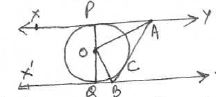
In simple words: The lines from the center to the tangent points split the angles at the center into two equal pairs. Since all these angles together make a straight line of \( 180^\circ \), the two middle angles must add up to exactly half of that, which is \( 90^\circ \).
Exam Tip: Showing the SSS congruence of the two pairs of triangles is crucial to get full marks on this classical circle theorem question.
Question 35. A triangle ABC is drawn to circumscribe a circle of radius 4 cm such that the segments BD and DC into which BC is divided by the point of contact D are of length 8 cm and 6 cm respectively. (see Fig.4). Find the sides AB and AC.
Answer:
Let the circle with center \( O \) touch the sides \( AB \) and \( AC \) of the triangle at points \( E \) and \( F \) respectively.
We know that the lengths of tangents drawn from an external point to a circle are equal. Therefore:
- \( AE = AF = x \) cm (tangents from \( A \))
- \( BE = BD = 8 \) cm (tangents from \( B \))
- \( CF = CD = 6 \) cm (tangents from \( C \))
Thus, the three sides of \( \Delta ABC \) can be written as:
- \( a = BC = BD + CD = 8 + 6 = 14 \) cm
- \( b = AC = AF + CF = (x + 6) \) cm
- \( c = AB = AE + BE = (x + 8) \) cm
The semi-perimeter \( s \) of \( \Delta ABC \) is:
\[ s = \frac{a + b + c}{2} = \frac{14 + (x + 6) + (x + 8)}{2} = \frac{2x + 28}{2} = (x + 14) \text{ cm} \]
Now, let us find the area of \( \Delta ABC \) using Heron's Formula:
\[ \text{Area} = \sqrt{s(s - a)(s - b)(s - c)} \]
Here:
- \( s - a = (x + 14) - 14 = x \)
- \( s - b = (x + 14) - (x + 6) = 8 \)
- \( s - c = (x + 14) - (x + 8) = 6 \)
Substituting these into the formula:
\[ \text{Area} = \sqrt{(x + 14)(x)(8)(6)} = \sqrt{48x(x + 14)} \quad \text{--- (Equation 1)} \]
Alternatively, we can express the total area of \( \Delta ABC \) as the sum of the areas of three smaller triangles, namely \( \Delta OBC \text{, } \Delta OCA \text{, and } \Delta OAB \):
\[ \text{Area}(\Delta ABC) = \text{Area}(\Delta OBC) + \text{Area}(\Delta OCA) + \text{Area}(\Delta OAB) \]
Since the radius (height of each small triangle) is \( 4 \) cm:
\[ \text{Area}(\Delta ABC) = \left( \frac{1}{2} \times 14 \times 4 \right) + \left( \frac{1}{2} \times (x + 6) \times 4 \right) + \left( \frac{1}{2} \times (x + 8) \times 4 \right) \]
This simplifies to:
\[ \text{Area}(\Delta ABC) = 28 + 2(x + 6) + 2(x + 8) \]
\[ \text{Area}(\Delta ABC) = 28 + 2x + 12 + 2x + 16 = 4x + 56 = 4(x + 14) \quad \text{--- (Equation 2)} \]
Equating Equation 1 and Equation 2:
\[ \sqrt{48x(x + 14)} = 4(x + 14) \]
Squaring both sides of the equation:
\[ 48x(x + 14) = 16(x + 14)^2 \]
Since \( x + 14 \neq 0 \), we can divide both sides by \( 16(x + 14) \):
\[ 3x = x + 14 \]
\[ 2x = 14 \]
\[ x = 7 \]
Thus, the lengths of the sides of the triangle are:
- \( AB = x + 8 = 7 + 8 = 15 \) cm
- \( AC = x + 6 = 7 + 6 = 13 \) cm
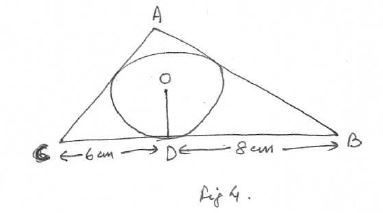
In simple words: The sides of the triangle are split by the circle into tangent sections. We write the unknown side length as \( x \), find the area using both Heron's formula and by splitting the triangle into three smaller ones, and then solve for \( x \) to find that the sides are 15 cm and 13 cm.
Exam Tip: Be sure to write both expressions for the area (Heron's and the sum of three triangle areas) clearly, as equating them is the primary step that allows you to solve for the unknown variable.
Question 36. A round table cover has six equal designs as shown in figure on the side (shaded one). If the radius of the cover is 28 cm, find the cost of making the design at the rate of Rs. 0.35 per cm2 (Use \( \sqrt{3} = 1.7 \) ).
Answer:
The round table cover has a circular shape with six equal shaded designs. These designs are formed by segments of the circle outside an inscribed regular hexagon.
Given:
- Radius of the circle, \( r = 28 \) cm
- Rate of making the design = Rs. 0.35 per cm2
- Value of \( \sqrt{3} = 1.7 \)
The central angle for each of the six equal sectors is:
\[ \theta = \frac{360^\circ}{6} = 60^\circ \]
For each sector, the radii and the chord form an equilateral triangle because the central angle is \( 60^\circ \) and the two containing sides are equal to the radius \( r \).
The area of one segment (one design) is:
\[ \text{Area of one design} = \text{Area of sector} - \text{Area of equilateral triangle} \]
\[ \text{Area of one design} = \left( \frac{\theta}{360^\circ} \times \pi r^2 \right) - \left( \frac{\sqrt{3}}{4} r^2 \right) \]
Since there are six identical designs, the total area of the six designs is:
\[ \text{Total Area} = 6 \times \left( \text{Area of sector} - \text{Area of equilateral triangle} \right) \]
\[ \text{Total Area} = 6 \times \left( \frac{60^\circ}{360^\circ} \times \pi r^2 \right) - 6 \times \left( \frac{\sqrt{3}}{4} r^2 \right) \]
\[ \text{Total Area} = \left( 6 \times \frac{1}{6} \times \pi r^2 \right) - \left( \frac{6 \sqrt{3}}{4} r^2 \right) \]
\[ \text{Total Area} = \pi r^2 - \frac{3 \sqrt{3}}{2} r^2 \]
\[ \text{Total Area} = r^2 \left( \pi - \frac{3 \sqrt{3}}{2} \right) \]
Now, let us substitute \( r = 28 \), \( \pi = \frac{22}{7} \), and \( \sqrt{3} = 1.7 \):
\[ \text{Total Area} = (28)^2 \left( \frac{22}{7} - \frac{3 \times 1.7}{2} \right) \]
\[ \text{Total Area} = 784 \left( \frac{22}{7} - \frac{5.1}{2} \right) \]
Distributing \( 784 \) inside the parentheses:
\[ \text{Total Area} = \left( 784 \times \frac{22}{7} \right) - \left( 784 \times \frac{5.1}{2} \right) \]
\[ \text{Total Area} = (112 \times 22) - (392 \times 5.1) \]
\[ \text{Total Area} = 2464 - 1999.2 \]
\[ \text{Total Area} = 464.8 \text{ cm}^2 \]
Now, let us calculate the total cost of making the design:
\[ \text{Total Cost} = \text{Total Area} \times \text{Rate} \]
\[ \text{Total Cost} = 464.8 \times 0.35 \]
\[ \text{Total Cost} = \text{Rs. } 162.68 \]
Consequently, the total cost of making the design is Rs. 162.68.
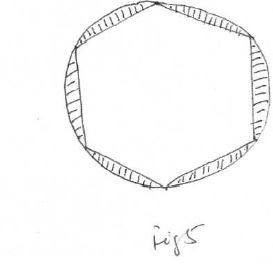
In simple words: The six designs are segment areas of the circle. By calculating the total area of the circle and subtracting the area of the central regular hexagon, we find the shaded design area is 464.8 cm2, which costs Rs. 162.68 to make at Rs. 0.35 per cm2.
Exam Tip: Expanding the formula before substituting values helps simplify the calculation immensely, as the fraction in the sector area cancels out with the coefficient 6.
Question 37. Two circles touch each other externally and the sum of their areas is \( 52\pi\text{ cm}^2 \). If the distance between the centres of two circles is 10 cm, find the radii of the two circles.
Answer:
We can denote the radii of the two circles as \( r_1 \) and \( r_2 \).
When two circles touch externally, the distance separating their center points is the sum of their radii:
\( r_1 + r_2 = 10\text{ cm} \) - (1)
We are given that the sum of their areas is \( 52\pi\text{ cm}^2 \):
\( \pi r_1^2 + \pi r_2^2 = 52\pi \)
\( \implies r_1^2 + r_2^2 = 52 \) - (2)
Using the first relation, we can write \( r_2 = 10 - r_1 \). Substituting this expression into equation (2) gives:
\( r_1^2 + (10 - r_1)^2 = 52 \)
\( \implies r_1^2 + 100 - 20r_1 + r_1^2 = 52 \)
\( \implies 2r_1^2 - 20r_1 + 48 = 0 \)
\( \implies r_1^2 - 10r_1 + 24 = 0 \)
\( \implies (r_1 - 6)(r_1 - 4) = 0 \)
This yields \( r_1 = 6 \) or \( r_1 = 4 \).
Consequently, if one radius is 6 cm, the other must be 4 cm.
The radii of the two circles are therefore 6 cm and 4 cm.
In simple words: When two circles touch outside, the line connecting their centers is just their two radii added together, which is 10 cm. By using the total area to find another relation, we solve a simple math equation to find that the radii must be 6 cm and 4 cm.
Exam Tip: Remember that for externally touching circles, the distance between centers is \( r_1 + r_2 \), whereas for internally touching circles, it is \( |r_1 - r_2| \). Writing down this initial relationship clearly earns you key step marks.
Question 38. Find the area of the shaded region in the figure on the side where ABCD is a square of side 14 cm (Use \( \pi = \frac{22}{7} \)).
Answer:
Let us consider the square \( ABCD \) with a side length of \( 14\text{ cm} \).
The four identical circles are arranged in a balanced two-by-two layout.
Therefore, the diameter of any single circle is half of the square's side:
\( d = \frac{14}{2} = 7\text{ cm} \)
This gives the radius \( r \) for each circle as:
\( r = 3.5\text{ cm} \)
The total space occupied by the square is:
\( \text{Area of Square } ABCD = 14 \times 14 = 196\text{ cm}^2 \)
The space enclosed by a single circle can be found using the formula:
\( \text{Area of one circle} = \pi r^2 = \frac{22}{7} \times 3.5 \times 3.5 = 38.5\text{ cm}^2 \)
Consequently, the cumulative area of all four circles is:
\( \text{Combined Area of 4 circles} = 4 \times 38.5 = 154\text{ cm}^2 \)
To find the area of the shaded part, we subtract this combined circle area from the square's total area:
\( \text{Area of shaded region} = 196 - 154 = 42\text{ cm}^2 \)
Thus, the shaded region has an area of \( 42\text{ cm}^2 \).
In simple words: To find the shaded area, we first find the area of the whole square, which is 196 square centimeters. Then, we find the area of the four circles inside, which is 154 square centimeters. Subtracting the circles from the square leaves us with 42 square centimeters of shaded area.
Exam Tip: Be careful with the diameter of the circles. Since two circles fit along one side of the square, each diameter is half the square's side, not the full side. Labeling this relationship clearly in your steps ensures full marks.
Question 39. In the given figure, from each corner of a square ABCD, of side 4 cm, quadrant of a circle of radius 1 cm each is cut and a circle of radius 1 cm is cut from the centre. Find the area of the shaded region.
Answer:
We are provided with the following measurements:
- The side length of the square \( ABCD \) is \( 4\text{ cm} \).
- The radius of each corner quadrant is \( 1\text{ cm} \).
- The radius of the middle circle is \( 1\text{ cm} \).
To begin, we calculate the entire area of the square:
\( \text{Area of the square} = 4\text{ cm} \times 4\text{ cm} = 16\text{ cm}^2 \)
Then, we find the combined area of the four corner quadrants:
Because four quadrants of identical radii combine to form a single circle, their total area is:
\( \text{Combined area of quadrants} = \pi \times (1)^2 = \pi\text{ cm}^2 \)
Next, the space occupied by the central circle is:
\( \text{Area of central circle} = \pi \times (1)^2 = \pi\text{ cm}^2 \)
Summing these removed parts, the total area of the cutouts is:
\( \text{Total removed area} = \pi + \pi = 2\pi\text{ cm}^2 \)
Substituting the value \( \pi = \frac{22}{7} \):
\( \text{Total removed area} = 2 \times \frac{22}{7} = \frac{44}{7}\text{ cm}^2 \)
We obtain the area of the remaining shaded portion by subtracting the cutout area from the square's total area:
\( \text{Shaded area} = 16 - \frac{44}{7} \)
\( = \frac{112 - 44}{7} \)
\( \implies \text{Shaded area} = \frac{68}{7}\text{ cm}^2 \approx 9.71\text{ cm}^2 \)
So, the area of the shaded region is \( \frac{68}{7}\text{ cm}^2 \) or \( 9.71\text{ cm}^2 \).
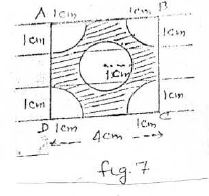
In simple words: First, we find the total area of the square, which is 16 square centimeters. Then, we add up the areas of the cutouts: four corner quarters make one circle, and there is another circle in the middle. Subtracting these two circles from the square leaves us with about 9.71 square centimeters of shaded area.
Exam Tip: Always state clearly that four quadrants of radius \( r \) combine to equal the area of one full circle of radius \( r \). This shortcut simplifies your calculations and shows the evaluator that you understand the geometry of a circle.
Question 40. Find the area of the shaded region which contains two semi-circles and a rectangle of breadth 1 cm.
Answer:
According to the diagram, the shaded zone is made up of:
1. A standing rectangle that has a width of \( 1\text{ cm} \) and a height of \( 12\text{ cm} \).
2. A pair of identical semi-circles joined to the edge of the rectangle.
We can compute the area of each part as follows:
1. Space occupied by the Rectangle:
The measurements of this rectangular portion are:
- Height \( (h) = 12\text{ cm} \)
- Width \( (b) = 1\text{ cm} \)
\( \text{Rectangle Area} = \text{height} \times \text{width} = 12\text{ cm} \times 1\text{ cm} = 12\text{ cm}^2 \)
2. Space occupied by the Two Semi-circles:
Both semi-circles together span a vertical height of \( 12\text{ cm} \).
As they are equal in size, the diameter of one semi-circle is:
\( d = \frac{12}{2} = 6\text{ cm} \)
Consequently, the radius \( r \) of each semi-circle is:
\( r = 3\text{ cm} \)
Combining two semi-circles of identical radii yields the area of one full circle:
\( \text{Combined Area of Semi-circles} = \pi r^2 \)
\( \implies \text{Combined Area of Semi-circles} = \pi \times 3^2 = 9\pi\text{ cm}^2 \)
Substituting \( \pi = \frac{22}{7} \):
\( \text{Combined Area of Semi-circles} = 9 \times \frac{22}{7} = \frac{198}{7}\text{ cm}^2 \approx 28.29\text{ cm}^2 \)
3. Entire Area of the Shaded Zone:
\( \text{Total Shaded Area} = \text{Rectangle Area} + \text{Combined Area of Semi-circles} \)
\( = 12 + 28.29 = 40.29\text{ cm}^2 \)
Therefore, the area of the shaded region is \( \frac{282}{7}\text{ cm}^2 \) or approximately \( 40.29\text{ cm}^2 \).
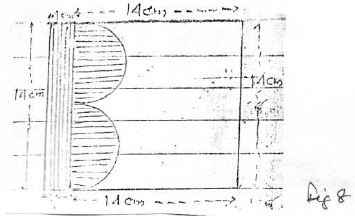
In simple words: The shaded shape looks like a letter "B". It is made of a vertical strip and two half-circles. The vertical strip has an area of 12 square centimeters, and the two half-circles together make one full circle of radius 3, which has an area of about 28.29 square centimeters. Adding them together gives about 40.29 square centimeters.
Exam Tip: Be sure to state that the two semi-circles form one complete circle. Doing so simplifies the formula to \( \pi r^2 \) and prevents potential rounding errors from calculating each semi-circle separately.
Question 41. A metallic cylinder has a radius 3 cm and height 5 cm. It is made of metal A. To reduce its weight a conical hole is drilled in the cylinder (as shown in the figure) and it is completely filled with a lighter metal B. The conical hole has a radius of 3/2 cm and its depth is 8/9 cm. Calculate the ratio of the volume of the metal A to the volume of metal B in the solid.
Answer:
Let us define the initial solid cylinder as being made of metal A, with the conical hole being filled by metal B.
1. Finding the volume of the original cylinder:
- Radius of this cylinder \( R = 3\text{ cm} \)
- Height of this cylinder \( H = 5\text{ cm} \)
Using the cylinder volume formula:
\( \text{Cylinder Volume} = \pi R^2 H = \pi \times (3)^2 \times 5 = 45\pi\text{ cm}^3 \)
2. Finding the volume of the conical insert (metal B):
- Radius of this cone \( r = \frac{3}{2}\text{ cm} \)
- Depth of this cone \( h = \frac{8}{9}\text{ cm} \)
Using the cone volume formula:
\( \text{Volume of Cone } (V_B) = \frac{1}{3} \pi r^2 h \)
\( \implies V_B = \frac{1}{3} \pi \times \left( \frac{3}{2} \right)^2 \times \frac{8}{9} \)
\( \implies V_B = \frac{1}{3} \pi \times \frac{9}{4} \times \frac{8}{9} \)
\( \implies V_B = \frac{2}{3}\pi\text{ cm}^3 \)
This means the space occupied by metal B inside the solid is:
\( V_B = \frac{2}{3}\pi\text{ cm}^3 \)
3. Finding the remaining volume of metal A:
Since the cone is hollowed out of the cylinder, the remaining amount of metal A is:
\( V_A = \text{Cylinder Volume} - \text{Cone Volume} \)
\( \implies V_A = 45\pi - \frac{2}{3}\pi = \left( \frac{135 - 2}{3} \right)\pi = \frac{133}{3}\pi\text{ cm}^3 \)
4. Calculating the ratio of metal A's volume to metal B's volume:
\( \text{Required Ratio} = \frac{V_A}{V_B} = \frac{\frac{133}{3}\pi}{\frac{2}{3}\pi} = \frac{133}{2} \)
Hence, the ratio of the volume of metal A to the volume of metal B in the solid is \( 133 : 2 \).
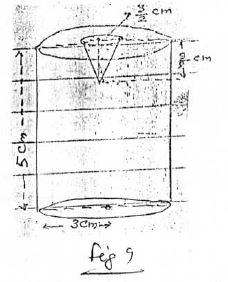
In simple words: To find the ratio, we calculate the volume of the whole cylinder first (45 pi) and then the volume of the conical hole (2/3 pi). Since the cone is filled with metal B, metal B's volume is 2/3 pi, and the remaining metal A is 133/3 pi. Dividing these two volumes gives a clean ratio of 133 to 2.
Exam Tip: Keep the calculations in terms of \( \pi \) until the very end. The \( \pi \) will cancel out beautifully in the ratio, saving you from dealing with complex decimals and preventing potential rounding mistakes.
Question 42. Two spheres of the same metal weigh 1 kg and 7 kg. The radius of the smaller sphere is 3 cm. The two spheres are melted to form a single big sphere. Find the diameter of the bigger sphere.
Answer:
Since both spheres are made of the same metal, their density remains identical.
Weight \( (W) \) of a sphere is directly proportional to its volume \( (V) \):
\( W \propto V \)
The volume of a sphere of radius \( r \) is \( V = \frac{4}{3}\pi r^3 \), which means:
\( V \propto r^3 \implies W \propto r^3 \)
Let \( W_1 \) and \( r_1 \) be the weight and radius of the smaller sphere, and \( W_{\text{big}} \) and \( r_{\text{big}} \) be the weight and radius of the newly formed big sphere.
We are given:
- Weight of the smaller sphere, \( W_1 = 1\text{ kg} \)
- Radius of the smaller sphere, \( r_1 = 3\text{ cm} \)
- Weight of the second sphere, \( W_2 = 7\text{ kg} \)
When these two spheres are melted down and combined into a single large sphere, the total weight of this new sphere is:
\( W_{\text{big}} = W_1 + W_2 = 1\text{ kg} + 7\text{ kg} = 8\text{ kg} \)
Using the proportionality relation:
\( \frac{W_{\text{big}}}{W_1} = \left( \frac{r_{\text{big}}}{r_1} \right)^3 \)
Substitute the known values:
\( \frac{8}{1} = \left( \frac{r_{\text{big}}}{3} \right)^3 \)
Take the cube root of both sides of the equation:
\( 2 = \frac{r_{\text{big}}}{3} \)
\( \implies r_{\text{big}} = 6\text{ cm} \)
The radius of the combined big sphere is \( 6\text{ cm} \).
The diameter \( D \) of this bigger sphere is:
\( D = 2 \times r_{\text{big}} = 2 \times 6 = 12\text{ cm} \)
Thus, the diameter of the bigger sphere is \( 12\text{ cm} \).
In simple words: Since the spheres are made of the same metal, their weight depends directly on their size (volume). Melting a 1 kg sphere and a 7 kg sphere together gives us an 8 kg sphere. Because weight is proportional to the cube of the radius, an 8-times heavier sphere has twice the radius, which is 6 cm, making its diameter 12 cm.
Exam Tip: Don't waste time calculating the radius of the 7 kg sphere (which is a non-integer cube root). Instead, work with the total combined weight of 8 kg, which has a perfect integer cube root, to solve the problem quickly and cleanly.
Question 43. A spherical copper shell of external diameter 18 cm is melted and recast into a solid cone of base radius 14 cm and height \( 4 \frac{3}{7} \) cm. Find the inner diameter of the shell.
Answer:
Let us represent the outer radius of the hollow spherical shell as \( R \) and its inner radius as \( r \).
The given dimensions are:
- The shell's outer diameter is \( 18\text{ cm} \).
- This means the outer radius \( R = \frac{18}{2} = 9\text{ cm} \).
- The base radius of the resulting cone \( (R_c) = 14\text{ cm} \).
- The height of the cone \( (h) = 4\frac{3}{7}\text{ cm} = \frac{31}{7}\text{ cm} \).
First, we determine the volume of the recast cone:
\( V_{\text{cone}} = \frac{1}{3} \pi R_c^2 h \)
\( \implies V_{\text{cone}} = \frac{1}{3} \pi \times (14)^2 \times \frac{31}{7} \)
\( \implies V_{\text{cone}} = \frac{1}{3} \pi \times 196 \times \frac{31}{7} \)
\( \implies V_{\text{cone}} = \frac{868}{3} \pi\text{ cm}^3 \)
Now, the volume of metal in the hollow sphere is:
\( V_{\text{shell}} = \frac{4}{3} \pi (R^3 - r^3) \)
\( \implies V_{\text{shell}} = \frac{4}{3} \pi (9^3 - r^3) \)
\( \implies V_{\text{shell}} = \frac{4}{3} \pi (729 - r^3)\text{ cm}^3 \)
Because the shell is completely melted to construct this solid cone, the two volumes must match:
\( V_{\text{shell}} = V_{\text{cone}} \)
\( \implies \frac{4}{3} \pi (729 - r^3) = \frac{868}{3} \pi \)
By simplifying and canceling the common factor \( \frac{\pi}{3} \) on both sides:
\( \implies 4(729 - r^3) = 868 \)
Dividing both sides by 4 yields:
\( \implies 729 - r^3 = 217 \)
Isolating \( r^3 \) gives:
\( \implies r^3 = 729 - 217 \)
\( \implies r^3 = 512 \)
Taking the cube root of both sides, we find:
\( \implies r = 8\text{ cm} \)
Since the internal radius is \( 8\text{ cm} \), the inner diameter is:
\( \text{Inner diameter} = 2 \times 8 = 16\text{ cm} \)
The inner diameter of the shell is \( 16\text{ cm} \).
In simple words: When the hollow spherical shell is melted into a solid cone, the volume of metal remains the same. We compute the volume of the cone using its dimensions and find it equals the outer sphere's volume minus the inner empty space's volume. Solving this tells us the inner radius is 8 cm, which means the inner diameter is 16 cm.
Exam Tip: Pay close attention to whether the question asks for the "radius" or "diameter". Students often lose a mark by leaving the final answer as the radius (8 cm) instead of doubling it to find the diameter (16 cm).
Question 44. A pen stand made of wood is in the shape of a cuboid with four conical depressions to hold pens. The dimensions of the cuboid are 15 cm X 10 cm X 3.5 cm. The radius of each of the depressions is 0.5 cm and the depth is 1.4 cm. Find the volume of wood in the entire stand.
Answer:
To find the volume of wood left in the pen stand, we subtract the space carved out by the four conical pen holders from the total volume of the wooden block.
1. Calculation of the block's cuboidal volume:
- Length \( (l) = 15\text{ cm} \)
- Breadth \( (b) = 10\text{ cm} \)
- Height \( (h) = 3.5\text{ cm} \)
Using the volume formula for a cuboid:
\( \text{Volume of Cuboid} = 15 \times 10 \times 3.5 = 525\text{ cm}^3 \)
2. Calculation of a single conical depression's volume:
- Radius of the cone \( (r) = 0.5\text{ cm} \)
- Depth of the cone \( (d) = 1.4\text{ cm} \)
Using the cone volume formula:
\( \text{Volume of 1 Cone} = \frac{1}{3} \pi r^2 d \)
\( \implies \text{Volume of 1 Cone} = \frac{1}{3} \times \frac{22}{7} \times (0.5)^2 \times 1.4 \)
\( \implies \text{Volume of 1 Cone} = \frac{11}{30}\text{ cm}^3 \approx 0.37\text{ cm}^3 \)
3. Total volume of all four cone-shaped holes:
\( \text{Total volume of 4 cones} = 4 \times \frac{11}{30} = \frac{22}{15}\text{ cm}^3 \approx 1.47\text{ cm}^3 \)
4. Net volume of the wooden pen stand:
\( \text{Net Wooden Volume} = 525 - 1.47 = 523.53\text{ cm}^3 \)
Consequently, the volume of wood remaining in the pen stand is \( 523.53\text{ cm}^3 \).
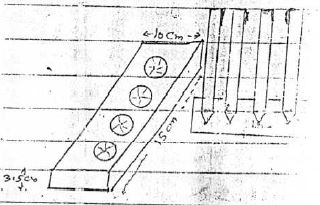
In simple words: The wooden block starts as a solid cuboid of 525 cubic centimeters. Four cone-shaped holes are drilled into it to hold the pens. Since each hole takes up about 0.37 cubic centimeters, we subtract the total hole space (1.47 cubic centimeters) to get 523.53 cubic centimeters of wood.
Exam Tip: Be precise with the decimal calculations for the cones. Rounding too early (e.g., using 0.4 for each cone instead of 11/30) can lead to a slightly different final answer, so carry your fractions until the final subtraction step.
Question 45. A vessel is in the form of an inverted cone. Its height is 8 cm and radius of its top, which is open, is 5 cm. It is filled with water upto the brim. When lead shots, each of which is a sphere of radius 0.5 cm, are dropped into the vessel, one-fourth of the water flows out. Find the number of lead shots dropped.
Answer:
Let us denote the count of spherical lead shots placed into the water-filled vessel as \( n \).
1. Computing the initial volume of water in the conical vessel:
- Radius of the vessel's top opening \( R = 5\text{ cm} \)
- Height of the vessel \( H = 8\text{ cm} \)
Using the formula for a cone's volume:
\( V_{\text{cone}} = \frac{1}{3} \pi R^2 H \)
\( \implies V_{\text{cone}} = \frac{1}{3} \pi \times 5^2 \times 8 = \frac{200}{3}\pi\text{ cm}^3 \)
2. Computing the volume of the displaced water:
The problem states that a quarter of the total water spills out:
\( V_{\text{spilled}} = \frac{1}{4} \times \frac{200}{3}\pi = \frac{50}{3}\pi\text{ cm}^3 \)
3. Computing the volume of a single spherical shot:
- Radius of each lead sphere \( r = 0.5\text{ cm} = \frac{1}{2}\text{ cm} \)
Using the volume formula for a sphere:
\( V_{\text{shot}} = \frac{4}{3} \pi r^3 \)
\( \implies V_{\text{shot}} = \frac{4}{3} \pi \times \left( \frac{1}{2} \right)^3 = \frac{1}{6}\pi\text{ cm}^3 \)
4. Determining the quantity of lead shots:
The total volume of the dropped spheres must equal the amount of water that spilled over:
\( n \times V_{\text{shot}} = V_{\text{spilled}} \)
\( \implies n \times \frac{1}{6}\pi = \frac{50}{3}\pi \)
Canceling \( \pi \) on both sides:
\( \implies \frac{n}{6} = \frac{50}{3} \)
\( \implies n = \frac{50 \times 6}{3} = 100 \)
Thus, the number of lead shots dropped into the vessel is 100.
In simple words: The water-filled cone has a certain volume, and when we drop the metal spheres in, they push out a quarter of that water. By equating the total volume of the spheres to the volume of the spilled water, we find that we need exactly 100 spheres to displace that much water.
Exam Tip: Never convert \( \pi \) to decimals like 3.14 or 22/7 mid-way through. Keeping the expressions in terms of \( \pi \) allows it to cancel out completely in the final equation, saving time and keeping your calculations clean.
Question 46. A container, shaped like a circular cylinder having diameter 12 cm and height 15 cm is full of ice-cream. The ice-cream is to be filled in cones of height 6 cm and diameter 3 cm having a hemispherical shape on the top of the same radius of base as that of cone. Find the number of such cones that can be filled with ice-cream.
Answer:
Let us assume the total number of ice-cream cones that can be filled is \( n \).
1. Finding the volume of the cylindrical container:
- The cylinder's diameter is \( 12\text{ cm} \), which gives a radius \( R = 6\text{ cm} \).
- The cylinder's height is \( H = 15\text{ cm} \).
Using the formula for cylinder volume:
\( V_{\text{cylinder}} = \pi R^2 H \)
\( \implies V_{\text{cylinder}} = \pi \times (6)^2 \times 15 = 540\pi\text{ cm}^3 \)
2. Finding the volume of a single ice-cream cone (conical base + hemispherical scoop):
- The diameter of both parts is \( 3\text{ cm} \), which gives a radius \( r = 1.5\text{ cm} = \frac{3}{2}\text{ cm} \).
- The height of the conical section is \( h = 6\text{ cm} \).
The total volume of one ice-cream unit is:
\( V_{\text{one}} = \text{Volume of Cone} + \text{Volume of Hemisphere} \)
\( V_{\text{one}} = \frac{1}{3}\pi r^2 h + \frac{2}{3}\pi r^3 \)
\( \implies V_{\text{one}} = \frac{1}{3}\pi \left(\frac{3}{2}\right)^2 (6) + \frac{2}{3}\pi \left(\frac{3}{2}\right)^3 \)
\( \implies V_{\text{one}} = \frac{9}{2}\pi + \frac{9}{4}\pi = \frac{27}{4}\pi\text{ cm}^3 \)
3. Computing the number of cones \( n \):
\( n = \frac{\text{Volume of Cylinder}}{\text{Volume of one Ice-Cream Cone}} \)
\( \implies n = \frac{540\pi}{\frac{27}{4}\pi} \)
\( \implies n = \frac{540 \times 4}{27} = 20 \times 4 = 80 \)
Hence, exactly 80 cones can be filled using the ice-cream from the container.
In simple words: The big cylindrical container holds 540 pi cubic centimeters of ice-cream. Each cone has a pointed bottom and a rounded dome on top, taking up 27/4 pi cubic centimeters in total. Dividing the total ice-cream volume by the volume of one cone shows we can fill exactly 80 cones.
Exam Tip: Be careful with the diameter measurements given in the problem. Always convert diameter to radius immediately before plugging values into the volume formulas, as using diameters instead of radii is the most common error in combination-of-solids questions.
Question 47. A container, open at the top and made of metal sheet, is in the form of a frustum of a cone of height 16 cm with radii of its lower and upper ends as 8 cm and 20 cm respectively. Find the cost of milk which can completely fill the container, at the rate of Rs. 20 per litre. Also, find the cost of metal sheet used to make the container, if it costs Rs. 8 per 100 cm^2. (Use \( \pi = 3.14 \))
Answer:
1. Finding the volume (capacity) of the container:
The open container represents a cone's frustum with:
- Height \( h = 16\text{ cm} \)
- Bigger radius \( r_1 = 20\text{ cm} \)
- Smaller radius \( r_2 = 8\text{ cm} \)
We determine its capacity using the frustum volume formula:
\( V = \frac{1}{3}\pi h (r_1^2 + r_2^2 + r_1 r_2) \)
\( \implies V = \frac{1}{3} \times 3.14 \times 16 \times (20^2 + 8^2 + 20 \times 8) \)
\( \implies V = \frac{1}{3} \times 3.14 \times 16 \times (400 + 64 + 160) \)
\( \implies V = \frac{1}{3} \times 3.14 \times 16 \times 624 \)
\( \implies V = 3.14 \times 16 \times 208 = 10449.92\text{ cm}^3 \)
To express this capacity in litres, we divide by 1000:
\( \text{Volume in litres} = \frac{10449.92}{1000} \approx 10.45\text{ litres} \)
Given that milk is priced at Rs. 20 per litre, the total milk cost is:
\( \text{Cost of milk} = 10.45 \times 20 = \text{Rs. } 209 \)
---
2. Calculating the cost of the metallic sheet:
As there is no top cover, the metallic sheet is only used for the side walls and the bottom circular plate:
\( \text{Sheet Area } (A) = \pi (r_1 + r_2)l + \pi r_2^2 \)
First, we must calculate the frustum's slant height \( l \):
\( l = \sqrt{h^2 + (r_1 - r_2)^2} \)
\( \implies l = \sqrt{16^2 + (20 - 8)^2} = \sqrt{256 + 144} = \sqrt{400} = 20\text{ cm} \)
Next, we evaluate the total sheet area \( A \):
\( A = \pi (r_1 + r_2)l + \pi r_2^2 \)
\( \implies A = 3.14 \times (20 + 8) \times 20 + 3.14 \times 8^2 \)
\( \implies A = 3.14 \times 28 \times 20 + 3.14 \times 64 \)
\( \implies A = 3.14 \times 560 + 3.14 \times 64 \)
\( \implies A = 3.14 \times 624 = 1959.36\text{ cm}^2 \)
Since the metal sheet costs Rs. 8 for every \( 100\text{ cm}^2 \), we compute the final expense:
\( \text{Cost of metal sheet} = 1959.36 \times \frac{8}{100} = \text{Rs. } 156.75 \)
Final Solutions:
- The total milk cost is Rs. 209.
- The total metal sheet cost is Rs. 156.75.
In simple words: First, we find the volume of the bucket, which is about 10.45 liters, and multiply it by Rs. 20 to find the milk cost (Rs. 209). Then, we calculate the surface area of the bucket's sides and bottom to find how much metal is used, which costs Rs. 156.75 at Rs. 8 per 100 square centimeters.
Exam Tip: For open-topped containers, always remember to add the area of the base (\( \pi r_2^2 \)) to the curved surface area, but do *not* add the top area. Forgetting the base or mistakenly adding the top are the most common ways students lose marks on this topic.
Question 48. A metallic right circular cone 20 cm high and whose vertical angle is 60° is cut into two parts at the middle of its height by a plane parallel to the base. If the frustum so obtained is melted and drawn into a wire of diameter 1 cm, find the length of the wire.
Answer:
Let us analyze the dimensions of the right circular cone and the resulting frustum:
- The total height of the cone is \( H = 20\text{ cm} \).
- The cone is sliced parallel to its base at exactly half its height, which gives a frustum with height \( h = 10\text{ cm} \).
- The cone's vertical angle is \( 60^\circ \), meaning the semi-vertical angle is \( \theta = 30^\circ \).
In the right triangles representing the upper section and the entire cone, we can find the top and bottom radii \( r_1 \) and \( r_2 \) of the frustum using trigonometry:
\( \tan 30^\circ = \frac{r_1}{10} \implies r_1 = 10 \tan 30^\circ = \frac{10}{\sqrt{3}}\text{ cm} \)
\( \tan 30^\circ = \frac{r_2}{20} \implies r_2 = 20 \tan 30^\circ = \frac{20}{\sqrt{3}}\text{ cm} \)
We calculate the volume of this frustum as:
\( V = \frac{1}{3}\pi h (r_1^2 + r_2^2 + r_1 r_2) \)
\( V = \frac{1}{3}\pi \times 10 \times \left( \left(\frac{10}{\sqrt{3}}\right)^2 + \left(\frac{20}{\sqrt{3}}\right)^2 + \left(\frac{10}{\sqrt{3}}\right)\left(\frac{20}{\sqrt{3}}\right) \right) \)
\( V = \frac{10}{3}\pi \left( \frac{100}{3} + \frac{400}{3} + \frac{200}{3} \right) \)
\( V = \frac{10}{3}\pi \left( \frac{700}{3} \right) = \frac{7000}{9}\pi\text{ cm}^3 \)
Since this frustum is melted and reshaped into a cylindrical wire with a diameter of \( 1\text{ cm} \):
- The wire's radius is \( r_{\text{wire}} = \frac{1}{2}\text{ cm} \).
- Let the length of the wire be \( L \).
The volume of the cylindrical wire is:
\( V_{\text{wire}} = \pi r_{\text{wire}}^2 L = \pi \left(\frac{1}{2}\right)^2 L = \frac{\pi L}{4} \)
As the volume of metal remains unchanged during melting:
\( V_{\text{wire}} = V \)
\( \implies \frac{\pi L}{4} = \frac{7000}{9}\pi \)
Canceling \( \pi \) on both sides:
\( \implies \frac{L}{4} = \frac{7000}{9} \)
\( \implies L = \frac{28000}{9}\text{ cm} \approx 3111.11\text{ cm} \text{ (or } 31.11\text{ m)} \)
Thus, the length of the wire is \( \frac{28000}{9}\text{ cm} \) (approximately \( 31.11\text{ m} \)).
In simple words: A cone is sliced in half horizontally to make a bucket shape (frustum). Using trigonometry, we find its top and bottom radii, which helps us calculate its total volume as 7000/9 pi. Since this metal is melted into a wire of diameter 1 cm, we equate their volumes to find the wire must be about 31.11 meters long.
Exam Tip: Use the trigonometric ratio \( \tan 30^\circ = \frac{\text{Radius}}{\text{Height}} \) to find the radii of the frustum. Drawing a clear, labeled 2D cross-section of the cone and marking the angles is highly recommended to secure diagram and step marks.
Question 49. The median of the following data is 525. Find the values of x and y if the total frequency is 100:
| Classes | 0-100 | 100-200 | 200-300 | 300-400 | 400-500 | 500-600 | 600-700 | 700-800 | 800-900 | 900-1000 |
|---|---|---|---|---|---|---|---|---|---|---|
| Frequency | 2 | 5 | X | 12 | 17 | 20 | Y | 9 | 7 | 4 |
Answer:
We are given that the total frequency sum \( N = 100 \) and the median value is 525.
Step 1: Establish the frequency relation
According to the cumulative frequency column, the sum of all frequencies is:
\( 76 + x + y = 100 \)
\( \implies x + y = 24 \) - (1)
Step 2: Locate the median interval
The median of 525 lies within the class boundaries of 500 - 600.
Hence, our median class is 500 - 600.
From this interval, we extract the following terms:
- Lower boundary \( l = 500 \)
- Frequency of the median class \( f = 20 \)
- Cumulative frequency of the class before \( \text{cf} = 36 + x \)
- Interval span \( h = 100 \)
- Half of total frequency \( \frac{N}{2} = 50 \)
Below is the full table showing Cumulative Frequencies:
| Class Interval | Frequency (\( f \)) | Cumulative Frequency (\( \text{cf} \)) |
|---|---|---|
| 0 - 100 | 2 | 2 |
| 100 - 200 | 5 | 7 |
| 200 - 300 | x | 7 + x |
| 300 - 400 | 12 | 19 + x |
| 400 - 500 | 17 | 36 + x |
| 500 - 600 (Median Class) | 20 | 56 + x |
| 600 - 700 | y | 56 + x + y |
| 700 - 800 | 9 | 65 + x + y |
| 800 - 900 | 7 | 72 + x + y |
| 900 - 1000 | 4 | 76 + x + y |
| Total | N = 100 | - |
Step 3: Solve for the variable x
We apply the grouped data median formula:
\( \text{Median} = l + \left[ \frac{\frac{N}{2} - \text{cf}}{f} \right] \times h \)
Substituting our values into the formula:
\( 525 = 500 + \left[ \frac{50 - (36 + x)}{20} \right] \times 100 \)
Subtracting 500 from both sides:
\( \implies 25 = \left[ 14 - x \right] \times 5 \)
Dividing both sides by 5:
\( \implies 5 = 14 - x \)
\( \implies x = 9 \)
Step 4: Solve for the variable y
Plugging \( x = 9 \) back into equation (1):
\( 9 + y = 24 \)
\( \implies y = 15 \)
Thus, the required values are \( x = 9 \) and \( y = 15 \).
In simple words: Since the total frequency is 100, we add up all the numbers and find that the two missing frequencies, x and y, must add up to 24. Since the median is 525, we use the median class (500-600) formula to find that x is 9, which then tells us y must be 15.
Exam Tip: When substituting cumulative frequency (\( \text{cf} \)) into the median formula, always put it in parentheses: \( -(36 + x) \). A common mistake is to write \( -36 + x \) instead of \( -36 - x \), which leads to a sign error and a wrong final answer.
Question 50. During the medical check up of 35 students of a class, their weights were recorded as follows-
| Weight (in kg) | Number of students |
|---|---|
| Less than 38 | 0 |
| Less than 40 | 3 |
| Less than 42 | 5 |
| Less than 44 | 9 |
| Less than 46 | 14 |
| Less than 48 | 28 |
| Less than 50 | 32 |
| Less than 52 | 35 |
Draw a less than type ogive for the above data. Hence obtain the median weight from the graph and verify the result by using the formula.
Answer:
1. Plotting the Less Than Type Ogive:
To create the graph, we plot the upper bounds on the horizontal axis (x-axis) and the cumulative frequencies on the vertical axis (y-axis). We locate the following coordinate points:
- \( (38, 0) \)
- \( (40, 3) \)
- \( (42, 5) \)
- \( (44, 9) \)
- \( (46, 14) \)
- \( (48, 28) \)
- \( (50, 32) \)
- \( (52, 35) \)
Connecting these coordinates with a smooth continuous line gives us the 'less than' ogive.
2. Finding the Median through Graphical Analysis:
- Here, the total count of students is \( N = 35 \).
- Half of the total count is \( \frac{N}{2} = 17.5 \).
We find 17.5 on the cumulative frequency axis (y-axis) and draw a horizontal dashed line over to the plotted curve. From that meeting point, we trace a vertical line down to the weight axis (x-axis).
The intersection lands exactly at 46.5 kg.
Thus, the graphical median weight is 46.5 kg.
---
3. Formula-Based Verification:
First, we set up the frequency table to identify our intervals:
| Class Interval | Frequency (\( f \)) | Cumulative Frequency (\( \text{cf} \)) |
|---|---|---|
| 36 - 38 | 0 | 0 |
| 38 - 40 | 3 | 3 |
| 40 - 42 | 2 | 5 |
| 42 - 44 | 4 | 9 |
| 44 - 46 | 5 | 14 |
| 46 - 48 (Median Class) | 14 | 28 |
| 48 - 50 | 4 | 32 |
| 50 - 52 | 3 | 35 |
- Determining the Median Class:
As \( \frac{N}{2} = 17.5 \), the cumulative frequency that is just higher than 17.5 is 28. This value belongs to the class interval 46 - 48.
Consequently, the median class is 46 - 48.
From this class, we obtain the required values:
- Lower limit \( l = 46 \)
- Class frequency \( f = 14 \)
- Cumulative frequency of the preceding group \( \text{cf} = 14 \)
- Class width \( h = 2 \)
Now, we evaluate using the median formula:
\( \text{Median} = l + \left[ \frac{\frac{N}{2} - \text{cf}}{f} \right] \times h \)
\( \implies \text{Median} = 46 + \left[ \frac{17.5 - 14}{14} \right] \times 2 \)
\( \implies \text{Median} = 46 + \left[ \frac{3.5}{14} \right] \times 2 \)
\( \implies \text{Median} = 46 + 0.25 \times 2 \)
\( \implies \text{Median} = 46 + 0.5 = 46.5\text{ kg} \)
Both approaches produce the same value: 46.5 kg.
In simple words: We plot the weight points on a graph to draw a rising curve called an ogive. By finding the middle student (17.5 on the vertical axis) and drawing lines to the curve and down to the horizontal axis, we get a median weight of 46.5 kg. Calculating this with the textbook formula confirms this exact same weight.
Exam Tip: Always show the projection lines (horizontal line from \( N/2 = 17.5 \) to the curve and vertical line down to the x-axis) as dotted lines on your graph. Board examiners specifically look for these projection lines to award full marks for the graphical estimation.
Extra
Question 1. To find the percentage of students in a group of students who write faster with their left hand / right hand.
Answer: To carry out this activity, gather a group of students (such as 30 students) and ask each of them to write a standard sentence first with their right hand, and then with their left hand, timing both attempts. Record the time taken by each student for both hands. Identify who wrote faster with their left hand and who wrote faster with their right hand. Calculate the percentage of left-hand faster writers and right-hand faster writers using the formula: Percentage = (Number of students in category / Total number of students) * 100. For instance, if 3 out of 30 students write faster with their left hand, the percentage is (3/30) * 100 = 10%. Present the final data in a table and represent it using a bar chart.
In simple words: Measure how long it takes each student to write a sentence with both hands to find which hand is faster. Then, calculate what percentage of the group is faster with their left hand and what percentage is faster with their right hand.
Exam Tip: Ensure that the sentence used for testing is exactly the same for all students and both hands to keep the experiment fair. Always double-check your percentage calculations so they add up to 100%.
Question 2. To help the students establish interesting mathematical relationships by measuring some parts of the body.
Answer: Measuring different parts of the human body reveals fascinating mathematical ratios that are relatively constant across most individuals. To perform this, have students work in pairs to measure their height, arm span (fingertip to fingertip), hand span, and the length of their forearm (elbow to wrist). Record these measurements in centimeters. Students can then calculate ratios such as arm span divided by height, and forearm length divided by foot length. They will discover that the ratio of arm span to height is very close to 1:1, and forearm length is roughly equal to foot length.
In simple words: Measure different parts of your body, like your height and arm span. You will find cool patterns, such as your arm span being almost exactly equal to your height.
Exam Tip: When presenting body measurements, construct a neat scatter plot to visually show the linear relationship between height and arm span.
List of Projects Given as Sample
Question 1. Observing interesting patterns in cricket match. Comparison of the performance of two teams in a one-day international cricket match.
Answer: To compare the performance of two teams in an ODI, you can collect the over-by-over run scoring data for both sides. Calculate statistical parameters such as the mean run rate, median runs per over, and the standard deviation to measure scoring consistency. You can plot line graphs of the cumulative runs scored by each team against the number of overs to visually identify where one team accelerated or where wickets fell. Additionally, comparing the partnership averages and the boundary counts provides deep insights into how both teams structured their innings.
In simple words: Look at the runs scored over-by-over by both cricket teams in a match. Use graphs and averages to compare how they performed and see where the game was won or lost.
Exam Tip: When comparing two datasets like cricket scores, using cumulative line graphs on the same axes makes it very easy to compare the scoring rates of both teams at a glance.
Question 2. Design a crossword puzzle with mathematical terms. To review mathematics vocabulary, to give the opportunity for creative expressions in designing puzzles, to act as a means of monitoring the study of a given unit and to give recreation.
Answer: Creating a mathematical crossword puzzle involves selecting a specific chapter or topic, such as geometry or algebra, and listing key terms (like "hypotenuse", "coefficient", "quadratic", or "parallel"). Write clear, mathematically accurate clues for each term, specifying whether they are "Across" or "Down". Next, design a grid where these words intersect at common letters, filling in the unused squares with black. This puzzle serves as an enjoyable tool to test vocabulary and reinforce understanding of definitions in a creative layout.
In simple words: Choose important math words and write clues for them. Arrange the words in an intersecting grid with blank and filled spaces to make a crossword puzzle that helps test vocabulary.
Exam Tip: Ensure that every clue is mathematically precise and has only one unique correct word that fits perfectly in the grid length.
Question 3. A measuring task. To investigate your local athletics track to see whether it is marked fairly for runners who start on different lines.
Answer: In a standard athletics track, runners in outer lanes have to run a larger curve than those in the inner lanes. To make the race fair, the starting lines for the outer lanes are staggered forward. To investigate this, measure the radius of the innermost lane's curve and calculate its perimeter using the circumference formula \( 2 \pi r \). Then, measure the width of each lane to find the radius of the outer lanes. Calculate the circumference for each lane. The difference in circumference between consecutive lanes determines the required staggered distance, which should match the actual markings on the track.
In simple words: Measure the curves of the running track lanes to see if the staggered starting positions are correct. This ensures that every runner covers the exact same distance of 400 meters.
Exam Tip: Use the formula \( C = 2 \pi r \) for the semicircular parts of the track and show your calculations clearly to verify the stagger distance between the lanes.
Question 4. Project in history of mathematics
i. Study various aspects of Pythagoras theorem.
ii. Investigation of various historical aspects of number \( \pi \).
Answer:
i. Pythagoras theorem states that in a right-angled triangle, the square of the hypotenuse is equal to the sum of the squares of the other two sides (\( a^2 + b^2 = c^2 \)). Historically, this concept was known to ancient Babylonians, Indians (in the Sulba Sutras), and Chinese mathematicians long before Pythagoras. Studying its aspects involves exploring these ancient proofs, geometric dissections, and modern algebraic verifications.
ii. The history of the mathematical constant \( \pi \) (pi) spans thousands of years. Early civilizations like the Babylonians and Egyptians used rough approximations like 3 or 3.16. Archimedes of Syracuse was the first to use a rigorous geometric algorithm using circumscribed and inscribed polygons to bound \( \pi \) between \( 3 \frac{10}{71} \) and \( 3 \frac{1}{7} \). Later, Indian mathematicians like Madhava of Sangamagrama developed infinite series representations, leading to the highly precise calculations we have today.
In simple words: Explore how ancient cultures discovered the right-triangle rule and how the value of pi was calculated from early rough estimates to modern exact values.
Exam Tip: For historical projects, always cite key figures like Baudhayana for the Pythagoras theorem and Archimedes or Madhava for pi to score high marks.
Suggested List of Projects
Question P1. Cricket. Collect data on runs scored in each over for a one day international (ODI) cricket match and obtain frequency distribution between runs and overs. Do this for both the teams and also for the first 25 and the remaining overs of the match. Observe any interesting features of the match. Compare it with similar analysis for a few other ODI's.
Answer: To carry out this project, select a specific ODI match and record the runs scored in each of the 50 overs for both Team A and Team B. Group the runs into frequency intervals (such as 0-3, 4-7, 8-11, 12-15, and 16+ runs per over) to construct a frequency distribution table. Perform this grouping separately for the first 25 overs (initial phase) and the last 25 overs (death overs phase) - for both teams. Compare these distributions to observe features like scoring acceleration, wickets fallen, or maiden overs. Repeat this analysis for two other matches to see if similar patterns emerge, such as higher run frequencies in the latter half of the innings.
In simple words: Write down the runs scored in every over of a 50-over cricket match for both teams. Group these runs to see how often different scores happen in the first half compared to the second half, and compare this with other matches.
Exam Tip: Represent your frequency distribution using a bar graph or histogram to make your comparison visually striking and easy to interpret.
Question P2. Age profile in your neighbourhood. Survey any 30 households in your locality and collect data on the age of the persons. Determine the age profile (number of persons Vs age) for men and women. Report any significant observation from the data.
Answer: To establish an age profile, conduct a survey across 30 families in your neighborhood, listing the age and gender of every resident. Group the gathered ages into class intervals (e.g., 0-10, 11-20, 21-30, etc.) for men and women separately. Create a frequency distribution table and plot a double bar graph showing the number of persons on the y-axis against the age groups on the x-axis. Analyze the data to find significant trends, such as a high concentration of young adults, a balanced gender ratio, or a larger elderly population in the area.
In simple words: Ask 30 families in your area about the age and gender of everyone in their home. Group these ages and draw a graph to show the population trends for men and women.
Exam Tip: When making your frequency table, ensure your class intervals are continuous and non-overlapping (like 0-10, 11-20, etc.) for clean data presentation.
Question P3. Educational Background in your neighbourhood. Survey any 30 households in your locality and collect data on the educational background of the persons. Obtain significant observations from your data.
Answer: Conduct a survey of 30 households in your locality to record the highest educational qualification attained by each member (such as primary school, high school, graduate, post-graduate, or professional degree). Organize this data into a frequency table categorizing the residents by their education level. To analyze the educational background effectively, calculate the percentage of individuals in each category. You can represent this distribution visually using a pie chart or a bar graph. Analyze the chart to draw meaningful conclusions, such as high rates of higher education or specific fields of study dominant in the neighborhood.
In simple words: Survey 30 homes to find out the highest education level of each person living there. Put this information into a chart or graph to show the overall literacy and education levels of your neighborhood.
Exam Tip: Use a pie chart to represent the educational levels, ensuring that the central angles for each sector are calculated accurately using the formula: \( \text{Angle} = (\text{Frequency} / \text{Total}) \times 360^{\circ} \).
Question P4. Number of Children in a family in your neighbourhood. Survey any 50 households in your locality and collect data on the number of children (male and female) in each family. Report any significant observation.
Answer: Conduct a survey of 50 households in your area, noting down the number of male children and female children in each household. Create a frequency distribution table where the categories represent the total number of children per family (e.g., 0, 1, 2, 3, or more). Additionally, calculate the average (mean) number of children per family, the total number of boys versus girls to check the local child sex ratio, and the percentage of families with a single child or no children. Summarize your findings to highlight patterns, such as a prevailing preference for two-child families.
In simple words: Find out how many boys and girls live in 50 local families. Put these numbers into a table to see the average family size and the ratio of boys to girls in your neighborhood.
Exam Tip: Calculate and report the mean, median, and mode for the number of children to demonstrate a complete statistical analysis of your data.
Question P5. Making of Platonic solids. Obtain and construct the nets of five platonic solids. Make these solids and observe the properties (number of faces, edges and vertices) of the solids. Try to find out, why there are only five platonic solids. (Try taking regular hexagon)
Answer: The five Platonic solids are the tetrahedron, hexahedron (cube), octahedron, dodecahedron, and icosahedron. Draw the flat layout (net) for each solid on cardstock, cut them out, fold along the edges, and glue them to construct the three-dimensional shapes. Record their properties: - Tetrahedron: 4 faces, 6 edges, 4 vertices - Cube: 6 faces, 12 edges, 8 vertices - Octahedron: 8 faces, 12 edges, 6 vertices - Dodecahedron: 12 faces, 30 edges, 20 vertices - Icosahedron: 20 faces, 30 edges, 12 vertices These solids satisfy Euler's formula: \( F + V - E = 2 \). There are only five Platonic solids because the sum of the interior angles of the regular polygons meeting at a vertex must be strictly less than \( 360^{\circ} \) to form a solid corner. Since three regular hexagons meeting at a vertex have an angle sum of \( 3 \times 120^{\circ} = 360^{\circ} \), they lie completely flat and cannot form a 3D vertex, making regular hexagons or any polygon with more sides impossible to use.
In simple words: Draw and cut out paper templates to build five regular 3D shapes. You will find that only these five can exist because their corner angles must add up to less than 360 degrees to fold upward into a 3D corner.
Exam Tip: State and verify Euler's Formula (\( F + V - E = 2 \)) for each of the five solids in your project report to secure full marks.
Question P6. History of Mathematics. Refer history of mathematics sources from your library or Internet and prepare a poster or a document on any topic of your interest. The students can choose several topics from history of mathematics, for doing a project. For instance the topic can be about an Indian mathematician or the concept of zero in various ancient civilizations.
Answer: A project on the history of mathematics can focus on the revolutionary development of the concept of "zero" across ancient civilizations. While Babylonians and Mayans used placeholder symbols for zero, it was ancient Indian mathematicians, most notably Brahmagupta in his 7th-century work Brahmasphutasiddhanta, who first established zero as a distinct number with its own mathematical rules and arithmetic operations. This discovery, along with the decimal system, traveled to the Islamic world and later to Europe, fundamentally changing global mathematics and enabling modern algebra and calculus.
In simple words: Research how zero started as a simple blank space placeholder in ancient times and became a real number with its own rules in ancient India, which changed math forever.
Exam Tip: When making a history of math project, include a timeline showing key dates and civilizations to make your poster or document visually organized and informative.
Question P7. Mathematics line designs. Using string: obtain interesting designs and patterns. Use threads and shapes made by cardboard, try to make designs on it by making slits on the cardboard. Observe different patterns on it.
Answer: Line design, or string art, uses straight lines to construct beautiful curved geometric outlines. Cut a regular shape (like a square, circle, or triangle) out of thick cardboard. Make evenly spaced slits along the edges of the cardboard shape and number them sequentially. By weaving colorful threads or strings across the slits following a specific mathematical rule (such as connecting slot n to slot n + 5, or doubling the index as in n to 2n), stunning curves and envelopes (like cardioids or parabolas) will emerge from the intersecting straight lines.
In simple words: Cut slits along the edges of a cardboard shape and thread colorful strings between them using a fixed pattern. You will see beautiful curved shapes appear out of straight lines.
Exam Tip: Label the slits with numbers and explain the mathematical rule or spacing you used to connect them in your project documentation.
Question P8. Computer project. Using a spreadsheet programme on a PC obtain the graph of the equation \( ax^2 + bx + c = 0 \) for a different values of a, b and c and note the interesting features and patterns. Interested students can also try for quadratic equations.
Answer: To plot the quadratic function \( y = ax^2 + bx + c \) using a spreadsheet program like Microsoft Excel or Google Sheets, set up input cells for the constants a, b, and c. In a column, generate a range of x values (e.g., from -10 to 10 with an increment of 0.5). In the adjacent column, calculate the corresponding y values using the formula `= $A$*x^2 + $B$*x + $C$`. Select the data and insert a "Scatter with Smooth Lines" chart to plot the parabola. Observe how changing a alters the opening width and direction, how b shifts the vertex horizontally and vertically, and how c moves the graph straight up or down.
In simple words: Use Excel or Google Sheets to calculate and graph the curve of a quadratic equation. Change the values of a, b, and c to see how the U-shaped curve shifts, widens, or flips upside down.
Exam Tip: Clearly explain the role of the discriminant (\( b^2 - 4ac \)) in your project, showing how it determines whether the parabola crosses the x-axis twice, once, or not at all.
Projects
Question Project 1. Efficiency in Packing. To investigate the efficiency of packing of objects of different shapes in a cuboid box. (Efficiency is the percentage of box space occupied by the objects.)
Answer: To investigate packing efficiency, take a cuboid box of known dimensions and calculate its total volume (\( V_{\text{box}} = l \times w \times h \)). Next, pack the box tightly with objects of a specific shape, such as spheres (e.g., marbles) or smaller cuboids (e.g., matchboxes). Count the number of objects (N) that fit inside. Calculate the total volume occupied by these objects (\( V_{\text{objects}} = N \times V_{\text{single object}} \)). The packing efficiency is given by: \( \text{Efficiency} = (V_{\text{objects}} / V_{\text{box}}) \times 100 \). Compare different shapes to see which packing arrangement minimizes empty airspace and yields the highest efficiency.
In simple words: Measure a box's volume and fill it with objects of one shape. Calculate how much of the box's space is actually filled by those objects to see which shape packs most efficiently with the least wasted space.
Exam Tip: When calculating the volume of packed spheres, use the formula \( V = \frac{4}{3} \pi r^3 \) and note that packing efficiency can never reach 100% due to the inevitable gaps between curved surfaces.
Question Project 2. Geometry in real life. In this project we try to find situations in daily life where geometrical notions can be effectively used. In particular, the student discovers situations in which properties of similar triangles learnt in the classroom are useful.
Answer: Similar triangles have identical shapes but different sizes, meaning their corresponding angles are equal and their corresponding sides are in the same ratio. In real life, this concept is highly useful for indirect measurement, such as finding the height of a tall tree or building without climbing it. By placing a stick of known height vertically on the ground and measuring both its shadow and the shadow of the tall building at the same time of day, we form two similar triangles. Using the ratio of the height to the shadow length, we can easily calculate the unknown height of the building: \( \frac{\text{Height of Building}}{\text{Shadow of Building}} = \frac{\text{Height of Stick}}{\text{Shadow of Stick}} \).
In simple words: Use the rules of similar triangles to measure very tall things, like trees or buildings, simply by comparing the lengths of their shadows with the shadow of a small stick.
Exam Tip: When explaining similarity, state the specific criterion used (such as AA or Angle-Angle similarity) to prove that the triangles formed by the object and the sun's rays are mathematically similar.
Question Project 3. Experiments on Probability. To appreciate that finding probability through experiment is different from finding probability by calculation. Students become sensitive towards the fact that if they increase the number of observations, probability found through experiment approaches the calculated probability.
Answer: Theoretical probability is calculated using formula-based analysis, whereas experimental probability is based on actual trial outcomes. For a fair coin toss, the theoretical probability of getting heads is exactly 0.5. To conduct this experiment, toss a coin 10 times and record the experimental probability (number of heads / 10). Next, increase the number of trials to 50, then 100, and finally 500 tosses. You will observe that for 10 trials, the experimental result might deviate significantly from 0.5 (e.g., 0.3 or 0.7), but as the number of trials increases, the experimental probability gets closer and closer to 0.5. This demonstrates the Law of Large Numbers.
In simple words: Flip a coin many times and record the results. You will see that as you flip it more and more, the actual percentage of heads gets closer and closer to the exact 50% that math predicts.
Exam Tip: Use a table to record your cumulative trials and plot a line graph showing how the experimental probability stabilizes around the theoretical value as trials increase.
Question Project 4. Displacement and rotation of a geometrical figure. To study the distance between different points of a geometrical figure when it is displaced and/or rotated. Enhances familiarity with co-ordinate geometry.
Answer: In coordinate geometry, shifting (translation) or turning (rotation) a shape are rigid transformations, meaning they do not change the size or shape of the figure. Plot a triangle ABC with known coordinates on a Cartesian plane and calculate the lengths of its sides using the distance formula \( d = \sqrt{(x_2 - x_1)^2 + (y_2 - y_1)^2} \). Next, displace the triangle by shifting every point by a vector (h, k) to get new coordinates A'B'C'. Alternatively, rotate the triangle by \( 90^{\circ} \) about the origin. Calculate the distances between the new points A'B', B'C', and A'C'. You will find that the distances remain completely unchanged, proving that distance is invariant under rigid motions. In simple words: Draw a shape on graph paper and measure its side lengths. Slide or spin the shape to a new spot and measure it again; you will see that the distances between the points stay exactly the same.
Exam Tip: Clearly write down the distance formula and show that \( AB = A'B' \), \( BC = B'C' \), and \( AC = A'C' \) to verify that the shape's dimensions are preserved.
Question Project 5. Frequency of letters/ words in a language. Analysis of a language text using graphical and pie chart techniques.
Answer: To analyze letter frequency, select a standard passage of around 200 words from an English book. Count the total number of letters and record the frequency of each individual letter (A to Z). Create a frequency distribution table to find which letters are used most often. Calculate the percentage frequency for the most common letters (typically 'E', 'T', and 'A'). Represent this linguistic data visually using a bar graph or a pie chart. This type of analysis forms the foundation of cryptography and code-breaking, where letter frequencies help crack simple substitution ciphers.
In simple words: Count how many times each letter of the alphabet appears in a short book passage. Use a bar graph to show which letters are used most often and which are the rarest.
Exam Tip: When making your bar graph, arrange the letters on the x-axis in descending order of their frequency to make the pattern and comparison instantly clear.
Group Activities
Question Group Activity 1. Fourth order Magic Dance. The interplay of mathematics and art can be very appealing. This activity makes an attempt to present a versatile form of the fourth order magic square through a dance.
Answer: A fourth-order magic square is a \( 4 \times 4 \) grid of numbers from 1 to 16, where the numbers in every row, column, and diagonal add up to the same magic constant, which is 34. To perform the "Magic Dance," mark a large \( 4 \times 4 \) grid on the floor. Assign sixteen students to represent the numbers 1 through 16. The dance choreography involves students moving and swapping positions in a synchronized sequence starting from a simple consecutive layout (1 to 16 in order) to the final magic square positions where the sum of each line equals 34. This active group movement beautifully combines geometric symmetry, algebraic sums, and artistic performance.
| 16 | 2 | 3 | 13 |
| 5 | 11 | 10 | 8 |
| 9 | 7 | 6 | 12 |
| 4 | 14 | 15 | 1 |
In simple words: Draw a large \( 4 \times 4 \) grid on the floor and have sixteen students stand in the boxes. Through a coordinated dance, the students move around until the numbers they hold add up to 34 in every direction.
Exam Tip: Provide the final \( 4 \times 4 \) magic square grid in your report to show the mathematical solution that the dance moves successfully achieved.
Question Group Activity 2. Live Lattice. Live lattice is a lattice formed by students placed in square or rectangular formation.
Answer: A mathematical lattice is a regular grid of intersection points. To create a "Live Lattice," arrange a group of students in a square or rectangular formation on an open field, where each student represents an integer coordinate point (x, y) on a Cartesian plane. Using this physical coordinate grid, teachers can call out linear equations, such as \( y = x \) or \( 2x + y = 5 \). The students whose physical positions satisfy the equation will stand up or raise their hands. This active simulation helps students visually grasp how algebraic equations map directly onto geometric straight lines and curves.
In simple words: Have students stand in neat rows and columns to act as coordinates on a giant graph. When a line equation is called out, the students standing on that path raise their hands to show the shape of the line.
Exam Tip: List a few sample coordinate points (like (1, 1), (2, 2) for the line \( y = x \)) to demonstrate how the algebraic rules are converted into physical positions.
Suggested Projects
Question Project 1. Mathematical designs and patterns using arithmetic progression.
Answer: An Arithmetic Progression (AP) is a sequence of numbers where the difference between consecutive terms is constant. We can use an AP to create beautiful concentric spiral or concentric circle designs. Choose a starting radius \( a = 1\text{ cm} \) and a common difference \( d = 0.5\text{ cm} \). Draw concentric circles with radii following the AP: \( 1\text{ cm}, 1.5\text{ cm}, 2\text{ cm}, 2.5\text{ cm} \), and so on. You can also color alternating bands with different patterns to create a visually appealing design. This geometric representation clearly demonstrates how the values in an AP grow linearly as the number of terms increases.
In simple words: Use a sequence of numbers that increases by the same amount each time, like 1, 2, 3, 4, to draw circles with growing sizes. Color the spaces in between to create a cool spiral design.
Exam Tip: In your project report, state the first term a and the common difference d used for your design, and write down the general formula for the n-th term: \( a_n = a + (n - 1)d \).
Question Project 2. Early history of Mathematics.
Answer: The early history of mathematics dates back to ancient civilizations such as Mesopotamia, Egypt, India, and China. Early mathematical developments were highly practical, focused on land measurement (geometry), trade calculations (arithmetic), and tracking celestial bodies (astronomy). For instance, the ancient Egyptians used geometry to redraw agricultural boundaries after the annual flooding of the Nile River, while early Indian scholars developed the Sulba Sutras containing rules for constructing geometric sacrificial altars. These early achievements formed the foundation for modern axiomatic mathematics.
In simple words: Study how ancient people in Egypt, India, and Babylon first invented math to help them measure land, trade goods, and study the stars.
Exam Tip: Focus on one specific ancient civilization (such as the Indus Valley or ancient Greece) and highlight their key contribution to make your history report focused and detailed.
Question Project 3. Analysis of test results and interpretation.
Answer: To analyze a class's test results, gather the marks obtained by a group of students in a recent mathematics exam. Organize the scores into a frequency distribution table with appropriate class intervals (e.g., 0-20, 21-40, etc.). Calculate key statistical measures of central tendency: the mean score to find the class average, the median score to find the middle performance, and the mode to see the most common mark. Additionally, construct a bar graph or histogram to visualize the distribution of performance. Interpret the results to identify if the test was too easy, too difficult, or well-balanced, and highlight areas where students need more support.
In simple words: Collect test marks from a class, find the average score, and draw a bar graph to see how many students did well, passed, or need extra help.
Exam Tip: Ensure that your interpretations include specific recommendations based on the calculated mean and standard deviation to show a high level of analytical skill.
Free study material for Mathematics
Higher Order Thinking Skills (HOTS) for Class 10 Mathematics All Chapters
Preparing with All Chapters HOTS Exercises
Explore rigorous problem-solving exercises for Class 10 Mathematics All Chapters. These questions focus on advanced applications of core formulas, ensuring complete readiness for school tests and academic evaluations.
NCERT-Aligned Solutions and Explanations
Each question in this set is mapped directly to the official NCERT book for Class 10. Review the detailed answer keys provided below each problem to verify your solution steps and correct mistakes early.
Next Steps for Class 10 Mathematics Preparation
Wrap up your chapter revision by testing your speed with our interactive Mathematics quizzes. Access all curriculum-aligned study resources online without any restrictions.
FAQs
You can download the teacher-verified PDF for CBSE Class 10 Maths HOTs Question Bank Set 02 from StudiesToday.com. These questions have been prepared for Class 10 Mathematics to help students learn high-level application and analytical skills required for the 2026-27 exams.
In the 2026 pattern, 50% of the marks are for competency-based questions. Our CBSE Class 10 Maths HOTs Question Bank Set 02 are to apply basic theory to real-world to help Class 10 students to solve case studies and assertion-reasoning questions in Mathematics.
Unlike direct questions that test memory, CBSE Class 10 Maths HOTs Question Bank Set 02 require out-of-the-box thinking as Class 10 Mathematics HOTS questions focus on understanding data and identifying logical errors.
After reading all conceots in Mathematics, practice CBSE Class 10 Maths HOTs Question Bank Set 02 by breaking down the problem into smaller logical steps.
Yes, we provide detailed, step-by-step solutions for CBSE Class 10 Maths HOTs Question Bank Set 02. These solutions highlight the analytical reasoning and logical steps to help students prepare as per CBSE marking scheme.