
NCERT Book Class 11 Geography World Climate and Climate Change

Class 11 Geography Fundamental of Physical Geography Chapter 11 World Climate and Climate Change: NCERT Study Material

Explore the complete NCERT textbook for Class 11 Geography. Tailored for the 2026-27 curriculum, this resource breaks down complex topics to help students prepare effectively for school examinations.

Read and Download Fundamental of Physical Geography Chapter 11 World Climate and Climate Change

Navigate directly to the Fundamental of Physical Geography Chapter 11 World Climate and Climate Change section using the digital viewer below. Organizing your study sessions chapter-by-chapter allows for seamless offline review. Be sure to utilize the accompanying NCERT Solutions to verify your textbook answers.
The world climate can be studied by organising information and data on climate and synthesising them in smaller units for easy understanding, description and analysis. Three broad approaches have been adopted for classifying climate. They are empirical, genetic and applied. Empirical classification is based on observed data, particularly on temperature and precipitation. Genetic classification attempts to organise climates according to their causes. Applied classification is for specific purpose.
 
 
KOEPPEN’S SCHEME OF CLASSIFICATION OF CLIMATE

The most widely used classification of climate is the empirical climate classification scheme developed by V. Koeppen. Koeppen identified a close relationship between the distribution of vegetation and climate. He selected certain values of temperature and precipitation and related them to the distribution of vegetation and used these values for classifying the climates. It is an empirical classification based on mean annual and mean monthly temperature and precipitation data. He introduced the use of capital and small letters to designate climatic groups and types. Although developed in 1918 and modified over a period of time, Koeppen’s scheme is still popular and in use.
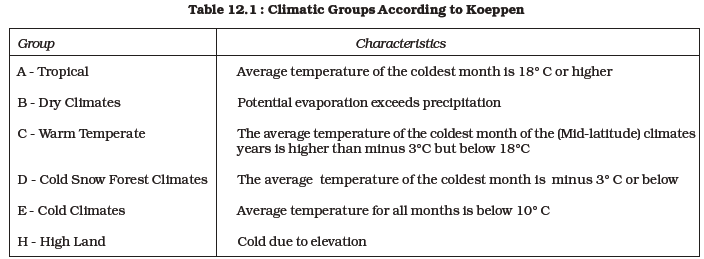
Koeppen recognised five major climatic groups, four of them are based on temperature and one on precipitation. Table 12.1 lists the climatic groups and their characteristics according to Koeppen. The capital letters : A,C, D and E delineate humid climates and B dry climates.
The climatic groups are subdivided into types, designated by small letters, based on seasonality of precipitation and temperature characteristics. The seasons of dryness are indicated by the small letters : f, m, w and s, where f corresponds to no dry season,
 
NCERT Class 11 Geography World Climate and Climate Change
 
 
m - monsoon climate, w- winter dry season and s - summer dry season. The small letters a, b, c and d refer to the degree of severity of temperature. The B- Dry Climates are subdivided using the capital letters S for steppe or semi-arid and W for deserts. The climatic types are listed in Table 12.2. The distribution of climatic groups and types is shown in Table 12.1.
 
 
Click on the below link to download NCERT Class 11 Geography World Climate and Climate Change

Fundamental of Physical Geography Chapter 11 World Climate and Climate Change Digital Textbook & Resources for Class 11 Geography

NCERT Book Class 11 Geography Fundamental of Physical Geography Chapter 11 World Climate and Climate Change

Access the official NCERT Textbook for Class 11 Geography Fundamental of Physical Geography Chapter 11 World Climate and Climate Change, updated for the current academic session. Recognized as the core reading material across schools nationwide, board evaluations rely entirely on this syllabus.

Access NCERT English Medium Textbooks

Explore our exhaustive library of NCERT books in English Medium spanning all subjects in Class 11. Every chapter features comprehensive explanations followed by extensive end-of-chapter exercises.

Enhance Learning with Official Textbooks

The Class 11 Geography Fundamental of Physical Geography Chapter 11 World Climate and Climate Change text is carefully engineered to build rock-solid foundational concepts. For an enriched academic journey, learners should pair this with our online NCERT Solutions and revision notes.

FAQs

Where can I download the latest NCERT Book Class 11 Geography World Climate and Climate Change in PDF for 2026-27?

You can download the latest, teacher-verified PDF for NCERT Book Class 11 Geography World Climate and Climate Change for free on StudiesToday.com. These digital editions are updated as per 2026-27 session and are optimized for mobile reading.

Does this Geography book follow the latest NCERT rationalized syllabus?

Yes, our collection of Class 11 Geography NCERT books follow the 2026 rationalization guidelines. All deleted chapters have been removed and has latest content for you to study.

Why is it better to download NCERT Book Class 11 Geography World Climate and Climate Change chapter-wise?

Downloading chapter-wise PDFs for Class 11 Geography allows for faster access, saves storage space, and makes it easier to focus in 2026 on specific topics during revision.

Are these NCERT books for Class 11 Geography sufficient for scoring 100%?

NCERT books are the main source for NCERT exams. By reading NCERT Book Class 11 Geography World Climate and Climate Change line-by-line and practicing its questions, students build strong understanding to get full marks in Geography.