

Sociology Concept Notes for Class 11: Understanding Society Chapter 04 Introducing Western Sociologists
Explore reliable concept summaries and revision materials through the CBSE Class 11 Sociology Introducing Western Sociologists Notes. Tailored for Class 11 learners, utilizing these notes for Sociology Understanding Society Chapter 04 Introducing Western Sociologists ensures thorough preparation and strengthens core academic definitions before final evaluations.
Download Understanding Society Chapter 04 Introducing Western Sociologists Revision Notes PDF
View or download the dedicated Understanding Society Chapter 04 Introducing Western Sociologists revision resource below. Engaging with these structured concept notes daily ensures continuous academic progress and mastery of the 2026-27 curriculum for Sociology.
Sociology is considered as child of the age of revolution. It was born in 19th century Western Europe after Revolutionary changes in the preceding three centuries that decisively changed the way of people lived. The following three revolutions paved the way for the emergence of sociology.
1. Enlightenment(Scientific revolution)
2. French Revolution
3. Industrial Revolution
The context of sociology
Enlightenment
During the 17th and 18th centuries Western Europe saw the emergence radically new way of thinking about the world, referred to as enlightenment. The ability to think rationally and critically transformed the individual human being in to both the producer and the user of all knowledge. On the other hand only persons who could think and the reason could be considered as fully human. The enlightenment was made possible and helped to develop attitudes of mind that we refer today as secular, scientific and humanistic.
French Revolution
The French Revolution (1789) brought about several changes.
• Announced the arrival of political sovereignty
• Declaration of human rights emphasizes the equality of all citizens
• It signalled the emancipation of individual from the oppressive rule of the religious and the feudal institutions that dominated in France before the revolution
• The peasants(bonded labour) free of their bonds
• A separation was build between the public realm of the state and a private realm of the household
• The ideals of the French Revolution-Liberty, Equality, Fraternity-become the watchword of the modern state
Industrial revolution
The foundation of modern industry were laid by the industrial revolution. It has two major aspects.
• Systematic application of Science and technology to industrial production particularly the invention of new machines
• Involved new ways of organising labour and Markets on a scale larger than anything in the past
Changes in the production system also resulted in major changes in social life. Factories are setup in urban areas. Modern industry enable the urban to dominate over the rural, the rich and powerful live in the cities. The working classes lives in the slums with poverty and squalor. Modern forms of governance with state assuming the control of health, sanitation, crime control and general development created the demand for new kind of knowledge. The social sciences particularly sociology emerged partly as a response to this need. Sociology was the science of the New Industrial society.
I. Karl Marx
He was social thinker who advocated an end to oppression and exploitation. He believed that scientific socialism would achieve this goal. Karl Marx argued that human society has progressed through different stages. These are
1. Primitive Communism
2. Slavery
3. Feudalism
4. Capitalism
Capitalism was the latest phase of human advancement but Karl Marx believed that it would give way to socialism.
Karl Marx placed great emphasis on economic structure and processes because he believed that they form the foundations of every social system throughout human history.
Class Struggle
For Marx, the most important method of classifying people into social groups was with reference to the production process. He argued that people who occupy the same position in the social production process will eventually form a class. Each class shares the same interests and objectives. Classes are formed through historical processes. Different classes are formed relating with the mode of production in different stages of history. As the mode of production changes, conflicts develop between different classes which result in struggles. Marx was a proponent of class struggle. He believed that class struggle was the major driving force of change in society. In ‘The Communist Manifesto’ Marx and Engels presented their views on class struggle. The nature of class struggle varied in different historical epochs. Each period of history was characterized by a conflict between the oppressor and oppressed class. Economic processes in a mode of production create contradictions which in turn lead to class conflict. In capitalism the bourgeoisie (capitalists) owned all the means of production (capital, factories and machinery, land and so on). The working class lost all the means of production that it had access in the past. The workers had no choice but to sell their labour for wages in order to survive. Class consciousness is developed through political mobilization. With the development of class consciousness class conflicts occur. As a result of class struggles, the subordinated and the oppressed classes overthrow the dominant or ruling class. This is called a revolution.
II. Emile Durkheim
He was a French Sociologist, founder of sociology as a formal discipline. His Important works :The division of labour in society, Suicide, The Elementary forms of Religious life.
Division of labour in society
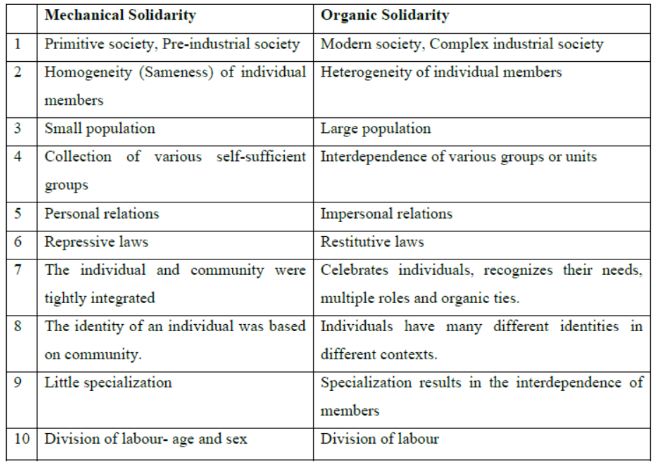
In his first book, ‘Division of Labour in Society,’ Durkheim demonstrated the evolution of society from the primitive to the modern. He classified a society into primitive and modern on the basis of the nature of social solidarity which existed in that society. He argued that primitive society was organized according to ‘mechanical’ solidarity, while modern society was based on ‘organic’ solidarity.
Mechanical solidarity
It s based on collective consciousness. It is found in societies with small population. Here the solidarity or ties between people are based on similarities and personal relationships. They are the members of same collectivity and resemble one another, because they feel the same emotions, same values and hold the same thing sacred. Any violation of the norm of the community attract harsh punishment
Organic solidarity
It is the characteristics of modern society and is based on heterogeneity of its members. Increase in the density of population is the major reason for the development of division of labour. Interdependence is the essence of organic solidarity, with the increasing division of labour the collective conscience decreases. The laws of modern society are restitutive in nature rather than repressive. In modern society individual was given some autonomy, Where as in primitive societies the individual was totally submerged in collectivity.
•A characteristic feature of modern society is that individual with a similar goals come together voluntarily to form groups and associations.
•Impersonal rules and regulations are required to govern the social relations in such societies, because personalized relation can no longer be maintained in a large population.
III. Max Weber (1864- 1920)
Max Weber was a German social thinker, sociologist. His Important work: The Protestant Ethic and the Spirit of Capitalism. Weber argued that the overall objective of the Social Sciences was to develop an interpretive understanding of social action. The method of enquiry of social science also had to be different from the methods of natural science.
Methods to Understand Social Action
1. Empathetic Understanding
The sociologists put themselves in the place of actor and imagine the meanings of the social action. The empathetic understanding enables the sociologists to access the subjective meanings and motivations of social actors.
Value Neutrality
Social world is founded on subjective human meanings, values, feelings, prejudices, ideals and so on. Sociologists were meant to describe, not judge, the subjective feelings of others. The sociologist must neutrally record subjective values without being affected by her/his own feelings/opinions about these values.
2. Ideal Type
An ideal type is a logically consistent model of a social phenomenon that highlights its most significant characteristics. It is a conceptual tool designed to help the analysis of a reality.
Authority
– Weber used the ideal type to illustrate the three types of authority.
1. Traditional Authority
– The source of traditional authority is custom and precedence.
2. Charismatic Authority
– The sources of charismatic authority derived from divine sources or the ‘gift of grace’.
3. Rational-legal Authority.
– Rational-legal authority is a feature of modern society.
– It is based on legal demarcation of authority.
– Rational-legal authority is epitomized in the bureaucracy.
Bureaucracy
It was a mode of organisation which was premised on the separation of the public from the domestic world. This was regulated by explicit rules and regulations. Moreover, as a public institution, bureaucracy restricted the power of the officials in regard to their responsibilities and did not provide absolute power to them.
Features of Bureaucratic Authority
1. Functioning of officials
Within the Bureaucracy officials have fixed areas of official jurisdiction governed by rules, laws and administrative regulations. Commands are issued by higher authorities for implementation by subordinates in a stable way
2. Hierarchical ordering of position
Authority and office are placed on a graded hierarchy, where the higher officials supervise the lower ones. This allows scope of appeal to a higher official in case of dissatisfaction with the decisions of lower officials.
3. Reliance on written document
The management of a bureaucratic organisation is carried out on the basis of written documents (files) which are preserved as records.
4. Office management
As office management is a specialized and modern activity it requires trained and skilled personnel to conduct operations.
5. Conduct in office
Officials who are employed on full-time basis are subject to strict discipline. The officials who are employed must know the distinction between their private affairs and public affairs.
Study Material and Revision Notes for Class 11 Sociology Understanding Society Chapter 04 Introducing Western Sociologists
Key Concepts and Summary for Class 11 Sociology Understanding Society Chapter 04 Introducing Western Sociologists
Access structured revision notes for Understanding Society Chapter 04 Introducing Western Sociologists designed in alignment with the latest CBSE curriculum for Class 11 Sociology. These summaries help clarify core themes and support effective daily study.
NCERT-Aligned Chapter Summary and Notes
Each chapter summary is structured around standard CBSE textbooks, allowing students to check their understanding and clarify complex ideas early in their revision.
Next Steps in Your Exam Preparation
Explore our broader library of printable assignments, chapter notes, and mock tests designed to support continuous revision and secure higher marks in CBSE assessments.
FAQs
You can download the teacher prepared revision notes for CBSE Class 11 Sociology Introducing Western Sociologists Notes from StudiesToday.com. These notes are designed as per 2026-27 academic session to help Class 11 students get the best study material for Sociology.
Yes, our CBSE Class 11 Sociology Introducing Western Sociologists Notes include 50% competency-based questions with focus on core logic, keyword definitions, and the practical application of Sociology principles which is important for getting more marks in 2026 CBSE exams.
Yes, our CBSE Class 11 Sociology Introducing Western Sociologists Notes provide a detailed, topic wise breakdown of the chapter. Fundamental definitions, complex numerical formulas and all topics of CBSE syllabus in Class 11 is covered.
These notes for Sociology are organized into bullet points and easy-to-read charts. By using CBSE Class 11 Sociology Introducing Western Sociologists Notes, Class 11 students fast revise formulas, key definitions before the exams.
No, all study resources on StudiesToday, including CBSE Class 11 Sociology Introducing Western Sociologists Notes, are available for immediate free download. Class 11 Sociology study material is available in PDF and can be downloaded on mobile.