

Economics Concept Notes for Class 11: Consumer Behaviour And Demand
Access comprehensive revision notes for Consumer Behaviour And Demand using the CBSE Class 11 Micro Economics Consumer Behaviour And Demand Notes. Designed to align with the 2026-27 academic syllabus for Class 11 Economics, these concept summaries help students streamline their exam preparation and review complex topics efficiently.
Download Consumer Behaviour And Demand Revision Notes PDF
View or download the dedicated Consumer Behaviour And Demand revision resource below. Engaging with these structured concept notes daily ensures continuous academic progress and mastery of the 2026-27 curriculum for Economics.
CONSUMER’S BEHAVIOUR AND DEMAND
THEORY OF DEMAND
Demand is defined as the quantity of a commodity or service that a consumer is able and willing to buy at a given price at a given price at a given point of time. The essential elements of demand for a commodity as follows:-
1. Desire for a commodity
2. Availability of money income to fulfil that desire
3. Willingness to spend money to fulfil the desire
→ CONCEPTS OF DEMAND
1. Price Demand: - It refers to the different quantities of a commodity which will be bought per unit of time in a market at different prices.
2. Income Demand: - It refers to the different quantities of a commodity which will be bought at different levels of income.
3. Derived Demand: - When the demand for a commodity depends on the demand for its parent product or final product, it is known as derived demand.
4. Joint Demand: - When several things are needed to make a commodity it is called joint demand.
→ LAW OF DEMAND
The law of demand states, ‘Other things remaining the same, demand for a commodity decreases with increase in price and demand for a commodity increases with decrease in price.’ According to the law of demand, there is an inverse (negative) relationship between demand for a commodity and its price. The inverse relationship between demand for a commodity and its price is due to the following reasons:
1. Demand is based on the concept of utility. Total utility is the total satisfaction derived from the consumption of different units of a commodity. Marginal utility is the utility derived from the consumption of an additional unit of a commodity. Law of Diminishing Marginal Utility’ states that as a consumer goes on consuming additional units of a commodity his marginal utility diminishes or demands for commodity decreases.
2. The second approach the two effects of Income and Substitution. Income Effect is based on the concept of real income. A change in the price of the commodity results in a change in the real income of the consumer. A fall in the price implies that with the same money income, a consumer is able to purchase more units of the commodity. Similarly at a higher price, a consumer’s ability to purchase falls. Substitution Effect is based on the concept of relative prices. When the price of a commodity rises, the relative price of its substitutes automatically diminishes, or in other words become cheaper. A household therefore will purchase more of a commodity which has become cheaper.
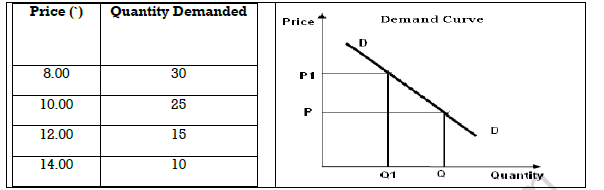
The law can be explained with the help of Demand schedule and demand curve. A Demand schedule is a tabular statement showing the inverse relationship between price and quantity demanded. A Demand curve is a graphical representation of the inverse relationship between price and quantity demanded. The slope of the demand curve whether individual or market is always negative.
♦ AN INDIVIDUAL DEMAND SCHEDULE
CHANGE IN QUANTITY DEMANDED/MOVEMENT ALONG DEMAND CURVE AND CHANGE IN DEMAND/SHIFT IN DEMAND
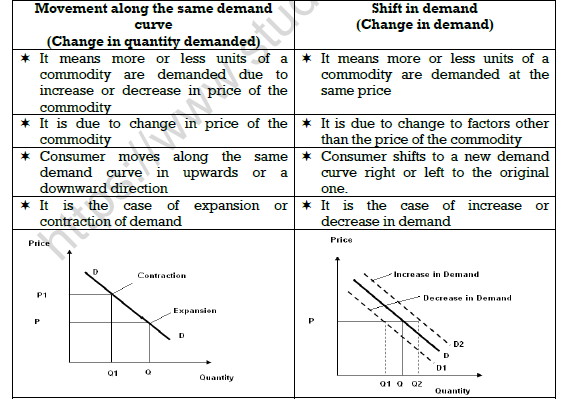
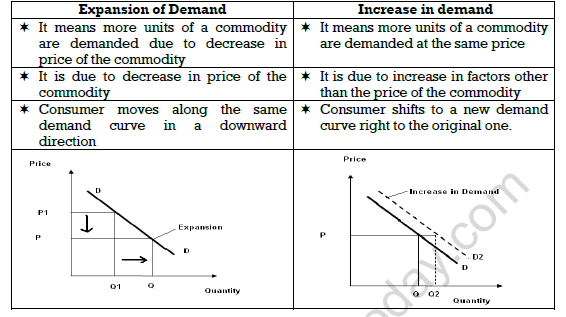
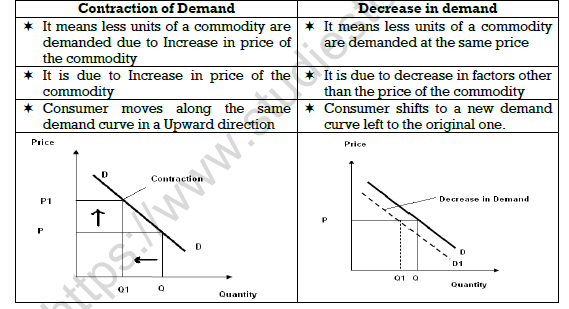
Change in quantity demanded means more or less units of a commodity are demanded due to increase or decrease in price of the commodity. A rise in demand with a fall in the price of the commodity is known as Expansion in Demand. A fall in demand with a rise in the price of a commodity is known as Contraction of Demand.
Shift in demand means more or less units of a commodity are demanded at the same price.
A Leftward Shift in the demand curve illustrates a Decrease in Demand.
A Rightward Shift in the demand curve represents an Increase in Demand.
→ DISTINCTION BETWEEN
♦ INDIVIDUAL DEMAND AND MARKET DEMAND
Individual Demand for a commodity refers to the amount of it bought by a person or a household at different prices.
Market Demand for a commodity refers to the total amount of the commodity bought by all consumers aggregated together at different prices. Market for a good at a particular price is the total demand of all consumers taken together. The market demand for a good can be derived from the individual demand curves. Market demand curve of a good can also be derived from the individual demand curves graphically by adding up the individual demand curves horizontally.
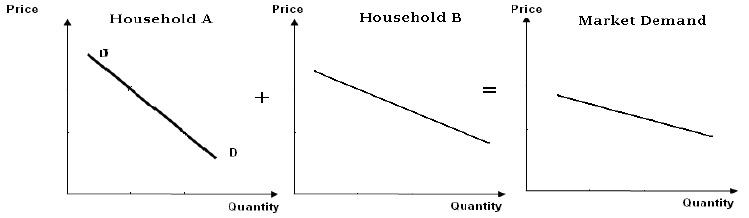
Suppose there are only two households in the market for a good. Suppose at price P1, the demand of household 1 q1 and that of household 2 is q2. Then, the market demand of the good at P1 is q1 + q2.
DETERMINANTS OF DEMAND
Demand for a commodity is influenced by a number of factors. These factors put together are called Demand Function. A demand function illustrates the relationship between the demand for a commodity and the various determinants.
A market demand function is represented as:-
Dn = f (Pn, Pr, Y, T, U)
Where
Dn = Demand for a commodity, say N
Pn = Price of Commodity N
Pr = Price of Related Goods
Y = Income of the household
T = Tastes and Preferences of the household
U = Other factors
RELATIONSHIP BETWEEN DEMAND FOR A COMMODITY AND ITS VARIOUS DETERMINANTS
1. Price of Related Goods: Demand for a commodity is also influenced by the prices of other related goods. The other related goods are generally of two types
(i) Substitute Goods
(ii) complementary goods, and
Substitute goods are those goods where each of them can be used in place of another without discomfort. Example: Tea and Coffee. There is a direct relation between the two goods. If the price of Tea rises then demand for coffee rises because consumer will substitute Tea with Coffee as Coffee would relatively cheaper. Demand curve for coffee shifts rightwards. Complementary goods are those where the utility of a good depend upon the availability of another good, e.g., car and petrol. Demand for goo
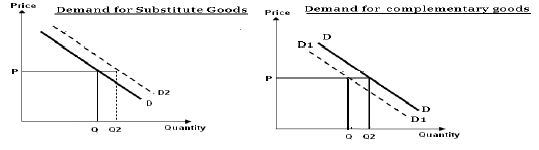
2. Level of income of household(s). Change in income of consumer has affect on demand for the following two types of goods
(a) Normal Goods: Normal goods are those goods which are demanded more at a higher income and less at a lower income. Demand is directly related to the change in the level of income of the consumer. Demand for normal goods increases with increase in income and decreases with decrease in income of consumer. E.g.: Car, refrigerator, etc.

(b) Inferior Goods: Inferior goods are those goods, which are, demand more at a lower income and less at a higher income. Demand is inversely related to change in income of the consumer. Demand for inferior goods decrease with increase in income and increases with decrease in income. E.g. : Bajra, coarse grains, etc.

We can also distinguish between three types of commodities:
a) Necessities: Demand for necessities initially increases with an increase in the income level but after reached a level it is not further affected by income levels
b) Comforts and luxuries: Demand for comforts and luxuries keeps on increasing with an increase in income levels
3. Taste and Preferences of consumers: It means a liking for a product or a service in relation to other products and services. A favourable change in tastes and preferences will increase the demand, whereas an unfavourable change will decrease the demand for the commodity.
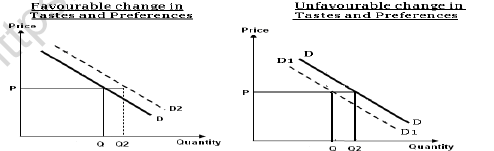
4. Other Factors: Demand for a commodity is also affected a number of other factors. These factors are situational and demand for a commodity changes according to the nature of these factors. Some of these other factors are:
a) Larger the size of population, more shall be the demand for a commodity and vice versa
b) Composition of population. eg. if there are more women in a region there will be larger demand for goods of use to women.
c) The more evenly distributed the income is the larger the number of consumers of the commodity would be.
d) Sociological factors: (a) class groups (b) education level (c) marital status (d) age and place of residence (e) religious factors, etc.
e) Weather conditions also lead to a seasonal change in demand for a commodity.
Please click on below link to download CBSE Class 11 Micro Economics Consumer Behaviour And Demand Notes
Free study material for Economics
Consumer Behaviour And Demand Concepts and Summary for Class 11 Economics
Key Concepts and Summary for Class 11 Economics Consumer Behaviour And Demand
Access structured revision notes for Consumer Behaviour And Demand designed in alignment with the latest CBSE curriculum for Class 11 Economics. These summaries help clarify core themes and support effective daily study.
NCERT-Aligned Chapter Summary and Notes
Built using the official NCERT book for Class 11 Economics, these notes provide reliable academic guidance. Pair your summary review with our recommended NCERT solutions to master optimal problem-solving approaches.
Next Steps in Your Exam Preparation
Explore our broader library of printable assignments, chapter notes, and mock tests designed to support continuous revision and secure higher marks in CBSE assessments.
FAQs
You can download the teacher prepared revision notes for CBSE Class 11 Micro Economics Consumer Behaviour And Demand Notes from StudiesToday.com. These notes are designed as per 2026-27 academic session to help Class 11 students get the best study material for Economics.
Yes, our CBSE Class 11 Micro Economics Consumer Behaviour And Demand Notes include 50% competency-based questions with focus on core logic, keyword definitions, and the practical application of Economics principles which is important for getting more marks in 2026 CBSE exams.
Yes, our CBSE Class 11 Micro Economics Consumer Behaviour And Demand Notes provide a detailed, topic wise breakdown of the chapter. Fundamental definitions, complex numerical formulas and all topics of CBSE syllabus in Class 11 is covered.
These notes for Economics are organized into bullet points and easy-to-read charts. By using CBSE Class 11 Micro Economics Consumer Behaviour And Demand Notes, Class 11 students fast revise formulas, key definitions before the exams.
No, all study resources on StudiesToday, including CBSE Class 11 Micro Economics Consumer Behaviour And Demand Notes, are available for immediate free download. Class 11 Economics study material is available in PDF and can be downloaded on mobile.