

Download Class 11 Economics Concept Summaries: CBSE Class 11 Economics Measures Of Dispersion Notes Set 01
Explore reliable concept summaries and revision materials through the CBSE Class 11 Economics Measures Of Dispersion Notes Set 01. Tailored for Class 11 learners, utilizing these notes for Economics Statistics for Economics Chapter 06 Measures of Dispersion ensures thorough preparation and strengthens core academic definitions before final evaluations.
Access Statistics for Economics Chapter 06 Measures of Dispersion Notes and Study Material
Navigate directly to the revision notes for Statistics for Economics Chapter 06 Measures of Dispersion using the digital viewer below. Each summary is structured to highlight high-weightage sections, allowing students to instantly access critical definitions and focus on core exam topics.
MEASURES OF DISPERSION
1. Dispersion refers to the variation of the items around an average. According to Dr Bowley : “Dispersion is the measure of variations of items.” To quote CONNOR : - “Dispersion is a measure of the extent to which the individual items vary.”
2. Objectives of Dispersion :
(i) To determine the reliability of an average
(ii) To compare the variability of two or more series
(iii) It serves the basis of other statistical measures such as correlation etc.
(iv) It serves the basis of statistical quality control.
3. Properties of a good measure of dispersion:
(i) It should be easy to understand.
(ii) It should be simple to calculate
(iii) It should be uniquely defined.
(iv) It should be based on all observations.
(v) It should not be unduly affected by extreme items.
4. Measures of dispersion may be either absolute or relative.
Absolute measures of dispersion are expressed in the some units in which data of the series are expressed i.e., rupees kgs, tons etc. where as relative measures of dispersion are independent of the units of measurement. They are expressed in percentage these are used to compare two or more series which are expressed in different units.
5. Absolute measures of dispersion are:-
(i) Range
(ii) Quartile Deviation
(iii) Mean Deviation
(iv) Standard deviation and variance.
6. Relative measures of dispersion are:-
(i) Coefficient of Range.
(ii) Coefficient of Quartile Deviation
(iii) Coefficient of mean Deviation
(iv) Coefficient of standard Deviation
(v) Coefficient of variation
7. Besides the above measures of dispersion there is a graphic method of studying dispersion, known as Lorenz curve.
8. Range is the simplest measure of dispersion : -
It is the difference between the largest and smallest value of the distribution. Computation of range:- It is calculated as Range = L - S
Coefficient of Range = L-S/ L-S
9. Merits of Range :-
(i) It is simple to understand and easy to calculate
(ii) It is widely used in statistical quality control.
10. Demerits of Range=
(i) It is affected by extreme values in the series.
(ii) It can not be calculated in case of open-ended series.
(iii) It is not based on all the items of the series.
11.Inter quartile range and quartile deviation are another measures of dispersion. Inter-quartile range is the difference between the upper quartile Q3 and lower quartile Q1. Quartile deviation is half of the difference between the upper quartile and lower quartile i.e. half of the inter-quartile range.
Computation of Inter-quartile Range and Quartile Deviation:-
Inter- quartile Range:- Q3 – Q1
Quartile Deviation (Q.D) : = Q3 - Q1 / 2
Co. efficient of Q.D : = Q3 - Q1 / Q3 + Q1
12. Merits of Quartile Deviation:-
(i) It is easy to compute.
(ii) It is less affected by extreme items
(iii) It can be computed in open-ended series.
13. Demerits of Quartile Deviation :-
(i) It ignores half i.e. 50% of the items.
(ii) It is useful only for rough study.
(iii) It is not based on all observations.
14. Mean deviation :- It is defined as the arithmetic average of the absolute deviations (ignoring signs) of the various items from a measure of central tendency ; i.e. mean or median. Generally, mean deviation is calculated from median because the sum of the absolute deviations taken from median is minimum or least.
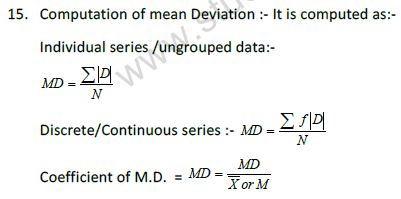
16. Merits of mean Deviation:-
(i) It is based on all observations.
(ii) It is least affected by extreme items.
(iii) It is simple to understand and easy to calculate.
17. Demerits of mean Deviation:-
(i) It ignores ± signs in deviations
(ii) It can not be computed with open - ended series.
(iii) It is not well defined measure because it is calculated from different
averages (Mean, Median & Mode)
(iv) It is difficult to compute when X or M comes in fractions.
Please click the link below to download pdf file for CBSE Class 11 Economics - Measures of Dispersion (English) Part B.
Free study material for Economics
Statistics for Economics Chapter 06 Measures of Dispersion Concepts and Summary for Class 11 Economics
Key Concepts and Summary for Class 11 Economics Statistics for Economics Chapter 06 Measures of Dispersion
Review targeted chapter notes for Class 11 Economics Statistics for Economics Chapter 06 Measures of Dispersion. Built according to official CBSE guidelines, these summaries highlight high-yield topics frequently tested in school evaluations.
NCERT-Aligned Chapter Summary and Notes
Built using the official NCERT book for Class 11 Economics, these notes provide reliable academic guidance. Pair your summary review with our recommended NCERT solutions to master optimal problem-solving approaches.
Next Steps in Your Exam Preparation
Follow up your revision by attempting the interactive online Economics MCQ test and practice worksheets for this chapter to verify your mastery. All platform resources are free to access.
FAQs
You can download the teacher prepared revision notes for CBSE Class 11 Economics Measures Of Dispersion Notes Set 01 from StudiesToday.com. These notes are designed as per 2026-27 academic session to help Class 11 students get the best study material for Economics.
Yes, our CBSE Class 11 Economics Measures Of Dispersion Notes Set 01 include 50% competency-based questions with focus on core logic, keyword definitions, and the practical application of Economics principles which is important for getting more marks in 2026 CBSE exams.
Yes, our CBSE Class 11 Economics Measures Of Dispersion Notes Set 01 provide a detailed, topic wise breakdown of the chapter. Fundamental definitions, complex numerical formulas and all topics of CBSE syllabus in Class 11 is covered.
These notes for Economics are organized into bullet points and easy-to-read charts. By using CBSE Class 11 Economics Measures Of Dispersion Notes Set 01, Class 11 students fast revise formulas, key definitions before the exams.
No, all study resources on StudiesToday, including CBSE Class 11 Economics Measures Of Dispersion Notes Set 01, are available for immediate free download. Class 11 Economics study material is available in PDF and can be downloaded on mobile.