

Revision Notes for Class 11 Economics: Statistics for Economics Chapter 05 Measures of Central Tendency
Explore reliable concept summaries and revision materials through the CBSE Class 11 Economics Measures Of Central Tendency Notes Set 01. Tailored for Class 11 learners, utilizing these notes for Economics Statistics for Economics Chapter 05 Measures of Central Tendency ensures thorough preparation and strengthens core academic definitions before final evaluations.
Review Statistics for Economics Chapter 05 Measures of Central Tendency for Class 11 Economics
View or download the dedicated Statistics for Economics Chapter 05 Measures of Central Tendency revision resource below. Engaging with these structured concept notes daily ensures continuous academic progress and mastery of the 2026-27 curriculum for Economics.
UNIT – 3
STATISTICAL TOOLS AND INTERPRETATION
1. Measures of central Tendency.
2. Measures of Dispersion
3. Co-relation and Measures of correlation
4. Introduction to Index Numbers.
Measures of Central Tendency
(Important Terms & Concepts) :-
1. Average or measures of central Tendency :- It is a value which is a typical or representative of a set of data. Averages are also called measures of central tendency, since they tend to lie centrally, with in a set of data arranged according to magnitude.
2. Functions of Average :-
√ Average helps to get a representative value to the entire set of data.
√ It Facilitates Comparison.
√ It is a useful tool in decision- making.
3. Essentials of a Good Average / good measures of Central Tendency : -
√ Simplicity in calculation
√ Easy to understand
√ Rigidly Defined
√ Precise Value
√ Based upon all observations
√ Unaffected by extreme values.
√ Capable for further statistical calculations.
4. Types of Averages / measures of central Tendency :- There are three averages, which are in common use- Arithmetic Mean, Median and Mode.
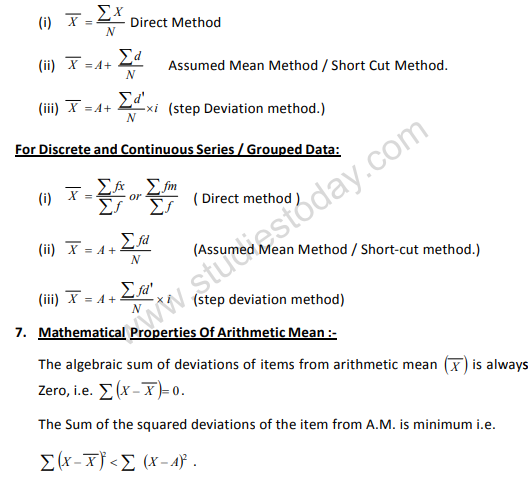
5. Arithmetic Means ( X ):- It is the most common type of measures of central tendency. It is obtained by dividing the sum of all observations in a series by the total numbers of observations.
6. Calculation of Arithmetic Mean :-
For Individual series / ungrouped Data :-
8. Merits of Arithmetic Mean:-
(i) It is easy to calculate and simple to understand.
(ii) It is rigidly defined.
(iii) It is a calculated value not a positional value.
(iv) It is based on all observations
9. Demerits of Arithmetic Mean:-
• It is affected by presence of extreme values
• It cannot be calculated in open-ended series
• It cannot be ascertained graphically.
• It sometimes gives misleading and surprising results.
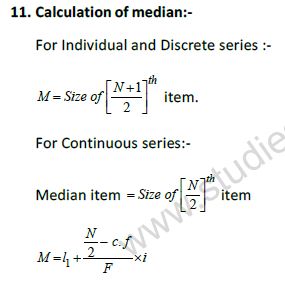
10. MEDIAN:-
It is defined as the middle value of the series when the data is arranged in ascending or descending order. In other words, median is that value of the distribution which divides the group into two equal parts, one part comprising all greater values and the other comprising values less than the median.
12. Merits of median :-
⇒ It is easy to understand and easy to compute.
⇒ It is not unduly affected by extreme observations
⇒ Median can be located graphically with the help of ogives.
⇒ It is the most appropriate average in case of open-ended classes.
⇒ It is the most suitable average for qualitative measurement such as intelligence, beauty etc.
⇒ It is a positional value and not a calculated value.
13. Demerits of Median
(I) It is not based on all observations of the series since it is a positional average.
(II) It requires arrangement of data, but other averages do not need it.
(III) It can not be computed exactly where the number of items in a series is even.
14. Related Measures Of Median- Quartiles & Percentiles:-
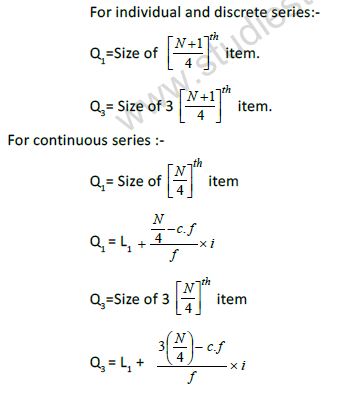
Quartiles are the measures which divide the data into four equal parts, each part contains equal number of observations. There are three quartiles - Q1, Q2, and Q3. The 1st quartile denoted by Q1 is called lower quartile and 25% of the item of the distribution are below it and 75% of the items are greater than it.
The second quartile is known as median and is denoted by Q2. It has 50% of the item above it. The third Quartile is known as Q3 and it is also called upper Quartile and 75% of the items are below it and 25% of the items are above it. Thus , Q1 and Q3 denote the two items with which central 50% of item lie.
Percentiles divide the series into hundred equal parts. For any series, there are 99 percentiles denoted by P1, P2, P3,……, P99. P50 is the median value.
Please click the link below to download pdf file for CBSE Class 11 Economics - Measures of Central Tendency (English) Part B.
Free study material for Economics
Revision Notes and Key Concepts for Class 11 Economics Statistics for Economics Chapter 05 Measures of Central Tendency
Key Concepts and Summary for Class 11 Economics Statistics for Economics Chapter 05 Measures of Central Tendency
Access structured revision notes for Statistics for Economics Chapter 05 Measures of Central Tendency designed in alignment with the latest CBSE curriculum for Class 11 Economics. These summaries help clarify core themes and support effective daily study.
NCERT-Aligned Chapter Summary and Notes
Cross-reference your comprehension with comprehensive NCERT solutions for Class 11 to ensure absolute clarity across all sub-topics in this chapter.
Next Steps in Your Exam Preparation
Follow up your revision by attempting the interactive online Economics MCQ test and practice worksheets for this chapter to verify your mastery. All platform resources are free to access.
FAQs
You can download the teacher prepared revision notes for CBSE Class 11 Economics Measures Of Central Tendency Notes Set 01 from StudiesToday.com. These notes are designed as per 2026-27 academic session to help Class 11 students get the best study material for Economics.
Yes, our CBSE Class 11 Economics Measures Of Central Tendency Notes Set 01 include 50% competency-based questions with focus on core logic, keyword definitions, and the practical application of Economics principles which is important for getting more marks in 2026 CBSE exams.
Yes, our CBSE Class 11 Economics Measures Of Central Tendency Notes Set 01 provide a detailed, topic wise breakdown of the chapter. Fundamental definitions, complex numerical formulas and all topics of CBSE syllabus in Class 11 is covered.
These notes for Economics are organized into bullet points and easy-to-read charts. By using CBSE Class 11 Economics Measures Of Central Tendency Notes Set 01, Class 11 students fast revise formulas, key definitions before the exams.
No, all study resources on StudiesToday, including CBSE Class 11 Economics Measures Of Central Tendency Notes Set 01, are available for immediate free download. Class 11 Economics study material is available in PDF and can be downloaded on mobile.