

Revision Notes for Class 7 Computer Science: File Format
Explore reliable concept summaries and revision materials through the CBSE Class 7 Computer Science File Format Notes. Tailored for Class 7 learners, utilizing these notes for Computer Science File Format ensures thorough preparation and strengthens core academic definitions before final evaluations.
Review File Format for Class 7 Computer Science
View or download the dedicated File Format revision resource below. Engaging with these structured concept notes daily ensures continuous academic progress and mastery of the 2026-27 curriculum for Computer Science.
Some Important Video File Formats
3GP – Third Generation Partnership Project
AVI- Microsoft Audio Visual Interleaved
DIVX- Digital Video Express Encoded Movie Files
FLV- Flash Video
MKV – Matroska Video File
MPEG- Motion Picture Experts Group file interchange format
MP4- MPEG-4 Video Stream MTS- AVCHD Video File VOB- Video Object File
WMV- Windows Media Video
Some Important Audio File Formats
MIDI- Musical Instrument Digital Interface MIDI-sequention Sound
MP3- MPEG Layer 3 Audio
WMA- Windows Media (Metafile)
Some Important Image File Formats
BMP- Microsoft Windows BITMAP
GIF- Graphics Interchange Format
JPEG, JPG- Joint Photographic Experts Groupt
PNG- Portable Network Graphics
PSD- Adobe Photoshop Document
TIF- Tagged Image File Format
AI- Adobe Illustrator File
SVG- Scalable Vector Graphics File
VSD- Microsoft Visio Document
Some Important Document File Formats
DOC- Microsoft Word Binary File Format
DOCX- Microsoft Word Open XML Document
ODT- OpenDocument Text Document
PDF- Portable Document Format
RTF- Rich Text Format
SWF- Shockwave Flash Movie
XLS- Microsoft Excel Spreadsheet
XML- Extensible Markup Language
CSV- Comma Separated Values File
ODS- OpenDocument Spreadsheet
XLSX- Microsoft Excel Open XML Spreadsheet
KEY- Keynote Presentation
PPT- Microsoft PowerPoint
PPTX- Microsoft PowerPoint 2007 XML
PPS- PowerPoint Slide Show
MISC
DAT- Data File
EXE- Executable file
TTF- TrueType Font
VCF- vCard File
Some Important File Extensions:-
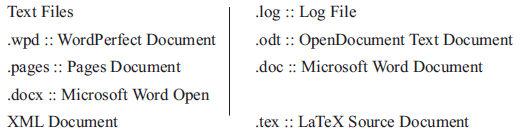
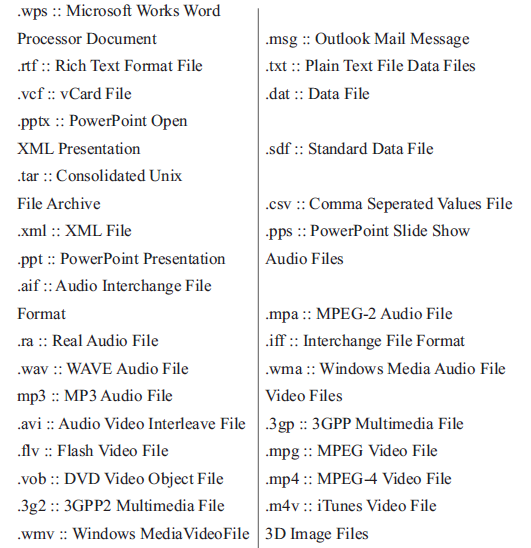
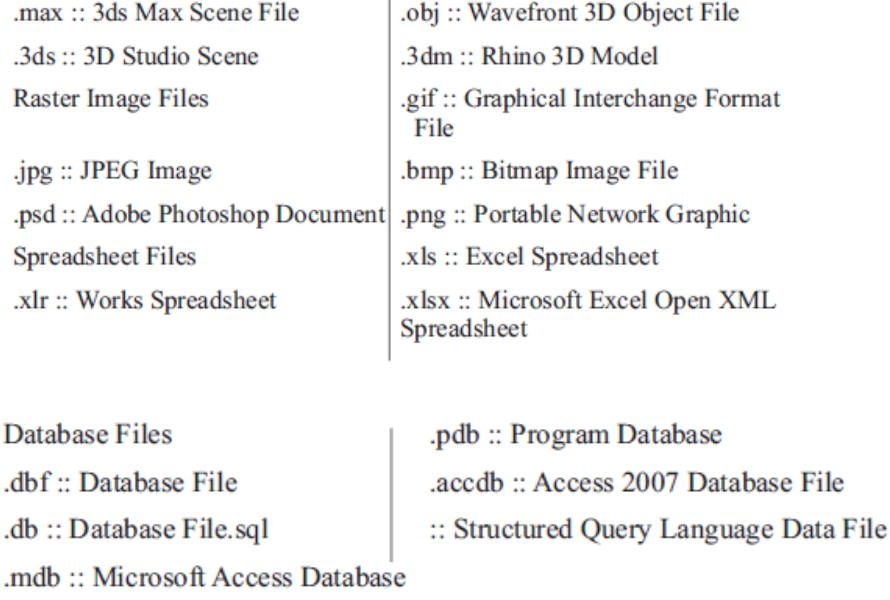
Abbrivations related to computer
A
Al – Artificial intelligence
ALGOL – Algorithmic Language
ARP – Address resolution Protocol
ASCII – American Standard Code for Information Interchange
B
BINAC – Binary Automatic Computer
BCC – Blind Carbon Copy
Bin – Binary
BASIC – Beginner’s All-purpose Symbolic Instruction Code
BIOS – Basic Input Output System
Bit – Binary Digit
BSNL – Bharat Sanchar Nigam Limited
C
CC – Carbon Copy
CAD – Computer Aided Design
COBOL – Common Business Oriented Language
CD – Compact Disc
CRT – Cathode Ray Tube
CDR – Compact Disc Recordable
CDROM – Compact Disc Read Only Memory
CDRW – Compact Disc Rewritable
CDR/W – Compact Disk Read/Write
D
DBA – Data Base Administrator
DBMS – Data Base Management System
DNS – Domain Name System
DPI – Dots Per Inch
DRAM – Dynamic Random Access Memory
DVD – Digital Video Disc/Digital Versatile Disc
DVDR – DVD Recordable
DVDROM – DVD Read Only Memory
DVDRW – DVD Rewritable
DVR – Digital Video Recorder
DOS – Disk Operating System
E
EBCDIC – Extended Binary Coded Decimal Interchange Code
e-Commerce – Electronic Commerce
EDP – Electronic Data Processing
EMEePmRoOryM – Electrically Erasable Programmable Read Only
ELM/e-Mail – Electronic Mail
ENIAC – Electronic Numerical Integrator and Computer
EOF – End Of File
EPROM – Erasable Programmable Read Only Memory
EXE – Executable
F
FAX – Far Away Xerox/ facsimile
FDC – Floppy Disk Controller
FDD – Floppy Disk Drive
FORTRAN – Formula Translation
FS – File System
FTP – File Transfer Protocol
G
Gb – Gigabit
GB – Gigabyte
GIF – Graphics Interchange Format
GSM – Global System for Mobile Communication
H
HDD – Hard Disk Drive
HP – Hewlett Packard
HTML – Hyper Text Markup Language
HTTP – Hyper Text Transfer Protocol
I
IBM – International Business Machine
IM – Instant Message
IMAP – Internet Message Access Protocol
ISP – Internet Service Provider
J
JPEG – Joint Photographic Experts Group
K
Kb – Kilobit
KB – Kilobyte
KHz – Kilohertz
Kbps – Kilobit Per Second
L
LCD – Liquid Crystal Display
LED – Light Emitting Diode
LPI – Lines Per Inch
LIS – Large Scale Integration
M
Mb – Megabit
MB – Megabyte
MPEG – Moving Picture Experts Group
MMS – Multimedia Message Service
MICR – Magnetic Ink Character reader
MIPS – Million Instructions Per Second
N
NIC – Network Interface Card
NOS – Network Operating System
O
OMR – Optical Mark Reader
OOP – Object Oriented Programming
OSS – Open Source Software
P
PAN – Personal Area Network
PC – Personal Computer
PDA – Personal Digital Assistant
PDF – Portable Document Format
POS – Point Of Sale
PNG – Portable Network Graphics
PPM – Pages Per Minute
PPP – Point-to-Point Protocol
PROM – Programmable Read Only Memory
PSTN – Public Switched Telephone Network
POST – Power On Self Test
PING – Packet Internet Gopher
R
RAM – Random Access Memory
RDBMS – Relational Data Base Management System
RIP – Routing Information Protocol
RTF – Rich Text Format
S
SMTP – Simple Mail Transfer Protocol
SQL – Structured Query Language
SRAM – Static Random Access Memory
SNMP – Simple Network Management Protocol
SIM – Subscriber Identification Module
T
TCP – Transmission Control Protocol
TB – Tera Bytes
U
UPS – Uninterrupted Power Supply
URI – Uniform Resource Identifier
URL – Uniform Resource Locator
USB – Universal Serial Bus
ULSI – Ultra Large Scale Integration
UNIVAC – Universal Automatic Computer
V
VAR – Variable
VGA – Video Graphics Array
VSNL – Videsh Sanchar Nigam Limited
VDU – Visual Display Unit
W
Wi-Fi – Wireless Fidelity
WLAN – Wireless Local Area Network
WPA – Wi-Fi Protected Access
WWW – World Wide Web
WORM – Write Once Read Many
X
XHTML – eXtensible Hyper text Markup Language
XML – eXtensible Markup language
Z
ZB – Zeta Byte
File Format Concepts and Summary for Class 7 Computer Science
About File Format Revision Notes
Explore reliable chapter overviews for File Format tailored for Class 7 learners. Use these structured points to grasp difficult themes and ensure solid preparation for upcoming assessments.
How to Use These Revision Notes
Cross-reference your comprehension with comprehensive NCERT solutions for Class 7 to ensure absolute clarity across all sub-topics in this chapter.
Enhance Practice with MCQs and Worksheets
Follow up your revision by attempting the interactive online Computer Science MCQ test and practice worksheets for this chapter to verify your mastery. All platform resources are free to access.
FAQs
You can download the teacher prepared revision notes for CBSE Class 7 Computer Science File Format Notes from StudiesToday.com. These notes are designed as per 2026-27 academic session to help Class 7 students get the best study material for Computer Science.
Yes, our CBSE Class 7 Computer Science File Format Notes include 50% competency-based questions with focus on core logic, keyword definitions, and the practical application of Computer Science principles which is important for getting more marks in 2026 CBSE exams.
Yes, our CBSE Class 7 Computer Science File Format Notes provide a detailed, topic wise breakdown of the chapter. Fundamental definitions, complex numerical formulas and all topics of CBSE syllabus in Class 7 is covered.
These notes for Computer Science are organized into bullet points and easy-to-read charts. By using CBSE Class 7 Computer Science File Format Notes, Class 7 students fast revise formulas, key definitions before the exams.
No, all study resources on StudiesToday, including CBSE Class 7 Computer Science File Format Notes, are available for immediate free download. Class 7 Computer Science study material is available in PDF and can be downloaded on mobile.