

School Assignments for Class 3 Mathematics: Basic Geometrical Concepts
Explore structured practice materials through the CBSE Class 3 Mathematics-Basic Geometrical Concepts. Tailored for Class 3 learners, utilizing these Mathematics assignments ensures thorough preparation and strengthens foundational knowledge before final CBSE evaluations.
Practice Class 3 Mathematics Assignments: Basic Geometrical Concepts
Navigate directly to the solved Mathematics assignments using the digital viewer below. Each practice set includes detailed step-by-step solutions, allowing students to instantly cross-check their work and identify areas requiring further revision.
Different Types of Lines
Curved Lines:
Lines that are not straight and bend smoothly are called curved lines. Examples include waves, loops, and arcs.
Straight Lines:
Lines that go in a fixed direction without bending are called straight lines.
Straight lines are of three types:
a. Horizontal or sleeping line: Lines that run flat across from left to right.
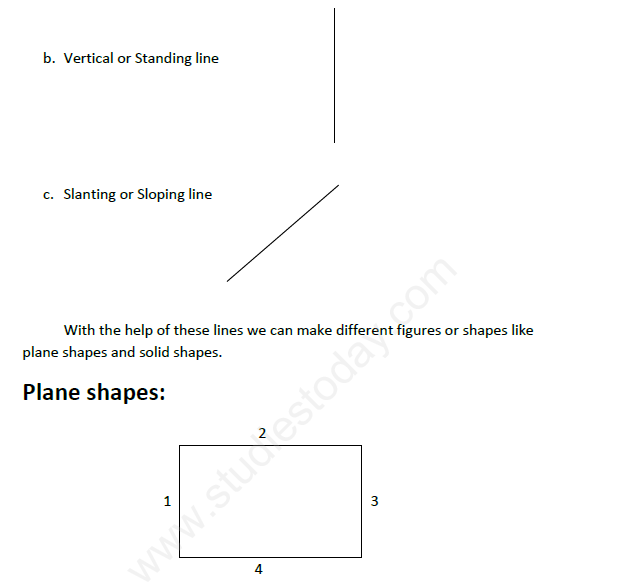
b. Vertical or Standing line: Lines that go straight up and down.
c. Slanting or Sloping line: Lines that are tilted or angled.
With the help of these lines we can make different figures or shapes like plane shapes and solid shapes.
Plane shapes:
This is a rectangle.
- It has 4 sides.
- It has 4 corners / vertices.
- Only opposite sides of a rectangle are equal. Here side (2 & 4), (1 & 3) are equal.
This is a square.
- It has 4 sides.
- It has 4 corners / vertices.
- All the four sides of a square are equal i.e. side 1 = side 2 = side 3 = side 4.
This is a triangle.
- It has 3 sides.
- It has 3 corners / vertices.
- Its sides may or may not have same length.
This is a circle.
- It has no sides.
- It has no corners / vertices.
Diagonal:
A line joining the opposite corners / vertices of a shape is called its diagonal.
In the given figure, AC and BD are the diagonals.
(Worksheet)
Topic: Geometry
Sub-topic: Basic Geometrical Concepts
Question 1. Fill in the blanks.
a. A square has 4 sides.
b. The opposite sides of a rectangle are equal.
c. The shape of a bottle cap is circular.
d. A triangle has 3 vertices.
Answer: 4, opposite, circular, 3
In simple words: Basic properties of fundamental geometrical shapes include counting sides and vertices, and recognizing shape symmetry.
Exam Tip: Remember that a square always has 4 equal sides, while a rectangle only has its opposite sides equal.
Question 2. Write True or False for each of the following:
a. A triangle has 3 sides and 4 vertices. - False
b. Diagonals of a square are equal. - True
c. All the 4 sides of a rectangle are equal. - False
d. Diagonals of a rectangle are equal. - True
e. A square has 2 pairs of opposite sides. - True
Answer:
a. False (A triangle has 3 sides and 3 vertices)
b. True
c. False (Only opposite sides of a rectangle are equal)
d. True
e. True
In simple words: Verify each geometrical statement using the fundamental rules of squares, rectangles, and triangles.
Exam Tip: Read carefully whether properties apply to squares or rectangles to avoid confusion between all sides equal versus opposite sides equal.
Question 3. In the given rectangle, can you write pair of:
a) Opposite sides?
Side 1 and Side 3
Side 4 and Side 2
b) Diagonals?
AC and BD
Answer:
a) Opposite sides are Side 1 and Side 3; Side 4 and Side 2.
b) Diagonals are AC and BD.
In simple words: Opposite sides face each other, and diagonals connect opposite corners.
Exam Tip: Labeling vertices clockwise or counter-clockwise helps correctly identify diagonals as lines connecting non-adjacent corners.

Please click the link below to download CBSE Class 3 Mathematics-Basic Geometrical Concepts
Free study material for Mathematics
Download Practice Assignments: Class 3 Mathematics Basic Geometrical Concepts
Class 3 Mathematics Basic Geometrical Concepts Printable Assignments
Access structured practice assignments for Basic Geometrical Concepts designed in alignment with the latest CBSE curriculum for Class 3 Mathematics. These printable sets cover objective and descriptive problem types to support thorough revision.
Why Practice Class 3 Mathematics Assignments?
- Exam Alignment: Questions strictly follow contemporary CBSE sample papers and grading schemes.
- Comprehensive Coverage: Features objective drills, case studies, and structured descriptive problems for Basic Geometrical Concepts.
- Pacing & Precision: Regular problem-solving builds critical calculation speed and test-taking accuracy.
How to Approach Mathematics Basic Geometrical Concepts Assignments
- Concept Foundation: Review the NCERT book for Class 3 Mathematics thoroughly before diving into assignment tasks.
- Self-Evaluation: Solve exercises independently before inspecting professional answer guides.
- Progress Monitoring: Note down complex formulas or concepts, clearing them up using available online practice aids.
FAQs
You can download free PDF assignments for Class 3 Mathematics Basic Geometrical Concepts from StudiesToday.com. These practice sheets have been updated for the 2026-27 session covering all concepts from latest NCERT textbook.
Yes, our teachers have given solutions for all questions in the Class 3 Mathematics Basic Geometrical Concepts assignments. This will help you to understand step-by-step methodology to get full marks in school tests and exams.
Yes. These assignments are designed as per the latest CBSE syllabus for 2026. We have included huge variety of question formats such as MCQs, Case-study based questions and important diagram-based problems found in Basic Geometrical Concepts.
Practicing topicw wise assignments will help Class 3 students understand every sub-topic of Basic Geometrical Concepts. Daily practice will improve speed, accuracy and answering competency-based questions.
Yes, all printable assignments for Class 3 Mathematics Basic Geometrical Concepts are available for free download in mobile-friendly PDF format.