

School Assignments for Class 11 History: Themes In World History Chapter 06 Displacing Indigenous Peoples
Review targeted academic assignments with the CBSE Class 11 History Displacing Indigenous Peoples Concepts and Assignment. Built according to official CBSE standards for the 2026-27 term, these downloadable Class 11 History worksheets support effective daily practice for Themes In World History Chapter 06 Displacing Indigenous Peoples.
Practice Class 11 History Assignments: Themes In World History Chapter 06 Displacing Indigenous Peoples
Navigate directly to the solved History assignments using the digital viewer below. Each practice set includes detailed step-by-step solutions, allowing students to instantly cross-check their work and identify areas requiring further revision.
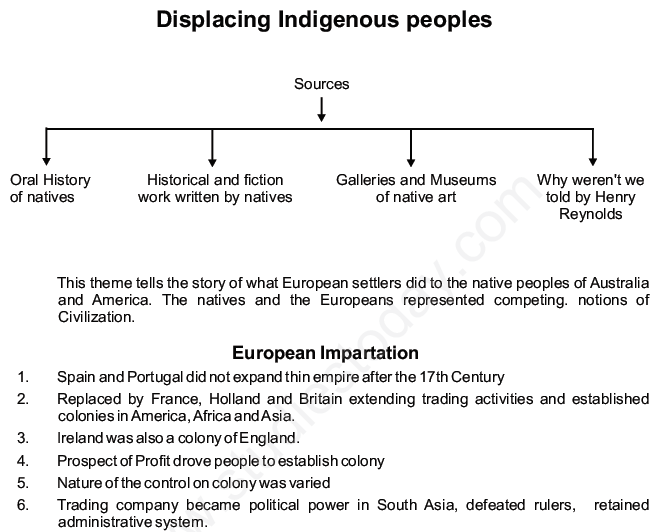
Sources
- Oral History of natives
- Historical and fiction work written by natives
- Galleries and Museums of native art
- Why weren't we told by Henry Reynolds
This theme tells the story of what European settlers did to the native peoples of Australia and America. The natives and the Europeans represented competing notions of civilization.
European Impartition
1. Spain and Portugal did not expand their empire after the 17th Century.
2. Replaced by France, Holland, and Britain extending trading activities and established colonies in America, Africa, and Asia.
3. Ireland was also a colony of England.
4. Prospect of profit drove people to establish colonies.
5. Nature of the control on colonies was varied.
6. Trading companies became political powers in South Asia, defeated rulers, and retained the administrative system.
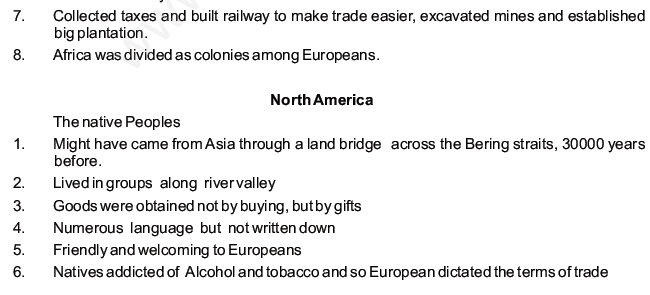
7. Collected taxes and built railways to make trade easier, excavated mines, and established big plantations.
8. Africa was divided into colonies among Europeans.
North America: The Native Peoples
1. Might have come from Asia through a land bridge across the Bering Straits, 30,000 years before.
2. Lived in groups along river valleys.
3. Goods were obtained not by buying, but by gifts.
4. Numerous languages but not written down.
5. Friendly and welcoming to Europeans.
6. Natives became addicted to alcohol and tobacco, and so Europeans dictated the terms of trade.
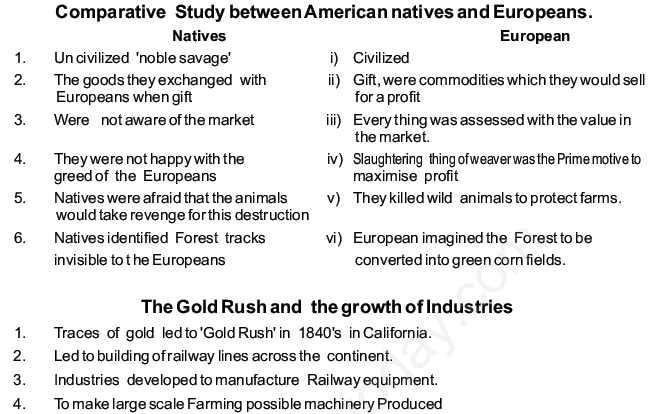
Comparative Study between American Natives and Europeans
| Natives | European |
|---|---|
| 1. Uncivilized 'noble savage' | i) Civilized |
| 2. The goods they exchanged with Europeans when given as gifts | ii) Gifts were commodities which they would sell for a profit |
| 3. Were not aware of the market | iii) Everything was assessed with value in the market |
| 4. They were not happy with the greed of the Europeans | iv) Slaughtering things or nature was the prime motive to maximize profit |
| 5. Natives were afraid that the animals would take revenge for this destruction | v) They killed wild animals to protect farms |
| 6. Natives identified forest tracks invisible to the Europeans | vi) European imagined the forest to be converted into green corn fields |
The Gold Rush and the Growth of Industries
1. Traces of gold led to the 'Gold Rush' in the 1840s in California.
2. Led to the building of railway lines across the continent.
3. Industries developed to manufacture railway equipment.
4. To make large-scale farming possible, machinery was produced.
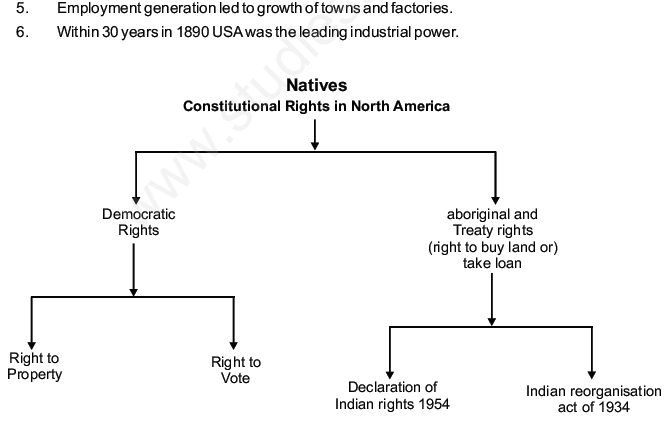
5. Employment generation led to the growth of towns and factories.
6. Within 30 years, by 1890, the USA was the leading industrial power.
Constitutional Rights in North America for Natives
- Democratic Rights (Right to Property, Right to Vote)
- Aboriginal and Treaty rights (right to buy land or take loans, Declaration of Indian Rights 1954, Indian Reorganization Act of 1934)
Australia
1. Early settlers were convicts deported from England on the condition not to return again.
2. Ejected natives from land and took over for cultivation without remorse.
3. Natives were employed in farms; later Chinese immigrants provided cheap labor.
4. Australia's non-white policy.
5. 'The Great Australian Silence' - the silence of historians about the aborigines.
6. Multiculturalism, an official policy in Australia from 1974, ensuring equal respect to all cultures.
7. White Australia policy ended in 1974 and Asian immigrants were allowed.
8. 'Terra nullius' legally invalid; recognized native claims to land from before 1770.
9. 'A National Sorry Day' as an apology for the children lost from the 1820s to the 1970s.
Model Questions & Answers
Question 1. How did expansion of USA take place?
Answer: i) Large areas were acquired by purchase, like Louisiana (1803) and Alaska (1867).
ii) By war - much of Southern USA was won from Mexico.
iii) Assigned by treaty with Great Britain in 1846.
In simple words: The USA expanded its territory through strategic land purchases, military conquest, and international treaties.
Exam Tip: Remember key years and acquisition methods (Louisiana Purchase, Mexican War, British Treaty) for full marks.
Question 2. How did USA solve the problem of slavery?
Answer: i) The northern states argued for ending slavery, which they condemned as an inhuman practice.
ii) Southern states plantation owners bought slaves from Africa to bring to the USA.
iii) Protests by anti-slavery groups led to a ban on the slave trade.
iv) Africans who were already in the USA remained slaves, as did their children.
v) In 1861-1865, a civil war took place in which the northern states won to abolish slavery.
vi) In 1968, African Americans won the battle for civil liberties.
In simple words: Slavery was legally abolished only after a bitter civil war in the 1860s, followed by decades of struggle for civil rights.
Exam Tip: Highlight the 1861-1865 American Civil War and the 1968 Civil Rights milestone.
Question 3. How did natives of North America lose their land? What were their sufferings?
Answer: i) Natives were forced to move by signing treaties or selling lands.
ii) They were cheated by taking more land or paying less.
iii) Depriving the native peoples of their land was seen as wrong.
iv) Cherokee tribe was governed by the state but could not enjoy the rights of citizens.
v) A judgment of the Chief Court stated that the Cherokee were a distinct community occupying their own territory in which the law of Georgia had no force.
vi) Andrew Jackson implemented the 'Trail of Tears'.
vii) Natives were called lazy, unskilled, and criticized for not learning English or dressing properly.
viii) They were deemed to 'deserve to die out'.
ix) They were concentrated into 'reservations'.
x) A series of rebellions were crushed.
In simple words: Native Americans suffered systemic land grabs, forced displacement (like the Trail of Tears), cultural stereotyping, and violent subjugation.
Exam Tip: Use key historical terms like 'Trail of Tears' and 'reservations' to score well.
2 Marks Questions (Unsolved - Complete Answers Provided)
Question 4. What was the White Australia Policy?
Answer: The White Australia Policy refers to a set of historical government policies that effectively barred people of non-European ethnic origin from immigrating to Australia, maintaining a predominantly white population until its dismantling starting in 1973-1974.
In simple words: It was an immigration policy that allowed only white people to settle in Australia.
Exam Tip: Mention its termination year (1974) when multiculturalism was officially adopted.
Question 5. Write two effects of the American Civil War.
Answer: 1. The total abolition of slavery across the United States.
2. Preservation of the Union, cementing the political supremacy of the federal government over individual states.
In simple words: Slavery ended and the United States remained one unified country.
Exam Tip: Clearly list two distinct political and social outcomes.
Question 6. What do you mean by Reservation?
Answer: Reservations were tracts of land set aside by the United States and Canadian governments where indigenous native tribes were forced to live after being displaced from their ancestral homelands.
In simple words: Specific areas of land where native tribes were forcibly confined by the government.
Exam Tip: Link reservations to the loss of native sovereignty and territory.
Question 7. What do you mean by 'Trail of Tears'?
Answer: The 'Trail of Tears' refers to the deadly forced relocation of Native American tribes (such as the Cherokee) from their ancestral lands in the southeastern United States to designated Indian Territory (modern-day Oklahoma) in the 1830s under President Andrew Jackson, resulting in thousands of deaths from disease, exposure, and exhaustion.
In simple words: The tragic forced march of native tribes from their homes to distant reservations.
Exam Tip: Mention President Andrew Jackson and the heavy loss of life.
Question 8. What is the meaning of 'terra nullius'?
Answer: 'Terra nullius' is a Latin expression meaning 'land belonging to no one' or 'empty land'. In Australian history, it was the legal doctrine used by British colonizers to claim ownership of the continent without treaty or compensation to the indigenous inhabitants, ignoring their prior ownership.
In simple words: A legal lie meaning 'land belonging to nobody', used by Britain to take Australia without acknowledging the natives.
Exam Tip: Define the Latin term and explain its colonial implication.
5 Marks Questions (Unsolved - Complete Answers Provided)
Question 9. Why was the history of the Australian native peoples left out of history books?
Answer: 1. Early European settlers and historians viewed indigenous Australians as 'uncivilized' and lacking a written history.
2. The doctrine of 'terra nullius' justified treating the land as vacant, rendering the natives legally and historically invisible.
3. White Australian nationalist narratives glorified pioneer settlement while deliberately ignoring massacres, dispossession, and frontier violence.
4. This widespread omission is famously known as 'The Great Australian Silence'.
In simple words: Historians ignored natives because colonial authorities wanted to justify land grabs and viewed indigenous culture as inferior.
Exam Tip: Reference 'The Great Australian Silence' to gain top marks.
Question 10. Comment on any points of difference between the native peoples of South and North America.
Answer: 1. Political Structure: South America (e.g., Aztecs, Incas) had large, centralized empires with massive urban centers, monumental architecture, and complex state apparatuses. North American natives predominantly lived in smaller, egalitarian tribal groups, confederacies, or nomadic bands.
2. Spanish vs. British Colonization: South America was conquered by Spain and Portugal, who established encomienda systems utilizing forced native labor for mining and agriculture. North America was colonized mainly by Britain and France, where settlers largely displaced or pushed natives westward rather than integrating them into a feudal labor structure.
In simple words: South American natives had large empires conquered for forced labor, while North American natives lived in smaller tribes and were displaced from their lands.
Question 11. Why did the US and Canadian Governments end all special provisions for the natives? Explain.
Answer: 1. Governments sought to assimilate indigenous peoples into mainstream capitalist society and eliminate distinct tribal identities.
2. Officials argued that special provisions and reservations segregated natives and hindered their modernization.
3. Governments wanted to gain unrestricted access to remaining reservation resources, minerals, and timber.
4. In the mid-20th century, policies shifted toward termination of tribal status to integrate natives as standard tax-paying citizens.
In simple words: Governments ended special provisions to force natives to assimilate into modern society and to access their remaining lands and resources.
Exam Tip: Focus on the concepts of assimilation and resource acquisition.
Question 12. Why did white Americans feel sympathy for the natives who simultaneously denied the benefits of citizenship?
Answer: 1. White Americans often viewed natives romantically as a 'vanishing race' doomed by the inevitable march of progress and civilization.
2. This paternalistic sympathy allowed citizens to feel emotional regret for indigenous suffering without questioning their own illegal land acquisition.
3. Granting full citizenship was seen as threatening because it would grant natives equal legal rights to disputed lands, voting power, and sovereignty.
In simple words: Americans felt sentimental pity for the 'dying' race, but refused citizenship because it would threaten their control over stolen lands.
Exam Tip: Highlight the contradiction between romanticized pity and political self-interest.
Question 13. What did the frontier mean to America?
Answer: 1. The frontier represented an expanding boundary of European-American settlement, symbolizing opportunity, freedom, and democratic expansion.
2. It embodied the myth of 'manifest destiny' - the belief that Americans were divinely ordained to expand across the North American continent.
3. Economically, it provided vast natural resources, fertile agricultural land, and mineral wealth.
4. Culturally, it shaped the American identity as rugged, self-reliant, and adventurous, though it meant violent displacement for indigenous populations.
In simple words: The frontier was a symbol of opportunity and manifest destiny for settlers, achieved at the heavy cost of native displacement.
Exam Tip: Use the term 'Manifest Destiny' and discuss both economic and cultural aspects.
10 Marks Questions (Unsolved - Complete Answers Provided)
Question 14. How can you say that the economic development of Australia under European settlement was not as varied as in America?
Answer: 1. Industrial Diversification: The USA rapidly developed heavy industries, manufacturing hubs, transcontinental railways, and technological innovations driven by the Gold Rush and a massive immigrant labor pool.
2. Agricultural vs. Pastoral Economy: Australia's economy remained heavily dependent on pastoral activities (such as sheep farming for wool) and primary resource extraction (mining) for a long time.
3. Urbanization: While the US developed numerous sprawling industrial cities across a vast continent, Australian economic development was concentrated in a few coastal cities with vast pastoral hinterlands.
4. Market Scale: The American domestic market was massive and self-sustaining, whereas Australia relied heavily on British capital and export markets.
In simple words: America quickly built a diverse industrial economy, while Australia's economy remained primarily focused on sheep farming and mining.
Exam Tip: Compare US industrialization with Australia's pastoral/mining focus.
Question 15. Why did a lot of Europeans hurry to America in the hope of making a quick fortune?
Answer: 1. Economic Hardship in Europe: High population pressures, poverty, unemployment, and landlessness in Europe drove peasants and workers to seek a better life.
2. The American Dream and Land Availability: America offered cheap or free fertile land under acts like the Homestead Act, promising upward social mobility.
3. Gold Rushes: Discoveries of gold in California (1840s) and other regions created a speculative frenzy of instant wealth.
4. Industrial Boom: Rapidly expanding factories and railway networks offered abundant wage-labor opportunities.
5. Religious and Political Freedom: Many sought escape from European religious persecution and autocratic political regimes.
In simple words: Europeans migrated to escape poverty and seize opportunities for land ownership, jobs, and gold discoveries.
Exam Tip: List push factors (poverty in Europe) and pull factors (gold, land, jobs in America).
Passage Based Questions (Based on Sydney Area Description, 1790)
Question 16. What do you mean by aboriginal production?
Answer: Aboriginal production refers to the traditional subsistence methods used by indigenous Australians, including hunting, gathering, fishing, and land management practices (such as fire-stick farming) that sustained their communities in harmony with the environment without intensive industrial agriculture.
In simple words: Traditional ways indigenous people gathered food and managed nature through hunting and gathering.
Exam Tip: Explain traditional subsistence practices like hunting and gathering.
Question 17. Who are the newcomers?
Answer: The newcomers refer to the British convicts, soldiers, and officers who arrived in Australia aboard the First Fleet in 1788 to establish the penal colony.
In simple words: British settlers and convicts who newly arrived in Australia.
Exam Tip: Identify the British colonizers and convicts.
Question 18. What were the activities of the natives?
Answer: The activities of the natives included foraging for wild plants, fishing in coastal waters and rivers, hunting native wildlife, crafting tools and weapons from wood and stone, and performing sacred rituals tied to their ancestral dreamtime.
In simple words: Natives engaged in fishing, hunting, gathering, tool-making, and cultural rituals.
Exam Tip: Mention daily subsistence tasks like fishing, hunting, and foraging.
Question 19. What is the name of the book from which this passage has been taken?
Answer: The passage is taken from the NCERT Class 11 History textbook, "Themes in World History" (Theme 10: Displacing Indigenous Peoples).
In simple words: The Class 11 NCERT History textbook.
Exam Tip: State the textbook name clearly.
Map Skill: On the outline map of Australia, place the following cities: Perth, Darwin, Adelaide, Melbourne, Canberra, Sydney.
Question 20. Map Location Guide.
Answer: - Perth: Located on the western coast of Australia.
- Darwin: Located on the northern coast of Australia.
- Adelaide: Located in South Australia along the southern coast.
- Melbourne: Located in the southeastern corner on the coast of Victoria.
- Canberra: Located inland in the Australian Capital Territory (ACT) between Sydney and Melbourne.
- Sydney: Located on the southeastern coast in New South Wales.
In simple words: Mark the major capital cities accurately along the coastal and inland regions of the Australian map.
Exam Tip: Practice locating capitals on an outline map as map pointing carries direct marks in exams.
Themes In World History Chapter 06 Displacing Indigenous Peoples Printable Assignments & Solutions for Class 11 History
Revision Assignment: Themes In World History Chapter 06 Displacing Indigenous Peoples (CBSE)
Explore reliable practice questions for Themes In World History Chapter 06 Displacing Indigenous Peoples tailored for Class 11 learners. Use these structured worksheets to evaluate preparedness and strengthen core problem-solving skills.
Key Advantages of Solving Themes In World History Chapter 06 Displacing Indigenous Peoples Assignments
- Syllabus Compliance: Sets reflect current CBSE evaluation criteria and official marking frameworks.
- Multi-Format Practice: Includes varied problem types designed to deepen comprehension across all sub-topics.
- Time Management: Routine practice optimizes pacing to finish school examinations comfortably within schedule.
Steps to Complete Themes In World History Chapter 06 Displacing Indigenous Peoples Assignments Successfully
- Textbook Review: Always study the core NCERT book for Class 11 History prior to beginning the assignment.
- Independent Attempt: Solve Themes In World History Chapter 06 Displacing Indigenous Peoples questions on your own initially before cross-checking with expert solutions.
- Error Tracking: Record challenging concepts in a dedicated notebook and practice online MCQ tests for revision.
FAQs
You can download free PDF assignments for Class 11 History Themes In World History Chapter 06 Displacing Indigenous Peoples from StudiesToday.com. These practice sheets have been updated for the 2026-27 session covering all concepts from latest NCERT textbook.
Yes, our teachers have given solutions for all questions in the Class 11 History Themes In World History Chapter 06 Displacing Indigenous Peoples assignments. This will help you to understand step-by-step methodology to get full marks in school tests and exams.
Yes. These assignments are designed as per the latest CBSE syllabus for 2026. We have included huge variety of question formats such as MCQs, Case-study based questions and important diagram-based problems found in Themes In World History Chapter 06 Displacing Indigenous Peoples.
Practicing topicw wise assignments will help Class 11 students understand every sub-topic of Themes In World History Chapter 06 Displacing Indigenous Peoples. Daily practice will improve speed, accuracy and answering competency-based questions.
Yes, all printable assignments for Class 11 History Themes In World History Chapter 06 Displacing Indigenous Peoples are available for free download in mobile-friendly PDF format.