

Download CBSE Class 11 History Assignments
Access comprehensive school assignments for Themes In World History Chapter 08 Confrontation Of Cultures using the CBSE Class 11 History Confrontation of Cultures Concepts and Assignment. Designed to align with the 2026-27 CBSE academic guidelines, these practice sets help Class 11 History students reinforce core concepts and improve their problem-solving accuracy.
Access CBSE School Assignments and Answers
Navigate directly to the solved History assignments using the digital viewer below. Each practice set includes detailed step-by-step solutions, allowing students to instantly cross-check their work and identify areas requiring further revision.
Model Questions with Answer
2 Mark Questions:
Question 1. Why South America is also called 'Latin America' ?
Answer: South America is called Latin America because:
1. Spanish and Portuguese languages are the main languages spoken across the continent.
2. These languages belong to the Latin family of languages.
In simple words: It is called Latin America because the dominant languages spoken there originate from Latin.
Exam Tip: Mention the linguistic connection to Latin to secure full marks in this short question.
Five Mark Questions:
Question 2. What were the efforts made to abolish slavery in South America ?
Answer: The historical context and efforts surrounding the abolition of slavery involved complex socio-economic developments:
1. The expansion of slavery accompanied the emerging capitalist system of production where exploitation was deemed essential to economic gain.
2. In 1601, King Philip II of Spain banned forced labour to protect indigenous populations.
3. The formal Law of 1609 abolished slavery, but European settlers strongly pressured the King to withdraw the law.
4. Due to shortages of native labor, African slaves were subsequently imported in large numbers.
5. Slavery had existed in Africa prior to the arrival of Europeans, and local African rulers sometimes traded captives in exchange for goods imported from South America.
6. Continuous moral and social reassessments of the immense suffering experienced by enslaved populations eventually paved the way for abolitionist movements.
In simple words: Although early royal decrees attempted to ban forced labour, economic interests led to the continuation of slavery via imported African labour until growing opposition challenged the system.
Exam Tip: Highlight the conflicting interests between the Spanish Crown (which occasionally tried to protect natives) and the colonial settlers who demanded cheap labor.
Ten Mark Questions:
Question 3. What had begun as uncertain voyages came to have lasting consequences for Europe, the Americas and Africa ? Explain.
Answer: The maritime explorations of the 15th and 16th centuries transformed global history through profound and lasting consequences:
1. Maritime Knowledge: 15th-century maritime projects drastically expanded geographical knowledge of sea routes and global connectivity.
2. Economic Impact: The influx of vast amounts of gold and silver into Europe fueled the expansion of international trade and early industrialization.
3. Shifting Powers: While Spain and Portugal initially dominated, they failed to fully capitalize on their profits, allowing nations like England and France to take advantage of the new discoveries.
4. Capital Formation: European nations formed joint-stock companies, financed trading expeditions, and established lucrative colonial empires.
5. Columbian Exchange: Europeans introduced new world agricultural products—such as tobacco, potatoes, cane sugar, cacao, rubber, and chillies—to global markets.
6. Tragic Human Cost: The encounters resulted in the physical decimation of local indigenous populations through warfare and European diseases, alongside the brutal enslavement of native populations and imported Africans in mines, plantations, and mills.
In simple words: Uncertain exploratory voyages triggered global trade, enriched European nations, introduced new crops, but also caused devastating loss of life and the establishment of transatlantic slave trade in the Americas and Africa.
Question 4. What are Chinampas?
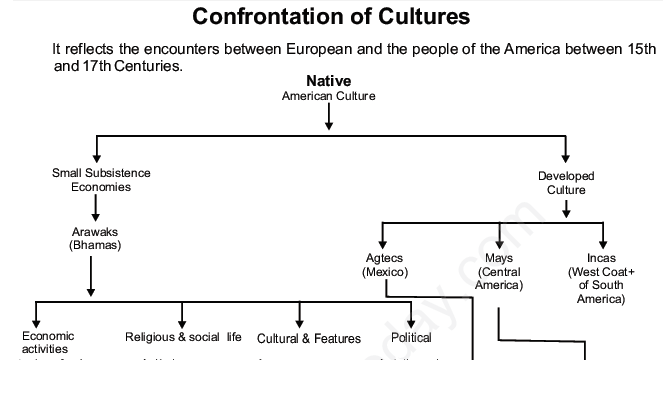
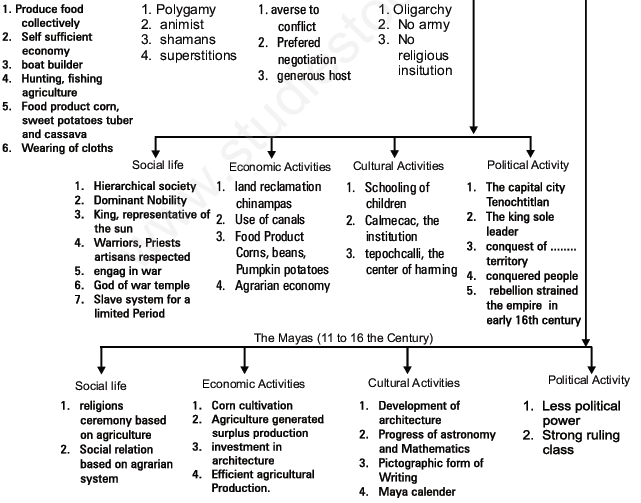
Answer: Chinampas were artificial islands constructed by the Aztecs in the shallow lake beds of the Valley of Mexico for intensive agriculture.
In simple words: They were floating garden beds used by the Aztecs to grow crops over water.
Exam Tip: Define chinampas clearly as an innovative Aztec agricultural technique.
Question 5. What do you mean by Tepochalli ?
Answer: Tepochalli was an Aztec institution or school where young commoner boys received military training and civic education.
In simple words: It was a traditional school for training Aztec youths in warfare and community duties.
Exam Tip: Distinguish Tepochalli (for commoners/military training) from Calmecac (for nobility/priests).
Question 6. What is calmecac ?
Answer: Calmecac was an exclusive Aztec school primarily attended by the sons of nobility, where they were trained to become priests, leaders, and administrators.
In simple words: It was an elite school for Aztec nobles and future leaders.
Exam Tip: Mention that it catered to the ruling elite and priesthood.
Question 7. What do you understand by Quipu ?
Answer: Quipu was a recording device made of knotted strings used by the Incas for accounting, record-keeping, and mathematical calculations.
In simple words: It was a system of colored, knotted strings used by the Incas to store numerical and administrative information.
Exam Tip: Emphasize that the Incas lacked a written script and used quipus for record-keeping.
Question 8. Who was Christopher Columbus ? How did he become famous ?
Answer: Christopher Columbus was an Italian explorer funded by the Spanish monarchs. He became famous for his 1492 voyage across the Atlantic Ocean, which marked the beginning of European exploration and colonization of the Americas.
In simple words: He was the explorer credited with reaching the Americas while searching for a western sea route to India.
Exam Tip: Note the year 1492 and his patronage by Spain.
Five Mark Questions:
Question 9. What are the special features of Maya culture ?
Answer: The special features of Maya culture include:
1. Advanced development in architecture, monumental pyramids, and urban planning.
2. Remarkable progress in astronomy, mathematics, and the creation of an accurate Maya calendar.
3. A sophisticated system of hieroglyphic writing and pictorial records.
4. An agrarian economy sustained by corn cultivation, surplus production, and advanced agricultural techniques.
In simple words: The Mayas were known for their advanced mathematics, astronomy, writing system, and monumental architecture.
Exam Tip: Bullet points highlighting astronomy, architecture, and writing are essential for full marks.
Question 10. What are the special features of the Aztecs ?
Answer: The special features of Aztec civilization include:
1. A highly structured, hierarchical society led by a king representing the sun.
2. Innovative agricultural practices such as land reclamation through chinampas and extensive canal irrigation.
3. A strong warrior tradition where priests and warriors held high social status.
4. Organized educational institutions like the Calmecac and Tepochalli for training children.
In simple words: The Aztecs built a powerful militaristic empire famous for chinampas farming, pyramids, and strict social hierarchy.
Exam Tip: Mention chinampas and their militaristic social structure.
Question 11. What are the similarities between the Aztecs and the Incas ?
Answer: Similarities between the Aztecs and the Incas include:
1. Both established highly centralized, powerful imperial states with strict hierarchical social structures.
2. Both had agrarian economies supported by intensive farming techniques (chinampas and terrace farming respectively).
3. Both civilizations were eventually conquered and dismantled by Spanish conquistadors in the 16th century.
4. Both societies relied heavily on tribute systems and organized labour from conquered populations.
In simple words: Both were large, highly organized, agricultural empires ruled by powerful elites before being conquered by the Spanish.
Question 12. How did Spain establish an Empire in America ?
Answer: Spain established its American empire through:
1. Superior military strength, firearms, gun powder, and horses which terrified indigenous populations.
2. Strategic alliances with local dissenting groups (such as Cortes befriending the Totonacs against the Aztecs).
3. Exploiting local political instability and religious beliefs (such as Montezuma mistaking Cortes for a returning deity).
4. Brutal military repression, forced labour in mines, and the devastating introduction of European diseases like smallpox.
In simple words: Spain conquered the Americas using advanced weaponry, tactical alliances with local rivals, disease, and ruthless military force.
Exam Tip: Mention weapons, horses, alliances, and disease as key factors.
Question 13. How did Pizarro capture the Incas of Peru ?
Answer: Francisco Pizarro captured the Inca Empire by taking advantage of a civil war over succession between Inca rulers, capturing the Inca emperor Atahualpa by surprise, demanding a massive ransom in gold and silver, and subsequently executing him while exploiting internal divisions within the empire.
In simple words: Pizarro captured the Inca ruler during a period of internal civil war, seized their wealth, and took control of the empire.
Exam Tip: Highlight the Inca civil war and the capture of Atahualpa.
Ten Marks Questions:
Question 14. Who was Cortes ? How did he colonise the Aztecs ?
Answer: Hernan Cortes was a Spanish conquistador who led the expedition that conquered the Aztec Empire in Mexico. His colonization process involved:
1. Landing in Mexico and forming strategic alliances with local groups like the Totonacs who opposed Aztec rule.
2. Marching on the capital Tenochtitlan, where Aztec king Montezuma initially welcomed them, fearing Cortes was an incarnation of an exile god.
3. Subduing the capital by November 1519, installing Christian images in native temples, and provoking uprisings through incessant demands for gold.
4. Surviving the mysterious death of Montezuma and subsequent outbreaks of deadly smallpox.
5. Defeating the final resistance under elected leader Cuatemoc and establishing Spanish colonial control with Cortes becoming Captain General of New Spain.
In simple words: Cortes used local alliances, Spanish weaponry, psychological advantage, and diseases to defeat the Aztecs and claim Mexico for Spain.
Exam Tip: Detail the step-by-step campaign from landing to the fall of Tenochtitlan.
Question 15. What was the process through which Cabral led to colonization of Brazil ?
Answer: Portuguese colonization of Brazil under Pedro Alvares Cabral and subsequent administrators proceeded through:
1. The accidental or exploratory discovery of Brazil by Cabral in 1500.
2. The division of the Brazilian coast by the King of Portugal into 14 hereditary captaincies to encourage settlement.
3. Granting Portuguese nobles land ownership rights and legal authority to enslave local indigenous people.
4. Establishing profitable sugar and sugarcane plantations operated by enslaved labour.
5. The active role of Jesuit missionaries in spreading Christianity, which simultaneously attempted to regulate relations and curb excessive enslavement.
In simple words: Portugal claimed Brazil, divided it into administrative captaincies, established sugar plantations using slave labour, and introduced Christianity via Jesuits.
Exam Tip: Mention the hereditary captaincies and sugar plantation economy.
Question 16. How did the 'discovery' of South America lead to the development of European colonialism ?
Answer: The discovery of South America catalyzed modern European colonialism by:
1. Opening vast new territories rich in precious metals (gold and silver) that enriched European treasuries.
2. Initiating global trade networks and the Columbian Exchange of agricultural goods and livestock.
3. Proving the viability of oceanic trade routes across the Atlantic, inspiring other European powers like England and France to establish merchant navies and joint-stock companies.
4. Promoting mercantilist economic policies centered on resource extraction, plantation agriculture, and the transatlantic slave trade.
In simple words: Finding South America proved that global oceanic empires could be built, sparking a race among European nations for wealth, colonies, and trade dominance.
Exam Tip: Connect resource extraction and mercantilism to the rise of European colonial rivalry.
Question 17. What were the factors for Spain and Portugal being the first in the 15th Century to venture across the Atlantic ?
Answer: Factors that enabled Spain and Portugal to pioneer Atlantic explorations in the 15th century included:
1. Technological advancements such as the invention of the magnetic compass, larger and sturdier ships (caravels), improved navigation equipment, and circulation of travel literature.
2. Economic pressures in Europe, including declining economies, a shortage of metallic money, and the disruption of eastern trade routes following the downfall of Constantinople.
3. Strong royal patronage and political motivation, exemplified by figures like Prince Henry the Navigator in Portugal.
4. Religious zeal to spread Christianity beyond European borders.
In simple words: New navigation technology, economic crises in Europe, blocked eastern trade routes, and royal support drove Spain and Portugal to explore the Atlantic.
Exam Tip: Categorize factors into technological, economic, political, and religious motives.
Passage Based Question
Question 18(i). Who was Dona Marina ?
Answer: Dona Marina (also known as La Malinche) was an indigenous woman from the Mexican Gulf coast who was given to Hernan Cortes as a translator and advisor.
In simple words: She was the indigenous interpreter who helped Cortes communicate with native tribes.
Exam Tip: Identify her critical role as a linguistic intermediary.
Question 19(ii). Why Dona Marina was called 'Matinche' ?
Answer: She was called 'Malinche' (or Matinche) as a corruption or indigenous phonetic adaptation of her baptismal name Marina combined with her respected status.
In simple words: It was the local pronunciation of her Spanish name Marina.
Exam Tip: Keep the explanation concise regarding her Hispanic name transformation.
Question 20(iii). Write the author's name of the 'True History of the Conquest of Mexico'.
Answer: The author of the 'True History of the Conquest of Mexico' is Bernal Diaz del Castillo.
In simple words: It was written by the Spanish soldier Bernal Diaz del Castillo.
Question 21(iv). Write the role of Dona Marina in the defeat of the Aztecs.
Answer: Dona Marina played a pivotal role in the defeat of the Aztecs by acting as Cortes's primary translator and cultural interpreter. She not only translated between Spanish and Nahuatl but also leaked critical intelligence regarding indigenous plots and political dynamics, enabling the Spanish to forge vital alliances and successfully navigate Aztec territory.
In simple words: She enabled communication and uncovered secret plots, which was vital for Cortes's military success.
Exam Tip: Highlight her dual role as interpreter and intelligence gatherer.
MAP Skill
Question 22. Locate the following cities on the outline map of South America: Santa Fe, Quito, Lima, Santiago, Buenos Aires, Rio de Janeiro.
Answer: These locations are mapped across South America as follows:
1. Santa Fe: Located in northern Argentina / central South America region.
2. Quito: Capital of Ecuador, located near the northwestern coast on the equator.
3. Lima: Capital of Peru, located on the central western coast along the Pacific Ocean.
4. Santiago: Capital of Chile, located in the central valley of Chile near the western coast.
5. Buenos Aires: Capital of Argentina, located on the southeastern coast along the Rio de la Plata.
6. Rio de Janeiro: Major coastal city in southeastern Brazil along the Atlantic Ocean.
In simple words: These are major historical and modern capitals/cities distributed across the countries of South America.
Exam Tip: Practice locating these key Andean and coastal cities on an outline map of South America.
Themes In World History Chapter 08 Confrontation Of Cultures Printable Assignments & Solutions for Class 11 History
Chapter Practice Questions for Class 11 History
Explore reliable practice questions for Themes In World History Chapter 08 Confrontation Of Cultures tailored for Class 11 learners. Use these structured worksheets to evaluate preparedness and strengthen core problem-solving skills.
Why Practice Class 11 History Assignments?
- Curriculum Standards: Assignments match modern CBSE sample formats to ensure relevant preparation.
- Thorough Revision: Detailed problem sets reinforce core concepts and eliminate conceptual weak spots.
- Execution Speed: Timed practice with assignment sets sharpens overall response timing.
Effective Strategy for Class 11 History Assignments
- Initial Reading: Begin by reading the NCERT book for Class 11 History to build a baseline understanding.
- Independent Testing: Attempt assignment questions unassisted, then verify work using provided answer keys.
- Supplementary Aids: Leverage revision notes and worksheets whenever you encounter difficult topics.
FAQs
You can download free PDF assignments for Class 11 History Themes In World History Chapter 08 Confrontation Of Cultures from StudiesToday.com. These practice sheets have been updated for the 2026-27 session covering all concepts from latest NCERT textbook.
Yes, our teachers have given solutions for all questions in the Class 11 History Themes In World History Chapter 08 Confrontation Of Cultures assignments. This will help you to understand step-by-step methodology to get full marks in school tests and exams.
Yes. These assignments are designed as per the latest CBSE syllabus for 2026. We have included huge variety of question formats such as MCQs, Case-study based questions and important diagram-based problems found in Themes In World History Chapter 08 Confrontation Of Cultures.
Practicing topicw wise assignments will help Class 11 students understand every sub-topic of Themes In World History Chapter 08 Confrontation Of Cultures. Daily practice will improve speed, accuracy and answering competency-based questions.
Yes, all printable assignments for Class 11 History Themes In World History Chapter 08 Confrontation Of Cultures are available for free download in mobile-friendly PDF format.