

Official CBSE Assignments for Class 11 History
Explore structured practice materials through the CBSE Class 11 History The Central Islamic Lands Concepts and Assignment. Tailored for Class 11 learners, utilizing these History assignments ensures thorough preparation and strengthens foundational knowledge before final CBSE evaluations.
Solved Practice Assignments for History
View or download the dedicated CBSE Class 11 History The Central Islamic Lands Concepts and Assignment resource below. Engaging with these assignments under focused study conditions ensures continuous academic progress and mastery of the 2026-27 curriculum.
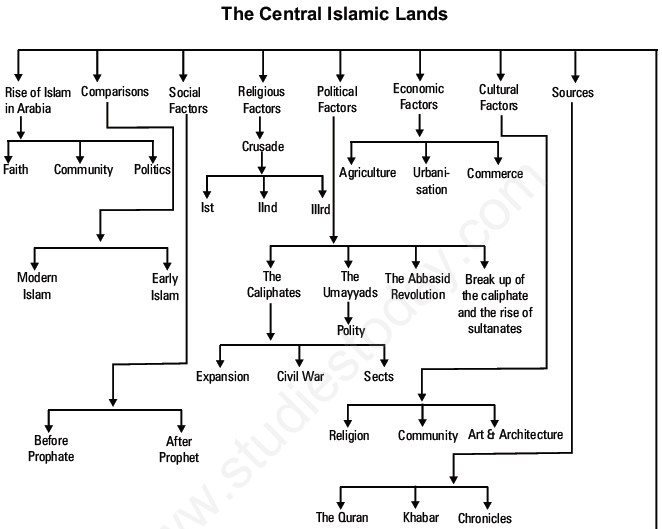
Model Question
2 Marks Questions:
Question 1. Who were the Bedouins ? Mention their two-characteristic features.
Answer: The Bedouins were Arabic nomadic tribes who moved from the dry parts of the desert to green oases in search of food and pasture for their animals.
1. They were organized into tribes called qabilas, headed by a chief chosen based on family, courage, wisdom, and generosity.
2. They practiced pastoral nomadism in the desert regions before the rise of Islam.
In simple words: The Bedouins were desert nomads who lived in tribal groups and moved around searching for food and water.
Exam Tip: Mention both their nomadic lifestyle and tribal organization (qabila) to secure full marks.
Question 2. Muhammad declared himself to be the messenger why ?
Answer: Prophet Muhammad declared himself to be the messenger (rasul) of God because he received divine revelations commanding him to preach that Allah alone should be worshipped and that all people must submit to His will.
In simple words: He received divine commands to spread the message of monotheism and devotion to Allah.
Exam Tip: Highlight the core concept of divine revelation and monotheism (worshipping Allah alone).
Question 3. Why was the civil war broke out after Muhammad's death ?
Answer: The civil war (fitna) broke out due to disputes over political succession, leadership authority, and the control of the expanding Islamic state after the death of Prophet Muhammad and the assassination of the third Caliph, Uthman.
In simple words: Civil wars occurred because of disagreements over who should lead the Muslim community and hold political power.
Exam Tip: Mention succession disputes and political leadership struggles as the primary triggers.
Question 4. What did the Umayyads do to consolidate their leadership within the Umma ?
Answer: The Umayyads consolidated their leadership by establishing a hereditary monarchy, centralizing administration at Damascus, adopting imperial administrative traditions, and maintaining military control over the garrison cities.
In simple words: They made the caliphate hereditary, set up their capital in Damascus, and strengthened their political control.
Exam Tip: Key terms to include are hereditary succession and the shift of the capital to Damascus.
Question 5. Mention two reasons responsible for the Abbasid's Revolutions.
Answer: 1. Widespread resentment among non-Arab Muslims (Mawali) against Umayyad discrimination and second-class status.
2. Effective secret organizational movements like the Dawa campaign mounted in Khorasan, which mobilized support against the Umayyad regime.
In simple words: The Abbasid revolution happened because non-Arab Muslims felt mistreated by the Umayyads and secret opposition groups successfully organized a revolt.
Exam Tip: Clearly state the grievances of the Mawali and the role of the Dawa movement.
5 Marks Questions:
Question 1. Mention the reason behind the break-up of the Caliphate and the rise of sultanate.
Answer: 1. Vast territorial expansion made direct central control from Baghdad extremely difficult.
2. Rise of regional governors (amirs) and military commanders who gained local autonomy and stopped sending regular revenues to the central caliph.
3. Emergence of Turkish military slave-soldiers (mamluks) who wielded actual military power and eventually established independent dynasties called sultanates.
4. Economic pressures and regional sectarian conflicts further fractured the unified empire.
In simple words: The massive empire became too hard to rule centrally, local commanders grew powerful, and military leaders took over to form independent sultanates.
Exam Tip: List administrative challenges, provincial autonomy, and the rise of military commanders.
Question 2. Discuss the messages and doctrines of prophet Muhammad.
Answer: 1. Monotheism: Preaching that Allah alone should be worshipped.
2. Simple Rituals: Practicing daily prayers (Salat) and giving alms (Zakat) to help the helpless.
3. Umma: Founding a community of believers bound by a common religious belief rather than tribal ties.
4. Accountability: Belief in the Day of Judgement and moral responsibility.
5. Social Equality: Appealing to the deprived sections of Meccan society by offering a new universal community identity.
In simple words: Prophet Muhammad taught belief in one God, daily prayers, charity, equality, and unity through the Umma.
Exam Tip: Structure your answer around belief in Allah, daily rituals, the Umma, and social justice.
Question 3. What were the reasons behind the Abbasids' Revolution ?
Answer: 1. The Umayyad caliphs favored Arab aristocracy, causing deep discontent among non-Arab converts to Islam (Mawali).
2. The Dawa movement, launched from the eastern province of Khorasan, systematically mobilized anti-Umayyad sentiment.
3. Shia Muslims supported the overthrow of the Umayyads, believing leadership should return to the family of the Prophet.
4. Economic grievances and heavy taxation on non-Arab subjects added to the widespread unrest.
In simple words: Non-Arab Muslims were angry about unfair treatment, and secret political movements successfully united people to overthrow the Umayyads.
Exam Tip: Emphasize the grievances of the Mawali and the strategic role of Khorasan and the Dawa movement.
Question 4. Discuss the major causes responsible for the crusade.
Answer: 1. Religious zeal in Western Europe to recapture Jerusalem and the Holy Land from Muslim control.
2. Political ambitions of European monarchs, knights, and the Papacy seeking territorial expansion and prestige.
3. The appeal by the Byzantine Empire for military assistance against the advancing Seljuk Turks.
4. Economic motives, including the desire for trade routes and wealth in the East.
In simple words: The Crusades were holy wars fought because European Christians wanted control of Jerusalem, kings sought power, and the Byzantine emperor asked for military help.
Exam Tip: Combine religious, political, and economic factors for a comprehensive answer.
Question 5. Mention five major contributions of the Arabs to the world.
Answer: 1. Preservation and translation of ancient Greek, Persian, and Indian scientific and philosophical texts into Arabic.
2. Advancements in mathematics, including the development of algebra and refinement of the numerical system.
3. Significant progress in medicine, notably through encyclopedic works like those of Ibn Sina (Avicenna).
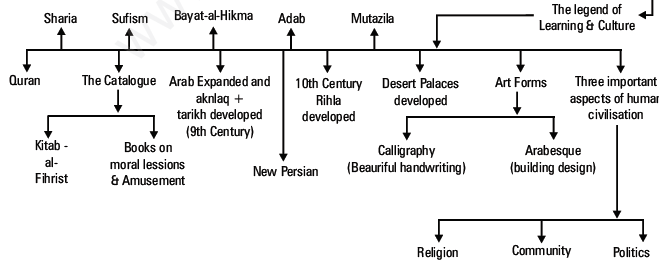
4. Development of exquisite art forms, including Calligraphy (beautiful handwriting) and Arabesque architectural designs.
5. Geographical and historical literature, including travel accounts (Rihla) and chronicles.
In simple words: Arabs contributed greatly through science, math (algebra), medicine, beautiful art and calligraphy, and historical writings.
Exam Tip: Mention specific fields like math, medicine, translation work, and art.
10 Marks Questions:
Question 1. What was the conflict named crusade ? Explain the reasons, events and consequences of the series of the crusade.
Answer: The Crusades were a series of religious wars initiated, supported, and sometimes directed by the Latin Church in the medieval period, primarily with the objective of recovering the Holy Land from Islamic rule.
Reasons:
1. Desire of European Christians to secure free access to Jerusalem and holy shrines.
2. Pope Urban II's call at the Council of Clermont in 1095 AD to unite European knights in a holy war.
3. Appeals from the Byzantine Emperor for aid against Seljuk Turkish expansion.
Events (Three Main Phases):
1. First Crusade (1098-1099 AD): European forces captured Jerusalem and established Crusader states.
2. Second Crusade (1145-1149 AD): Launched in response to the fall of Edessa, but ended in failure for the Crusaders.
3. Third Crusade (1189 AD): Triggered by the capture of Jerusalem by Saladin; involved prominent European monarchs but failed to retake the city permanently.
Consequences:
1. Intensified long-term hostility and cultural mistrust between Christian and Muslim worlds.
2. Increased trade and cultural exchange between East and West, introducing new goods and ideas to Europe.
3. Weakening of the Byzantine Empire and eventual decline of Crusader presence in the Middle East.
In simple words: The Crusades were holy wars fought between Christians and Muslims over Jerusalem. They caused immense conflict but also increased trade and cultural contact between Europe and the Islamic world.
Exam Tip: Divide your long answer clearly into definition, causes, key phases (events), and consequences to score full marks.
Question 2. 'The Muslims deepened through contact with other people as the religious and social experiences' Examine.
Answer: 1. As the Islamic empire expanded across diverse territories containing ancient civilizations, Muslims interacted with Christians, Jews, Zoroastrians, and other communities.
2. This extensive contact obliged the Muslim community to reflect upon, define, and confront complex theological, legal, and social issues concerning God, faith, and governance.
3. Intellectual traditions flourished through institutions like Bayt-al-Hikma (House of Wisdom), where Greek, Persian, and Indian philosophies were studied, debated, and integrated.
4. Social practices, administrative methods, and urban lifestyles were adapted and refined, creating a rich composite Islamic civilization.
5. The ideal conduct, scholarship, and cultural synthesis of this period became a legendary landmark of human learning and culture, encompassing Quranic studies, Sufism, legal systems (Sharia), and artistic expressions.
In simple words: By interacting with different cultures and faiths during their expansion, Muslims developed advanced scholarship, refined laws, and built a rich, diverse civilization of learning and culture.
Exam Tip: Focus on intellectual synthesis, administrative adaptation, and cultural achievements like the House of Wisdom.
Passage - based Questions
1. The Quran
Question 1(a). What do you Understand by Quran ?
Answer: The Quran is the holy scripture of Islam, considered by Muslims to be the verbatim word of God revealed to Prophet Muhammad through the angel Gabriel over a period of 23 years.
In simple words: The Quran is the holy book of Muslims containing God's direct revelations to Prophet Muhammad.
Exam Tip: Define it as the supreme divine scripture and primary source of Islamic faith.
Question 1(b). According to Muslim tradition, what do you mean by messages ?
Answer: According to Muslim tradition, 'messages' refer to the divine revelations and guidance communicated by God to Prophet Muhammad, which were subsequently memorized, recorded, and compiled into the Quran.
In simple words: Messages are the divine instructions sent down by God to the Prophet.
Exam Tip: Connect messages directly to divine revelations received by the Prophet.
Question 1(c). What kind of problem was posed in the history of early Islam ?
Answer: Early Islam faced critical problems regarding political leadership succession, governance of a rapidly expanding multi-ethnic empire, internal civil wars (fitna), and the integration of diverse non-Arab populations into the Islamic community.
In simple words: Early Islam struggled with leadership disputes, civil wars, and ruling a fast-growing empire.
Exam Tip: Mention succession disputes and administrative challenges of a growing empire.
Question 1(d). What do the theologians generally believe ?
Answer: Theologians generally believe in the absolute oneness of God (Tawhid), the finality of Prophet Muhammad's prophethood, the divine authenticity of the Quran, and the moral accountability of humans on the Day of Judgement.
In simple words: Theologians believe in one God, the final prophethood of Muhammad, and the truth of the Quran.
Exam Tip: Highlight core theological pillars such as Tawhid and prophetic finality.
2. Islamic Calendar
Question 2(a). Mention the importance of 622AD in Islamic calendar.
Answer: The year 622 AD marks the Hijra (the migration of Prophet Muhammad and his followers from Mecca to Medina), which serves as the starting year (Year 1 AH) of the Islamic lunar calendar.
In simple words: The year 622 AD is important because it marks the Prophet's journey from Mecca to Medina, which is year one of the Islamic calendar.
Exam Tip: State clearly that 622 AD is the year of the Hijra and marks the beginning of the Hijri calendar.
Question 2(b). What is the total number of days in Hijari year ?
Answer: A Hijri (Islamic lunar) year consists of 354 or 355 days, distributed over 12 lunar months.
In simple words: A Hijri year has either 354 or 355 days based on the lunar cycle.
Exam Tip: Specify that it is a lunar year consisting of 354-355 days.
Question 2(c). Why do Islamic religious festivals not correspond in any way to the seasons ?
Answer: Islamic festivals do not correspond to solar seasons because the Islamic calendar is strictly lunar (based on moon phases), making the Hijri year about 11 days shorter than the solar Gregorian year, causing festivals to shift through all seasons over a 33-year cycle.
In simple words: Islamic festivals shift through different seasons because the Islamic calendar follows the moon, making it shorter than the sun-based calendar.
Exam Tip: Explain the difference between the lunar calendar and the solar calendar.
Question 2(d). What is the meaning of Haj ?
Answer: 'Haj' means to set out for a place or to undertake a pilgrimage. In Islamic terminology, it refers to the annual pilgrimage to the holy city of Mecca, which is a mandatory religious duty for all adult Muslims who are physically and financially able.
In simple words: Haj means a pilgrimage, specifically the sacred journey to Mecca that Muslims strive to make once in their lifetime.
Exam Tip: Define both the literal meaning (pilgrimage/journey) and its religious significance.
Map Work
Question 1. On the given outline map of world, locate the following places :
a) Palestine
b) Mecca
c) Medina
d) Syria
e) Constantinople
Answer: These historical locations are to be marked on the world map as follows:
- Mecca: Located in the western Arabian Peninsula (Hejaz region).
- Medina: Located north of Mecca in the western Arabian Peninsula.
- Palestine: Located in the Levant region along the eastern coast of the Mediterranean Sea.
- Syria: Located north of Palestine in the Middle East / Levant region.
- Constantinople: Located at the strategic strait connecting the Black Sea and the Mediterranean (modern-day Istanbul, Turkey).
In simple words: Locate these key political and religious centers in the Middle East and surrounding regions on your outline map.
Exam Tip: Practice locating key Arabian and Mediterranean centers on outline maps regularly.
Question 2. On the given outline map of world. Locate the following places :
a) Arab sea
b) Caspian sea
c) Black sea
d) Transoxiana
e) Bukhara and Samarkand.
Answer: These geographical bodies and regions are to be located as follows:
- Arab Sea: Located in the northwestern part of the Indian Ocean, bordered by the Arabian Peninsula and India.
- Caspian Sea: The largest inland body of water located between Europe and Asia.
- Black Sea: Located between Eastern Europe and Western Asia, north of Turkey.
- Transoxiana: The ancient Central Asian region corresponding roughly to modern-day Uzbekistan, Tajikistan, and parts of Kazakhstan/Turkmenistan, situated between the Amu Darya and Syr Darya rivers.
- Bukhara and Samarkand: Historic oasis cities located in Transoxiana (Uzbekistan).
In simple words: Identify these major seas and Central Asian cultural centers on the world map.
Exam Tip: Clearly label water bodies and inland Central Asian cities like Bukhara and Samarkand.
Chapter Assignment & Practice Material for Class 11 History Themes In World History Chapter 04 The Central Islamic Lands
Chapter Practice Questions for Class 11 History
Review targeted chapter assignments for Class 11 History Themes In World History Chapter 04 The Central Islamic Lands. Built according to official CBSE guidelines, these downloadable problem sets help students build accuracy and prepare effectively for school tests.
Maximize Exam Scores with Chapter Practice Sets
- Curriculum Standards: Assignments match modern CBSE sample formats to ensure relevant preparation.
- Thorough Revision: Detailed problem sets reinforce core concepts and eliminate conceptual weak spots.
- Execution Speed: Timed practice with assignment sets sharpens overall response timing.
Steps to Complete Themes In World History Chapter 04 The Central Islamic Lands Assignments Successfully
- Textbook Review: Always study the core NCERT book for Class 11 History prior to beginning the assignment.
- Independent Attempt: Solve Themes In World History Chapter 04 The Central Islamic Lands questions on your own initially before cross-checking with expert solutions.
- Error Tracking: Record challenging concepts in a dedicated notebook and practice online MCQ tests for revision.
FAQs
You can download free PDF assignments for Class 11 History Themes In World History Chapter 04 The Central Islamic Lands from StudiesToday.com. These practice sheets have been updated for the 2026-27 session covering all concepts from latest NCERT textbook.
Yes, our teachers have given solutions for all questions in the Class 11 History Themes In World History Chapter 04 The Central Islamic Lands assignments. This will help you to understand step-by-step methodology to get full marks in school tests and exams.
Yes. These assignments are designed as per the latest CBSE syllabus for 2026. We have included huge variety of question formats such as MCQs, Case-study based questions and important diagram-based problems found in Themes In World History Chapter 04 The Central Islamic Lands.
Practicing topicw wise assignments will help Class 11 students understand every sub-topic of Themes In World History Chapter 04 The Central Islamic Lands. Daily practice will improve speed, accuracy and answering competency-based questions.
Yes, all printable assignments for Class 11 History Themes In World History Chapter 04 The Central Islamic Lands are available for free download in mobile-friendly PDF format.