

School Assignments for Class 11 History: Themes In World History Chapter 09 The Industrial Revolution
Access comprehensive school assignments for Themes In World History Chapter 09 The Industrial Revolution using the CBSE Class 11 History The Industrial Revolution Concepts and Assignment. Designed to align with the 2026-27 CBSE academic guidelines, these practice sets help Class 11 History students reinforce core concepts and improve their problem-solving accuracy.
Practice Class 11 History Assignments: Themes In World History Chapter 09 The Industrial Revolution
Access the complete assignment PDF for Class 11 History below. Regular practice with these targeted academic tasks builds familiarity with standard question patterns and helps secure higher marks in final school evaluations.
2 Marks Questions :
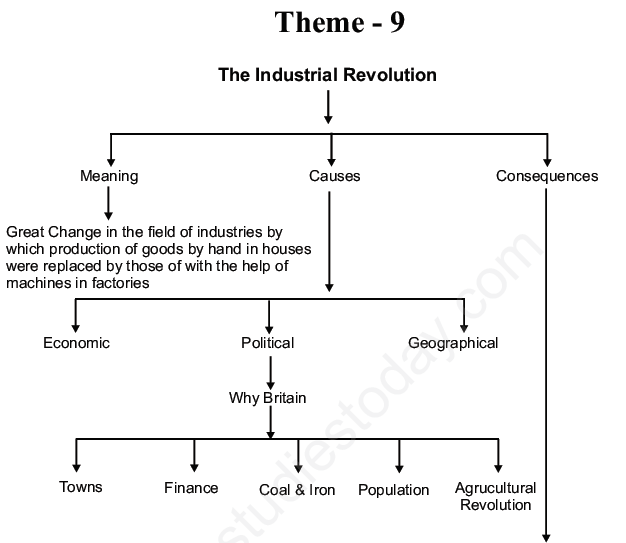
Question 1. What is meant by Industrial Revolution ?
Answer: A major change in industries by which goods produced in houses by hands were replaced by those in factories with the help of machines.
In simple words: The Industrial Revolution was the transition from hand-made goods at home to machine-made goods in factories.
Exam Tip: Mention the shift from domestic handloom/cottage production to mechanized factory production to secure full marks.
5 Marks Questions :
Question 2. Who were the inventors ?
Answer: - The inventors were mainly workers.
- Few of them were trained scientists because education in basic science was extremely limited.
- John Kay and James Hargreaves were familiar with skills of weaving and carpentry.
- Richard Arkwright was a barber and a wig maker.
- Samuel Crompton was not technically skilled.
- Edmund Cartwright studied literature.
- Thomas Savery was an army officer.
- Thomas Newcomen was a blacksmith.
In simple words: Most early inventors were practical workers and craftsmen rather than formal scientists.
Exam Tip: Highlight that practical experience and trial-and-error played a bigger role than formal scientific training during the early industrial period.
10 Marks Question :
Question 3. What were the causes of Industrial Revolution ? Why was Britain the first country to experience it ?
Answer: The causes of the Industrial Revolution may be divided under the following heads:
- Political factors
- Economic, social, and cultural factors
- Geographical factors
Britain was the first country in Europe to have all the above factors to create situations favoring the Revolution, for example:
- Political stability
- Unified under a monarchy
- Common laws
- Single currency
- Active market system
- Taxes on goods and use of money as the medium of exchange
- Wages and salaries system
- Agricultural Revolution increasing food supply
- Bank of England founded (and financial stability)
- Global significance of London as a trade hub
- Abundance of coal and iron resources
- India as a colonial market and source of raw materials
- Rapid invention of machines, introduction of railways and canals, and steam power.
In simple words: Britain led the Industrial Revolution due to political stability, rich natural resources like coal and iron, financial systems, and colonial possessions.
Exam Tip: Structure your answer under clear headings (Political, Economic, Geographical) and link each factor directly to why Britain benefited first.
2 Marks Questions :
Question 1. What do you mean by First and Second Industrial Revolution ?
Answer: The First Industrial Revolution (roughly 1760 to 1840) was centered on iron, coal, textiles, and the steam engine. The Second Industrial Revolution (from the late 19th to early 20th century) was characterized by steel production, electricity, petroleum, automobiles, and chemical industries.
In simple words: The first phase focused on steam and textiles, while the second phase focused on electricity, steel, and mass production.
Exam Tip: Distinguish the two by their core energy sources and dominant industries (Steam and Textiles vs. Electricity and Steel).
Question 2. What was Agricultural Revolution ?
Answer: The Agricultural Revolution was the period of significant agricultural development in Britain marked by enclosure movements, crop rotation (such as the Norfolk four-course system), selective breeding of livestock, and new farm machinery, which vastly increased food production and displaced rural labor.
In simple words: Better farming methods produced more food with fewer workers, pushing excess rural labor into industrial towns.
Exam Tip: Mention how the Agricultural Revolution acted as a precursor to the Industrial Revolution by supplying both food and surplus labor.
Question 3. What do you mean by Luddism ?
Answer: Luddism was a 19th-century social movement of English textile workers who destroyed machinery (such as mechanical looms and knitting frames) that they believed was threatening their jobs and livelihood, led by the mythical figure Ned Ludd.
In simple words: Luddism was a protest movement where workers smashed factory machines that took away their jobs.
Exam Tip: Define Luddism not merely as anti-technology violence, but as a protest against declining wages and worsening working conditions.
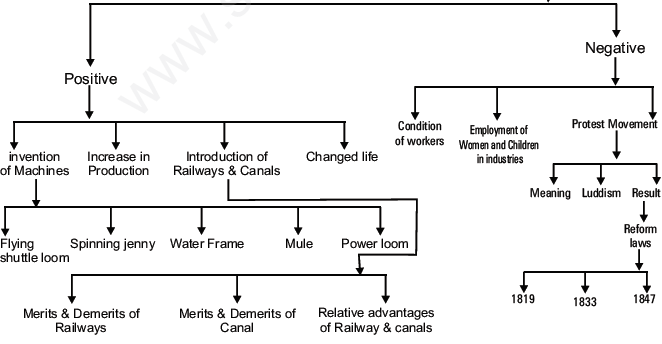
Question 4. Name the inventors of the following: Flying shuttle loom, Spinning Jenny, Water Frame, Power Loom.
Answer:
- Flying shuttle loom: John Kay (1733)
- Spinning Jenny: James Hargreaves (1765)
- Water Frame: Richard Arkwright (1769)
- Power Loom: Edmund Cartwright (1787)
In simple words: John Kay made the Flying shuttle, Hargreaves made the Spinning Jenny, Arkwright made the Water Frame, and Cartwright made the Power Loom.
Exam Tip: Memorize inventors and their exact inventions along with approximate dates for objective questions.
Question 5. Describe two advantages of introduction of Railways.
Answer:
1. Rapid and cheap transportation of bulky goods like coal, iron, and manufactured products over long distances.
2. Boosted employment, stimulated the iron and coal industries, and connected remote inland areas to major ports and markets.
In simple words: Railways made transport much faster and cheaper, helping industries grow rapidly.
Exam Tip: Keep points concise and distinct, focusing on economic connectivity and resource transport.
5 Marks Questions :
Question 1. How did iron lubricate the power of industrialisation ? Give examples.
Answer: Iron was fundamental to the Industrial Revolution because it provided the durable material required to build industrial machinery, bridges, railway tracks, steam engines, and factory structures. Unlike wood, iron could withstand extreme pressure and high temperatures. For example, Abraham Darby developed coke-smelted pig iron, which enabled the mass production of iron. This iron was subsequently used to build the world's first iron bridge at Ironbridge and to lay extensive railway networks across Britain.
In simple words: Iron was the building block of the Industrial Revolution, used to make durable machines, bridges, and railways.
Exam Tip: Use historical examples like Abraham Darby's smelting technique or iron bridges to substantiate your answer.
Question 2. Discuss the importance of coal in Industrial Revolution.
Answer: Coal was the primary energy source that drove the Industrial Revolution. Britain had abundant and easily accessible coal deposits. Coal fueled the steam engines that pumped water out of mines, powered textile machinery, and propelled locomotives and steamships. It replaced wood and charcoal as the chief fuel for metallurgical processes, allowing iron production to scale up massively without depleting forests.
In simple words: Coal was the main fuel that powered steam engines, factories, and transport systems.
Exam Tip: Emphasize coal's dual role as both an energy source for steam power and a reducing agent in iron smelting.
Question 3. Why did cotton industry symbolise British industrialisation ?
Answer: The cotton industry symbolized British industrialization because it was the first sector to fully mechanize, utilizing inventions like the Spinning Jenny, Water Frame, and Power Loom. It created the modern factory system, brought about mass production, relied heavily on imported raw cotton (often from slave plantations in America and colonies like India), and turned Britain into the workshop of the world through massive global exports of cheap finished textiles.
In simple words: The cotton industry was the first to use machines on a large scale, turning Britain into a global manufacturing giant.
Exam Tip: Mention the transition from hand spinning/weaving to factory-based mass production as the defining hallmark of the cotton sector.
Question 4. Who invented steam power ? How was it developed later ?
Answer: The early atmospheric engine was invented by Thomas Savery (1698) and improved by Thomas Newcomen (1712) primarily to pump water out of coal mines. Later, James Watt significantly developed and improved the steam engine (patented in 1769) by adding a separate condenser, which drastically reduced fuel consumption and converted reciprocating motion into rotary motion, making it adaptable to drive factory machinery and locomotives.
In simple words: Newcomen built early pumps, but James Watt improved the steam engine so it could run factory machines and trains efficiently.
Exam Tip: Clearly distinguish between Newcomen's atmospheric engine (mining pumps) and James Watt's rotary steam engine (universal power source).
Question 5. How did industrialisation change the lives of women in cities ?
Answer: Industrialization drew many women out of domestic agricultural work and into urban factories, particularly in the textile sector, where they were employed in large numbers because they could be paid lower wages than men. While employment gave women a degree of financial independence, it subjected them to grueling working conditions, long hours, health hazards, and the heavy double burden of managing factory labor alongside household and childcare responsibilities in overcrowded, unsanitary industrial cities.
In simple words: Factory work gave women independent earnings, but subjected them to low wages, long hours, and harsh living conditions.
Exam Tip: Highlight both the economic independence aspect and the severe exploitation/double burden faced by working women.
10 Marks Questions :
Question 1. Explain the relative significance of Railways and canals.
Answer: Canals were the backbone of early inland transport during the initial phase of the Industrial Revolution (late 18th century). They were exceptionally efficient for moving heavy, bulky goods like coal and iron at low cost across flat terrain, as barges could carry heavy loads pulled by horses. However, canals were slow, restricted by fixed geographical routes, prone to freezing in winter, and expensive to construct over hilly terrain.
Railways emerged in the 1830s and revolutionized transport by overcoming the geographical limitations of canals. Railways were much faster, could operate year-round regardless of weather, traverse steep inclines and tunnels, and connect inland industrial centers directly to ports and markets. While canals pioneered bulk transport, railways accelerated the pace of industrialization, integrated national markets, and became the dominant transport mode of the 19th century.
In simple words: Canals provided cheap early transport for heavy goods, but railways offered much faster, year-round transport across all terrains.
Exam Tip: Compare them on speed, cost, geographical flexibility, and historical timeline (canals first, railways later).
Question 2. Discuss in brief the results of industrialisation.
Answer: The consequences of industrialization were profound and far-reaching:
1. Economic Growth: Mass production of goods, rise of factory systems, growth of capitalism, and expansion of global trade.
2. Urbanization: Massive migration from rural areas to cities, leading to overcrowded, unsanitary urban slums lacking clean water and sanitation.
3. Social Class Structure: Emergence of a wealthy industrial bourgeoisie (capitalist class) and an impoverished industrial working class (proletariat).
4. Exploitation of Labor: Extensive use of child labor, dangerous factory environments, long working hours, and low wages.
5. Technological & Infrastructural Progress: Development of steam power, railways, canals, and telegraphs, transforming global communications.
6. Political & Social Movements: Rise of trade unions, Luddism, and reform movements advocating for labor rights and universal suffrage.
In simple words: Industrialization brought wealth, machinery, and modern cities, but also caused severe poverty, pollution, and worker exploitation.
Exam Tip: Categorize your answer into economic, social, urban, and political consequences for a well-rounded 10-mark response.
Question 3. What do you mean by Protest Movements ? What were its results ?
Answer: Protest movements during the Industrial Revolution refer to organized actions by workers and citizens against poor working conditions, low wages, high food prices, and the displacement caused by machinery. Examples include Luddism (machine-breaking), food riots, and political campaigns for workers' rights.
Results of these protest movements:
- Passage of early Factory Acts (such as the Acts of 1819, 1833, and 1847) that limited working hours for women and children.
- Legalization of trade unions (Trade Union Act) allowing collective bargaining.
- Expansion of voting rights through political reforms like the Reform Acts.
In simple words: Worker protests forced the government to pass laws limiting work hours, legalizing trade unions, and improving factory conditions.
Exam Tip: Connect worker protests directly to the legislative reforms (Factory Acts and Reform Laws) that followed.
Question 4. What was the impact of Britain's involvement in wars on industrialisation ?
Answer: Britain's prolonged wars, particularly the Napoleonic Wars against France (1793-1815), had a complex impact on its industrialization:
- Stimulated heavy industries: Government demand for weaponry, ammunition, uniforms, and iron cannon spurred iron production, coal mining, and engineering innovations.
- Trade disruptions: Blockades and naval warfare temporarily disrupted European export markets and grain imports, causing economic strains.
- Financial strain: High government borrowing and national debt increased taxation, yet the Bank of England and financial systems adapted to fund wartime military expansion.
- Technological incentive: Wartime labor shortages further encouraged mechanization in textile and manufacturing factories.
In simple words: Wars increased the demand for iron and weapons, boosting heavy industries, though blockades and taxes created economic challenges.
Exam Tip: Highlight both the positive stimulus on heavy industries/weapons and the negative disruptions to foreign trade.
Question 5. What are the Reform Laws. Explain with example.
Answer: Reform laws were legislative acts passed by the British Parliament in the 19th century to regulate factory conditions, curb extreme worker exploitation, and address social grievances arising from industrialization. Key examples include:
- The Factory Act of 1819: Prohibited the employment of children under 9 in cotton mills and limited work hours for older children.
- The Factory Act of 1833: Prohibited night work for children under 18, restricted daily hours for children, and established factory inspectors to enforce the law.
- The Ten Hours Act of 1847: Limited the working hours of women and teenagers under 18 in textile factories to ten hours a day.
In simple words: Reform laws were government acts passed to protect child workers and limit long working hours in factories.
Exam Tip: Quote specific years (1819, 1833, 1847) and their core provisions regarding children and working hours.
Hot Questions
2 Marks Questions :
Question 1. Why the word 'industrial' used with the word 'revolution' is too limited ? Give two reasons.
Answer:
1. It implies only manufacturing changes, whereas the transformation also revolutionized agriculture, transport (railways/canals), and finance.
2. It overlooks profound social, cultural, and demographic changes, such as mass urbanization, class stratification, and changes in family life.
In simple words: The term is too narrow because the changes affected farming, transport, and society, not just factories.
Exam Tip: Argue that the revolution transformed entire societies and economies, making 'industrial' an incomplete descriptor.
Question 2. Why were women and children employed in factories ? Give two reasons.
Answer:
1. They could be paid significantly lower wages than adult male workers, reducing production costs.
2. Their small stature and nimble fingers made them ideal for crawling under or operating delicate machinery like spinning frames and piecing broken threads in textile mills.
In simple words: Women and children were hired because they were paid less and their small hands were useful for working with machines.
Exam Tip: Focus on economic motives (low wages) and physical advantages (small size for tight machinery spaces).
Question 3. How coal mines were dangerous places to work in ?
Answer: Coal mines were extremely perilous due to frequent roof collapses, explosions of toxic gases (firedamp), suffocation from lack of oxygen (blackdamp), flooding, and injuries from heavy coal-carrying carts operated often by women and children in cramped shafts.
In simple words: Coal mines had constant risks of cave-ins, gas explosions, floods, and suffocation.
Exam Tip: Mention specific mining hazards like toxic gases, cave-ins, and darkness.
Question 4. How did Charles Dickens describe pollution in the new industrial towns ?
Answer: Charles Dickens, in novels like *Hard Times*, vividly described industrial towns (fictional Coketown) as grim places smothered by endless black smoke from factory chimneys, rivers polluted with foul industrial effluent, and monotonous red-brick buildings where soot coated everything, symbolizing the soul-crushing nature of industrialization.
In simple words: Dickens described industrial towns as smoky, polluted places covered in soot and grime from factory chimneys.
Exam Tip: Reference literary critique (like Charles Dickens) to show the social and environmental impact of industrial towns.
Question 5. How was revolution brought about in metallurgical industry ?
Answer: The metallurgical revolution was brought about by Abraham Darby's invention of coke-smelting (using coal-derived coke instead of charcoal), Henry Cort's puddling process to turn pig iron into malleable wrought iron, and the invention of hot blast techniques, which vastly improved iron purity and production capacity.
In simple words: The iron industry was revolutionized by using coke instead of charcoal and inventing new smelting and purification methods.
Exam Tip: Mention key metallurgical innovators: Abraham Darby (coke smelting) and Henry Cort (puddling process).
5 marks Questions :
Question 1. How was child labour prevalent in the new industries and factories ?
Answer: Child labor was rampant in early factories, coal mines, and textile mills. Children as young as five or six worked 12 to 14 hours a day under harsh conditions. In textile mills, they worked as 'piecers,' leaning over spinning machines to tie broken threads, risking loss of fingers or limbs. In coal mines, 'trappers' sat in total darkness opening ventilation doors, and 'hurriers' dragged heavy coal carts through low tunnels. They faced brutal physical punishment, malnutrition, and stunted physical development.
In simple words: Young children worked long, dangerous hours in factories and mines, facing injuries and harsh punishment.
Exam Tip: Describe specific job roles (piecers, trappers, hurriers) to demonstrate deep knowledge of child labor practices.
Question 2. 'The machines in the factories of Lancashire and Birmingham were run in India' Explain.
Answer: This statement highlights the colonial economic relationship between Britain and India. British industrial centers like Lancashire (textiles) and Birmingham (metal goods) depended heavily on India as both a supplier of cheap raw materials (raw cotton) and a captive market for finished British machine-made goods. Indian traditional handicrafts were systematically ruined by discriminatory tariffs and cheap British imports, meaning Indian agriculture and resources indirectly fueled and sustained British factory production.
In simple words: British factories survived on raw materials from India and sold their machine-made products back to Indian markets.
Exam Tip: Explain the drain of wealth and the colonial loop: raw cotton from India to Britain, finished cloth back to India.
Question 3. 'The Factory workers were living in death ? Do you agree ? Give reasons for your answer.
Answer: Yes, the phrase aptly reflects the grim reality of factory workers who endured living and working conditions that severely compromised their health and life expectancy. Reasons include:
- Unsanitary, overcrowded urban slums lacking clean drinking water and sewage systems.
- Rampant spread of fatal diseases like cholera, tuberculosis, and typhus.
- Dangerous factory machinery lacking basic safety guards, causing mutilation or death.
- Toxic work environments filled with cotton dust, coal soot, and chemical fumes causing chronic lung diseases.
- Extremely low life expectancy among the urban working class compared to rural populations.
In simple words: Workers lived in disease-ridden slums and faced dangerous, unhealthy factory conditions that drastically shortened their lives.
Exam Tip: Support your agreement with specific living condition evidence (slums, waterborne diseases, industrial accidents).
Question 4. What steps were taken to improve the condition of the factory workers ?
Answer: Several steps were taken by reformers, trade unions, and the British Parliament to improve worker conditions:
- Enactment of Factory Acts (1819, 1833, 1847) restricting working hours for women and children and setting minimum working ages.
- Appointment of factory inspectors to enforce safety and labor laws.
- Legalization of trade unions, allowing workers to bargain for better wages and safer conditions.
- Public health acts and municipal reforms to improve urban sanitation, housing, and clean water supply.
In simple words: The government passed labor laws, sent inspectors, and legalized trade unions to protect workers.
Exam Tip: List legislative interventions (Factory Acts) and collective action (trade unions) as the primary remedial steps.
Question 5. How did French Revolution and Napoleonic wars affect French industries and factories ? Why ?
Answer: The French Revolution and subsequent Napoleonic Wars initially delayed French industrialization compared to Britain. The reasons include political instability, destruction of infrastructure, loss of colonial trade due to British naval blockades, and shortage of capital and coal resources. However, wartime military demands eventually stimulated certain metallurgical and chemical sectors, though overall industrial modernization in France lagged behind Britain until the mid-19th century.
In simple words: Wars and political turmoil delayed French industrial growth by disrupting trade and destroying infrastructure.
Exam Tip: Contrast France's delayed industrialization with Britain's rapid wartime expansion due to political instability and naval blockades.
10 Marks Questions :
Question 1. How the term 'Industrial Revolution' has been challenged ? Explain with example.
Answer: Economic historians like Sir John Clapham and later scholars have challenged the term 'Industrial Revolution' on several grounds:
1. Gradualism vs. Sudden Change: The word 'revolution' implies a sudden, dramatic upheaval. In reality, economic transformation was extremely gradual, spread over more than a century (1760-1850).
2. Sectoral Unevenness: Rapid mechanization was concentrated primarily in cotton and iron industries. Traditional industries, handloom weaving, and agriculture modernized at a much slower pace.
3. Regional Disparities: Industrialization was localized in specific regions like Lancashire, Yorkshire, and the Midlands, while large parts of Britain remained rural and untouched by factories for decades.
Example: Even in the 1850s, a vast majority of workers in Britain were still employed in domestic service, agriculture, or small workshops rather than large steam-powered factories.
In simple words: Historians argue it was not a sudden 'revolution' because industrial growth was slow, uneven, and limited to certain regions and sectors.
Exam Tip: Use the arguments of gradualism, uneven sectoral growth, and regional concentration to effectively critique the term 'Industrial Revolution'.
Question 2. How would you explain the various consequences of Industrial Revolution ? Give a critical analysis.
Answer: A critical analysis of the Industrial Revolution reveals a complex duality of unprecedented progress and deep human suffering:
- Economic & Technological Triumph: It laid the foundations of modern capitalist economies, mass production, global trade networks, and remarkable technological milestones like steam engines and railways.
- Social Inequality & Exploitation: It created a severe class divide between the wealthy bourgeoisie and impoverished proletariat, normalizing child labor and harsh working hours.
- Urban Degradation: Rapid, unplanned urbanization led to squalid slums, severe pollution, and public health crises.
- Long-term Benefits: Ultimately, the abuses of the Industrial Revolution catalyzed modern labor laws, trade unionism, universal education, and democratic reforms, demonstrating that progress came at an immense human cost before corrective social policies were instituted.
In simple words: The Industrial Revolution brought massive economic and technical progress, but caused severe social suffering and pollution before labor reforms improved conditions.
Exam Tip: Provide a balanced critical analysis by weighing economic achievements against social costs and subsequent reform movements.
Download Practice Assignments: Class 11 History Themes In World History Chapter 09 The Industrial Revolution
Chapter Practice Questions for Class 11 History
Explore reliable practice questions for Themes In World History Chapter 09 The Industrial Revolution tailored for Class 11 learners. Use these structured worksheets to evaluate preparedness and strengthen core problem-solving skills.
Why Practice Class 11 History Assignments?
- Curriculum Standards: Assignments match modern CBSE sample formats to ensure relevant preparation.
- Thorough Revision: Detailed problem sets reinforce core concepts and eliminate conceptual weak spots.
- Execution Speed: Timed practice with assignment sets sharpens overall response timing.
Effective Strategy for Class 11 History Assignments
- Textbook Review: Always study the core NCERT book for Class 11 History prior to beginning the assignment.
- Independent Attempt: Solve Themes In World History Chapter 09 The Industrial Revolution questions on your own initially before cross-checking with expert solutions.
- Error Tracking: Record challenging concepts in a dedicated notebook and practice online MCQ tests for revision.
FAQs
You can download free PDF assignments for Class 11 History Themes In World History Chapter 09 The Industrial Revolution from StudiesToday.com. These practice sheets have been updated for the 2026-27 session covering all concepts from latest NCERT textbook.
Yes, our teachers have given solutions for all questions in the Class 11 History Themes In World History Chapter 09 The Industrial Revolution assignments. This will help you to understand step-by-step methodology to get full marks in school tests and exams.
Yes. These assignments are designed as per the latest CBSE syllabus for 2026. We have included huge variety of question formats such as MCQs, Case-study based questions and important diagram-based problems found in Themes In World History Chapter 09 The Industrial Revolution.
Practicing topicw wise assignments will help Class 11 students understand every sub-topic of Themes In World History Chapter 09 The Industrial Revolution. Daily practice will improve speed, accuracy and answering competency-based questions.
Yes, all printable assignments for Class 11 History Themes In World History Chapter 09 The Industrial Revolution are available for free download in mobile-friendly PDF format.