

School Assignments for Class 6 English: Pronouns
Review targeted academic assignments with the CBSE Class 6 English Pronouns. Built according to official CBSE standards for the 2026-27 term, these downloadable Class 6 English worksheets support effective daily practice for Pronouns.
Practice Class 6 English Assignments: Pronouns
View or download the dedicated CBSE Class 6 English Pronouns resource below. Engaging with these assignments under focused study conditions ensures continuous academic progress and mastery of the 2026-27 curriculum.
Pronoun
Pronouns are words that take the place of nouns in a sentence.
Example.
Ruhail is an intelligent student. He goes to school daily. He studies a lot. He is making preparation for examination. He will get high marks examination. In the above paragraph pronoun “he” is used instead of noun “Ruhail”. If we do not use pronoun in above paragraph we will have to use the noun “Ruhail” again and again in each sentence. So, the purpose of pronoun is to avoid the repetition of a noun.
Examples. He, she, it, they, you, I, we, who, him, her, them, me, us, whom, his, its, their, your, mine, our and whose, myself, himself, herself, yourself, which, this, that these, those, are the pronouns which are mostly used.
Pronoun can be divided into following groups.
· Personal Pronouns: e.g. I, you, He, she, it, they, who, me, him, her, them, whom
· Possessive Pronouns: e.g. yours, mine, his, hers, ours, theirs,
· Reflexive Pronouns: e.g. myself, himself, herself, itself, yourself, ourselves, themselves
Personal Pronouns
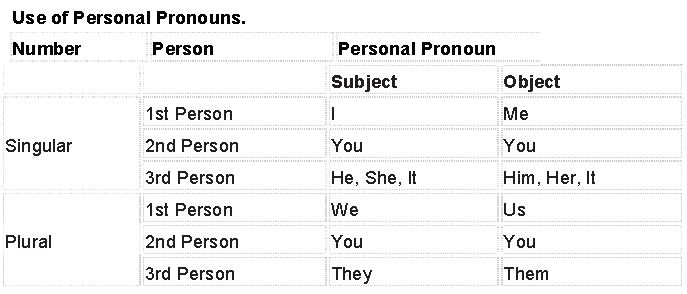
Personal pronoun describes a particular person or thing or group.
Personal pronoun describes the person speaking (I, me, we, us), the person spoken to (you), or the person or thing spoken about (he, she, it, they, him, her, them).
Example.
He helps poor.
The pronoun “he” in above sentence describes a person who helps poor.
Examples.
She is intelligent
They are playing chess.
He sent me a letter.
It is raining.
We love our country.
The teacher appreciated them.
I met him yesterday.
He gave her a gift.
Did you go to home?
Possessive Pronouns
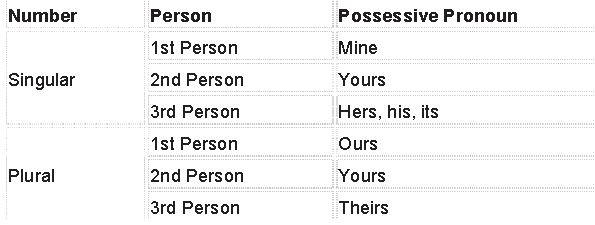
Possessive Pronoun indicates close possession or ownership or relationship of a
thing/person to another thing/person.
e.g. yours, mine, his, hers, ours, theirs, hers,
Example.
This book is mine.
The pronoun “mine” describes the relationship between book and a person (me) who
possesses this book or who is the owner of this book
Examples.
That car is hers.
Your book is old. Mine is new.
The pen on the table is mine.
The smallest cup is yours.
The voice is hers.
The car is ours not theirs.
I have lost my camera. May I use yours?
They received your letter. Did you received theirs.
Note: Possessive adjectives (my, her, your) may be confused with possessive pronouns. Possessive adjective modifies noun in terms of possession. Both
possessive adjective and possessive pronoun show possession or ownership, but possessive adjective is used (with noun) to modify the noun while Possessive pronoun is used instead (in place of) a noun.
Examples.
This is my book. (Possessive adjective: “my” modifies the noun “book”)
This book is mine. (Possessive pronoun: “mine” is used instead of noun “to whom the book belongs”)
Reflexive Pronoun.
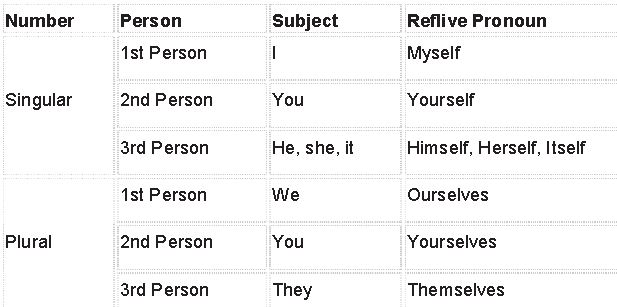
Reflexive pronoun describes noun when subject’s action affects the subject itself. e.g himself, yourself, herself, ourselves, themselves, itself are reflexive pronouns.
Reflexive pronouns always act as objects not subjects, and they require an interaction between the subject and an object.
Examples.
I looked at myself in the mirror.
You should think about yourself.
They prepared themselves for completion.
She pleases herself by think that she will win the prize.
He bought a car for himself.
He locked himself in the room.
He who loves only himself is a selfish
A. Pick out the pronouns and write their kinds-
1. This bicycle is mine
Answer : Possessive Pronoun
2. We often have to blame ourselves for our failure.
Answer : Reflexive Pronoun
3. These are cricket players.
Answer : Demonstrative Pronoun
4. He himself offered to help me.
Answer : Emphatic Pronoun
5. Whose book is this?
Answer : Interrogative Pronoun
B. Identify whether the underlined pronouns are reflexive or emphatic-
1. She herself told me this.
Answer : Emphatic Pronoun
2. The writer expresses himself perfectly.
Answer : Reflexive Pronoun
3. The children hurt themselves accidentally.
Answer : Reflexive Pronoun
4. I myself believe so.
Answer : Emphatic Pronoun
5. “You must complete the work yourself”, said my mother.
Answer : Reflexive Pronoun
C. Transform each sentence using Possessive Pronouns-
Example- That is their house.
Ans- That house is theirs.
1. Those are my pens.
Answer : Those pens are mine.
2. This was his room.
Answer : This room was his.
3. This is your table.
Answer : This table is yours.
4. This is our kitchen.
Answer : This kitchen is ours.
Reflexive and intensive pronouns for Class 6 English
Question. One person who made ....... a career based on the sea was Rachel Carson.
(a) himself
(b) herself
(c) itself
(d) myself
Answer. B
Question. Deep-sea divers wear wetsuits to protect ....... under the water.
(a) ourselves
(b) yourselves
(c) themselves
(d) itself
Answer. C
Question. If you were a diver, you would buy ....... a JIM suit or helmet.
(a) myself
(b) himself
(c) yourself
(d) herself
Answer. C
Question. Divers use external air supplies to enable ....... to breathe under water.
(a) ourselves
(b) yourselves
(c) himself
(d) themselves
Answer. D
Question. Decompression sickness manifests ....... with joint pain, and it can be fatal.
(a) myself
(b) herself
(c) itself
(d) himself
Answer. C
Question. Rachel Carson's first book, Under the Sea-Wind, described struggles sea creatures find ....... facing.
(a) ourselves
(b) yourselves
(c) themselves
(d) itself
Answer. C
Question. Rachel Carson's life was marked with conservation efforts that we ....... can learn from.
(a) ourselves
(b) yourselves
(c) themselves
(d) herself
Answer. A
Question. Rachel Carson put on a diver's helmet and explored the reefs of the Florida Keys for ........
(a) myself
(b) himself
(c) herself
(d) ourself
Answer. C
Question. The bends occurs when divers raise ....... to the top too quickly.
(a) ourselves
(b) themselves
(c) yourselves
(d) itself
Answer. B
Question. A diver must supply ....... with a mixture of oxygen and different gasses.
(a) himself
(b) itself
(c) yourself
(d) myself
Answer. A
First Ford
Henry Ford built one of the world’s fi rst automobiles. What did he call his first car?
To answer the question, fi nd the possessive pronoun in each set of pronouns below. Write the letter of the possessive pronoun in the space above its line number at the bottom of the page.
1.
S. me
I. mine
L. somebody
R. you
Answer. I
2.
U. it
H. she
T. you
A. ours
Answer. A
3.
N. each
D. they
W. him
R. its
Answer. R
4.
E. yours
N. us
S. nothing
R. anyone
Answer. E
5.
A. nobody
U. hers
E. they’re
H. he
Answer. U
6.
N. anything
S. we
L. your
C. himself
Answer. L
7.
O. whom
H. something
D. my
P. both
Answer. D
8.
C. I
M. someone
T. who
Q. their
Answer. Q
9.
Y. his
K. everybody
S. them
I. it’s
Answer. Y
10.
S. you’re
J. all
C. whose
R. nobody
Answer. C
Long Life
This is one of the few animals in the world that has a longer average life span than people. What is the name of this animal?
To answer the question, complete each sentence below by choosing the correct possessive pronoun. Choose your answers from the pronouns that follow each sentence. Write the letter of each answer in the space above its sentence number at the bottom of the page. You will need to divide the letters into words.
1. My group was preparing for __________ presentation about preserving the environment for wildlife.
E. our
N. ours
Answer. E
2. I thought that all of the group members had __________ information ready.
U. their
H. they’re
Answer. U
3. “__________ folder is on the table?” I asked.
K. Who’s
O. Whose
Answer. O
4. “That folder is __________ ,” said Maria.
E. my
L. mine
Answer. L
5. After Maria got her folder, Natalie couldn’t fi nd __________ .
R. hers
S. her
Answer. R
6. “__________ folder is on the desk at the back of the room,” Tom said to Natalie.
X. Your
Y. You’re
Answer. X
7. Natalie started the presentation with __________ concerns about the environment.
D. hers
T. her
Answer. T
8. I followed with __________ part of the presentation.
M. mine
T. my
Answer. T
9. Our fi rst slide was of a lake with __________ blue water.
T. it’s
B. its
Answer. B
Out in the Wilderness
This wilderness area was established as the fi rst national park in 1872. What is the name of this park?
To answer the question, read the sentences below. Find the possessive pronouns and determine whether they are used correctly. If the possessive pronouns are used correctly, write the letter for “correct” in the space above the sentence number at the bottom of the page. If at least one possessive pronoun in a sentence is used incorrectly, write the letter for “incorrect.” You will need to reverse the word.
1. Randy and his family went camping last weekend in one of our country’s national parks.
T. Correct
N. Incorrect
Answer. T
2. They loaded they’re gear in the back of the family’s van.
L. Correct
N. Incorrect
Answer. N
3. Randy compared his new knapsack to his sister’s old one, and found that his was bigger than hers.
S. Correct
I. Incorrect
Answer. S
4. She said, “But mine has more compartments.”
W. Correct
R. Incorrect
Answer. W
5. “Who’s bag is this?” asked their father.
D. Correct
O. Incorrect
Answer. O
6. “Its mine,” said Randy.
R. Correct
E. Incorrect
Answer. E
7. “Be sure to get all of you’re things,” said their father.
S. Correct
Y. Incorrect
Answer. Y
8. “I have all my stuff,” said Randy, ready to leave.
L. Correct
F. Incorrect
Answer. L
Towering Volcano
Rising seventeen miles from the surface of the planet, with a crater fi fty miles wide, this volcano on Mars is thought to be the biggest in our solar system.
What is its name?
To answer the question, match each contraction on the left with the words from which it is formed on the right. Write the letter of your answer in the space above the contraction’s number at the bottom of the page.
Contractions Words
1. you’re P. who is
2. it’s M. you would
3. she’ll O. he would
4. they’re U. you are
5. I’m N. I have
6. you’d S. she will
7. they’ve Y. we will
8. who’s L. they are
9. he’d O. it is
10. I’ve M. they have
11. we’ll S. I am
Answer. U 2. O 3. S 4. L 5. S 6. M 7. M 8. P 9. O 10. N 11. Y
Free study material for English
Download Practice Assignments: Class 6 English Pronouns
Download Assignment: Pronouns (Class 6 English)
Review targeted chapter assignments for Class 6 English Pronouns. Built according to official CBSE guidelines, these downloadable problem sets help students build accuracy and prepare effectively for school tests.
Why Practice Class 6 English Assignments?
- Syllabus Compliance: Sets reflect current CBSE evaluation criteria and official marking frameworks.
- Multi-Format Practice: Includes varied problem types designed to deepen comprehension across all sub-topics.
- Time Management: Routine practice optimizes pacing to finish school examinations comfortably within schedule.
How to Approach English Pronouns Assignments
- Textbook Review: Always study the core NCERT book for Class 6 English prior to beginning the assignment.
- Independent Attempt: Solve Pronouns questions on your own initially before cross-checking with expert solutions.
- Error Tracking: Record challenging concepts in a dedicated notebook and practice online MCQ tests for revision.
FAQs
You can download free PDF assignments for Class 6 English Pronouns from StudiesToday.com. These practice sheets have been updated for the 2026-27 session covering all concepts from latest NCERT textbook.
Yes, our teachers have given solutions for all questions in the Class 6 English Pronouns assignments. This will help you to understand step-by-step methodology to get full marks in school tests and exams.
Yes. These assignments are designed as per the latest CBSE syllabus for 2026. We have included huge variety of question formats such as MCQs, Case-study based questions and important diagram-based problems found in Pronouns.
Practicing topicw wise assignments will help Class 6 students understand every sub-topic of Pronouns. Daily practice will improve speed, accuracy and answering competency-based questions.
Yes, all printable assignments for Class 6 English Pronouns are available for free download in mobile-friendly PDF format.