

Conduct of Examinations for Class IX and Class XI has been revised and shall be as under :
1. The Examination Date and Duration have been changed. The Examination shall now be held on
16th February,2013 (Saturday) from 10.00 AM to 12.00 Noon in all schools except the schools
falling in Winter Bound areas.
2. The sample question paper of Problem Solving Assessment for classes IX and XI and sample OMR
sheet is available on CBSE website www.cbse.nic.in under Academic Section.
3. The examination shall be conducted in the school.
4. Candidates shall appear against their Registration No. issued earlier.
Problem Solving Assessment
Sample Question Paper
Class-XI
Maximum Marks: 90
Test Booklet Code: P1 No.: 8888888
Time Allowed: Two hours
This Test Booklet contains 20 pages. Do not open this Test Booklet until you are asked to do so.
Important Instructions:
- The Answer Sheet is inside this Test Booklet. When you are directed to open the Test Booklet, take out the Answer Sheet and fill in the particulars on Side-1 and Side-2 carefully with blue/black ball point pen only.
- The Test Booklet Code for this Test Booklet is P1. The Candidate should check carefully that the Test Booklet Code printed on Side-2 of the Answer Sheet is the same as printed on Test Booklet. In case of discrepancy, the candidate should immediately report the matter to the invigilator for replacement of both the Test Booklet and the Answer Sheet.
- The Test Booklet contains 60 questions divided into three sections A, B and C. A candidate is required to attempt all the three sections. There are 24 questions in section A, 18 Questions in section B and 18 questions in section C.
Section A : Language Conventions (Question Nos 1 to 24) - To be attempted either from English Language or from Hindi Language
Section B : Qualitative Reasoning (Questions 25 to 42)
Section C : Quantitative Reasoning (Questions 43 to 60) - All the three sections contain Multiple Choice Questions (MCQs). Some of these questions are passage based MCQs whereas others are stand alone MCQs. Each of these questions has four options out of which only ONE option is correct. A candidate has to select the correct option and fill the corresponding number in the Answer Sheet against the question.
- Each Question carries 1 ½ marks. For each correct response, the candidate will get 1 ½ marks. There is no negative marking for any of the questions and unattempted question earns no mark.
- The candidates should not leave the Examination Hall without handing over their Answer Sheet to the Invigilator on duty and sign the Attendance Sheet. Cases where a candidate has not signed the Attendance Sheet or the Answer Sheet not handed over to the Invigilator shall be dealt as an Unfair means case.
- On completion of the test, the candidates MUST HAND OVER THE ANSWER SHEET TO THE INVIGILATOR in the room/hall. The candidates are allowed to take away this Test Booklet with them.
- Use blue/ black ball point pen only for writing particulars on this page and writing or marking responses on Answer Sheet.
- The candidates should ensure that the answer sheet is not folded or damaged. Do not make any stray marks on the answer sheet.
- The candidates are governed by all Rules and Regulations of the Board with regard to their conduct in the Examination Hall. All cases of unfair means will be dealt with as per Rules and Regulations of the Board.
Registration No : ---------------------------------
Candidate's Name : ----------------------------------
Candidate's Signature : --------------------------- Invigilator's Signature : --------------
Section A (Language Conventions)
Note: This section of the question paper contains 24 questions each in English Language and Hindi Language. A candidate is required to attempt all the 24 questions in one language only (Either in English Language or in Hindi Language).
English Language Questions 1 to 24
(Questions 1 to 8) Read the following passage carefully and select the most suitable option from each list according to the corresponding number in the passage.
For Ananya, Mathematics was extremely (1) hard to understand. In order to keep her results high enough to succeed and to satisfy her parents, Ananya attempted a number of strategies (2). The answer (3) though (4) was simple. She had to work constantly and dilajentley (5) at applying the different formulas to a range of contexts (6). Often she was envious of (7) her peers to whom comprehension came easily. However, at the end of the year, it seemed her relentless work was rewarded (8) when her results put her amongst the leading scholars of her class.
Q.1 Which of these would be the best word to use to replace the word 'extremely' as it is used in the passage above? [1½ Marks]
1) vastly
2) mostly
3) especially
4) massively
Answer: 3) especially
1. 'Extremely hard' means hard to a very high degree.
2. 'Especially' can replace it as an intensifier without changing the meaning; 'vastly' and 'massively' are used for size or amount, and 'mostly' means mainly.
3. Hence, the correct option is 3.
Teacher's Note:
a) Replace the word in the sentence and read it aloud; only one option sounds natural.
Q.2 Which of these is closest in meaning to 'strategies' as used in the passage above? [1½ Marks]
1) rules
2) questions
3) approaches
4) instructions
Answer: 3) approaches
1. Ananya tried different plans to improve her results.
2. A strategy is a plan or method, so 'approaches' is the closest word.
3. Hence, the correct option is 3.
Teacher's Note:
a) Rules and instructions are given to a person; strategies are chosen by the person.
Q.3 Which of the following could replace 'answer' as used in the passage above? [1½ Marks]
1) reply
2) puzzle
3) solution
4) explanation
Answer: 3) solution
1. Here 'answer' means the way out of her difficulty with Mathematics.
2. 'Solution' fits this meaning; 'reply' means a spoken or written response.
3. Hence, the correct option is 3.
Teacher's Note:
a) The same word has different meanings, so always read the whole sentence.
Q.4 Which of the following could replace 'though' as used in the passage above? [1½ Marks]
1) yet
2) even so
3) however
4) all the same
Answer: 3) however
1. In 'The answer though was simple', 'though' is an adverb placed in the middle of the sentence, meaning 'however'.
2. 'Yet', 'even so' and 'all the same' are used at the start or end of a clause, not in this position.
3. Hence, the correct option is 3.
Teacher's Note:
a) Check the position of the word as well as its meaning.
b) A mid-sentence "though" is replaced by "however" between commas.
Q.5 Which of the following is the correct way to spell 'dilajentley'? [1½ Marks]
1) dilajently
2) diligently
3) dilejently
4) dilegently
Answer: 2) diligently
1. The word comes from 'diligent', so the adverb is spelt d-i-l-i-g-e-n-t-l-y.
2. Hence, the correct option is 2.
Teacher's Note:
a) Remember "diligent" with the letters g-e-n-t.
Q.6 Which of these is closest in meaning to 'contexts' as used in the passage above? [1½ Marks]
1) ways
2) settings
3) numbers
4) situations
Answer: 4) situations
1. Applying formulas 'to a range of contexts' means using them in different problem situations.
2. 'Situations' is closest in meaning to the circumstances in which the formulas are applied.
3. Hence, the correct option is 4.
Teacher's Note:
a) "Settings" can suggest a place, whereas the passage talks about kinds of problems.
Q.7 Which of the following is closest in meaning to 'was envious of' as used in the passage above? [1½ Marks]
1) was jealous of
2) was resentful of
3) was bitter towards
4) was hostile towards
Answer: 1) was jealous of
1. To be envious of someone is to want what they have.
2. 'Was jealous of' has this meaning; resentful, bitter and hostile describe anger or unfriendliness.
3. Hence, the correct option is 1.
Teacher's Note:
a) Ananya felt a wish for her peers' ease, not anger towards them.
Q.8 Which of the following is the opposite in meaning to 'rewarded' as used in the passage above? [1½ Marks]
1) forfeited
2) punished
3) penalised
4) disadvantaged
Answer: 2) punished
1. 'Rewarded' means given something good for effort.
2. Its opposite is 'punished'; 'penalised' is weaker and 'forfeited' means lost.
3. Hence, the correct option is 2.
Teacher's Note:
a) Reward and punishment are the standard pair of opposites.
(Questions 9 to 12) This passage contains errors and an omission. Choose the correct option from the lists below to correct these errors and complete the passage.
I entered into the compound, (9)
________ was surrounded by gloomy stone towers, (10)
and realised I was alone and that I had to fend for yourself. (11)
I had only the clothes on my back and a desired to see my family. (12)
Q.9 Which word can be left out of this line without changing its meaning? [1½ Marks]
1) the
2) into
3) entered
4) compound
Answer: 2) into
1. 'Entered the compound' has the same meaning as 'entered into the compound'.
2. 'Entered' already carries the sense of going in, so 'into' is not needed.
3. Hence, the correct option is 2.
Teacher's Note:
a) The verb "enter" is never followed by "into" in this literal sense.
Q.10 Which word correctly completes the sentence? [1½ Marks]
1) that
2) what
3) which
4) whom
Answer: 3) which
1. The blank refers to 'the compound', a thing, and starts a describing clause.
2. 'Which' is the relative pronoun for things, so the sentence reads 'the compound, which was surrounded by gloomy stone towers'.
3. Hence, the correct option is 3.
Teacher's Note:
a) "Whom" is used only for people; "that" cannot follow a comma in such a clause.
Q.11 Which word should replace 'yourself'? [1½ Marks]
1) I
2) me
3) mine
4) myself
Answer: 4) myself
1. The speaker is 'I', so the reflexive pronoun must be 'myself' in 'fend for myself'.
2. Hence, the correct option is 4.
Teacher's Note:
a) A reflexive pronoun must agree with the subject of the sentence.
Q.12 Which word correctly replaces 'desired'? [1½ Marks]
1) desire
2) desires
3) desiring
4) desirable
Answer: 1) desire
1. After the article 'a', a noun is needed.
2. 'Desire' is the noun, giving 'a desire to see my family'.
3. Hence, the correct option is 1.
Teacher's Note:
a) Look at the word before the gap: "a" is followed by a noun or adjective, here a noun.
(Questions 13 to 16) Each of the numbered lines given below contains an error. Choose the correct option from the lists below to correct the corresponding error.
Within recent years, experts in Kolkata (13)
had worried about high mercury levels in some fish species. (14)
High mercury levels can be dangerous muscle (15)
weakness and mental and emotional problems
such as depression are common symptoms. (16)
Q.13 [1½ Marks]
1) in
2) at
3) over
4) from
Answer: 1) in
1. The error is in 'Within recent years', and the replacement must fit 'recent years'.
2. The standard phrase is 'In recent years', so 'Within' is replaced by 'in'.
3. Hence, the correct option is 1.
Teacher's Note:
a) "In recent years" is the common phrase for a recent period of time.
b) The fourth option is printed with the label 3 in the paper; it is numbered 4 here.
Q.14 [1½ Marks]
1) had become worried
2) have became worried
3) have become worried
4) had increased worrying
Answer: 3) have become worried
1. 'In recent years' links the past to the present, so the present perfect tense is needed.
2. 'Become' is the correct past participle, not 'became', so the verb is 'have become worried'.
3. Hence, the correct option is 3.
Teacher's Note:
a) Present perfect = have/has + past participle; "became" is a simple past form.
Q.15 This line needs: [1½ Marks]
1) a comma after the word dangerous.
2) an action word to make it a sentence.
3) a comma to link it to the next line to join two clauses together in the sentence.
4) a full stop to complete the first sentence and a capital to begin the next sentence
Answer: 4) a full stop to complete the first sentence and a capital to begin the next sentence
1. 'High mercury levels can be dangerous.' is a complete sentence.
2. 'Muscle weakness and mental and emotional problems such as depression are common symptoms.' is another complete sentence.
3. So a full stop is needed after 'dangerous' and a capital letter for 'Muscle'.
4. Hence, the correct option is 4.
Teacher's Note:
a) Joining two full sentences with just a comma creates a run-on error.
b) Test each half by asking whether it can stand alone.
Q.16 [1½ Marks]
1) (such as depression)
2) "such as depression"
3) such as depression!
4) such as - depression
Answer: 1) (such as depression)
1. 'Such as depression' is extra information that can be removed without spoiling the sentence.
2. Extra information is placed in brackets or between commas, so '(such as depression)' is correct.
3. Quotation marks, an exclamation mark or a dash would be wrong here.
4. Hence, the correct option is 1.
Teacher's Note:
a) Brackets or commas mark off a non-essential phrase.
b) An exclamation mark is out of place in a factual sentence.
(Questions 17 to 20) Complete this passage by selecting the most suitable word from each list to fill the corresponding gap.
Cosmas Indicopleustes
Cosmas was an ancient Greek merchant who made sea voyages to India . He described and sketched some of what he saw and his works __(17)___ some of the earliest world maps.
He was given the name Indicopleustes, which means "Indian ___(18)____".
Although there had been trade between the Roman Empire and India from as early as the first __(19)___ BC, Cosmas was one of the few individuals who had actually made the journey himself and, as such, is __(20)___ of this name.
Q.17 [1½ Marks]
1) receive
2) contain
3) exclude
4) subsume
Answer: 2) contain
1. The sentence says his works hold some of the earliest world maps.
2. 'Contain' gives this meaning; 'exclude' means to leave out and 'receive' does not suit the sense.
3. Hence, the correct option is 2.
Teacher's Note:
a) "Subsume" is a rare word that means to include in a larger group, so it does not fit here.
Q.18 [1½ Marks]
1) sailor
2) sketcher
3) emperor
4) merchant
Answer: 4) merchant
1. The passage calls Cosmas 'an ancient Greek merchant who made sea voyages to India'.
2. So the name 'Indicopleustes' means 'Indian merchant'.
3. Hence, the correct option is 4.
Teacher's Note:
a) Use the information given in the first line of the passage.
Q.19 [1½ Marks]
1) age
2) time
3) century
4) instance
Answer: 3) century
1. A period before the common era is counted in centuries, as in 'the first century BC'.
2. Hence, the correct option is 3.
Teacher's Note:
a) Dates with BC use the pattern "the first century BC".
Q.20 [1½ Marks]
1) proud
2) worthy
3) boastful
4) honoured
Answer: 2) worthy
1. 'Worthy of this name' means he deserves the name, because he made the journey himself.
2. 'Proud of' and 'boastful of' describe feeling, and 'honoured of' is not correct usage; 'worthy of' is the correct phrase.
3. Hence, the correct option is 2.
Teacher's Note:
a) The fixed phrase is "worthy of".
(Questions 21 to 24) Complete this passage by selecting the most suitable option from each list to fill the corresponding gap.
The boat trip to Barren Island, __(21)___ home to the only active volcano in India, was not pleasant.
Our battle with the waves ___(22)___ with a display of billowing white ash.
We could see remnants of black lava from the recent__(23)____that had spilled down to the water's edge.
Barren Island is a suitable name for the island given that it is home to a ___(24)____ of animal inhabitants.
Q.21 [1½ Marks]
1) what is
2) which is
3) what were
4) which were
Answer: 2) which is
1. The clause describes Barren Island, a single place, so a singular verb and the pronoun 'which' are needed.
2. 'Which is' gives 'Barren Island, which is home to the only active volcano in India'.
3. Hence, the correct option is 2.
Teacher's Note:
a) "What" cannot introduce a describing clause after a noun.
Q.22 [1½ Marks]
1) is rewarded
2) are rewarded
3) was rewarded
4) were rewarded
Answer: 3) was rewarded
1. The subject is 'Our battle', which is singular.
2. The trip already happened, so the past tense is used: 'was rewarded'.
3. Hence, the correct option is 3.
Teacher's Note:
a) Match the verb with the singular subject "battle", not with "waves".
b) The other sentences in the passage are in the past tense.
Q.23 [1½ Marks]
1) outburst
2) eruption
3) occasion
4) destruction
Answer: 2) eruption
1. Black lava spilled down to the water's edge after a volcano erupted.
2. 'Eruption' is the correct word for the event of a volcano throwing out lava.
3. Hence, the correct option is 2.
Teacher's Note:
a) Choose the word that is normally used for volcanoes.
Q.24 [1½ Marks]
1) limited number
2) plentiful supply
3) specific quantity
4) numerous amount
Answer: 1) limited number
1. 'Barren' means unable to support much life.
2. The name is suitable only if the island has few animals, so 'a limited number of animal inhabitants' fits.
3. 'Plentiful supply' contradicts the name, and 'numerous amount' is incorrect because 'numerous' is not used with 'amount'.
4. Hence, the correct option is 1.
Teacher's Note:
a) Use the meaning of the island's name as the clue.
b) Words such as "numerous" go with countable nouns, "amount" with uncountable ones.
OR
भाषा (हिंदी) प्रश्न संख्या 1 से 24
निर्देश- निम्नलिखित प्रश्न संख्या 1 से 8 में सबसे सही विकल्प चुनिए-
1. 'राधिका में अदम्य साहस है।' वाक्य में रेखांकित शब्द है- [1½ Marks]
1) विशेषण
2) प्रविशेषण
3) भाववाचक संज्ञा
4) क्रिया
Answer: 3) भाववाचक संज्ञा
1. 'साहस' किसी भाव या गुण का नाम है।
2. जो शब्द भाव, गुण या दशा का बोध कराए, वह भाववाचक संज्ञा होता है।
3. अतः सही विकल्प 3 है।
Teacher's Note:
a) 'अदम्य' विशेषण है और 'साहस' उसका विशेष्य होने के कारण संज्ञा है।
2. 'उस बच्चे को बुलाओ।' वाक्य में रेखांकित शब्द है- [1½ Marks]
1) निश्चयवाचक सर्वनाम
2) अनिश्चय वाचक सर्वनाम
3) संकेतवाचक विशेषण
4) सार्वनामिक विशेषण
Answer: 4) सार्वनामिक विशेषण
1. 'उस' मूल रूप से सर्वनाम है, परंतु यहाँ वह संज्ञा 'बच्चे' की विशेषता बता रहा है।
2. जो सर्वनाम संज्ञा के साथ आकर उसकी विशेषता बताए, वह सार्वनामिक विशेषण कहलाता है।
3. अतः सही विकल्प 4 है।
Teacher's Note:
a) सर्वनाम अकेला आता है; संज्ञा के साथ आते ही वह सार्वनामिक विशेषण बन जाता है।
3. 'मनीष पाँचवीं कक्षा में पढ़ती है।' वाक्य में ...................... क्रिया है। [1½ Marks]
1) सकर्मक
2) अकर्मक
3) प्रेरणार्थक
4) द्विकर्मक
Answer: 2) अकर्मक
1. वाक्य में 'पढ़ती है' क्रिया का कोई कर्म नहीं है।
2. जिस क्रिया का फल कर्ता पर ही पड़े और कर्म की आवश्यकता न हो, वह अकर्मक क्रिया होती है।
3. अतः सही विकल्प 2 है।
Teacher's Note:
a) क्रिया से पूछिए 'क्या पढ़ता है?'; उत्तर न मिले तो क्रिया अकर्मक होती है।
b) वाक्य में 'मनीष' के साथ 'पढ़ती' लिखा है, जबकि पुल्लिंग कर्ता के साथ 'पढ़ता' आता है; उत्तर पर इसका असर नहीं पड़ता।
4. 'बच्चे तो गए थे, लेकिन तुम घर पर नहीं थे।' वाक्य में निपात है- [1½ Marks]
1) थे
2) पर
3) तो
4) नहीं
Answer: 3) तो
1. निपात वे शब्द हैं जो किसी शब्द पर बल देते हैं, जैसे तो, ही, भी।
2. इस वाक्य में 'तो' बच्चों के जाने पर बल दे रहा है, इसलिए वह निपात है।
3. अतः सही विकल्प 3 है।
Teacher's Note:
a) 'थे' क्रिया है और 'पर' संबंधबोधक है।
5. कौन-सा शब्द युग्म बाकी शब्द-युग्मों से भिन्न है - [1½ Marks]
1) देश-विदेश
2) आकाश-पाताल
3) कंकड़-पत्थर
4) दिन-रात
Answer: 3) कंकड़-पत्थर
1. देश-विदेश, आकाश-पाताल और दिन-रात, तीनों के शब्द एक-दूसरे के विपरीत अर्थ वाले (विलोम) हैं।
2. कंकड़-पत्थर में दोनों शब्द समान अर्थ वाले साथ-साथ आते हैं, इसलिए यह युग्म भिन्न है।
3. अतः सही विकल्प 3 है।
Teacher's Note:
a) पहले बाकी तीन युग्मों में समान संबंध खोजिए, जो शेष रह जाए वही उत्तर है।
b) विपरीतार्थक और समानार्थक युग्मों में भेद करना सीखिए।
6. संयुक्त वाक्य का उदाहरण है- [1½ Marks]
1) जिसने तुम्हारा यह हाल किया है, उसे बुलाओ।
2) स्टेशन आया और मैं उतर गया।
3) स्टेशन आते ही मैं उतर गया।
4) ऐसा हाल करने वाले को बुलाओ।
Answer: 2) स्टेशन आया और मैं उतर गया।
1. संयुक्त वाक्य में दो या अधिक स्वतंत्र वाक्य 'और', 'तथा', 'पर' जैसे समुच्चयबोधक से जुड़े होते हैं।
2. 'स्टेशन आया' और 'मैं उतर गया' दोनों स्वतंत्र वाक्य हैं, जो 'और' से जुड़े हैं।
3. अतः सही विकल्प 2 है।
Teacher's Note:
a) विकल्प 1 मिश्र वाक्य है और विकल्प 3 तथा 4 सरल वाक्य हैं।
7. 'दरबार में एक-एक कवि - .................... को सम्मानित किया गया।' वाक्य के रेखांकित शब्द के विपरीत लिंग वाले शब्द से वाक्य पूरा कीजिए - [1½ Marks]
1) लेखिका
2) कवयित्री
3) विदुषी
4) वीरांगना
Answer: 2) कवयित्री
1. रेखांकित शब्द 'कवि' पुल्लिंग है, उसका स्त्रीलिंग रूप 'कवयित्री' है।
2. अतः सही विकल्प 2 है।
Teacher's Note:
a) विकल्प 1, 3, 4 स्त्रीलिंग शब्द हैं, पर वे 'कवि' का सीधा विपरीत रूप नहीं हैं।
8. 'वह पेड़ से गिर गया।' वाक्य के रेखांकित अंश कौन-सा कारक है? [1½ Marks]
1) करण
2) अपादान
3) कर्ता
4) संबंध
Answer: 2) अपादान
1. 'से' का प्रयोग यहाँ अलग होने के अर्थ में हुआ है, क्योंकि वह पेड़ से अलग होकर गिरा।
2. अलगाव का बोध कराने वाला कारक अपादान कहलाता है।
3. अतः सही विकल्प 2 है।
Teacher's Note:
a) 'से' करण में साधन और अपादान में अलगाव बताता है; दोनों में अंतर पहचानिए।
निर्देश- निम्नलिखित प्रश्न संख्या 9 से 16 में सबसे उचित विकल्प का चयन कीजिए-
9. राम के वनवास जाने पर अयोध्यावासी ................................... [1½ Marks]
1) भाव-उत्कृष्ट हो उठे
2) भाव-घनीभूत हो उठे
3) भाव-विह्वल हो उठे
4) भाव-विभोर हो उठे
Answer: 3) भाव-विह्वल हो उठे
1. राम के वन जाने पर प्रजा शोक से व्याकुल हो गई थी।
2. व्याकुल या बेचैन होने के अर्थ में 'भाव-विह्वल हो उठे' सही है, जबकि 'भाव-विभोर' का अर्थ आनंद में मग्न होना है।
3. अतः सही विकल्प 3 है।
Teacher's Note:
a) अवसर शोक का है, इसलिए आनंद वाले शब्द 'भाव-विभोर' को छोड़िए।
10. समारोह में यज्ञ की ........................... प्रज्वलित की गई। [1½ Marks]
1) आग
2) ज्वाला
3) अनल
4) अग्नि
Answer: 4) अग्नि
1. यज्ञ के साथ पवित्र अर्थ वाला शब्द 'अग्नि' प्रयोग होता है।
2. 'यज्ञ की अग्नि प्रज्वलित की गई' प्रचलित और शुद्ध प्रयोग है।
3. अतः सही विकल्प 4 है।
Teacher's Note:
a) पर्यायवाची शब्दों का प्रयोग प्रसंग के अनुसार बदलता है।
11. 'अच्छा-अच्छा! बहुत हो गया। अब चुप करो।' वाक्य का रेखांकित अंश .............अर्थ की ओर संकेत करता है। [1½ Marks]
1) बहुत अच्छा
2) स्वीकृति
3) खीझना
4) रीझना
Answer: 3) खीझना
1. वक्ता कह रहा है कि 'बहुत हो गया, अब चुप करो', यानी वह तंग आ गया है।
2. ऐसी स्थिति में 'अच्छा-अच्छा' खीझ या झुँझलाहट का भाव प्रकट करता है।
3. अतः सही विकल्प 3 है।
Teacher's Note:
a) अच्छा शब्द का अर्थ वाक्य के भाव के अनुसार बदल जाता है।
12. 'बगीचे में अचानक सामने आए साँप को देख राकेश उछल पड़ा।' वाक्य के रेखांकित अंश का अर्थ है- [1½ Marks]
1) खुश होना
2) भयभीत होना
3) आश्चर्यचकित होना
4) विचलित होना
Answer: 2) भयभीत होना
1. अचानक साँप सामने आने पर राकेश डरकर उछल गया।
2. इस प्रसंग में 'उछल पड़ना' का अर्थ डर से चौंकना, अर्थात भयभीत होना है।
3. अतः सही विकल्प 2 है।
Teacher's Note:
a) वाक्य के प्रसंग से मुहावरे का अर्थ तय कीजिए; साँप से डर ही स्वाभाविक भाव है।
13. सतीश में दूसरों की बात सुनने का धैर्य नहीं है। हमेशा अपनी बात कहता रहता है। इसे कहते हैं- [1½ Marks]
1) अपनी ढपली अपना राग
2) अपनी ढपली अपना गान
3) अपना गीत अपना साज़
4) अपनी धुन अपना राग
Answer: 1) अपनी ढपली अपना राग
1. जो व्यक्ति दूसरों की न सुनकर अपनी ही बात कहे, उसके लिए मुहावरा 'अपनी ढपली अपना राग' है।
2. बाकी विकल्प इस रूप में प्रचलित मुहावरे नहीं हैं।
3. अतः सही विकल्प 1 है।
Teacher's Note:
a) मुहावरे के शब्द ज्यों-के-त्यों याद रखिए; एक शब्द बदलते ही वाक्यांश मुहावरा नहीं रहता।
14. मनुष्य अपने कर्मों से विधि के ........................... को बदल सकता है। [1½ Marks]
1) लेख
2) विधान
3) भाग्य
4) विधाता
Answer: 2) विधान
1. 'विधि का विधान' प्रचलित वाक्यांश है, जिसका अर्थ भाग्य की व्यवस्था है।
2. इसलिए रिक्त स्थान में 'विधान' आएगा।
3. अतः सही विकल्प 2 है।
Teacher's Note:
a) 'विधि' और 'विधान' का युग्म एक साथ आता है।
15. सुरेश बहुत कृतघ्न है। वाक्य में रेखांकित शब्द का अर्थ है- [1½ Marks]
1) उपकार को मानने वाला
2) उपकार को न मानने वाला
3) उपकार का बदला चुकाने वाला
4) उपकार का बदला न चुकाने वाला
Answer: 2) उपकार को न मानने वाला
1. 'कृतघ्न' शब्द 'कृत' (किया हुआ) और 'घ्न' (नष्ट करने वाला) से बना है।
2. जो किए हुए उपकार को भुला दे या न माने, वह कृतघ्न कहलाता है।
3. अतः सही विकल्प 2 है।
Teacher's Note:
a) 'कृतज्ञ' इसका विलोम है, जिसका अर्थ उपकार मानने वाला है।
16. हमें किसी की ................................ नहीं करनी चाहिए। [1½ Marks]
1) अपेक्षा
2) निरपेक्षता
3) उपेक्षा
4) सापेक्षता
Answer: 3) उपेक्षा
1. 'किसी की ... नहीं करनी चाहिए' में 'उपेक्षा' (अनादर या तिरस्कार) ही अर्थ के अनुकूल है।
2. 'अपेक्षा' का अर्थ आशा है, जो 'किसी से' के साथ आती है, इसलिए यहाँ उपयुक्त नहीं है।
3. अतः सही विकल्प 3 है।
Teacher's Note:
a) उपेक्षा और अपेक्षा के अर्थ का अंतर परीक्षा में बार-बार पूछा जाता है।
निर्देश- नीचे दिए गए अनुच्छेद को पढ़कर प्रश्न संख्या 17 से 24 में उचित विकल्प का चयन कीजिए-
अगर हमें किसी ऐसे (17)................................. में जीना पड़े जिसमें (18)............................. के बारे में कोई (19)............................... हमें मिले ही नहीं, (20)................................. क्या हो? अगर हम (21) ........................... का हिसाब-किताब ही (22)............................ दें तो? कितना ज़रूरी (23)............................... है हमारे लिए समय (24).............................. ज्ञान? ये कुछ ऐसे रोचक सवाल हैं जिनके जवाब तभी मिल सकते हैं जबकि हमारे पास ऐसा वातावरण उपलब्ध हो जो पूरी तरह से समय के संकेतों से मुक्त हो।
17. [1½ Marks]
1) स्थान
2) कोठरी
3) माहौल
4) बस्ती
Answer: 3) माहौल
1. अनुच्छेद के अंत में वातावरण की बात कही गई है, इसलिए यहाँ ऐसा शब्द चाहिए जो वातावरण का अर्थ दे; इस अर्थ में 'माहौल' सबसे उपयुक्त है।
2. अतः सही विकल्प 3 है।
Teacher's Note:
a) संदर्भ और व्याकरण दोनों से रिक्त स्थान जाँचिए, तभी सही विकल्प मिलता है।
18. [1½ Marks]
1) मूल्य
2) समय
3) सवाल
4) यहाँ
Answer: 2) समय
1. पूरे अनुच्छेद का विषय समय है और अंत में समय के संकेतों से मुक्त वातावरण की चर्चा है, इसलिए यहाँ 'समय' आएगा।
2. अतः सही विकल्प 2 है।
Teacher's Note:
a) अनुच्छेद को पूरा पढ़ने पर ही रिक्त स्थान का भाव स्पष्ट होता है।
b) विकल्प को रिक्त स्थान में रखकर वाक्य ज़ोर से पढ़िए।
19. [1½ Marks]
1) पता
2) खबर
3) निशान
4) संकेत
Answer: 4) संकेत
1. अंतिम पंक्ति में 'समय के संकेतों' शब्द आया है, इसलिए 'कोई संकेत हमें मिले ही नहीं' सही है।
2. अतः सही विकल्प 4 है।
Teacher's Note:
a) संदर्भ और व्याकरण दोनों से रिक्त स्थान जाँचिए, तभी सही विकल्प मिलता है।
20. [1½ Marks]
1) तो
2) पर
3) अर
4) पता
Answer: 1) तो
1. 'अगर ... तो क्या हो?' वाक्य रचना में अगर के साथ 'तो' का प्रयोग होता है।
2. अतः सही विकल्प 1 है।
Teacher's Note:
a) संदर्भ और व्याकरण दोनों से रिक्त स्थान जाँचिए, तभी सही विकल्प मिलता है।
21. [1½ Marks]
1) जगह
2) समय
3) सबका
4) सभी
Answer: 2) समय
1. आगे 'हिसाब-किताब' और 'समय का ज्ञान' का प्रसंग है, इसलिए 'समय का हिसाब-किताब' उचित है।
2. अतः सही विकल्प 2 है।
Teacher's Note:
a) अनुच्छेद को पूरा पढ़ने पर ही रिक्त स्थान का भाव स्पष्ट होता है।
b) विकल्प को रिक्त स्थान में रखकर वाक्य ज़ोर से पढ़िए।
22. [1½ Marks]
1) गायब
2) जोड़
3) खो
4) हटाया
Answer: 3) खो
1. 'हिसाब-किताब ही खो दें तो?' यही सार्थक वाक्य बनता है।
2. अतः सही विकल्प 3 है।
Teacher's Note:
a) संदर्भ और व्याकरण दोनों से रिक्त स्थान जाँचिए, तभी सही विकल्प मिलता है।
23. [1½ Marks]
1) वाकई
2) नहीं
3) होते
4) होता
Answer: 4) होता
1. 'ज्ञान' एकवचन है, इसलिए क्रिया 'होता है' लगेगी: कितना ज़रूरी होता है।
2. अतः सही विकल्प 4 है।
Teacher's Note:
a) संदर्भ और व्याकरण दोनों से रिक्त स्थान जाँचिए, तभी सही विकल्प मिलता है।
24. [1½ Marks]
1) का
2) की
3) के
4) पर
Answer: 1) का
1. 'ज्ञान' पुल्लिंग एकवचन है, इसलिए संबंध कारक 'का' आता है: समय का ज्ञान।
2. अतः सही विकल्प 1 है।
Teacher's Note:
a) अनुच्छेद को पूरा पढ़ने पर ही रिक्त स्थान का भाव स्पष्ट होता है।
b) विकल्प को रिक्त स्थान में रखकर वाक्य ज़ोर से पढ़िए।
Section B (Qualitative Reasoning) Questions 25 to 42
(Questions 25-30) Read the following passage and answer the questions that follow:
David
I spent some time gazing at David inside the Galleria dell Accademia. It is sculpted from a single block of stone and the grain of the marble so perfectly mimics human flesh that you can almost see the blue veins beneath the statue's skin . Even though the line-up to get in had been quite long, it was worth the wait.
The viewer's feelings about the treasure are not diminished by having seen pictures of it in advance. Photos really can't do the work justice.
Q.25 What knowledge does the reader need to have in order to understand the comment about the viewer's feelings? [1½ Marks]
1) The statue is of a human.
2) Michelangelo was the sculptor.
3) The statue is considered a masterpiece.
4) The Galleria dell Accademia is in Florence, Italy
Answer: 3) The statue is considered a masterpiece.
1. The comment calls the statue 'the treasure' and says seeing pictures does not lessen the viewer's feelings.
2. To understand why someone would feel strongly, the reader must know the statue is regarded as a great work of art.
3. Hence, the correct option is 3.
Teacher's Note:
a) Ask what background idea the writer assumes the reader already has.
Q.26 Which of these sentences would be an accurate summary of the passage? [1½ Marks]
1) David draws large crowds.
2) David deserves its reputation.
3) David was sculpted from one piece of marble.
4) David is on display at the Galleria dell Accademia.
Answer: 2) David deserves its reputation.
1. The passage describes the lifelike marble and says the visit was 'worth the wait' and that photos cannot do it justice.
2. The overall message is that the statue is as wonderful as people say.
3. The other options are single details, not the main idea.
4. Hence, the correct option is 2.
Teacher's Note:
a) A summary must cover the whole passage, not only one fact.
b) Options 1, 3 and 4 are each true but narrow.
Q.27 The writer describes David in this passage by [1½ Marks]
1) mentioning the pictures he has seen of it.
2) describing the way it is displayed in the gallery.
3) focusing on a detail in order to convey an image.
4) commenting on the time he spent gazing at the statue.
Answer: 3) focusing on a detail in order to convey an image.
1. The writer focuses on one detail, the marble's grain that looks like flesh with blue veins.
2. This detail helps the reader to picture the statue.
3. Hence, the correct option is 3.
Teacher's Note:
a) The vivid "blue veins" detail is the technique the question points to.
Q.28 The second sentence shows that the writer appreciates [1½ Marks]
1) the tools used by the sculptor.
2) the sculptor's ability to plan ahead.
3) the human body as the inspiration for great art.
4) the opportunity to view pictures of the sculpture in advance.
Answer: 2) the sculptor's ability to plan ahead.
1. The second sentence says the statue is sculpted from a single block and the marble's grain matches human flesh.
2. Using one block so that its grain suits the figure needs careful planning before carving.
3. Hence, the correct option is 2.
Teacher's Note:
a) No tools or pictures are praised in that sentence.
b) Decide what the sentence admires: the skill shown in using a single block.
Q.29 Which aspect of art does the writer value in this passage? [1½ Marks]
1) realism
2) repetition
3) abstraction
4) symbolism
Answer: 1) realism
1. The writer admires how the marble mimics human flesh and shows veins beneath the skin.
2. Being true to life is called realism.
3. Hence, the correct option is 1.
Teacher's Note:
a) Abstraction is the opposite of what the passage praises.
Q.30 The final sentence expresses an opinion that is most similar to which of the following statements? [1½ Marks]
1) Justice is blind.
2) Seeing is believing.
3) Believe half of what you see.
4) Original is better than restored.
Answer: 2) Seeing is believing.
1. The final sentence says photos cannot do the statue justice.
2. This means one has to see the real thing to understand it, which is the idea behind "Seeing is believing".
3. Hence, the correct option is 2.
Teacher's Note:
a) Do not be misled by the word "justice" in the sentence and in option 1.
b) The idea is about seeing for oneself.
(Questions 31 to 36) Read the following passage and answer the questions that follow:
"Aunt Betsey, there's going to be a new Declaration of Independence."
"Bless and save us, what do you mean, child?" And the startled old lady precipitated a pie into the oven with destructive haste.
"I mean that, being of age, I'm going to take care of myself, and not be a burden any longer. Uncle wishes me out of the way; thinks I ought to go, and, sooner or later, will tell me so. I don't intend to wait for that, but, like the people in fairy tales, travel away into the world and seek my fortune. I know I can find it."
Christie emphasized her speech by energetic demonstrations in the bread-trough, kneading the dough as if it was her destiny, and she was shaping it to suit herself; while Aunt Betsey stood listening, with uplifted pie-fork, and as much astonishment as her placid face was capable of expressing. As the girl paused, with a decided thump, the old lady exclaimed:
"What crazy idee you got into your head now?"
Q.31 Christie's reference to a new Declaration of Independence is a reference to [1½ Marks]
1) Uncle's plans to force Christie to leave home.
2) Christie's desire to be in control of her own future.
3) an upcoming change in the nation's political structures.
4) Christie's frustration with Aunt Betsey's expectations of obedience.
Answer: 2) Christie's desire to be in control of her own future.
1. Christie goes on to say that, being of age, she will take care of herself and seek her fortune.
2. Her 'Declaration of Independence' is therefore her decision to be independent and run her own life.
3. Hence, the correct option is 2.
Teacher's Note:
a) A figure of speech must be explained from what the speaker says next.
Q.32 Aunt Betsey's initial reaction to Christie's announcement is best described as [1½ Marks]
1) angry.
2) curious.
3) surprised.
4) concerned.
Answer: 3) surprised.
1. She is 'startled' and puts a pie into the oven 'with destructive haste'.
2. The writer also mentions her 'astonishment'.
3. Hence, the correct option is 3.
Teacher's Note:
a) Words such as "startled" and "astonishment" are the clues.
b) Do not choose "concerned"; that comes later in her question.
Q.33 How does Christie regard fairy tales? [1½ Marks]
1) They provide positive inspiration.
2) They are a source of entertainment.
3) They contain important moral lessons.
4) They present an unrealistic view of the world.
Answer: 1) They provide positive inspiration.
1. Christie says she will 'like the people in fairy tales, travel away into the world and seek my fortune'.
2. She follows the example of fairy-tale characters and is confident she will succeed, so she finds them inspiring.
3. Hence, the correct option is 1.
Teacher's Note:
a) She copies the characters, so she does not see the tales as unrealistic.
Q.34 The manner in which Christie kneaded the bread emphasised her [1½ Marks]
1) resolve.
2) impatience.
3) excitement.
4) resentment.
Answer: 1) resolve.
1. She kneaded 'as if it was her destiny, and she was shaping it to suit herself'.
2. This shows firm determination to shape her own future, that is resolve.
3. Hence, the correct option is 1.
Teacher's Note:
a) "Shaping it to suit herself" links the dough to her determination.
Q.35 Judging from the passage as a whole, Aunt Betsey's temperament can be described as being generally [1½ Marks]
1) calm.
2) stern.
3) nervous.
4) depressed.
Answer: 1) calm.
1. The writer describes her 'placid face', and 'placid' means calm.
2. Her astonishment is called unusual for such a face, so calm is her general nature.
3. Hence, the correct option is 1.
Teacher's Note:
a) The word "generally" points to her usual nature, not to her momentary shock.
Q.36 Which of these words best reflects the meaning of the word 'decided' as used in the second to last sentence? [1½ Marks]
1) final
2) precise
3) focussed
4) deliberate
Answer: 4) deliberate
1. In 'a decided thump', 'decided' means firm and clearly intended.
2. 'Deliberate' describes an action done on purpose and with firmness, so it is closest.
3. Hence, the correct option is 4.
Teacher's Note:
a) "Decided" as an adjective means clear and unmistakable, not "having made up one's mind".
b) Test each option in place of the word in the sentence.
Q.37 Pari tells her friends that she likes French films.
Which of these would best justify her statement? [1½ Marks]
1) She has seen the same French film in four different cinemas.
2) She has seen four different French films in the same cinema.
3) She has seen four French romance films in four different cinemas.
4) She has seen four different French films with the same leading actress
Answer: 2) She has seen four different French films in the same cinema.
1. To like French films in general, she must have enjoyed several different French films.
2. Option 1 shows only one film, option 3 may show a liking for romance, and option 4 may show a liking for one actress.
3. Option 2 varies the film and keeps other factors constant, so it justifies the statement best.
4. Hence, the correct option is 2.
Teacher's Note:
a) Look for the evidence that changes only one thing, the film, and keeps everything else the same.
b) Other factors such as genre or actress could be the real reason in the remaining options.
Q.38 Consider the relationship between the following words:
police officer : badge
Which of these word pairs expresses this same relationship? [1½ Marks]
1) cap : nurse
2) general: stars
3) doctor: syringe
4) fire fighter: hose
Answer: 2) general: stars
1. A badge is the symbol that shows the rank or identity of a police officer.
2. Stars on the uniform likewise show the rank of a general.
3. A syringe and a hose are tools, not symbols of identity or rank.
4. Hence, the correct option is 2.
Teacher's Note:
a) Word-pair questions need the exact relationship stated first, here "person : symbol of rank".
b) Option 1 reverses the order of the pair.
Portugal's people
Portugal has a population of about 10 million. The population density is greatest in Lisbon the capital, and its suburbs, where about 1.9 million people live. The second largest city in Portugal is Oporto in the north. Generally speaking, there are more people living in the country's coastal regions than in the inland areas.
Q.39 Which of the following graphics would help to clarify the information in this passage? [1½ Marks]
1) diagrams of Portugese regions
2) photographs of the cities and people
3) a map of Europe with Portugal highlighted
4) a pie graph of resident numbers in towns and cities
Answer: 4) a pie graph of resident numbers in towns and cities
1. The passage gives figures about population and where people live.
2. A pie graph of resident numbers in towns and cities would show these shares clearly.
3. Hence, the correct option is 4.
Teacher's Note:
a) Pick the graphic that matches the type of information, here numbers and proportions.
Q.40 Most people are about as happy as they make their minds up to be.
This quotation says that happiness is [1½ Marks]
1) not able to be accurately measured.
2) a difficult decision for some people.
3) a result of conscious intellectual effort.
4) determined by attitude, not circumstances
Answer: 4) determined by attitude, not circumstances
1. The quotation says people are as happy as they decide to be.
2. So happiness depends on the attitude one chooses and not on outside conditions.
3. Hence, the correct option is 4.
Teacher's Note:
a) "Make their minds up" refers to attitude, not to hard intellectual work as in option 3.
Q.41 The statement "An engine is a part of a car." can be expressed as engine : car.
Which of these word pairs expresses this same relationship? [1½ Marks]
1) building : balcony
2) artefact : museum
3) geography : mountain
4) competition : competitor
Answer: 1) building : balcony
1. The pair engine : car shows a part followed by the whole.
2. A balcony is a part of a building, so the pair must be written part first, whole second.
3. Among the options, only building : balcony relates a building and its part.
4. Hence, the correct option is 1.
Teacher's Note:
a) The order of the words in the pair matters, so check which comes first.
b) Option 1 is the only part-whole pair; the others are place, subject or group relations.
Q.42 Lateral thinking occurs when someone comes up with an unusual way of solving a problem. Raj needs a wrinkle free shirt for an important job interview.
Which of these is an example of Raj using lateral thinking? [1½ Marks]
1) Wear a T-shirt.
2) Use his cold, broken, iron.
3) Heat a frying pan and use it as an iron.
4) Put the shirt on and stretch it with his hands.
Answer: 3) Heat a frying pan and use it as an iron.
1. Lateral thinking is an unusual but workable way of solving a problem.
2. A heated frying pan has a flat hot surface and can press out wrinkles, so it does the job of an iron.
3. The other options do not remove the wrinkles or avoid the problem.
4. Hence, the correct option is 3.
Teacher's Note:
a) The unusual idea must still solve the problem.
b) Using a broken iron or wearing another shirt does not remove the wrinkles.
Section-C (Quantitative Reasoning) Questions 43 to 60
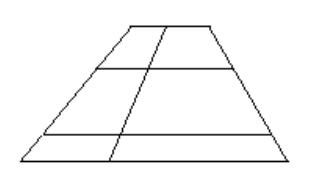
Q.43 In the diagram below, only the horizontal lines are parallel. There are no other pairs of parallel lines.
How many trapeziums are shown altogether? [1½ Marks]
1) 12
2) 16
3) 18
4) 20
Answer: 3) 18
1. The figure has 4 horizontal lines (the top, two middle ones and the base), all parallel.
2. It has 3 slanting lines (the left side, the right side and the inner line), all of which cross every horizontal line.
3. Each trapezium uses 2 of the 4 horizontal lines and 2 of the 3 slanting lines.
4. Number of ways to choose 2 horizontal lines = 6 and number of ways to choose 2 slanting lines = 3.
5. Total trapeziums = 6 × 3 = 18.
6. Hence, the correct option is 3.
Teacher's Note:
a) Count by choosing pairs of parallel sides rather than by counting shapes one by one.
b) Check that every chosen pair of slanting lines really crosses both chosen horizontals.
c) A 2 line choice from 4 gives 6; from 3 gives 3.
Q.44 Sana likes to wear her watch upside down.
She wants to see a movie that starts in half an hour.
What time does the movie start? [1½ Marks]
1) 13:45
2) 18:15
3) 19:45
4) 20:15
[Figure: Analogue clock face as seen on the upside-down watch. The long (minute) hand points to the 3 position on the right. The short (hour) hand points between the 1 and the 2, towards the upper right at about 54 degrees from the 12 mark]
Answer: 4) 20:15
1. Turning the watch the right way up rotates the dial by 180 degrees.
2. The minute hand pointing at 3 (15 minutes) then points at 9, which is 45 minutes.
3. The hour hand, between the 1 and the 2, turns to a position between the 7 and the 8, which agrees with 7:45.
4. So the real time now is 7:45.
5. The movie starts in half an hour: 7:45 + 0:30 = 8:15, which is 20:15 in the 24-hour form.
6. Hence, the correct option is 4.
Teacher's Note:
a) Rotate both hands by 180 degrees; hour hand 1 becomes 7, minute 15 becomes 45.
b) Option 2 (18:15) mistakes the hour by one.
c) The hour hand sits close to the next number, which confirms 45 minutes past.
Q.45 Ravi is making a mixture of sand, cement and water. He adds 6 kg of cement and 4 litres of water to every 10 kg of sand.
Which of these statements is not correct? [1½ Marks]
1) The water is 20 % of the mixture.
2) The ratio of sand to cement to water is 5:2:3.
3) To make 30 kg of mixture, Ravi needs 9 kg of cement.
4) If he uses 4.5 kg of cement, then he needs 3 L of water.
Answer: 2) The ratio of sand to cement to water is 5:2:3.
1. Sand : cement : water = 10 : 6 : 4 = 5 : 3 : 2, and the total mixture is 10 + 6 + 4 = 20 units.
2. Water share = \( \frac{4}{20} \) = 20 %, so statement 1 is correct.
3. The ratio is 5 : 3 : 2, not 5 : 2 : 3, so statement 2 is not correct.
4. For 30 kg of mixture, cement = \( \frac{6}{20} \) × 30 = 9 kg, so statement 3 is correct.
5. For 4.5 kg of cement, water = 4.5 × \( \frac{4}{6} \) = 3 L, so statement 4 is correct.
6. Hence, the correct option is 2.
Teacher's Note:
a) The word "not" in the question means that you look for the false statement.
b) Write the ratio in the order sand, cement, water exactly as asked; swapping the last two terms is the trap.
c) Verify each statement with the same unit rate of 10 : 6 : 4.
Q.46 Aarush sat down to study at 8 am. The angle of elevation of the sun was 15°. When he had finished studying the angle of elevation of the sun was 55°.
How long did Aarush study? [1½ Marks]
1) 40 min
2) 1 hour 20 mins
3) 2 hours 23 mins
4) 2 hours 40 mins
Answer: 4) 2 hours 40 mins
1. The sun appears to move through 360° in 24 hours, that is 15° every hour.
2. Change in angle of elevation = 55° - 15° = 40°.
3. Time taken = \( \frac{40}{15} \) hours = 2 hours 40 minutes.
4. Hence, the correct option is 4.
Teacher's Note:
a) The sun moves 15° per hour, which is the key rate to remember.
b) Convert the decimal part carefully: 40 ÷ 15 = 2.666 hours, and 0.666 hour is 40 minutes.
Q.47 A pump brings underground water up to ground level. The water flow is measured in litres per minute. This pump fills an 18 litre bucket in 7 seconds.
The pump flow is closest to [1½ Marks]
1) 23 L/min
2) 126 L/min
3) 144 L/min
4) 150 L/min
Answer: 4) 150 L/min
1. Flow per second = \( \frac{18}{7} \) = 2.57 L/s.
2. Flow per minute = 2.57 × 60 = 154.3 L/min.
3. The closest option is 150 L/min.
4. Hence, the correct option is 4.
Teacher's Note:
a) Convert seconds to minutes by multiplying the rate by 60.
Q.48 40 grams of salt is dissolved in 20 litres of water. 10 litres of this solution is then removed and an additional 10 litres of water is added.
The final concentration of salt in the solution is [1½ Marks]
1) 0.5 g/L
2) 1 g/L
3) 1.33 g/L
4) 2 g/L
Answer: 2) 1 g/L
1. Initial concentration = \( \frac{40}{20} \) = 2 g/L.
2. Removing 10 litres removes half of the solution and half of the salt, leaving 20 g of salt in 10 litres.
3. Adding 10 litres of water makes the volume 20 litres with the same 20 g of salt.
4. Final concentration = \( \frac{20}{20} \) = 1 g/L.
5. Hence, the correct option is 2.
Teacher's Note:
a) Track the amount of salt and the volume separately.
b) Adding pure water dilutes the solution but never adds salt.
Q.49 Eight students participated in a knock-out table-tennis competition.
In the first round Adi played Bali and Bali won. Adi was then out of the competition.
Which of these statements is not correct? [1½ Marks]
1) Faroz and Dasa played in the final.
2) Hari won against Gari and lost to Faroz.
3) Dasa won against Chapel and lost to Faroz.
4) Bali, Chapel, Faroz and Hari won the first round.
[Figure: Knock-out chart. Round 1 lists Adi, Bali, Chapel, Dasa, Eknath, Faroz, Gari, Hari in pairs (Adi-Bali, Chapel-Dasa, Eknath-Faroz, Gari-Hari). Round 2 shows Bali, an empty box, an empty box and Hari. The Final row shows Dasa and an empty box, and the winner shown at the bottom is Faroz]
Answer: 4) Bali, Chapel, Faroz and Hari won the first round.
1. The chart shows Bali and Hari in round 2 and Dasa in the final, so Bali beat Adi, Hari beat Gari, and Dasa beat Chapel in round 1.
2. The winner is Faroz, who beat Eknath in round 1, so Faroz reached the final and beat Dasa there. Statements 1, 2 and 3 are all consistent with the chart.
3. Chapel lost to Dasa in the first round, so Chapel did not win the first round, and statement 4 is not correct.
4. Hence, the correct option is 4.
Teacher's Note:
a) In a knock-out round each pair produces one winner and one loser.
b) Check each statement against the chart pair by pair.
Q.50 One morning Bina downloaded songs from the internet. This increased her collection by 50%. However, in the afternoon a virus destroyed 50% of her total collection.
If Bina's collection then numbered 300 songs, how many did she have at the start of the day? [1½ Marks]
1) 200
2) 300
3) 400
4) 600
Answer: 3) 400
1. Let the starting number of songs be x.
2. After the 50% increase she has 1.5x songs.
3. After the virus destroys 50%, she has \( \frac{1}{2} \) × 1.5x = 0.75x songs.
4. 0.75x = 300, so x = 300 ÷ 0.75 = 400.
5. Hence, the correct option is 3.
Teacher's Note:
a) A rise of 50% followed by a fall of 50% does not bring you back to the start.
b) Work backwards: 300 doubles to 600 before the virus and 600 ÷ 1.5 = 400 at the start.
Q.51 A triathalon is a race made up of three events; swimming, cycling and running.
In this triathalon, there were three competitors who swam 1 km, cycled 100 km and ran 24 km.
Their approximate average speeds for each event are shown in the following table.
In which order did A, B and C finish the race? [1½ Marks]
1) A, then B, then C
2) B, then A, then C
3) C, then B, then A
4) A, then C, then B
| Swim | Cycle | Run | |
|---|---|---|---|
| A | 5 km/h | 40 km/h | 12 km/h |
| B | 2 km/h | 50 km/h | 10 km/h |
| C | 4 km/h | 40 km/h | 12 km/h |
Answer: 4) A, then C, then B
1. Time = distance ÷ speed for each event.
2. A: \( \frac{1}{5} \) + \( \frac{100}{40} \) + \( \frac{24}{12} \) = 0.2 + 2.5 + 2 = 4.7 hours.
3. B: \( \frac{1}{2} \) + \( \frac{100}{50} \) + \( \frac{24}{10} \) = 0.5 + 2 + 2.4 = 4.9 hours.
4. C: \( \frac{1}{4} \) + \( \frac{100}{40} \) + \( \frac{24}{12} \) = 0.25 + 2.5 + 2 = 4.75 hours.
5. The shortest total time wins, so the order is A (4.7 h), C (4.75 h), B (4.9 h).
6. Hence, the correct option is 4.
Teacher's Note:
a) Add the times of all three events; the highest cycling speed alone does not decide the race.
b) A and C differ only in swimming speed, so a faster swim means a faster finish.
c) Compare totals to two decimal places because A and C are close.
Q.52 On Tuesday, Rasheed rode to school from his home at an average speed of 12 km/h and arrived 5 minutes late. On Wednesday, Rasheed rode to school from his home at an average speed of 18 km/h and arrived 10 minutes early.
How far does Rasheed live from school? [1½ Marks]
1) 4.2 km
2) 8.5 km
3) 9 km
4) 15 km
Answer: 3) 9 km
1. Let the distance be d km and the on-time journey time be T hours.
2. Tuesday: \( \frac{d}{12} \) = T + \( \frac{5}{60} \).
3. Wednesday: \( \frac{d}{18} \) = T - \( \frac{10}{60} \).
4. Subtracting: d × (\( \frac{1}{12} \) - \( \frac{1}{18} \)) = \( \frac{15}{60} \), so d × \( \frac{1}{36} \) = \( \frac{1}{4} \).
5. d = 9 km.
6. Check: 9 ÷ 12 = 45 min and 9 ÷ 18 = 30 min, which differ by 15 minutes as required.
7. Hence, the correct option is 3.
Teacher's Note:
a) The difference between being 5 min late and 10 min early is 15 minutes.
b) Option 2 is a typical wrong value from dividing without converting minutes to hours.
c) Verify by finding the two travel times and their difference.
(Questions 53-56) Read the following passage and answer the questions as follow:
In a Spin
You have only to watch the daily movement of the sun and the nightly turn of the stars across our sky to realise that the Earth is turning. While you may be standing completely still on the surface of the Earth, that surface is itself turning at a rate of about 1700 km/h. At this rate, our planet takes 23 hours and 56 minutes to make one full rotation on its axis relative to any distant fixed star - a period of time that astronomers call a sidereal day. This is a tiny bit shorter than our ordinary solar day which is 24 hours long - the time between high noon on two consecutive days. The sidereal and solar days are different lengths because by the time the Earth has made one full rotation on its axis and the distant star is directly overhead again, the Earth has also moved 0.986 degrees further around its nearly circular orbit around the sun. As a result, at the end of a sidereal day, the Earth must continue to rotate that extra 0.986 degrees until the sun is overhead to complete a solar day. This extra rotation takes 4 minutes.
There are a number of factors that affect the rate at which a planet turns on its axis. Mercury, the closest planet to the sun, rotates much more slowly than Earth because of the dragging effect of the sun's enormous gravity. A solar day on Mercury is the same length as 58 Earth days! Our own Earth's spin is being slowed down by the tidal effect of the Moon and scientists have found that the Earth solar day is getting longer at a rate of 1 second every thousand years.
Q.53 Which of the following statements is true? [1½ Marks]
1) The sun is speeding up the Earth's rate of spin.
2) Our clocks use the solar day as it is more convenient.
3) The sidereal day is longer than the solar day on Earth.
4) All planets in our solar system have the same length of sidereal day.
Answer: 2) Our clocks use the solar day as it is more convenient.
1. The passage says the ordinary solar day is 24 hours long, which is the day our clocks follow.
2. The sun's gravity slows Mercury, and the Moon slows the Earth, so statement 1 is false.
3. The sidereal day (23 h 56 min) is shorter than the solar day, so statement 3 is false.
4. Planets rotate at different rates, so statement 4 is false.
5. Hence, the correct option is 2.
Teacher's Note:
a) Check each statement against the passage and drop those that contradict it.
b) A clock day of 24 hours matches the solar day, which is why it is used.
Q.54 What would happen if the Earth's spin were to slow down? [1½ Marks]
1) Night-time would be longer than daytime.
2) The solar day would be shorter than the sidereal day.
3) The sidereal day and solar day would both be longer.
4) There would be more hours of daylight than hours of darkness.
Answer: 3) The sidereal day and solar day would both be longer.
1. A slower spin means the Earth needs more time for one full rotation, so the sidereal day becomes longer.
2. The solar day is the sidereal day plus the extra rotation time, so it also becomes longer.
3. Day and night would both lengthen equally, so options 1 and 4 are not supported.
4. Hence, the correct option is 3.
Teacher's Note:
a) The passage already says the solar day is lengthening by one second every thousand years.
Q.55 Venus spins in the opposite direction to that in which it orbits the sun, therefore [1½ Marks]
1) its sidereal day is longer than its solar day.
2) its solar day is longer than its sidereal day.
3) the length of its sidereal day is constantly changing.
4) the length of its sidereal day and its solar day are the same.
Answer: 1) its sidereal day is longer than its solar day.
1. On Earth, spin and orbit are in the same direction, so the planet must turn a little extra to bring the sun overhead again and the solar day is longer.
2. On Venus, spin and orbit are in opposite directions, so the orbital motion helps the sun to come overhead sooner.
3. Therefore its solar day is shorter than its sidereal day.
4. Hence, the correct option is 1.
Teacher's Note:
a) Reverse the Earth's situation: the extra rotation is not needed, it is cut short.
b) Options 3 and 4 are not supported by any reasoning in the passage.
Q.56 Mercury rotates at a speed of 11 km/h. Therefore the circumference of Mercury is approximately [1½ Marks]
1) 1 550 km.
2) 9 200 km.
3) 12 100 km.
4) 15 600 km.
Answer: 4) 15 600 km.
1. One rotation of Mercury takes a solar day, which the passage gives as 58 Earth days.
2. Time = 58 × 24 = 1392 hours.
3. Circumference = speed × time = 11 × 1392 = 15 312 km.
4. The closest option is 15 600 km.
5. Hence, the correct option is 4.
Teacher's Note:
a) Convert days to hours before multiplying by a speed in km/h.
b) The answer is approximate because the options are rounded.
(Questions 57 to 60) Read the following passage and answer the questions that follow:
Bits and Bytes
While human communication is made up of letters and numbers, the processors within computers and other digital appliances communicate using a system called binary. The bi in binary means "two". So the system is based on only using two options: either 0 or 1.
The binary system uses bits and bytes. Each bit can only have one of two values - either 0 or 1. A byte is a sequence of 8 bits. An average text file is made up of about 100 kilobytes (which is 100 000 bytes or 800 000 bits) while a TV show downloaded from the internet may be many gigabytes (1 000 000 000 bytes) in size!
Computer processors run billions of calculations every second. Each calculation involves converting our normal base 10 numbers which are in combinations of 10 digits, (0, 1, 2, 3, 4, 5, 6, 7, 8, 9) into a binary code, using base 2 numbers, or powers of 2. This results in a sequence of only 0s and 1s as you can see from the table below. This table shows how base 10 numbers are coded into 4 bits. More bits would be needed for bigger numbers.
| Base 10 Number | Resulting Binary Code |
|---|---|
| 0 | 0000 |
| 1 | 0001 |
| 2 or (21) | 0010 |
| 3 | 0011 |
| 4 or (22) | 0100 |
| 5 | 0101 |
| 6 | 0110 |
| 7 | 0111 |
| 8 or (23) | 1000 |
| 9 | 1001 |
| 10 | 1010 |
| 11 | 1011 |
| 12 | 1100 |
Binary can also be used to encode images for transmission over networks. The simplest versions work by breaking up an image into a series of squares. Squares that are dark are given the value 0 while those that are light are given the value 1. Each row of squares can then be represented by a sequence of bits as shown:
[Figure: A 3 by 3 grid. Image broken into squares: row 1 is dark, light, dark; row 2 is light, dark, light; row 3 is light, light, dark. Squares turned into bits: row 1 is 0 1 0, row 2 is 1 0 1, row 3 is 1 1 0. Rows of bits turned into a sequence with spaces separating each row's values: 010 101 110]
Q.57 What binary sequence would be formed from the image below? [1½ Marks]
1) 110 110 101
2) 000 001 110
3) 001 001 010
4) 111 110 001
[Figure: A 3 by 3 grid. Row 1: light, light, dark. Row 2: light, light, dark. Row 3: light, dark, light]
Answer: 1) 110 110 101
1. Light squares are 1 and dark squares are 0.
2. Row 1 is light, light, dark = 110.
3. Row 2 is light, light, dark = 110.
4. Row 3 is light, dark, light = 101.
5. The sequence is 110 110 101, so the correct option is 1.
Teacher's Note:
a) Read the rows from top to bottom and each square from left to right.
b) Dark is 0 and light is 1, not the other way round.
Q.58 Using the pattern indicated in the table, what would be the binary code for the integer 13? [1½ Marks]
1) 1101
2) 1110
3) 1111
4) 10001
Answer: 1) 1101
1. From the table, 12 is 1100.
2. 13 is one more than 12, and adding 1 to 1100 gives 1101.
3. Check: 8 + 4 + 1 = 13, so the bits for 8, 4 and 1 are on: 1101.
4. Hence, the correct option is 1.
Teacher's Note:
a) Add 1 to the previous code, or write the number as a sum of powers of 2.
Q.59 Which of these numbers would be written as 10000 in binary code? [1½ Marks]
1) 14
2) 16
3) 18
4) 20
Answer: 2) 16
1. In binary, the place values from the right are 1, 2, 4, 8, 16.
2. The code 10000 has a 1 only in the fifth place, which is 16.
3. Hence, the correct option is 2.
Teacher's Note:
a) A single 1 followed by zeros is always a power of 2.
b) The table shows 8 = 1000, so 16 = 10000 follows the same pattern.
Q.60 Using binary code, what would be the sum of the binary numbers 0110 and 0101? [1½ Marks]
1) 0211
2) 0111
3) 1011
4) 110101
Answer: 3) 1011
1. 0110 is 6 and 0101 is 5 in base 10.
2. Their sum is 6 + 5 = 11.
3. From the table, 11 is written 1011.
4. Check by adding in binary from the right: 0 + 1 = 1; 1 + 0 = 1; 1 + 1 = 10, write 0 and carry 1; 0 + 0 + 1 = 1. The sum is 1011.
5. Hence, the correct option is 3.
Teacher's Note:
a) Convert to base 10, add, and convert back; the table helps for numbers up to 12.
b) Option 1 contains a 2, which cannot occur in binary.
c) Option 4 simply joins the two numbers like text.
the room/hall. They can take away the textbooket with them.
6. The following shall be supplied by the Board :
The Question Paper containing OMR Answer Sheet
List of Candidates registered for Class IX and Class XI for academic session 2012-13
Attendance Sheets
Absentee Performa
7. At the end of examination, school shall send the following in separate sealed cover for class IX and
Class XI to the Regional Officer :
OMR Answer Sheets
Absentee Performa
Attendance Sheets
8. Proper care may be taken in packing of the answer sheets so that these do not get damaged in the
process of transaction.