

Selina Concise Solutions for Class 10 Physics: Chapter 11 Calorimetry Solutions
Review the Selina Concise Solutions for ICSE Class 10 Physics Chapter 11 Calorimetry Solutions designed for Class 10 Physics students. Published under the latest ICSE guidelines for 2026-27, these chapter-wise solutions provide the foundational knowledge required for exam success.
Chapter-wise Solutions: Chapter 11 Calorimetry Solutions
Navigate directly to the Chapter 11 Calorimetry Solutions solutions using the digital viewer below. Organizing your study sessions chapter-by-chapter allows for seamless offline study and quick reference during revision.
Exercise 11 A
Question 1. Define the term heat.
Answer: The kinetic energy due to random motion of the molecules of a substance is known as its heat energy.
In simple words: Heat is the energy that molecules have when they move around randomly. Think of tiny balls bouncing everywhere inside a hot object.
📝 Teacher's Note: Show students how rubbing hands together makes them warm. The moving hands are like moving molecules - they create heat energy.
🎯 Exam Tip: Always write "kinetic energy due to random motion of molecules." These exact words get you marks.
Question 2. Name the S.I. unit of heat.
Answer: S.I. unit of heat is joule (symbol J).
In simple words: We measure heat energy in joules, just like we measure distance in metres.
📝 Teacher's Note: Tell students that joule is the same unit we use for all types of energy - heat, light, sound, movement.
🎯 Exam Tip: Write "joule" and add the symbol "(J)" in brackets. Don't forget the capital J.
Question 3. Define the term calorie. How is it related to joule?
Answer: One calorie of heat is the heat energy required to raise the temperature of 1 g of water from 14.5°C to 15.5°C.
1 calorie = 4.186 J
In simple words: A calorie is an old way to measure heat. It takes exactly one calorie of heat to make 1 gram of water 1 degree warmer.
📝 Teacher's Note: Use a small cup of water and explain that heating it by 1 degree needs 1 calorie. Students connect this to calories on food packets.
🎯 Exam Tip: Remember the exact numbers: 1 g water, 14.5°C to 15.5°C, and 1 calorie = 4.186 J. All must be correct.
Question 4. Define one kilo-calorie of heat.
Answer: One kilo-calorie of heat is the heat energy required to raise the temperature of 1 kg of water from 14.5°C to 15.5°C.
In simple words: A kilo-calorie is 1000 calories. It heats 1 kilogram of water by 1 degree. This is what we see on food packets.
📝 Teacher's Note: Show food packets with "Cal" or "kcal" written on them. These are kilo-calories, not small calories.
🎯 Exam Tip: Write "1 kg of water" not "1 g". This is the key difference from normal calorie. Temperature range stays same.
Question 5. Define temperature and name its S.I. unit.
Answer: The quantity which determines the direction of flow of heat between two bodies kept in contact is called temperature.
S.I. unit kelvin (K).
In simple words: Temperature tells us which way heat will flow. Heat always flows from hot things to cold things.
📝 Teacher's Note: Put one hand in warm water, one in cold water. Heat flows from warm hand to cold water. That's how temperature works.
🎯 Exam Tip: Write "determines the direction of flow of heat" - this phrase is important. Unit is "kelvin" with symbol "K".
Question 6. Differentiate between heat and temperature.
Answer:
| Heat | Temperature |
|---|---|
| The kinetic energy due to random motion of the molecules of a substance is known as its heat energy. | The quantity which determines the direction of flow of heat between two bodies kept in contact is called temperature. |
| S.I. unit joule (J). | S.I. unit kelvin (K). |
| It is measured by the principle of calorimetry. | It is measured by a thermometer. |
In simple words: Heat is energy inside moving molecules. Temperature tells us which direction heat will move between objects.
📝 Teacher's Note: Heat is like the total money in your pocket. Temperature is like how much you want to buy something - it decides if money flows out.
🎯 Exam Tip: Make a neat table with three rows. Don't mix up the units - J for heat, K for temperature.
Question 7. Define calorimetry
Answer: The measurement of the quantity of heat is called calorimetry.
In simple words: Calorimetry means measuring how much heat energy something has or needs.
📝 Teacher's Note: Compare it to using a weighing scale to measure mass. Calorimetry is like using special methods to measure heat.
🎯 Exam Tip: Just write "measurement of quantity of heat" - simple and direct. Don't add extra words.
Question 8. Define the term heat capacity and state its S.I. unit.
Answer: The heat capacity of a body is the amount of heat energy required to raise its temperature by 1°C or 1K.
S.I. unit is joule per kelvin (JK⁻¹).
In simple words: Heat capacity tells us how much heat energy we need to make something 1 degree warmer.
📝 Teacher's Note: Think of it like asking "how much fuel do I need to warm up this object by 1 degree?" Different objects need different amounts.
🎯 Exam Tip: Write both "1°C or 1K" and the unit as "JK⁻¹" with the minus sign as superscript.
Question 9. Define the term specific heat capacity and state its S.I. unit.
Answer: The specific heat capacity of a substance is the amount of heat energy required to raise the temperature of unit mass of that substance through by 1°C (or 1K).
S.I. unit is joule per kilogram per kelvin (Jkg⁻¹K⁻¹).
In simple words: Specific heat capacity tells us how much heat energy we need to warm up exactly 1 kg of something by 1 degree.
📝 Teacher's Note: It's like asking "how much fuel per kilogram?" Different materials need different amounts of heat per kilogram.
🎯 Exam Tip: Write "unit mass" and the unit as "Jkg⁻¹K⁻¹" with both minus signs as superscript. Don't miss any part.
Question 10. How is heat capacity of a body related to specific heat capacity of its substance?
Answer: Heat capacity = Mass × specific heat capacity
In simple words: If you know how much heat 1 kg needs (specific heat capacity) and the total mass, multiply them to get total heat capacity.
📝 Teacher's Note: Use simple math: if 1 kg needs 5 J per degree, then 3 kg needs 3 × 5 = 15 J per degree. That's the formula.
🎯 Exam Tip: Write the formula clearly: Heat capacity = Mass × specific heat capacity. Use the multiplication sign ×.
Question 11. Differentiate between heat capacity and specific heat capacity.
Answer: Heat capacity of the body is the amount of heat required to raise the temperature of (whole) body by 1°C whereas specific heat capacity is the amount of heat required to raise the temperature of unit mass of the body by 1°C.
Heat capacity of a substance depends upon the material and mass of the body. Specific heat capacity of a substance does not depend on the mass of the body.
S.I. unit of heat capacity is JK⁻¹ and S.I. unit of specific heat capacity is Jkg⁻¹K⁻¹.
In simple words: Heat capacity is for the whole object. Specific heat capacity is per kilogram of material. Bigger objects have more heat capacity but same specific heat capacity.
📝 Teacher's Note: Use two rocks of different sizes made of same material. Big rock has more heat capacity but both have same specific heat capacity.
🎯 Exam Tip: Mention three differences: definition, dependence on mass, and units. Write units with proper superscripts.
Question 12. Name a liquid which has the highest specific heat capacity.
Answer: Water has the highest specific heat capacity.
In simple words: Among all common liquids, water needs the most heat energy to warm up per kilogram.
📝 Teacher's Note: This is why water is used in car radiators and hot water bottles. It can store lots of heat energy.
🎯 Exam Tip: Just write "Water" - one word answer. Don't add unnecessary explanations unless asked.
Question 13. Write the approximate value of specific heat capacity of water in S.I. unit.
Answer: Specific heat capacity of water = 4200 J kg⁻¹ K⁻¹.
In simple words: To warm up 1 kg of water by 1 degree, you need 4200 joules of heat energy.
📝 Teacher's Note: This is a very high value. That's why water takes long to heat up and long to cool down compared to other liquids.
🎯 Exam Tip: Remember the number 4200 and write the complete unit "J kg⁻¹ K⁻¹" with proper superscripts.
Question 14. What do you mean by the following statements:
(i) the heat capacity of a body is 50JK⁻¹?
(ii) The specific heat capacity of copper is 0.4Jg⁻¹K⁻¹
Answer:
(i) The heat capacity of a body is 50JK⁻¹ means to increase the temperature of this body by 1K we have to supply 50 joules of energy.
(ii) The specific heat capacity of copper is 0.4Jg⁻¹K⁻¹ means to increase the temperature of one gram of copper by 1K we have to supply 0.4 joules of energy.
In simple words: These numbers tell us exactly how much heat energy we need to make things warmer by 1 degree.
📝 Teacher's Note: Use real examples: "This cup needs 50 J to get 1 degree warmer" and "1 gram copper needs 0.4 J to get 1 degree warmer."
🎯 Exam Tip: For (i) write "this body", for (ii) write "one gram of copper". Be specific about what is being heated.
Question 15. Name three factors on which heat energy absorbed by a body depends and state how does it depend on them.
Answer: The quantity of heat energy absorbed by a body depends on three factors:
- Mass of the body - The amount of heat energy required is directly proportional to the mass of the substance.
- Nature of material of the body - The amount of heat energy required depends on the nature of the substance and it is expressed in terms of its specific heat capacity c.
- Rise in temperature of the body - The amount of heat energy required is directly proportional to the rise in temperature.
In simple words: Three things matter: how heavy the object is, what material it's made of, and how much warmer you want to make it.
📝 Teacher's Note: Use examples: heating 2 kg takes more energy than 1 kg; heating iron and water by same amount needs different energy; heating by 10 degrees needs more than heating by 5 degrees.
🎯 Exam Tip: List all three factors clearly. For each factor, mention if it's "directly proportional" or how it affects heat energy.
Question 16. Write the expression for the heat energy Q received by the substance when m kg of substance of specific heat capacity c J kg⁻¹k⁻¹ is heated through Δt° C.
Answer: The expression for the heat energy Q
Q = mc Δt (in joule)
In simple words: To find total heat energy, multiply mass × specific heat capacity × temperature change.
📝 Teacher's Note: This is the most important formula in calorimetry. Make students write it clearly: Q = m × c × Δt.
🎯 Exam Tip: Write the formula exactly as "Q = mc Δt" and add "(in joule)" to show the unit.
Question 17. (a) Same amount of heat is supplied to two liquid A and B. The liquid A and B. The liquid A shows a greater rise in temperature. What can you say about the heat capacity of A as compared to that of B?
(b) Two metallic blocks P and Q of masses in ratio 2 : 1 are given same amount of heat. If their temperature rise by same amount, compare their specific heat capacities.
Answer:
(a) Heat capacity of liquid A is less than that of B.
As the substance with low heat capacity shows greater rise in temperature.
(b) Let \( C_P \) and \( C_Q \) be the specific heat capacities of blocks P and Q respectively,
We know that,
\[ c = \frac{Q}{m \times \Delta t} \]
\[ \frac{C_P}{C_Q} = \frac{\frac{Q}{2m \times \Delta t}}{\frac{Q}{m \times \Delta t}} = \frac{1}{2} \]
Hence, the required ratio is 1 : 2
In simple words: If something heats up faster with same energy, it has lower heat capacity. When mass is double but temperature rise is same, specific heat capacity becomes half.
📝 Teacher's Note: For part (a): smaller heat capacity means easier to heat up. For part (b): bigger mass needs lower specific heat capacity to rise by same temperature.
🎯 Exam Tip: For (a) write "less than". For (b) show the formula step and get ratio 1:2. Use MathJax for fractions.
Question 18. Why do the farmers fill their fields with water on a cold winter night?
Answer: In the absence of water, if on a cold winter night the atmospheric temperature falls below 0°C, the water in the fine capillaries of plant will freeze, so the veins will burst due to the increase in the volume of water on freezing. As a result, plants will die and the crop will be destroyed. In order to save the crop on such cold nights, farmers fill their fields with water because water has high specific heat capacity, so it does not allow the temperature in the surrounding area of plants to fall up to 0°C.
In simple words: Water stores lots of heat energy and releases it slowly. This keeps plants warm and prevents them from freezing and dying.
📝 Teacher's Note: Explain that water is like a heat blanket for plants. It gives out heat energy slowly and keeps plants above freezing temperature.
🎯 Exam Tip: Mention two things: plants die when water in them freezes, and water's high specific heat capacity prevents this by keeping temperature above 0°C.
Question 19. Discuss the role of high specific heat capacity of water with reference to climate in coastal areas.
Answer: The specific heat capacity of water is very high. It is about five times as high as that of sand. Hence the heat energy required for the same rise in temperature by a certain mass of water will be nearly five times than that required by the same mass of sand. Similarly, a certain mass of water will give out nearly five times more heat energy than that given by sand of the same mass for the same fall in temperature. As such, sand gets heated or cooled more rapidly as compared to water under the similar conditions. Thus a large difference in temperature is developed between the land and the sea due to which land and sea breezes are formed. These breezes make the climate near the sea shore moderate.
In simple words: Water heats up and cools down very slowly compared to land. This creates cool sea breezes that make coastal areas have pleasant weather.
📝 Teacher's Note: Compare heating sand and water in sun - sand gets hot quickly but water stays cool. This difference creates the pleasant coastal climate.
🎯 Exam Tip: Explain the comparison with sand (5 times difference), mention land and sea breezes, and conclude with "moderate climate."
Question 20. Water is used in hot water bottles for fomentation give a reason.
Answer: The reason is that water does not cool quickly due to its large specific heat capacity, so a hot water bottle provides heat energy for fomentation for a long time.
In simple words: Hot water stays hot for a long time because it can store lots of heat energy. This makes it perfect for keeping warm.
📝 Teacher's Note: Compare with a hot metal spoon that cools down quickly. Water holds its heat much longer, making it useful for heat therapy.
🎯 Exam Tip: Write "does not cool quickly" and "large specific heat capacity" and "provides heat for long time" - all three points.
Question 21. Water is used as an effective coolant. Give reason.
Answer: By allowing water to flow in pipes around the heated parts of a machine, heat energy from such part is removed. Water in pipes extracts more heat from surrounding without much rise in its temperature because of its large specific heat capacity. So, Water is used as an effective coolant.
In simple words: Water can take away a lot of heat without getting very hot itself. This is because water has high specific heat capacity. So it works well to cool machines.
📝 Teacher's Note: Show students how a car radiator works. Water goes around the engine to take away heat. The water does not get too hot because it can absorb a lot of heat.
🎯 Exam Tip: Always write "high specific heat capacity of water" as the main reason. This is the key phrase examiners look for.
Question 22. Give one example each where high specific heat capacity of water is used (i) as coolant, (ii) as heat reservoir.
Answer:
(1) Radiator in car.
(2) To avoid freezing of wine and juice bottles.
In simple words: Car radiator uses water to cool the engine. Wine bottles use water around them to stay warm and not freeze.
📝 Teacher's Note: Explain that "heat reservoir" means something that stores heat. Water around bottles keeps them warm because it releases heat slowly.
🎯 Exam Tip: For coolant write "car radiator". For heat reservoir write "preventing freezing" or "hot water bottles". Give specific examples.
Question 23. What is a calorimeter? Name the material of which it is made of. Give two reasons for using the material stated by you.
Answer: A calorimeter is a cylindrical vessel which is used to measure the amount of heat gained or lost by a body when it is mixed with other body.
It is made up of thin copper sheet because:
(i) Copper is a good conductor of heat, so the vessel soon acquires the temperature of its contents.
(ii) Copper has low specific heat capacity so the heat capacity of calorimeter is low and the amount of heat energy taken by the calorimeter from its contents to acquire the temperature of its contents is negligible.
In simple words: A calorimeter is a special cup to measure heat. It is made of copper because copper transfers heat quickly and does not take much heat for itself.
📝 Teacher's Note: Show students a copper vessel. Explain that copper gets hot quickly when you put hot things in it. This helps in getting accurate measurements.
🎯 Exam Tip: Write both reasons clearly: "good conductor of heat" and "low specific heat capacity". These are the two main points for full marks.
Question 24. Why is the base of a cooking pan made thick and heavy.
Answer: By making the base of a cooking pan thick, its thermal capacity becomes large and it imparts sufficient heat energy at a low temperature to the food for its proper cooking. Further it keeps the food warm for a long time, after cooking.
In simple words: A thick base can store more heat. It gives heat slowly to food for even cooking. It also keeps food warm for longer time.
📝 Teacher's Note: Compare a thin pan and thick pan. Show how thick pan heats food evenly and keeps it warm longer. Thin pans get very hot spots.
🎯 Exam Tip: Write "large thermal capacity" and "even heat distribution" as main reasons. Also mention it keeps food warm longer.
Question 25. What is the principle of method of mixture (or principle of calorimetry)? Name the law on which this principle is based.
Answer: The principle of method of mixture:
Heat energy lost by the hot body = Heat energy gained by the cold body.
This principle is based on law of conservation of energy.
In simple words: When hot and cold things are mixed, the heat lost by hot thing equals the heat gained by cold thing. No heat is lost or created - just transferred.
📝 Teacher's Note: Mix hot and cold water in front of students. Show that hot water cools down and cold water heats up. The total heat stays the same.
🎯 Exam Tip: Write the equation clearly. Always mention "law of conservation of energy" as the basis. This gets you extra marks.
Question 26. A mass m₁ of a substance of specific heat capacity c₁ at temperature t₁ is mixed with a mass m₂ of other substance of specific heat capacity c₂ at a lower temperature t₂. Deduce the expression for the temperature of the mixture. State the assumption made, if any.
Answer: A mass m₁ of a substance A of specific heat capacity c₁ at temperature T₁ is mixed with a mass m₂ of other substance B of specific heat capacity c₂ at a lower temperature T₂ and final temperature of the mixture becomes T.
Fall in temperature of substance A = T₁ – T
Rise in temperature of substance B = T – T₂
Heat energy lost by A = m₁ × c₁ × fall in temperature
= m₁c₁ (T₁ – T)
Heat energy gained by B = m₂ × c₂ × rise in temperature
= m₂c₂ (T – T₂)
If no energy lost in the surrounding, then by the principle of mixtures,
Heat energy lost by A = Heat energy gained by B
m₁c₁(T₁ - T) = m₂c₂(T – T₂)
After rearranging this equation, we get
\[ T = \frac{m_1c_1T_1 + m_2c_2T_2}{m_1c_1 + m_2c_2} \]
Here we have assumed that there is no loss of heat energy.
In simple words: We mix two things at different temperatures. The final temperature depends on their masses, specific heat capacities, and starting temperatures. We assume no heat is lost to surroundings.
📝 Teacher's Note: Start with simple example - mixing equal amounts of hot and cold water. Then build up to the general formula step by step.
🎯 Exam Tip: Show all steps clearly. Write the assumption "no heat loss to surroundings". The final formula must be derived, not just stated.
Question 27. Describe a method to determine the specific heat capacity of a solid, like a piece of copper.
Answer: We can do a simple experiment as follows:
- The given solid in the form of a small piece, is first weighed and is then heated by suspending it by a thread in a beaker containing boiling water.
- While the solid is getting heated, the empty dry calorimeter with the stirrer is weighed. The calorimeter is then filled nearly one third with water and is weighed again. The difference in the two reading gives the mass of water taken.
- The initial temperature of water in the calorimeter is noted with a thermometer.
- When the solid has attained the steady temperature, its temperature is recorded by the thermometer kept in boiling water.
- The solid is then gently dropped into the calorimeter carefully without splashing out the water.
- The contents of the calorimeter are well stirred and the final highest temperature reached is noted.
Then specific heat capacity of solid can be calculated by the formula:
\[ c = \frac{(m_2 - m_1)c_w(T - T_1) + m_1c_c(T - T_1)}{m(T_2 - T)} \text{ J kg}^{-1}\text{K}^{-1} \]
where, Mass of solid = m kg
Mass of calorimeter = m₁ kg
Mass of calorimeter + water = m₂ Kg
Initial temperature of water = T₁°C
Temperature of heated solid = T₂°C
Temperature of mixture = T°C
c is the specific heat capacity of solid
cᶜ is the specific heat capacity of material of the calorimeter
cw is the specific heat capacity of water
In simple words: Heat the solid in boiling water. Put it in calorimeter with cold water. Measure all temperatures and masses. Use the formula to find specific heat capacity.
📝 Teacher's Note: Demonstrate each step slowly. Emphasize safety - handle hot solid carefully. Show why we need to weigh everything precisely.
🎯 Exam Tip: List all 6 steps in order. Write the formula with all symbols defined clearly. This is a common practical exam question.
Question 28. How will you determine the specific heat capacity of a liquid like olive oil by the method of mixtures?
Answer: In this case we take a solid of known specific heat capacity. Then follow this procedure:
- The solid in the form of small piece, is first weighed and is then heated by suspending it by a thread in a beaker containing boiling water.
- While the solid is getting heated, the empty dry calorimeter with the stirrer is weighed. The calorimeter is then filled nearly one third with olive oil and is weighed again. The difference in the two reading gives the mass of olive oil taken.
- The initial temperature of olive oil in the calorimeter is noted with a thermometer.
- When the solid has attained the steady temperature, its temperature is recorded by the thermometer kept in boiling water.
- The solid is then gently dropped into the calorimeter carefully without splashing out the olive oil.
- The contents of the calorimeter are well stirred and the final highest temperature reached is noted.
Then specific heat capacity of olive oil (cL) can be calculated by the formula:
\[ c_L = \frac{mc(T_2 - T) - m_1c_c(T - T_1)}{(m_2 - m_1)(T - T_1)} \text{ J kg}^{-1}\text{K}^{-1} \]
where, mass of solid = m kg.
Mass of calorimeter = m₁ kg.
Mass of calorimeter + olive oil = m₂ Kg
Initial temperature of olive oil = T₁°C
Temperature of heated solid = T₂°C
Temperature of mixture = T°C
c is the specific heat capacity of solid
cᶜ is the specific heat capacity of material of the calorimeter
In simple words: Use a hot solid with known specific heat capacity. Put it in olive oil. Measure temperatures. Calculate olive oil's specific heat capacity using the formula.
📝 Teacher's Note: Explain the difference from previous method - here we know solid's specific heat capacity but want to find liquid's. The solid acts as the heat source.
🎯 Exam Tip: Mention that we use a solid of "known specific heat capacity". This is the key difference from finding solid's specific heat capacity.
Question 29. In an experiment to determine the specific heat capacity of a solid following operations were made: Mass of calorimeter + stirrer = x kg, Mass of water = y kg, Initial temperature of water t₁℃, Mass of solid = z kg, Temperature of solid = t₂ ℃, Temperature of mixture = t ℃, Specific heat capacity of calorimeter and water are c₁ and c₂ respectively. Express the specific heat capacity c of the solid in terms of the above data.
Answer: The specific heat capacity c of the solid in terms of the above data is:
\[ c = \frac{(xc_1 + yc_2)(T - T_1)}{z(T_2 - T)} \]
In simple words: This is the formula to find specific heat capacity of solid when you know all the masses, temperatures, and specific heat capacities of calorimeter and water.
📝 Teacher's Note: Show how this formula comes from the basic principle of mixtures. Each term represents heat gained or lost by different parts.
🎯 Exam Tip: Just substitute the given symbols correctly in the standard formula. Check that your answer has the right units.
Question 30. A heater of power P watt raises the temperature of m kg of a liquid by Δt K in time t s. Express the specific heat capacity of liquid in terms of above data.
Answer: The specific heat capacity of liquid in terms of the above data is:
\[ c = \frac{Pt}{m\Delta T} \]
In simple words: When electrical heater heats a liquid, all electrical energy becomes heat energy. Use this to find specific heat capacity.
📝 Teacher's Note: Explain that electrical energy = Pt and this equals heat energy = mcΔT. So we can equate them to find c.
🎯 Exam Tip: Remember the electrical energy formula P×t. Set it equal to heat energy mcΔT and solve for c.
Multiple Choice Questions
Question 1. The S.I. unit of heat capacity is:
(a) J kg⁻¹
(b) J K⁻¹
(c) J kg⁻¹ K⁻¹
(d) cal ℃⁻¹
Answer: (b) J K⁻¹
In simple words: Heat capacity is heat needed per degree rise in temperature. So unit is Joules per Kelvin.
📝 Teacher's Note: Explain difference between heat capacity (total heat for 1°C rise) and specific heat capacity (heat per kg per 1°C rise).
🎯 Exam Tip: Heat capacity unit is J K⁻¹. Specific heat capacity unit is J kg⁻¹ K⁻¹. Don't confuse them.
Question 2. The S.I. unit of specific heat capacity is:
(a) J kg⁻¹
(b) J K⁻¹
(c) J kg⁻¹ K⁻¹
(d) kilocal kg⁻¹ ℃⁻¹
Answer: (c) J kg⁻¹ K⁻¹
In simple words: Specific heat capacity is heat needed per kg per degree rise. So unit is Joules per kg per Kelvin.
📝 Teacher's Note: Break down the unit: J (for energy), kg⁻¹ (per kilogram), K⁻¹ (per Kelvin temperature rise).
🎯 Exam Tip: Remember: specific heat capacity always has kg⁻¹ in the unit because it is "per kilogram".
Question 3. The specific heat capacity of water is:
(a) 4200 J kg⁻¹ K⁻¹
(b) 420 J g⁻¹ K⁻¹
(c) 0.42 J g⁻¹ K⁻¹
(d) 4.2 J kg⁻¹ K⁻¹
Answer: (a) 4200 J kg⁻¹ K⁻¹
In simple words: Water needs 4200 Joules of heat to raise temperature of 1 kg by 1 degree. This is a high value.
📝 Teacher's Note: This is a very important value to remember. Show students that water has very high specific heat capacity compared to most substances.
🎯 Exam Tip: Memorize 4200 J kg⁻¹ K⁻¹ for water. This value appears in many numerical problems.
Numericals
Question 1. By imparting heat to a body its temperature rises by 15° C. what is the corresponding rise in temperature on kelvin scale?
Answer: The size of 1 degree on the Kelvin scale is the same as the size of 1 degree on the Celsius scale. Thus, the difference (or change) in temperature is the same on both the Celsius and Kelvin scales. Therefore, the corresponding rise in temperature on the Kelvin scale will be 15K.
In simple words: Temperature rise is same in both Celsius and Kelvin scales. So 15°C rise = 15K rise.
📝 Teacher's Note: Explain that only the starting point is different in Celsius and Kelvin scales. The size of each degree is exactly the same.
🎯 Exam Tip: For temperature differences or changes, Celsius and Kelvin values are always equal. Write both the numerical value and the unit clearly.
Question 2.
(a) Calculate the heat capacity of a copper vessel of mass 150g if the specific heat capacity of copper is 410 J kg⁻¹ K⁻¹
(b) How much heat energy will be required to increase the temperature of the vessel in part (a) from 25°C to 35°C?
Answer:
(a) Finding heat capacity:
Given:
Mass of copper vessel = 150 g = 0.15 kg
Specific heat capacity of copper = 410 J kg⁻¹ K⁻¹
Step 1: Use the formula for heat capacity
Heat capacity = Mass × Specific heat capacity
Heat capacity = 0.15 kg × 410 J kg⁻¹ K⁻¹
Heat capacity = 61.5 J K⁻¹
(b) Finding heat energy required:
Given:
Change in temperature = (35 - 25)°C = 10°C = 10 K
Step 2: Use the formula \( Q = mc\Delta T \)
Energy required = 0.15 × 410 × 10
Energy required = 615 J
In simple words: Heat capacity tells us how much heat a thing can hold. We multiply mass and specific heat to get it. Then we use this to find how much energy we need to heat the vessel by 10°C.
📝 Teacher's Note: Show students that heat capacity is different from specific heat capacity. Heat capacity depends on the amount of material. More material means more heat capacity.
🎯 Exam Tip: Always convert grams to kg first. Write both formulas clearly: Heat capacity = m × c, and Q = mc∆T. Show all steps with units.
Question 3. A piece of iron of mass 2.0 kg has a thermal capacity of 966 J K⁻¹. Find: (i) heat energy needed to warm it by 15°C and (ii) its specific heat capacity in S.I. unit.
Answer:
Given:
Mass of iron = 2.0 kg
Thermal capacity (heat capacity) = 966 J K⁻¹
Temperature change = 15°C = 15 K
(i) Heat energy needed:
Heat energy = Heat capacity × Change in temperature
Heat energy = 966 J K⁻¹ × 15 K = 14,490 J
(ii) Specific heat capacity:
Specific heat capacity = Heat capacity ÷ Mass
Specific heat capacity = 966 ÷ 2 = 483 J kg⁻¹ K⁻¹
In simple words: Thermal capacity means how much heat the whole piece needs to warm up by 1°C. Specific heat capacity means how much heat 1 kg of that material needs to warm up by 1°C.
📝 Teacher's Note: Explain that thermal capacity and heat capacity are the same thing. Make sure students understand the difference between heat capacity (for the whole object) and specific heat capacity (per kg).
🎯 Exam Tip: Write the relationship clearly: Specific heat capacity = Heat capacity ÷ Mass. Always include units in your final answer.
Question 4. Calculate the amount of heat energy required to raise the temperature of 100 g of copper from 20°C to 70°C. Specific heat capacity of copper = 390 J kg⁻¹ K⁻¹.
Answer:
Given:
Mass of copper = 100 g = 0.1 kg
Initial temperature = 20°C
Final temperature = 70°C
Change in temperature = (70 - 20)°C = 50°C = 50 K
Specific heat capacity of copper = 390 J kg⁻¹ K⁻¹
Step 1: Use the formula \( Q = mc\Delta T \)
Q = 0.1 × 390 × 50
Q = 1950 J
Amount of heat required = 1950 J
In simple words: We need 1950 J of heat energy to make 100g of copper 50°C hotter. This is like the energy needed to run a small bulb for about 2 seconds.
📝 Teacher's Note: Remind students to always convert grams to kg. Show them that temperature difference is the same in °C and K, so we can use either unit.
🎯 Exam Tip: Write "Given" first, then show the formula Q = mc∆T, then substitute values. Don't forget to convert grams to kilograms.
Question 5. 1300 J of heat energy is supplied to raise the temperature of 0.5 kg of lead from 20°C to 40°C. Calculate the specific heat capacity of lead.
Answer:
Given:
Heat energy supplied = 1300 J
Mass of lead = 0.5 kg
Change in temperature = (40 - 20)°C = 20°C = 20 K
Step 1: Use the formula \( Q = mc\Delta T \)
Rearranging: \( c = \frac{Q}{m\Delta T} \)
Step 2: Substitute values
\( c = \frac{1300}{0.5 \times 20} = \frac{1300}{10} = 130 \text{ J kg}^{-1} \text{K}^{-1} \)
Specific heat capacity of lead = 130 J kg⁻¹ K⁻¹
In simple words: Lead needs only 130 J to heat 1 kg by 1°C. This is much less than water (4200 J), so lead heats up faster than water.
📝 Teacher's Note: Show students how to rearrange the formula. Lead has low specific heat, so it heats up and cools down quickly. This is why metal spoons get hot fast in hot soup.
🎯 Exam Tip: Always rearrange the formula first, then substitute. Write c = Q/(m∆T) clearly. Include units in your final answer.
Question 6. Find the time taken by a 500 W heater to raise the temperature of 50 kg of material of specific heat capacity 960 J kg⁻¹ K⁻¹, from 18°C to 38°C. Assume that all the heat energy supplied by the heater is given to the material.
Answer:
Given:
Power of heater = 500 W
Mass of material = 50 kg
Specific heat capacity = 960 J kg⁻¹ K⁻¹
Change in temperature = (38 - 18)°C = 20°C = 20 K
Step 1: Find heat energy needed
\( Q = mc\Delta T \)
Q = 50 × 960 × 20 = 960,000 J
Step 2: Find time using Power formula
Power = Energy ÷ Time
Rearranging: \( t = \frac{Q}{P} \)
Step 3: Substitute values
\( t = \frac{960,000}{500} = 1920 \text{ seconds} \)
t = 1920 ÷ 60 = 32 minutes
Time taken = 1920 seconds = 32 minutes
In simple words: The heater gives 500 J every second. We need 960,000 J total. So it takes 1920 seconds to give all that energy.
📝 Teacher's Note: Explain that Power = Energy/Time, so Time = Energy/Power. Show students how to convert seconds to minutes by dividing by 60.
🎯 Exam Tip: First find Q using mc∆T, then find time using t = Q/P. Always convert final answer to minutes if the time is large.
Question 7. An electric heater of power 600 W raises the temperature of 4.0 kg of a liquid from 10.0°C to 15.0°C in 100 s. Calculate: (i) the heat capacity of 4.0 kg of liquid, (ii) the specific heat capacity of the liquid.
Answer:
Given:
Power of heater = 600 W
Mass of liquid = 4.0 kg
Change in temperature = (15.0 - 10.0)°C = 5.0°C = 5.0 K
Time = 100 s
Step 1: Find heat energy supplied by heater
Energy = Power × Time
Q = 600 × 100 = 60,000 J
Step 2: Find specific heat capacity
Using \( Q = mc\Delta T \)
Rearranging: \( c = \frac{Q}{m\Delta T} = \frac{60,000}{4.0 \times 5.0} = \frac{60,000}{20} = 3000 \text{ J kg}^{-1} \text{K}^{-1} \)
(i) Heat capacity:
Heat capacity = c × m = 3000 × 4.0 = 12,000 J K⁻¹ = 1.2 × 10⁴ J K⁻¹
(ii) Specific heat capacity = 3000 J kg⁻¹ K⁻¹
In simple words: The heater gave 60,000 J in 100 seconds. All this energy went to heat the liquid by 5°C. We use this to find how much energy 1 kg needs for 1°C.
📝 Teacher's Note: Show that all electrical energy becomes heat energy in this case. Heat capacity is for the whole 4 kg, while specific heat capacity is per 1 kg.
🎯 Exam Tip: First find total energy using P×t, then find specific heat using c = Q/(m∆T). Heat capacity = specific heat × mass.
Question 8. 0.5 kg of lemon squash at 30°C is placed in a refrigerator which can remove heat at an average rate of 30 J s⁻¹. How long will it take to cool the lemon squash to 5°C? Specific heat capacity of squash = 4200 J kg⁻¹ K⁻¹.
Answer:
Given:
Mass of squash = 0.5 kg
Initial temperature = 30°C
Final temperature = 5°C
Change in temperature = 30 - 5 = 25 K
Rate of heat removal = 30 J s⁻¹
Specific heat capacity = 4200 J kg⁻¹ K⁻¹
Step 1: Find heat energy to be removed
\( Q = mc\Delta T \)
Q = 0.5 × 4200 × 25 = 52,500 J
Step 2: Find time using rate formula
\( t = \frac{Q}{\text{Rate}} = \frac{52,500}{30} = 1750 \text{ seconds} \)
Converting to minutes: t = 1750 ÷ 60 = 29.17 minutes = 29 min 10 sec
Time taken = 1750 seconds = 29 min 10 sec
In simple words: The squash needs to lose 52,500 J of heat energy to cool down by 25°C. The fridge removes 30 J every second, so it takes 1750 seconds.
📝 Teacher's Note: Explain that cooling means removing heat energy. The refrigerator works like a reverse heater - it takes heat away instead of adding it.
🎯 Exam Tip: For cooling problems, find heat to be removed using Q = mc∆T, then divide by the rate of heat removal to get time.
Question 9. 200 g mass of certain metal at 83°C is immersed in 300 g of water at 30°C the final temperature is 33°C. Calculate the specific heat capacity of the metal. Assume that the specific heat capacity of water is 4.2 J g⁻¹ K⁻¹.
Answer:
Given:
Mass of metal (m₁) = 200 g
Initial temperature of metal (T₁) = 83°C
Mass of water (m₂) = 300 g
Initial temperature of water (T₂) = 30°C
Final temperature (T) = 33°C
Specific heat capacity of water (c₂) = 4.2 J g⁻¹ K⁻¹
Step 1: Apply principle of calorimetry
Heat lost by metal = Heat gained by water
\( m_1c_1(T_1 - T) = m_2c_2(T - T_2) \)
Step 2: Substitute values
200 × c₁ × (83 - 33) = 300 × 4.2 × (33 - 30)
200 × c₁ × 50 = 300 × 4.2 × 3
10,000 × c₁ = 3780
Step 3: Solve for c₁
\( c_1 = \frac{3780}{10,000} = 0.378 \text{ J g}^{-1} \text{K}^{-1} \)
Specific heat capacity of metal = 0.378 J g⁻¹ K⁻¹
In simple words: Hot metal loses heat and cold water gains heat until both reach the same temperature. The metal's low specific heat means it needs less energy per gram to change temperature.
📝 Teacher's Note: This is called the method of mixtures. Always remember: heat lost = heat gained. The final temperature is between the two starting temperatures.
🎯 Exam Tip: Write the calorimetry equation first: m₁c₁(T₁-T) = m₂c₂(T-T₂). Make sure temperature differences are positive.
Question 10. 45 g of water at 50°C in a beaker is cooled when 50 g of copper at 18°C is added to it. The contents are stirred till a final constant temperature is reached. Calculate this final temperature. The specific heat capacity of copper is 0.39 J g⁻¹ K⁻¹ and that of water is 4.2 J g⁻¹ K⁻¹. State the assumption used.
Answer:
Given:
Mass of water (m₁) = 45 g
Initial temperature of water (T₁) = 50°C
Mass of copper (m₂) = 50 g
Initial temperature of copper (T₂) = 18°C
Specific heat capacity of water (c₁) = 4.2 J g⁻¹ K⁻¹
Specific heat capacity of copper (c₂) = 0.39 J g⁻¹ K⁻¹
Final temperature = T
Step 1: Apply principle of calorimetry
Heat lost by water = Heat gained by copper
\( m_1c_1(T_1 - T) = m_2c_2(T - T_2) \)
Step 2: Expand and rearrange
\( m_1c_1T_1 - m_1c_1T = m_2c_2T - m_2c_2T_2 \)
\( m_1c_1T_1 + m_2c_2T_2 = T(m_1c_1 + m_2c_2) \)
Step 3: Substitute values
\( T = \frac{m_1c_1T_1 + m_2c_2T_2}{m_1c_1 + m_2c_2} \)
\( T = \frac{45 \times 4.2 \times 50 + 50 \times 0.39 \times 18}{45 \times 4.2 + 50 \times 0.39} \)
\( T = \frac{9450 + 351}{189 + 19.5} = \frac{9801}{208.5} = 47°\text{C} \)
Final temperature = 47°C
Assumption used: No heat is lost to the surroundings or the beaker.
In simple words: The hot water cools down and the cold copper heats up until they reach the same temperature. Water has much higher specific heat, so the final temperature is closer to water's starting temperature.
📝 Teacher's Note: Show students that the final temperature is closer to the substance with higher heat capacity (water). This is because water can store more heat per degree.
🎯 Exam Tip: Use the general formula for mixing: T = (m₁c₁T₁ + m₂c₂T₂)/(m₁c₁ + m₂c₂). Always state the assumption about no heat loss.
Question 11. 200 g of hot water at 80°C is added to 300 g of cold water at 10°C. Neglecting the heat taken by the container, calculate the final temperature of the mixture of water. Specific heat capacity of water = 4200 J kg⁻¹ K⁻¹.
Answer:
Given:
Mass of hot water (m₁) = 200 g
Temperature of hot water (T₁) = 80°C
Mass of cold water (m₂) = 300 g
Temperature of cold water (T₂) = 10°C
Final temperature = T
Step 1: Apply principle of calorimetry
Since both are water, c₁ = c₂ = c
Heat lost by hot water = Heat gained by cold water
\( m_1c(T_1 - T) = m_2c(T - T_2) \)
Step 2: Cancel c and rearrange
\( m_1(T_1 - T) = m_2(T - T_2) \)
\( m_1T_1 - m_1T = m_2T - m_2T_2 \)
\( T = \frac{m_1T_1 + m_2T_2}{m_1 + m_2} \)
Step 3: Substitute values
\( T = \frac{200 \times 80 + 300 \times 10}{200 + 300} = \frac{16000 + 3000}{500} = \frac{19000}{500} = 38°\text{C} \)
Final temperature = 38°C
In simple words: When we mix hot and cold water, we get a temperature in between. Since there is more cold water (300g vs 200g), the final temperature is closer to the cold water temperature.
📝 Teacher's Note: For mixing same materials, the formula becomes simpler: T = (m₁T₁ + m₂T₂)/(m₁ + m₂). This is like finding a weighted average.
🎯 Exam Tip: When mixing the same substance, specific heat cancels out. The final temperature depends only on masses and initial temperatures.
Question 12. The temperature of 600 g of cold water rises by 15°C when 300 g of hot water at 50°C is added to it. What was the initial temperature of the cold water?
Answer:
Given:
Mass of hot water (m₁) = 300 g
Temperature of hot water (T₁) = 50°C
Mass of cold water (m₂) = 600 g
Rise in temperature of cold water = 15°C
Final temperature = T
Initial temperature of cold water = T₂
Step 1: Find final temperature
Since cold water rises by 15°C: T = T₂ + 15
Step 2: Apply principle of calorimetry
Heat lost by hot water = Heat gained by cold water
\( m_1c(T_1 - T) = m_2c(T - T_2) \)
Since c cancels out:
300(50 - T) = 600(T - T₂)
300(50 - T) = 600 × 15 [Since T - T₂ = 15]
300(50 - T) = 9000
50 - T = 30
T = 20°C
Step 3: Find initial temperature of cold water
T₂ = T - 15 = 20 - 15 = 5°C
Initial temperature of cold water = 5°C
In simple words: The cold water started at 5°C, warmed up by 15°C to reach 20°C when mixed with hot water. The hot water cooled from 50°C to 20°C.
📝 Teacher's Note: This is a reverse problem. We know the temperature change and need to find the starting temperature. Use the fact that final temperature = initial temperature + change.
🎯 Exam Tip: When temperature rise is given, substitute (T - T₂) with the rise value directly. Then solve step by step to find the unknown initial temperature.
Question 13. 1.0 kg of water is container in a 1.25 kW kettle Calculate the time taken for the temperature of water to rise from 25° C to its boiling point 100°C. Specific heat capacity of water = 4.2 J g⁻¹ K⁻¹
Answer:
Given:
Mass of water = 1000 g
Change in temperature = 100°C - 25°C = 75°C (or 75K)
Power of kettle = 1.25 kW = 1250 W
Specific heat capacity = 4.2 J g⁻¹ K⁻¹
Step 1: Find amount of heat energy required
Q = m × c × ΔT
Q = 1000 × 4.2 × 75 = 315000 J
Step 2: Find time taken
Power = Energy/Time
Time = Energy/Power = 315000/1250 = 252 seconds
Time = 4 minutes 12 seconds
In simple words: We first find how much heat energy is needed to warm the water. Then we use the kettle's power to find how long it takes.
📝 Teacher's Note: Show students that we convert kg to grams first. Also explain that power tells us how fast energy is given to water. Higher power means faster heating.
🎯 Exam Tip: Always write "Given" first, then show each step clearly. Remember to convert units (kg to g). Write final answer with correct units (minutes and seconds).
Exercise 11B
Question 1. (a) What do you understand by the change of phase of a substance? (b) Is there any change in temperature during the change of phase? (c) Does the substance absorb or liberate any heat energy during the change of phase?
Answer:
(a) The process of change from one state to another at a constant temperature is called the change of phase of substance. For example, ice melting to water at 0°C.
(b) There is no change in temperature during the change of phase.
(c) Yes, the substance absorbs or liberates heat during the change of phase.
In simple words: Phase change is when matter changes form (like ice to water) but temperature stays the same. Heat is still needed but it does not make things hotter.
📝 Teacher's Note: Use ice cubes melting as example. Students can see that ice stays at 0°C while melting even when we add heat. This makes the concept very clear.
🎯 Exam Tip: Write "constant temperature" for phase change. This is the key point examiners look for. Always give an example like ice melting.
Question 2. Explain the terms melting and melting point
Answer:
Melting: The change from solid to liquid phase on heating at a constant temperature is called melting.
Melting point: The constant temperature at which a solid changes to liquid is called the melting point.
In simple words: Melting is when a solid becomes liquid (like ice becoming water). Melting point is the exact temperature where this happens.
📝 Teacher's Note: Students often confuse heating with melting. Explain that melting happens only at one fixed temperature, not throughout heating. Use ice at 0°C as the best example.
🎯 Exam Tip: Always write "constant temperature" in both definitions. For melting point, write the exact temperature (like 0°C for ice) if given in question.
Question 3. Describe an experiment to show that there is absorption of heat energy when the ice melts.
Answer:
Experiment to show that there is absorption of heat energy when ice melts:
- Take a boiling test tube and fill it half with ice chips. Insert a thermometer gently into the ice taking care that its bulb does not touch the walls of test tube. Note the temperature of ice. It will be 0°C.
- Heat the test tube slowly over the flame and note the temperature after every half minute till the temperature of water formed after melting of ice increases to 30°C.
- Plot a graph between temperature and time. This graph is called heating curve of ice.
From the graph, it is clear that the temperature of ice remains constant equal to 0°C in the AB part till the whole ice is melted. The heat supplied during this time is being used in melting the ice. After this, the temperature of water formed by melting the ice begins to rise in the part BC. Thus, change of phase occurs in part AB and heat energy is absorbed during this time without any rise in temperature.
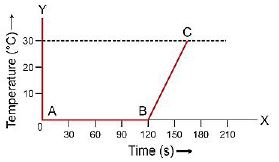
In simple words: We heat ice and measure temperature. The graph shows temperature stays at 0°C while ice melts, proving heat is used for melting, not heating.
📝 Teacher's Note: This is a practical experiment students can observe. The flat part of the heating curve is the key evidence. Make sure students understand why temperature stays constant.
🎯 Exam Tip: Draw the heating curve graph clearly. Label the flat part as "melting" and the rising part as "heating water". This diagram gets you extra marks.
Question 4. A substance undergoes (i) a change in its temperature, (ii) a change in its phase without change in its temperature. In each case, state the change in energy of molecules of the substance.
Answer:
(i) Average kinetic energy of molecules changes.
(ii) Average potential energy of molecules changes.
In simple words: When temperature changes, molecules move faster or slower (kinetic energy). When phase changes, molecules get closer or farther apart (potential energy).
📝 Teacher's Note: Use simple examples - moving students for kinetic energy, students standing closer/farther for potential energy. This helps students remember which energy changes when.
🎯 Exam Tip: Temperature change = kinetic energy change. Phase change = potential energy change. Learn this rule and you will never get confused.
Question 5. How does the (a) average kinetic energy (b) average potential energy of molecules of a substance change during its change in phase at a constant temperature?
Answer:
(a) Average kinetic energy does not change.
(b) Average potential energy increases.
Explanation: When a substance is heated at constant temperature (i.e. during its phase change state), the heat supplied makes the vibrating molecules gain potential energy to overcome the intermolecular force of attraction and move about freely. This means that the substance changes its form.
However, this heat does not increase the kinetic energy of the molecules, and hence, no rise in temperature takes place during the change in phase of a substance.
This heat supplied to the substance is known as latent heat and is utilized in changing the state of matter without any rise in temperature.
In simple words: During phase change, temperature stays same so molecules do not move faster (no kinetic energy change). But they spread apart, so potential energy increases.
📝 Teacher's Note: Emphasize that constant temperature means no kinetic energy change. The energy goes into breaking bonds between molecules, which is potential energy.
🎯 Exam Tip: Remember: constant temperature = no kinetic energy change. Always mention "latent heat" - this is the heat used for phase change.
Question 6. State the effect of presence of impurity on the melting point of ice. Give one use of it.
Answer:
The melting point of ice decreases by the presence of impurity in it.
Use: In making the freezing mixture by adding salt to ice. This freezing mixture is used in preparation of ice creams.
In simple words: Adding salt to ice makes it melt at a temperature lower than 0°C. This is used to make ice cream because it creates very cold mixture.
📝 Teacher's Note: Students see this in winter when salt is put on roads to melt ice. Connect this real-life example to the science concept.
🎯 Exam Tip: Write "melting point decreases" clearly. For the use, mention ice cream preparation - this is the most common exam answer.
Question 7. State the effect of increase of pressure on the melting point of ice.
Answer:
The melting point of ice decreases by the increase in pressure. The melting point of ice decreases by 0.0072°C for every one atmosphere rise in pressure.
In simple words: When we press ice harder, it melts at a lower temperature than 0°C. More pressure makes ice melt easier.
📝 Teacher's Note: This is why ice skaters can glide - the pressure from skates melts ice slightly, creating a thin water layer. Students love this example.
🎯 Exam Tip: Write "melting point decreases with increase in pressure". If asked for value, write 0.0072°C per atmosphere. This shows detailed knowledge.
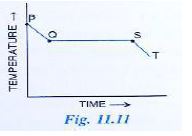
Question 8. Fig 11. 11 shows the variation in temperature with time when some wax cools from the liquid phase to the solid phase. (i) In which part of the curve, the wax is in liquid phase? (ii) What does the part QS of the curve represent? (iii) In which part of the curve, the wax will be the in the liquid as well as solid phase? (iv) In which part of the curve, the wax is in solid phase?
Answer:
(i) In part PQ, the wax is in liquid phase.
(ii) In the part QS, temperature remains constant with time, and hence, this part of the curve represents freezing.
(iii) In part QS, the wax will be in the liquid as well as solid phase.
(iv) In part ST, the wax is in solid phase.
In simple words: The graph shows wax cooling down. The flat part (QS) is where liquid wax becomes solid wax at the same temperature.
📝 Teacher's Note: This is the opposite of the ice melting curve. Help students understand that cooling curves also have flat portions during phase changes.
🎯 Exam Tip: The flat part of any heating or cooling curve always represents phase change. Both phases exist together during this flat part.
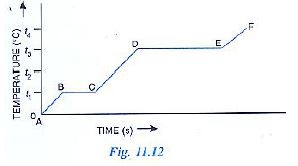
Question 9. The diagram in Fig 11.12 below shows the change of phase of a substance on a temperature time graph. (a) What do the parts AB, BC, CD and DE represent? (b) what is the melting points of the substance? (c) what is the boiling points of the substance?
Answer:
(a) AB part shows rise in temperature of solid from 0 to T₁°C, BC part shows melting at temperature T₁°C, CD part shows rise in temperature of liquid from T₁°C to T₃°C, DE part shows the boiling at temperature T₃°C.
(b) T₁°C.
(c) T₃°C.
In simple words: This graph shows heating from solid to gas. The flat parts (BC and DE) are where melting and boiling happen at fixed temperatures.
📝 Teacher's Note: This is a complete heating curve from solid to gas. Show students that there are two flat portions - one for melting, one for boiling.
🎯 Exam Tip: Melting point is the temperature of the first flat part. Boiling point is the temperature of the second flat part. Read the graph values carefully.
Question 10. 1 kg of ice at 0°C is heated at a constant rate and its temperature is recorded after every 30 s till steam is formed at 100℃. Draw a temperature time graph to represent the change of phase.
Answer:
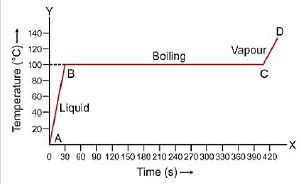
In simple words: The graph has three parts - flat at 0°C (ice melting), rising from 0°C to 100°C (water heating), flat at 100°C (water boiling to steam).
📝 Teacher's Note: Students must draw three distinct parts. The flat parts are at 0°C and 100°C. The rising part connects them. Label each part clearly.
🎯 Exam Tip: Draw neat flat lines at exactly 0°C and 100°C. Label each section (ice melting, water heating, water boiling). This shows complete understanding.
Question 11. The melting point of naphthalene, a crystalline solid is 80℃ and the room temperature is 30℃. A sample of liquid naphthalene at 100℃ is cooled down to the room temperature. Draw a temperature time graph to represent this cooling.
Answer:
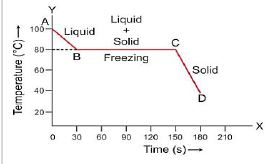
In simple words: The graph shows naphthalene cooling from 100°C to 30°C, with a flat part at 80°C where it changes from liquid to solid.
📝 Teacher's Note: This is a cooling curve, opposite of heating curves. The flat part is at 80°C where freezing happens. Make sure students understand cooling graphs too.
🎯 Exam Tip: Start at 100°C, have a flat line at 80°C (melting point), end at 30°C (room temperature). The flat part shows freezing occurring.
Question 12. Explain the terms boiling and boiling point
Answer:
Boiling: The change from liquid to gaseous phase on heating at a constant temperature is called boiling.
Boiling point: The particular temperature at which vaporization occurs is called the boiling point of liquid.
In simple words: Boiling is when liquid becomes gas (like water becoming steam). Boiling point is the exact temperature where this happens (100°C for water).
📝 Teacher's Note: Students see boiling water at home. Connect this everyday experience to the scientific definition. Emphasize that boiling happens at one fixed temperature.
🎯 Exam Tip: Always write "constant temperature" in boiling definition. For boiling point, mention it is specific for each liquid (water = 100°C at normal pressure).
Question 13. How is the volume of water affected when it boils at 100℃?
Answer: Volume of water increases when it boils at 100°C.
In simple words: When water becomes steam, it takes up much more space. Think of how a small pot of water can fill a whole kitchen with steam.
📝 Teacher's Note: Show students a kettle boiling. Point out how the steam coming out takes much more space than the water inside. This helps them see volume expansion.
🎯 Exam Tip: Write "volume increases" clearly. The examiner wants to see you know that steam takes more space than liquid water.
Question 14. How is the boiling point of water affected when some salt is added to it?
Answer: The boiling point of water increases on adding salt.
In simple words: When you add salt to water, it needs more heat to boil. This is why pasta water with salt boils at a higher temperature.
📝 Teacher's Note: Ask students why their mothers add salt when cooking pasta or vegetables. The salt makes water boil at higher temperature, so food cooks faster.
🎯 Exam Tip: Write "boiling point increases" when salt is added. This is a very common exam question.
Question 15. What is the effect of increase in pressure on the boiling point of a liquid?
Answer: The boiling point of a liquid increases on increasing the pressure.
In simple words: When you press down harder on a liquid, it needs more heat to boil. Like squeezing something makes it harder to break apart.
📝 Teacher's Note: Relate this to a pressure cooker. More pressure inside means water boils at higher temperature. That's why food cooks faster in pressure cookers.
🎯 Exam Tip: Remember the simple rule: more pressure = higher boiling point. Always write "increases" when pressure increases.
Question 16. Write down the approximate range of temperature at which water boils in a pressure cooker.
Answer: In a pressure cooker, the water boils at about 120°C to 125°C.
In simple words: A pressure cooker makes water boil at 120-125°C instead of normal 100°C. This higher temperature cooks food much faster.
📝 Teacher's Note: Students should know that normal water boils at 100°C, but pressure cooker water boils at 120-125°C. This 20-25 degree difference is very important.
🎯 Exam Tip: Write the exact range: 120°C to 125°C. Don't forget the degree symbol and C for Celsius.
Question 17. It is difficult to cook vegetables on hills and mountains. Explain the reason.
Answer: This is because at high altitudes atmospheric pressure is low; therefore, boiling point of water decreases and so it does not provide the required heat energy for cooking.
In simple words: On mountains, air pressure is less. So water boils at lower temperature (maybe 90°C). This cooler boiling water cannot cook vegetables properly.
📝 Teacher's Note: Explain that on mountains there is less air pressing down. Less pressure means water boils at lower temperature. Lower temperature means poor cooking.
🎯 Exam Tip: Write three points: high altitude → low pressure → low boiling point → poor cooking. This shows the complete chain of reasoning.
Question 18. Complete the following sentences:
(a) When ice melts, its volume _________
(b) Decrease in pressure over ice ________ its melting point.
(c) Increase in pressure _________ the boiling point of water.
(d) A pressure cooker is based on the principle that boiling point of water increases with the _________
(e) The boiling point of water is defined as _________
Answer:
(a) When ice melts, its volume decreases.
(b) Decrease in pressure over ice increases its melting point.
(c) Increase in pressure increases the boiling point of water.
(d) A pressure cooker is based on the principle that boiling point of water increases with the increase in pressure.
(e) The boiling point of water is defined as the constant temperature at which water changes to steam.
In simple words: Ice becomes smaller when it melts. Less pressure makes ice melt at higher temperature. More pressure makes water boil at higher temperature. This is how pressure cookers work.
📝 Teacher's Note: For part (a), students often get confused. Ice floats on water because it is less dense - when it melts, it takes less space.
🎯 Exam Tip: Learn these fill-in-the-blank answers by heart. They are very common in exams: decreases, increases, increases, increase in pressure, constant temperature.
Question 19. What do you understand by the term latent heat?
Answer: Latent heat: The heat energy exchanged in change of phase is not externally manifested by any rise or fall in temperature, it is considered to be hidden in the substance and is called the latent heat.
In simple words: Latent heat is hidden heat. When ice melts, you add heat but temperature stays at 0°C. This heat is hidden inside - it's doing the work of melting.
📝 Teacher's Note: Use the word "hidden" to explain latent. The heat goes into breaking bonds between particles, not into making them move faster (temperature).
🎯 Exam Tip: Write "heat energy that does not change temperature" and "hidden heat for phase change." These are key phrases examiners look for.
Question 20. Define the term specific latent heat of fusion of ice state its S.I unit.
Answer: The quantity of heat required to convert unit mass of ice into liquid water at 0°C (melting point) is called the specific latent heat of fusion of ice. Its S.I. unit is J kg⁻¹.
In simple words: This tells us how much heat is needed to melt 1 kg of ice at 0°C. The unit J kg⁻¹ means joules per kilogram.
📝 Teacher's Note: Emphasize "unit mass" means 1 kg. Also emphasize "at 0°C" - this is the melting point. Students often forget these details.
🎯 Exam Tip: Always write "unit mass" and "at 0°C" in your definition. Don't forget the unit: J kg⁻¹ (joules per kilogram).
Question 21. Write the approximate value of specific latent heat of ice.
Answer: Specific latent heat of ice: 336000 J kg⁻¹.
In simple words: You need 336000 joules of heat to melt 1 kg of ice at 0°C. That's a lot of energy!
📝 Teacher's Note: Students can remember this as 336 kJ/kg or 336000 J/kg. Both are correct. Sometimes it's also given as 336 J/g.
🎯 Exam Tip: Learn this value: 336000 J kg⁻¹ or 336 J g⁻¹. Both forms appear in exams. Don't forget the units.
Question 22. The specific latent heat of fusion of ice is 336 J g⁻¹. Explain the meaning of its statement.
Answer: It means 1 g of ice at 0°C absorbs 336 J of heat energy to convert into water at 0°C.
In simple words: For every 1 gram of ice, you need 336 joules of heat to melt it completely at 0°C. The temperature stays 0°C during melting.
📝 Teacher's Note: Stress that temperature doesn't change during melting. All 336 J goes into breaking the ice structure, not raising temperature.
🎯 Exam Tip: Write the complete sentence: "1 g ice at 0°C absorbs 336 J to convert to water at 0°C." This shows you understand the meaning fully.
Question 23. 1 g ice of 0℃ melts to form 1 g water at 0℃. State whether the latent heat is absorbed or given out by ice.
Answer: Latent heat is absorbed by ice.
In simple words: Ice takes in heat energy from surroundings to melt. Just like you need energy to do work, ice needs energy to change from solid to liquid.
📝 Teacher's Note: When something melts, it always absorbs heat. When something freezes, it gives out heat. This is a simple rule students should remember.
🎯 Exam Tip: Melting = absorbs heat. Freezing = gives out heat. Learn this simple rule and you'll never get confused.
Question 24. Which has more heat: 1 g ice at 0℃ or 1g water 0℃? Give reason.
Answer: 1 g of water at 0°C has more heat than 1 g of ice at 0°C. This is because ice at 0°C absorbs 336 J of heat energy to convert into water at 0°C.
In simple words: Water has more energy than ice at the same temperature. Water got this extra energy when the ice melted.
📝 Teacher's Note: Both are at 0°C but water has 336 J more energy per gram. This extra energy came from the melting process.
🎯 Exam Tip: Write "water has more heat" and give the reason: "because 336 J was absorbed during melting." Both parts are needed for full marks.
Question 25. (a) Which requires more heat: 1 g ice at 0℃ or 1 g water at 0℃ to raise its temperature to 10℃? (b) Explain your answer in part (a).
Answer:
(a) 1 g ice at 0°C requires more heat because ice would require additional heat energy equal to latent heat of melting.
(b) 1 g ice at 0°C first absorbs 336 J heat to convert into 1 g water at 0°C.
In simple words: Ice needs extra heat first to melt (336 J), then heat to warm up to 10°C. Water only needs heat to warm up to 10°C.
📝 Teacher's Note: Ice has two steps: first melt (needs 336 J), then heat up (needs more energy). Water has only one step: heat up.
🎯 Exam Tip: Write "ice requires more heat" and explain the two-step process: melting first, then heating. This shows complete understanding.
Question 26. Ice cream appears cooler to the mouth than water at 0℃. Give reason.
Answer: This is because 1 g of ice at 0°C takes 336 J of heat energy from the mouth to melt at 0°C. Thus, mouth loses an additional 336 J of heat energy for 1 g of ice at 0°C than for 1g of water at 0°C. Therefore, cooling produced by 1 g of ice at 0°C is more than for 1g of water at 0°C.
In simple words: Ice steals more heat from your mouth. It takes your mouth's heat to melt first, then takes more heat to warm up. Water only takes heat to warm up.
📝 Teacher's Note: Students love this example! Ice "steals" 336 J extra from your mouth compared to cold water. That's why ice feels colder.
🎯 Exam Tip: Mention the 336 J of extra heat taken by ice for melting. This specific number shows you know the concept well.
Question 27. Why do bottled soft drinks get cooled, more quickly by the ice cubes than by the iced water, both at 0℃?
Answer: This is because 1 g of ice at 0°C takes 336 J of heat energy from the bottle to melt into water at 0°C. Thus, bottle loses an additional 336 J of heat energy for 1 g of ice at 0°C than for 1 g iced water at 0°C. Therefore, bottled soft drinks get cooled, more quickly by the ice cubes than by iced water.
In simple words: Ice cubes absorb more heat from the bottle because they need energy to melt. Cold water cannot absorb this extra melting heat.
📝 Teacher's Note: This is the same principle as ice cream feeling colder. Ice absorbs extra heat for melting, making it a better cooling agent.
🎯 Exam Tip: Always mention the 336 J extra heat absorbed by ice during melting. This makes your answer complete and shows deeper understanding.
Question 28. It is generally cold after a hail-storm then during and before the hail storm. Give reason.
Answer: The reason is that after the hail storm, the ice absorbs the heat energy required for melting from the surrounding, so the temperature of the surrounding falls further down and we feel colder.
In simple words: After hail falls, all that ice melts by taking heat from the air around us. This makes the air much colder.
📝 Teacher's Note: Hailstones are like many ice cubes falling from the sky. When they melt, they take heat from the air, making everything colder.
🎯 Exam Tip: Explain that ice absorbs heat from surroundings for melting, which lowers the surrounding temperature. This is the key point.
Question 29. The temperature of the surrounding starts falling when ice in a frozen lake starts melting. Give reason.
Answer: The reason is that the heat energy required for melting the frozen lake is absorbed from the surrounding atmosphere. As a result, the temperature of the surrounding falls and it became very cold.
In simple words: When a big frozen lake melts, it needs huge amounts of heat. It takes this heat from the air around it, making the weather very cold.
📝 Teacher's Note: A frozen lake is like a giant ice cube. When it melts, it absorbs enormous amounts of heat from the atmosphere, cooling the whole area.
🎯 Exam Tip: Write that melting ice "absorbs heat from surroundings" and this "lowers surrounding temperature." These are the key phrases for full marks.
Question 30. Explain the following:
(i) The surrounding become pleasantly warm when water in a lake starts freezing in cold countries.
(ii) The heat supplied to a substance during it change of state, does not cause any rise in its temperature.
Answer:
(i) The reason is that the specific latent heat of fusion of ice is sufficiently high, so when the water of lake freezes, a large quantity of heat has to be released and hence the surrounding temperature becomes pleasantly warm.
(ii) Heat supplied to a substance during its change of state, does not cause any rise in its temperature because this is latent heat of phase change which is required to change the phase only.
In simple words: When water freezes, it gives out heat (opposite of melting). This warms the air. During phase change, heat is used to change the state, not to change temperature.
📝 Teacher's Note: Freezing is opposite of melting. Melting absorbs heat, freezing releases heat. Students should remember this opposite relationship.
🎯 Exam Tip: For (i) write "heat is released during freezing." For (ii) write "latent heat changes phase, not temperature." These are key concepts.
Multiple Choice Type
Question 1. The S.I. unit of specific latent heat is:
(a) cal g⁻¹
(b) cal g⁻¹K⁻¹
(c) J kg⁻¹
(d) J kg⁻¹ K⁻¹
Answer: (c) J kg⁻¹
In simple words: Specific latent heat is measured in joules per kilogram. It tells how much energy is needed per kg of substance.
📝 Teacher's Note: Students often confuse this with specific heat capacity which has temperature (K) in the unit. Latent heat doesn't involve temperature change.
🎯 Exam Tip: Remember: latent heat unit has no K (temperature) because temperature doesn't change during phase change.
Question 2. The specific latent heat of fusion of water is:
(a) 80 cal g⁻¹
(b) 2260 J g⁻¹
(c) 80 J g⁻¹
(d) 336 J kg⁻¹
Answer: (a) 80 cal g⁻¹
In simple words: Water's latent heat of fusion is 80 calories per gram or 336 J per gram. Both are correct but in different units.
📝 Teacher's Note: Students should know both values: 80 cal/g and 336 J/g. They can convert between calories and joules using 1 cal = 4.2 J.
🎯 Exam Tip: Learn both values: 80 cal g⁻¹ and 336 J g⁻¹. Questions can ask in either unit.
Numericals
Question 1. 10g of ice at 0℃ absorbs 5460 J of heat energy to melt and change to water at 50℃. Calculate the specific latent heat of fusion of ice. Specific heat capacity of water is 4200 J kg⁻¹ K⁻¹
Answer:
Given:
Mass of ice = 10g = 0.01kg
Amount of heat energy absorbed, Q = 5460J
Specific latent heat of fusion of ice = ?
Specific heat capacity of water = 4200 J kg⁻¹K⁻¹
Step 1: Find heat needed to raise temperature of water from 0°C to 50°C.
Heat for temperature rise = \( mc\Delta T = 0.01 \times 4200 \times 50 = 2100J \)
Step 2: Use the total heat equation.
Let Specific latent heat of fusion of ice = L J g⁻¹
Total heat = Heat for melting + Heat for temperature rise
\( Q = mL + mc\Delta T \)
\( 5460 = 10 \times L + 2100 \)
\( 10L = 5460 - 2100 = 3360 \)
\( L = 336 J g^{-1} \)
Specific latent heat of fusion of ice = 336 J g⁻¹
In simple words: The ice needs 3360 J to melt (10g × 336 J/g) and 2100 J to heat up to 50°C. Total = 5460 J.
📝 Teacher's Note: Students must understand this is a two-step process: first melting (uses latent heat), then heating (uses specific heat capacity).
🎯 Exam Tip: Always write the formula Q = mL + mcΔT for such problems. Show both steps clearly: melting heat and heating heat.
Question 2. How much heat energy is released when 5.0 of water at 20℃ changes into ice at 0℃? Take specific heat capacity of water = 4.2 J kg⁻¹ K⁻¹, Specific latent heat of fusion of ice 336 J g⁻¹
Answer: Mass of water m = 5.0 g
specific heat capacity of water c = 4.2 J g⁻¹ K⁻¹
specific latent heat of fusion of ice L = 336 J g⁻¹
Amount of heat energy released when 5.0 g of water at 20°C changes into water at 0°C = 5 × 4.2 × 20 = 420 J.
Amount of heat energy released when 5.0g of water at 0°C changes into ice at 0°C = 5 × 336J = 1680J.
Total amount of heat released = 1680 J + 420 J = 2100 J.
In simple words: First water cools from 20°C to 0°C. Then water turns into ice at 0°C. We add both amounts to get total heat released.
📝 Teacher's Note: Show students two steps - cooling water and then freezing water. Use ice cubes from home as example. Cooling needs less energy than freezing.
🎯 Exam Tip: Always solve in two steps. First find heat for cooling. Then find heat for freezing. Add both values for total heat.
Question 3. A molten metal of mass 150 g is kept at its melting point 800℃. When it is allowed to freeze at the same temperature, it gives out 75,000 J of heat energy.
(a) What is the specific latent heat of the metal?
(b) If the specific heat capacity of metal is 200 J kg⁻¹ K⁻¹, how much additional heat energy will the metal give out in cooling to – 50 ℃?
Answer: Mass of metal = 150 g
Specific latent heat of metal
\( L = \frac{Q}{m} = \frac{75000}{150} = 500 Jg^{-1} \)
Specific heat capacity of metal is 200 J kg⁻¹ K⁻¹.
Change in temperature = 800 − (−50) = 850°C (or 850 K).
\( Q = mc\Delta T = 0.15 \times 200 \times 850 = 25500J \)
In simple words: First we find how much heat is needed to melt 1 gram of metal. Then we find heat needed to cool the solid metal from 800°C to -50°C.
📝 Teacher's Note: Explain that latent heat is heat needed to change state without changing temperature. Use melting candle wax as example.
🎯 Exam Tip: For latent heat use L = Q/m. For cooling use Q = mcΔT. Always convert kg to g or vice versa carefully.
Question 4. A refrigerator converts 100g of water at 20℃ to ice at – 10℃ in 73.5 min. Calculate the average the rate of heat extraction in watt. The specific heat capacity of water is 4.2 J kg⁻¹ K⁻¹, Specific latent heat of ice is 336 J g⁻¹and the specific heat capacity of ice if 2.1 J kg⁻¹ K⁻¹.
Answer: Amount of heat released when 100g of water cools from 20° to 0°C = 100 × 20 × 4.2 = 8400J.
Amount of heat released when 100g of water converts into ice at 0°C = 100 × 336 = 33600J.
Amount of heat released when 100g of ice cools from 0°C to -10°C = 100 × 10 × 2.1 = 2100J.
Total amount of heat = 8400 + 33600 + 2100 = 44100J.
Time taken = 73.5min = 4410s.
Average rate of heat extraction (power)
\( P = \frac{E}{t} = \frac{44100}{4410} = 10W \)
In simple words: Three steps happen - water cools, water freezes, ice cools more. We find total heat and divide by time to get power.
📝 Teacher's Note: Show students a real refrigerator. Explain it removes heat in three steps. Power = Energy/Time like speed = distance/time.
🎯 Exam Tip: Always convert minutes to seconds for power calculations. Write all three heat calculations clearly. Final answer must be in watts.
Question 5. In an experiment, 17g of ice is used to bring down the temperature of 40 g of water at 34℃ to its freezing temperature. The specific heat capacity of water is 4.2 J kg⁻¹ K⁻¹. Calculate the specific latent heat of ice. State one important assumption made in the above calculation.
Answer: Mass of ice m₁ = 17 g
Mass of water m₂ = 40 g.
Change in temperature = 34 – 0 = 34K
Specific heat capacity of water is 4.2Jg⁻¹K⁻¹.
Assuming there is no loss of heat, heat energy gained by ice (latent heat of ice), Q = heat energy released by water
Q = 40 × 34 × 4.2 = 5712 J.
Specific latent heat of ice = \( L = \frac{Q}{m} = \frac{5712}{17} = 336Jg^{-1} \)
In simple words: Hot water gives heat to ice. Ice melts using this heat. We assume no heat is lost to surroundings.
📝 Teacher's Note: This is calorimetry principle - heat lost = heat gained. Use hot tea cooling in room as example. Some heat always escapes.
🎯 Exam Tip: Write "Heat lost by water = Heat gained by ice." Always state assumption: "No heat loss to surroundings." Show L = Q/m formula clearly.
Question 6. Find the result of mixing 10 g of ice at - 10℃ with 10 g of water at 10℃. Specific heat capacity of ice = 2.1 J kg⁻¹ K⁻¹, Specific latent heat of ice = 336 J g⁻¹and specific heat capacity of water = 4.2 J kg⁻¹ K⁻¹
Answer: Let whole of the ice melts and let the final temperature of the mixture be T°C.
Amount of heat energy gained by 10g of ice at -10°C to raise its temperature to 0°C = 10 × 10 × 2.1 = 210J
Amount of heat energy gained by 10g of ice at 0°C to convert into water at 0°C = 10 × 336 = 3360 J
Amount of heat energy gained by 10g of water (obtained from ice) at 0°C to raise its temperature to T°C = 10 × 4.2 × (T − 0) = 42T
Amount of heat energy released by 10g of water at 10°C to lower its temperature to T°C = 10 × 4.2 × (10 − T) = 420 − 42T
Heat energy gained = Heat energy lost
210 + 3360 + 42T = 420 − 42T
T = −37.5°C
This cannot be true because water cannot exist at this temperature.
So whole of the ice does not melt. Let m gm of ice melts. The final temperature of the mixture becomes 0°C.
So, amount of heat energy gained by 10g of ice at -10°C to raise its temperature to 0°C = 10 × 10 × 2.1 = 210J
Amount of heat energy gained by m gm of ice at 0°C to convert into water at 0°C = m × 336 = 336m J
Amount of heat energy released by 10g of water at 10°C to lower its temperature to 0°C = 10 × 4.2 × (10 − 0) = 420
Heat energy gained = Heat energy lost
210 + 336m = 420
m = 0.625 gm
In simple words: We try to see if all ice melts. But calculation gives impossible temperature. So only some ice melts and final temperature is 0°C.
📝 Teacher's Note: When calculation gives impossible result, think again. Final temperature cannot be below freezing point if water exists. Show this with ice-water mixing at home.
🎯 Exam Tip: If temperature calculation gives negative value with liquid water, recalculate assuming final temperature is 0°C. Only some ice will melt.
Question 7. A piece of ice of mass 40 g is added to 200 g of water at 50℃, Calculate the final temperature of water when all the ice has melted. Specific heat capacity of water = 4200 J kg⁻¹ K⁻¹, and specific latent heat of fusion of ice = 336 × 10³J kg⁻¹.
Answer: Let final temperature of water when all the ice has melted = T°C.
Amount of heat lost when 200g of water at 50°C cools to T°C = 200 × 4.2 × (50 − T) = 42000 − 840T
Amount of heat gained when 40g of ice at 0°C converts into water at 0°C.= 40 × 336J = 13440 J
Amount of heat gained when temperature of 40g of water at 0°C rises to T°C = 40 × 4.2 × (T0) = 168T
We know that
Amount of heat gained = amount of heat energy lost.
13440 + 168T = 42000 − 840T
168T + 840T = 42000 − 13440
1008T = 28560
T = 28560/1008 = 28.33°C.
In simple words: Hot water gives heat to ice. Ice melts and warms up. Both reach same final temperature which we calculate.
📝 Teacher's Note: This is like mixing hot and cold water. Ice needs extra heat to melt first. Use mixing drinks with ice as example.
🎯 Exam Tip: Ice needs heat in two steps - melting then warming. Hot water gives heat in one step - cooling. Equate total heat gained to total heat lost.
Question 8. 250 g of water at 30℃ is contained in a copper vessel of mass 50g. Calculate the mass of ice required to bring down the temperature of the vessel and its contents to 5℃. Given: specific latent heat of fusion of ice = 336 × 10³J kg⁻¹, specific heat capacity of copper = 400 J kg⁻¹ K⁻¹, specific heat capacity of water = 4200 J kg⁻¹ K⁻¹
Answer: Mass of copper vessel m₁ = 50 g.
Mass of water contained in copper vessel m₂ = 250 g.
Mass of ice required to bring down the temperature of vessel = m
Final temperature = 5°C.
Amount of heat gained when 'm' g of ice at 0°C converts into water at 0°C = m × 336 J
Amount of heat gained when temperature of 'm' g of water at 0°C rises to 5° C = m × 4.2 × 5
Total amount of heat gained = m × 336 + m × 4.2 × 5
Amount of heat lost when 250 g of water at 30°C cools to 5°C = 250 × 4.2 × 25 = 26250 J
Amount of heat lost when 50 g of vessel at 30°C cools to 5°C = 50 × 0.4 × 25 = 500 J
Total amount of heat lost = 26250 + 500 = 26750 J
We know that amount of heat gained = amount of heat lost
m × 336 + m × 4.2 × 5 = 26750
357 m = 26750
m = 26750/357 = 74.93 g
Hence, mass of ice required is 74.93 g.
In simple words: Both water and copper vessel cool down and give heat to ice. Ice melts and warms up using this heat.
📝 Teacher's Note: The vessel also gives heat, not just water. Like putting ice in metal pot - both pot and water cool down. Convert kg to g carefully.
🎯 Exam Tip: Count heat loss from both water AND vessel. Ice gains heat in two steps. Write equation clearly: Heat gained by ice = Heat lost by water + Heat lost by vessel.
Question 9. 2 kg of ice melts when water at 100℃ is poured in a hole drilled in a block of ice. What mass of water was used? Given: Specific heat capacity of water = 4200 J kg⁻¹ K⁻¹, Lice = 336×10³J kg⁻¹.
Answer: Since the whole block does not melt and only 2 kg of it melts, so the final temperature would be 0°C.
Amount of heat energy gained by 2 kg of ice at 0°C to convert into water at 0°C = 2 × 336000 = 672000 J
Let amount of water poured = m kg.
Initial temperature of water = 100°C.
Final temperature of water = 0°C.
Amount of heat energy lost by m kg of water at 100°C to reach temperature 0°C = m × 4200 × 100 = 420000m J
We know that heat energy gained = heat energy lost.
672000J = m × 420000J
m = 672000/420000 = 1.6kg
In simple words: Hot water cools from 100°C to 0°C. This heat melts 2 kg of ice. We find how much hot water gives this much heat.
📝 Teacher's Note: Only some ice melts, so final temperature stays at 0°C. Like pouring hot water on ice block - some ice melts but block stays cold.
🎯 Exam Tip: When "only some ice melts," final temperature is 0°C. All hot water cools to 0°C. Use this to find mass of hot water needed.
Question 10. Calculate the total amount of heat energy required to convert 100g of ice at −10℃ completely into water at 100℃. Specific heat capacity of ice = 2.1 kg⁻¹ K⁻¹, specific heat capacity of water = 4.2 J kg⁻¹ K⁻¹, specific latent heat of ice = 336 J g⁻¹
Answer: Amount of heat energy gained by 100 g of ice at -10°C to raise its temperature to 0°C = 100 × 2.1 × 10 = 2100 J
Amount of heat energy gained by 100 g of ice at 0°C to convert into water at 0°C = 100 × 336 = 33600 J
Amount of heat energy gained when temperature of 100 g of water at 0°C rises to 100°C = 100 × 4.2 × 100 = 42000 J
Total amount of heat energy gained is = 2100 + 33600 + 42000 = 77700 J = 7.77 × 10⁴J
In simple words: Three steps - ice warms to 0°C, ice melts to water, water warms to 100°C. We add all three amounts of heat.
📝 Teacher's Note: Show three clear steps like cooking - first heat frozen food, then it melts, then it gets hot. Each step needs different amounts of energy.
🎯 Exam Tip: Always write three separate calculations. Step 1: heat ice to 0°C. Step 2: melt ice. Step 3: heat water to 100°C. Add all three for total.
Question 11. The amount of heat energy required to convert 1 kg of ice at – 10℃ to water at 100℃ is 7,77,000 J. Calculate the specific latent heat of ice. Specific heat capacity if ice = 2100 J kg⁻¹ K⁻¹, Specific heat capacity of water = 4200 J kg⁻¹ K⁻¹
Answer: Amount of heat energy gained by 1kg of ice at −10°C to raise its temperature to 0°C = 1 × 2100 × 10 = 21000 J
Amount of heat energy gained by 1kg of ice at 0°C to convert into water at 0°C = L
Amount of heat energy gained when temperature of 1kg of water at 0°C rises to 100°C = 1 × 4200 × 100 = 420000 J
Total amount of heat energy gained = 21000 + 420000 + L = 441000 + L.
Given that total amount of heat gained is = 777000J.
So,
441000 + L = 777000.
L = 777000 − 441000.
L = 336000JKg⁻¹
In simple words: We know total heat needed. We subtract heat for warming ice and water. The remaining heat is what was needed for melting.
📝 Teacher's Note: This is reverse calculation. We know answer and find missing part. Like knowing total cost and finding cost of one item.
🎯 Exam Tip: Write Total heat = Heat to warm ice + Latent heat + Heat to warm water. Put known values and solve for L. Check units carefully.
Exercise 11 C
Question 1. Explain the meaning of green house effect.
Answer: The earth receives heat radiations from sun which reach us after passing through its atmosphere. The earth's atmosphere is transparent for the visible and thermal radiations of short wavelengths coming from the sun. The earth's surface and objects on it thus become warm in the day time. After the sunset, the earth's surface and the objects on it radiate the infrared radiations of long wavelengths. A part of these radiations are reflected back by the clouds and a part of it is absorbed by the green house gases like carbon dioxide, methane, water vapours and chlorofluorocarbons. Thus the clouds and green house gases prevents a large fraction of radiations given out by the earth's surface, from escaping into the space. This phenomenon is called greenhouse effect.
In simple words: Earth gets heat from the sun during day. At night, Earth tries to send this heat back to space. But some gases in the air trap this heat and keep Earth warm. This is greenhouse effect.
📝 Teacher's Note: Use a blanket example. Tell students greenhouse effect is like covering yourself with a blanket at night. The blanket keeps you warm by trapping your body heat.
🎯 Exam Tip: Always write about short wavelength coming from sun and long wavelength going from Earth. Mention the four greenhouse gases clearly.
Question 2. Name two green house gases.
Answer: Carbon dioxide, methane, water vapours and chlorofluorocarbons.
In simple words: The main greenhouse gases are carbon dioxide and methane. Water vapour and CFCs are also greenhouse gases.
📝 Teacher's Note: Ask students to remember CO2 from breathing out and methane from cow burps. This makes it easy to remember the gases.
🎯 Exam Tip: Write at least two gas names clearly. Carbon dioxide and methane are the most common answers that get full marks.
Question 3. Name the radiations for which the green house gases are (A) transparent (b) opaque.
Answer:
(a) Short wavelength radiations
(b) Long wavelength radiations
In simple words: Greenhouse gases let short wavelength light pass through easily. But they block long wavelength heat rays from escaping.
📝 Teacher's Note: Use glass window example. Sunlight comes in through glass easily but heat gets trapped inside a car on hot days.
🎯 Exam Tip: Write "transparent to short wavelength" and "opaque to long wavelength". These exact words get marks.
Question 4. Name three fossil fuels that emit carbon dioxide into the atmosphere.
Answer: Coal, petroleum, natural gas.
In simple words: Coal, petrol and natural gas are fossil fuels. When we burn them, they release carbon dioxide gas into the air.
📝 Teacher's Note: Connect to daily life. Coal for electricity, petrol for cars, gas for cooking. All these release CO2 when burned.
🎯 Exam Tip: Write all three names clearly. These are the standard fossil fuels that examiners expect to see.
Question 5. How does green house effect help in keeping the temperature of earth's surface suitable for living of human beings?
Answer: From sun, we receive \(1366 \text{ W m}^{-2}\) energy at the top of our earth's atmosphere, out of which only \(235 \text{ W m}^{-2}\) energy reaches near the earth's surface. The earth and ocean surface absorbs \(168 \text{ W m}^{-2}\) energy and only \(67 \text{ W m}^{-2}\) energy remains in the lower atmosphere. With this much energy received on earth surface, its actual surface temperature would have been around \(-18°\text{C}\) which is quite uncomfortable for human living. Fortunately the greenhouse gases present in the earth's atmosphere contribute in trapping the heat energy within the atmosphere and they produce an average warming effect of about \(33°\text{C}\) to keep the effective temperature around \(15°\text{C}\). So, greenhouse effect helps in keeping the temperature of earth's surface suitable for living of human beings.
In simple words: Without greenhouse effect, Earth would be very cold at -18°C. Greenhouse gases warm Earth by 33°C to make it 15°C. This warm temperature helps humans and animals live comfortably.
📝 Teacher's Note: Tell students -18°C is like inside a freezer. 15°C is like a pleasant winter day. Greenhouse effect makes this difference.
🎯 Exam Tip: Remember the three temperatures: -18°C without greenhouse effect, +33°C warming, final 15°C. Write these numbers to get marks.
Question 6. Give three reasons for the increase of green house gases.
Answer: Three reasons for increase of greenhouse gases:
- The burning of fuels, deforestation and industrial production
- Increase of population.
- Imbalance of carbon dioxide cycle
In simple words: More people burn more fuel and cut more trees. Factories make more greenhouse gases. More people means more CO2 production.
📝 Teacher's Note: Connect to students' lives. More cars, more factories, cutting forests for buildings. All these increase greenhouse gases.
🎯 Exam Tip: Write about burning fuels, cutting trees, and growing population. These are the main causes examiners want to see.
Question 7. State the effect of enhancement of green house effect.
Answer: The effect of enhancement of greenhouse effect are:
- The variable change in the climate in different parts of the world has created difficulty and forced the people and animals to migrate from one place to another place.
- It has affected the blooming season of the different plants.
- The climate changes have shown the immediate effect on simple organism and plants.
- It has affected the world's ecology.
- It has increased the heat stroke deaths.
In simple words: Too much greenhouse effect causes climate change. People and animals move to find better places. Plants bloom at wrong times. More people die from heat.
📝 Teacher's Note: Give examples students can see. Unusual weather, animals moving to cooler places, flowers blooming early, more hot days.
🎯 Exam Tip: Write about migration, plant changes, ecology effects, and health problems. Use proper scientific words like "migration" and "ecology".
Question 8. What is meant by global warming?
Answer: Global warming means the increase in the average effective temperature of earth's surface due to an increase in the amount of greenhouse gases in its atmosphere.
In simple words: Global warming means Earth is getting hotter because there are too many greenhouse gases in the air. The whole planet becomes warmer.
📝 Teacher's Note: Explain "global" means whole world, "warming" means getting hotter. It is not just hot weather in one place but everywhere becoming warmer.
🎯 Exam Tip: Write "increase in average temperature" and "due to greenhouse gases". These are the key phrases that get marks.
Question 9. State the impact of global warming on life on the earth.
Answer: The effect of enhancement of greenhouse effect are:
- The variable change in the climate in different parts of the world has created difficulty and forced the people and animals to migrate from one place to another place.
- It has affected the blooming season of the different plants.
- The climate changes have shown the immediate effect on simple organism and plants.
- It has affected the world's ecology.
- It has increased the heat stroke deaths.
In simple words: Global warming makes life difficult for all living things. Animals move to cooler places. Plants grow at wrong times. People get sick from too much heat.
📝 Teacher's Note: Connect to news about animals moving, unusual seasons, heat waves. Students can relate to these current events.
🎯 Exam Tip: Cover impacts on animals, plants, and humans. Write about migration, plant cycles, and health effects for complete answer.
Question 10. How will rise in sea level affect population in coastal countries?
Answer: Due to rise in sea level the building and roads in the coastal areas will get flooded and they could suffer damage from hurricanes and tropical storms.
In simple words: When sea level rises, water comes into cities near the sea. Buildings and roads get flooded. Big storms become more dangerous.
📝 Teacher's Note: Show pictures of coastal flooding. Cities like Mumbai face this problem during heavy rains and high tides.
🎯 Exam Tip: Write about flooding of coastal areas and damage from storms. Mention both regular flooding and storm damage.
Question 11. What impact will global warming have on the health of the affected population?
Answer: Due to global warming, many new diseases have emerged because bacteria can survive better in increased temperature and they can multiply faster. It is extending the distribution of mosquitoes due to increase in humanity levels and their frequent growth in warmer atmosphere. This has resulted in increase of many new diseases. The deaths due to heat stroke have certainly increased.
In simple words: Global warming helps harmful bacteria grow faster. More mosquitoes spread diseases. People die more from heat. Hot weather makes people sick.
📝 Teacher's Note: Explain that germs like warm weather. More mosquitoes mean more malaria and dengue. Hot weather causes dehydration and heat stroke.
🎯 Exam Tip: Write about bacteria growth, mosquito diseases, and heat stroke deaths. Cover all three health impacts clearly.
Question 12. How will climate changes affect the various animal species?
Answer: At the present rate of increase of green house effect, it is expected that nearly 30% of animal species will extinct by the year 2050 and up to 70% by the end of the year 2100. This will disturb ecosystem. The animals from the equatorial region will shift to higher latitude in search of ice and cold region. The absorption of carbon dioxide by the ocean will cause acidification due to which marine species will migrate.
In simple words: Many animals will die out because of global warming. Animals from hot places will move to colder places. Ocean animals will move because ocean water becomes acidic.
📝 Teacher's Note: Use polar bear example. They need ice to hunt but ice is melting. Fish move when water becomes too acidic for them.
🎯 Exam Tip: Write the percentages 30% by 2050 and 70% by 2100. Mention animal migration and ocean acidification effects.
Question 13. What impact will climate changes have on the crops of food?
Answer: At the present rate of increase of green house effect, it is expected that nearly 30% of the plant species will extinct by the year 2050 and up to 70% by the end of the year 2100. In the near future, warming of nearly \(3°\text{C}\) will result in poor yield in farms in low latitude regions. This will increase the rise of malnutrition.
In simple words: Many plants will die because of global warming. Farms will grow less food. People will not get enough nutrition.
📝 Teacher's Note: Explain that crops need specific temperatures. Too hot or too cold weather kills crops. Less food means hunger problems.
🎯 Exam Tip: Write about plant extinction percentages and poor crop yields. Mention malnutrition as the final result.
Question 14. How will global warming disturb the ecological balance?
Answer: At the present rate of increase in green house effect, is estimated that nearly 30% of the plant and animal species will extinct by the year 2050 and upto 70 % by the end of year 2100. This will disrupt ecosystem. The animals from the equatorial region will shift to higher latitude in search of cold regions. The absorption of carbon dioxide by ocean will cause acidification due to which marine species will migrate.
In simple words: Ecological balance means all plants and animals living together properly. Global warming kills many species and makes others move. This breaks the natural balance.
📝 Teacher's Note: Use food chain example. If small fish die, big fish have no food. When one species dies, it affects all others.
🎯 Exam Tip: Write about species extinction, animal migration, and ecosystem disruption. Use the word "ecosystem" clearly.
Question 15. State three ways to minimize the global warming.
Answer:
- Avoid Deforestation
- By Conservation of water.
- Usage of fossil fuel should be reduced.
In simple words: To reduce global warming, do not cut trees. Save water. Use less petrol, diesel and coal. Plant more trees.
📝 Teacher's Note: Give practical tips students can follow. Use public transport, plant trees, save electricity, use less plastic.
🎯 Exam Tip: Write about forest protection, water conservation, and reducing fossil fuel use. These are the main solutions examiners look for.
Question 16. What is carbon tax? Who shall pay this tax?
Answer: The tax calculated on the basis of: carbon emission from industry, number of employee hour and turnover of the factory is called carbon tax. This tax shall be paid by industries. This will encourage the industries to use the energy efficient techniques.
In simple words: Carbon tax is money that factories pay based on how much CO2 they release. This tax makes factories use cleaner methods to avoid paying more.
📝 Teacher's Note: Explain it like a fine for polluting. Companies that pollute more pay more tax. This makes them want to pollute less.
🎯 Exam Tip: Write that industries pay this tax based on their carbon emissions. Mention it encourages cleaner technology use.
Multiple Choice
Question 1. Without green house effect, the average temperature of earth's surface would have been:
(a) -18℃
(b) 33℃
(c) 0℃
(d) 15℃
Answer: (a) -18℃
In simple words: Without greenhouse gases, Earth would be freezing cold at -18°C. That is colder than a home freezer.
📝 Teacher's Note: Compare -18°C to freezer temperature. Students can feel how cold that would be. Life cannot survive at such cold temperatures.
🎯 Exam Tip: Remember -18°C is the temperature without greenhouse effect. This is a common exam question with this exact number.
Question 2. The global warming has resulted:
(a) the increase in yield of crops
(b) the decrease in sea levels
(c) the decrease in human deaths
(d) the increase in sea levels
Answer: (d) the increase in sea levels
In simple words: Global warming melts ice at North and South poles. This melted ice water goes into oceans and makes sea levels rise.
📝 Teacher's Note: Use ice cube in water glass example. When ice melts, water level goes up. Same happens with polar ice and oceans.
🎯 Exam Tip: Sea level rise is the most obvious result of global warming. Ice melting is the clear connection to remember.
ICSE Textbook Solutions for Class 10 Physics Chapter 11 Calorimetry Solutions
ICSE Chapter Solutions: Class 10 Physics Chapter 11 Calorimetry Solutions
Find reliable chapter-wise explanations for Class 10 Physics Chapter 11 Calorimetry Solutions. Curated to follow standard ICSE guidelines, these problem solutions assist students in building strong conceptual foundations.
Step-by-Step Explanations and Breakdown
Every exercise question in this chapter includes step-by-step working steps, allowing you to self-evaluate, catch mistakes early, and understand the underlying logic.
More Study Resources for Class 10 Physics
Explore our broader library of study materials and chapter notes to support your continuous revision and secure higher marks.
FAQs
You can download the verified Selina Concise solutions for Chapter 11 Calorimetry Solutions on StudiesToday.com. Our teachers have prepared answers for Class 10 Physics as per 2026-27 ICSE academic session.
Yes, our solutions for Chapter 11 Calorimetry Solutions are designed as per new 2026 ICSE standards. 40% competency-based questions required for Class 10, are included to help students understand application-based logic behind every Physics answer.
Yes, every exercise in Chapter 11 Calorimetry Solutions from the Selina Concise textbook has been solved step-by-step. Class 10 students will learn Physics conceots before their ICSE exams.
Yes, follow structured format of these Selina Concise solutions for Chapter 11 Calorimetry Solutions to get full 20% internal assessment marks and use Class 10 Physics projects and viva preparation as per ICSE 2026 guidelines.